
Career & Professional Growth
Diagrams
Concepts
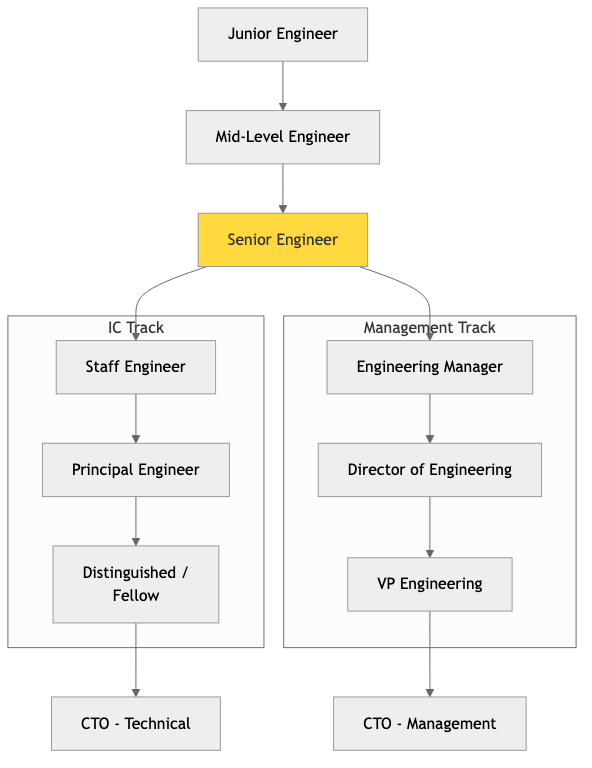
IC vs Management Track
The software industry broadly recognizes two parallel career paths: the Individual Contributor (IC) track and the Engineering Management track. Both can lead to senior, well-compensated positions, and neither is inherently superior. The critical distinction lies in the nature of the impact: ICs create value through technical output, architectural decisions, and deep expertise, while managers create value through people, process, and organizational leverage.
Individual Contributor Levels
Junior Engineer (L1-L2) Entry-level engineers who operate under close guidance. They work on well-scoped tasks within a single codebase, fix bugs, write tests, and learn team conventions. Their primary responsibility is to grow their own skills and become self-sufficient.
Mid-Level Engineer (L3-L4) Engineers who independently own features end-to-end. They design components, review code from peers, mentor juniors informally, and make sound technical decisions within the boundaries of an existing architecture. They are reliable contributors who rarely need oversight on day-to-day work.
Senior Engineer (L5) The first level where scope consistently extends beyond a single team. Senior engineers define technical direction for their team, identify and resolve ambiguous problems, make architectural trade-offs, and influence cross-team decisions. They are force multipliers who raise the quality of everyone around them through code review, design documents, and informal leadership.
Staff Engineer (L6) Staff engineers operate at the organization level. They own multi-quarter technical strategies, drive alignment across multiple teams, resolve the hardest cross-cutting concerns (performance, reliability, security), and frequently represent engineering in conversations with product and business leadership. They write less code day-to-day but the code they do write tends to be foundational.
Principal Engineer (L7) Principal engineers set technical direction for an entire engineering department or product area. They define multi-year technology roadmaps, make build-vs-buy decisions with company-wide implications, and serve as the final escalation point for the most difficult technical disagreements. They often have a visible external presence through conference talks, published papers, or open source leadership.
Distinguished Engineer / Fellow (L8+) The most senior IC roles, typically reserved for individuals whose work has had industry-wide impact. They shape company strategy at the executive level, represent the organization externally, and are recognized authorities in their domain. Only a handful of engineers at any company hold these titles.
Engineering Management Levels
Tech Lead Often a hybrid role rather than a pure management position. Tech leads write code while also coordinating work across a team of 3-8 engineers. They run standups, unblock teammates, and translate product requirements into technical tasks.
Engineering Manager (EM) The first pure people-management role. EMs are responsible for hiring, performance reviews, career development, and team health for a single team. They may or may not write code, but they must maintain enough technical depth to evaluate work, participate in design reviews, and earn the respect of their reports.
Senior Engineering Manager / Director Manages multiple teams or a team of managers. Directors own headcount planning, cross-team prioritization, and organizational design. They are accountable for delivery across a product area and must balance technical debt against feature velocity at a portfolio level.
VP of Engineering Responsible for the engineering function across a business unit or the entire company. VPs set engineering culture, define hiring bars, manage budgets, and partner with product and executive leadership on strategy. Their success is measured by organizational output, retention, and the ability to scale the team.
CTO / SVP of Engineering The most senior engineering leadership role. Depending on the company, the CTO may be externally facing (technology vision, industry relationships, speaking) or internally focused (engineering execution, architecture, platform). In many organizations, the CTO and VP of Engineering are complementary roles.
Code of Ethics in Software Engineering
Software engineers hold significant power over the systems that mediate daily life. A professional code of ethics provides a framework for navigating the tension between business pressure and societal responsibility.
The ACM Code of Ethics (revised 2018) and the IEEE-CS/ACM Software Engineering Code of Ethics outline several core principles:
- Public interest: Software engineers should act in the broad public interest, not just in the interest of their employer or client.
- Quality and integrity: Engineers should strive for high quality in both the products they create and the processes they follow.
- Informed consent: Users should understand what data is collected, how it is used, and what risks they face.
- Avoiding harm: Engineers have a responsibility to anticipate and mitigate negative consequences of their work, including bias in algorithms, privacy violations, and security vulnerabilities.
- Professional competence: Engineers should only undertake work they are qualified to perform and should be transparent about limitations.
- Whistleblowing: When an engineer becomes aware of practices that endanger the public, they have an ethical obligation to raise concerns, even at personal cost.
In practice, ethical dilemmas rarely present as clear-cut choices. They emerge gradually: a metric that incentivizes addictive behavior, a data pipeline that quietly expands its scope, a deadline that pressures a team to skip security review. The value of a code of ethics is not that it provides easy answers, but that it gives engineers a vocabulary and a framework for pushing back.
Open Source Contribution as Career Development
Contributing to open source projects serves multiple career functions simultaneously:
Skill development. Working on established open source projects exposes engineers to codebases far larger and more diverse than what they encounter at work. Reading and modifying code written by engineers at other companies broadens technical perspective.
Public portfolio. Open source contributions are visible, verifiable proof of technical ability. A history of thoughtful pull requests, well-written issues, and constructive code reviews speaks louder than any resume bullet point.
Network building. Open source communities connect engineers across company boundaries. Maintainers and frequent contributors develop professional relationships that lead to job referrals, conference invitations, and collaboration opportunities.
Reputation and influence. Engineers who maintain widely-used projects or make significant contributions to foundational tools gain industry recognition that transcends any single employer.
Giving back. Most commercial software depends on open source foundations. Contributing upstream is both a professional responsibility and a way to ensure the tools you depend on remain healthy.
Effective open source contribution starts small: fixing documentation, triaging issues, writing tests, and reviewing pull requests. Over time, contributors who demonstrate reliability and good judgment are invited into maintainer roles with greater responsibility.
Building a Professional Portfolio
A professional portfolio for a software engineer extends well beyond a GitHub profile. It encompasses every artifact that demonstrates capability, judgment, and impact.
Technical blog posts and articles. Writing about problems you have solved, architectural decisions you have made, or technologies you have evaluated forces clarity of thought and creates a durable record of expertise. Even internal blog posts or design documents, when appropriately anonymized, can form the basis of public writing.
Conference talks and workshops. Speaking at meetups, conferences, or internal tech talks develops communication skills and establishes expertise. Recorded talks have long shelf lives and reach audiences far beyond the room.
Design documents and RFCs. The ability to articulate a technical strategy, enumerate alternatives, and justify a recommendation is one of the most valued skills at senior levels. Maintaining a portfolio of design documents (appropriately sanitized) demonstrates this ability concretely.
Side projects and experiments. Personal projects demonstrate curiosity and initiative. They are most valuable when they solve a real problem, even a small one, rather than when they showcase a technology for its own sake.
Mentoring track record. As engineers advance, their impact increasingly comes through others. A record of engineers you have mentored who have grown and thrived is powerful evidence of leadership ability.
Mentoring and Knowledge Sharing
Mentoring is one of the highest-leverage activities an engineer can perform. A single conversation that reframes a problem or unblocks a mental model can save weeks of effort and permanently raise someone's effectiveness.
Formal mentoring involves a structured relationship with scheduled meetings, explicit goals, and a defined time period. Many companies run formal mentoring programs that pair junior engineers with senior ones across team boundaries.
Informal mentoring happens through code review, pairing sessions, design discussions, and hallway conversations. It is often more impactful than formal mentoring because it is embedded in real work rather than abstracted from it.
Sponsorship goes beyond mentoring. A sponsor actively advocates for someone's advancement: recommending them for high-visibility projects, nominating them for promotion, and vouching for their capabilities in rooms they are not in. Sponsorship is particularly important for engineers from underrepresented groups who may lack access to informal networks.
Knowledge sharing at scale includes writing documentation, recording technical talks, maintaining wikis, and building internal tools that encode expertise. These activities have compounding returns because they serve every future engineer who encounters the same problem.
Staying Current: Continuous Learning Strategies
The software industry evolves rapidly, but the rate of meaningful change is lower than it appears. Foundations shift slowly; frameworks and tools change quickly. Effective continuous learning focuses on depth in fundamentals while maintaining breadth awareness of the ecosystem.
Structured learning. Online courses, books, and academic papers provide deep, systematic understanding. Engineers who periodically invest in structured learning on topics like distributed systems, database internals, or programming language theory build durable knowledge that remains relevant across technology shifts.
Reading broadly. Following engineering blogs from companies like Netflix, Uber, Stripe, and Cloudflare provides exposure to real-world problems at scale. Aggregators like Hacker News, Lobsters, and specialized subreddits surface important developments.
Learning by building. The most effective way to learn a new technology is to build something with it. Side projects, hackathons, and proof-of-concept implementations create visceral understanding that reading alone cannot.
Teaching others. Explaining a concept forces you to identify and fill gaps in your own understanding. Engineers who regularly give talks, write blog posts, or lead study groups learn faster than those who only consume.
Deliberate practice. Targeted practice on specific weaknesses, whether through coding challenges, system design exercises, or writing workshops, produces faster improvement than general experience alone.
Community participation. Attending meetups, joining online communities, and participating in conferences exposes engineers to perspectives and problems outside their daily work.
Business Value
Career and professional growth practices generate tangible business value, even though their effects are often indirect and long-term.
Retention. Engineers who see a clear growth path at their company are significantly less likely to leave. Given that replacing a senior engineer costs 1.5 to 2 times their annual salary (recruiting fees, onboarding time, lost productivity, institutional knowledge loss), investment in career development pays for itself quickly.
Hiring quality. Companies known for strong engineering cultures and growth opportunities attract stronger candidates. Google, Stripe, and Netflix invest heavily in their engineering brands not out of vanity, but because it directly reduces recruiting costs and improves candidate pipelines.
Knowledge retention. Mentoring and knowledge-sharing practices reduce bus factor and ensure that critical institutional knowledge is distributed across the team. When a senior engineer leaves a team that practices active knowledge sharing, the disruption is manageable. When they leave a team that does not, the consequences can be severe.
Innovation capacity. Engineers who are encouraged to learn continuously and contribute to open source bring external ideas and practices back to their teams. This cross-pollination drives innovation that insular teams cannot achieve.
Promotion readiness. Well-defined career ladders and active coaching mean that when a team needs a tech lead or a senior engineer, internal candidates are ready. External hiring for senior roles is slower, more expensive, and riskier than internal promotion.
Organizational resilience. Teams with strong mentoring cultures develop depth across multiple skill areas. This makes them more adaptable to changing priorities, unexpected departures, and new technical challenges.
Real-World Examples
Google's IC Ladder and Promotion Process
Google maintains one of the industry's most well-known IC career ladders, spanning from L3 (entry-level SWE) through L11 (Senior Fellow, a title held by only a handful of engineers in the company's history). The ladder is explicitly defined with expectations at each level covering technical complexity, scope of impact, leadership, and collaboration.
Google's promotion process is committee-based: candidates assemble a "promo packet" with evidence of impact, and a committee of engineers at or above the target level evaluates the case. This system is designed to reduce bias from any single manager's perspective, though it has been criticized for creating incentive distortions, particularly the phenomenon of "promo-driven development" where engineers optimize for visible, promotable projects rather than high-impact but unglamorous maintenance work.
Google also runs a formal peer-feedback system (calibration sessions) where managers discuss their reports' performance relative to level expectations. This process, while imperfect, provides a degree of consistency across the organization that purely manager-driven evaluations struggle to achieve.
Spotify's Dual-Track Career Framework
Spotify developed a career framework that explicitly supports both IC and management tracks with equivalent levels of seniority and compensation. Their framework was notable for several design choices.
First, they defined "steps" rather than rigid levels, emphasizing that growth is continuous rather than a series of discrete jumps. Second, they provided detailed descriptions of expected behaviors at each step, organized around themes like "mastery," "influence," and "leadership." Third, they invested significant effort in communicating to the organization that the IC track was genuinely equal to the management track, not a consolation prize.
Spotify also introduced the concept of "chapters" and "guilds" to support professional development across team boundaries. Chapter leads are responsible for the career growth of engineers with shared disciplines (e.g., all backend engineers), while guilds are voluntary communities of practice around specific interests. These structures create mentoring and learning opportunities that a purely team-based organization cannot provide.
Etsy's Engineering Career Ladder and Blameless Postmortems
Etsy built a career ladder that explicitly valued operational excellence, reliability, and collaboration alongside feature delivery. Their ladder was one of the first to include expectations around incident response, on-call participation, and postmortem facilitation at every level.
Etsy's blameless postmortem culture is directly relevant to professional growth. By treating incidents as learning opportunities rather than occasions for blame, Etsy created an environment where engineers at all levels could make mistakes, learn from them, and grow. Junior engineers who participated in postmortems developed systems thinking skills far faster than they would have through feature work alone.
Etsy also ran a program called "First Friday" where new engineers deployed code to production on their first day. This practice, while primarily an onboarding tool, served a professional development purpose: it demystified production deployments and established from day one that every engineer was trusted to contribute meaningfully.
Microsoft's Shift to a Growth Mindset Culture
Under Satya Nadella's leadership beginning in 2014, Microsoft undertook a deliberate cultural transformation centered on Carol Dweck's "growth mindset" framework. The company moved away from a stack-ranking performance system that pitted employees against each other and toward a model that rewarded learning, collaboration, and customer impact.
This transformation had concrete effects on engineering career development. The old system discouraged risk-taking and knowledge sharing (helping a peer succeed meant creating competition for your own ranking). The new system explicitly rewarded "building on the ideas of others" and "learning from failure." Microsoft's engineering culture shifted from one where senior engineers hoarded knowledge as a competitive advantage to one where mentoring and teaching were recognized as core leadership behaviors.
The results were measurable: employee satisfaction scores improved, attrition decreased among high performers, and Microsoft's ability to attract senior engineering talent from competitors improved significantly.
Common Mistakes and Pitfalls
1. Treating Management as the Only Path to Advancement
Many organizations implicitly or explicitly signal that management is the "real" career path and that remaining an IC is a sign of limited ambition. This drives talented engineers into management roles they neither enjoy nor excel at, simultaneously weakening the IC bench and producing mediocre managers. Companies must build IC ladders with genuine parity in compensation, influence, and prestige.
2. Optimizing for Promotion Rather Than Impact
When career ladders are poorly designed or promotion criteria are vague, engineers learn to optimize for visibility rather than value. They seek out greenfield projects over maintenance work, avoid on-call rotations, and abandon efforts that do not produce promotable artifacts. The antidote is clear, well-communicated expectations that explicitly value operational work, reliability improvements, and technical debt reduction.
3. Neglecting Soft Skills Development
Engineers who focus exclusively on technical skills hit a ceiling. Above the senior level, nearly every impactful activity requires persuasion, written communication, conflict resolution, or stakeholder management. Engineers who dismiss these as "non-technical" or "political" find themselves unable to advance and frustrated that less technically skilled peers are promoted ahead of them.
4. Failing to Document and Communicate Impact
Many engineers do excellent work but fail to articulate what they accomplished and why it mattered. They assume that good work speaks for itself. It does not. At every level, the ability to clearly communicate your contributions, both to your manager and to promotion committees, is essential. This is not self-promotion; it is professional communication.
5. Changing Jobs Too Frequently or Not Frequently Enough
Engineers who change jobs every 12-18 months accumulate breadth but struggle to develop the depth that comes from owning a system through multiple cycles of growth, scaling, and maintenance. Conversely, engineers who remain at the same company for a decade without changing teams or roles risk stagnation, a narrowing of perspective, and over-specialization in proprietary systems with no external market value.
6. Ignoring the Business Context
Engineers who focus purely on technology without understanding the business context of their work limit their career growth. Senior and staff-level engineers are expected to make decisions that account for business constraints, customer needs, and competitive dynamics. An engineer who cannot explain why their technical recommendation is the right choice for the business, not just the technically elegant choice, will struggle at higher levels.
Trade-offs
| Decision | Advantages | Disadvantages | |---|---|---| | IC track vs management track | IC: deep technical mastery, direct creative satisfaction, less organizational politics. Management: broader organizational impact, people development, more direct influence on strategy. | IC: can feel isolated at senior levels, limited organizational authority. Management: reduced hands-on technical work, emotional labor, accountability for others' performance. | | Specialization vs generalization | Specialization: higher market value in niche, deeper expertise, clearer professional identity. | Specialization: vulnerability to technology shifts, fewer job opportunities, risk of pigeonholing. Generalization: "jack of all trades" perception, slower depth accumulation. | | Staying at one company vs moving frequently | Staying: deep institutional knowledge, compounding relationships, opportunity for long-term ownership. | Staying: compensation stagnation, echo chamber risk, over-reliance on internal tools. Moving: breadth of experience but shallow depth, constant re-proving, loss of accumulated context. | | Open source contribution vs proprietary focus | Open source: public portfolio, network effects, broader skill development, industry reputation. | Open source: time investment without direct compensation, potential IP conflicts with employer, maintainer burnout. Proprietary: direct business impact but invisible external portfolio. | | Formal education vs self-directed learning | Formal: structured curriculum, credential signaling, peer cohort, forced depth. | Formal: high cost (time and money), curriculum may lag industry, opportunity cost. Self-directed: flexible and current but requires strong discipline and may have gaps. | | Building personal brand vs heads-down work | Personal brand: career insurance, network effects, speaking and writing opportunities, influence. | Personal brand: time-consuming, risk of performative expertise, can create resentment from peers. Heads-down: direct output but invisible externally. |
When to Use / When Not to Use
When to Invest Heavily in Career Development Infrastructure
- When attrition among mid-level and senior engineers is above industry baseline, signaling that growth paths are unclear or insufficient.
- When the organization is scaling rapidly and needs to promote from within to fill leadership roles.
- When external hiring for senior roles consistently fails or produces poor cultural fits.
- When engineers report in surveys that they do not understand what is required for promotion or feel that the process is opaque.
- When the organization is transitioning from a startup culture (where titles are informal and growth is ad hoc) to a more structured environment.
When to Be Cautious About Over-Investing
- When the organization is very small (under 20 engineers) and formal career ladders would create bureaucratic overhead disproportionate to the team size. Informal mentoring and direct conversation are more appropriate at this scale.
- When the business is in survival mode and short-term execution matters more than long-term career architecture. Building elaborate career frameworks while the company is running out of runway is a misallocation of energy.
- When career development infrastructure becomes a substitute for actually developing people. A beautifully designed career ladder document is worthless if managers do not have regular growth conversations with their reports.
- When the focus on career progression creates unhealthy competition that undermines collaboration. If engineers are sabotaging each other's work to look better by comparison, the system needs fundamental redesign, not additional process.
Open Source Contribution: When It Makes Sense
Open source contribution is most valuable when the engineer has stable foundational skills and is looking to broaden their exposure, build a public portfolio, or develop expertise in a specific domain. It is less valuable when the engineer would benefit more from focused depth in their current role or when employer IP policies create legal risk.
Mentoring: When to Prioritize It
Mentoring should be a priority for senior engineers at all times, but formal mentoring programs are most impactful during periods of rapid hiring (when many new engineers need onboarding simultaneously) and during organizational transitions (when institutional knowledge is at risk of being lost).
Key Takeaways
-
Career growth requires intentional planning. Engineers who drift without a deliberate strategy for skill development, network building, and impact documentation will find their careers shaped by circumstance rather than choice. Regular self-assessment against clear criteria (whether from a formal ladder or a personal framework) is essential.
-
The IC and management tracks are genuinely different jobs. Choosing management because it seems like the only path to advancement is a mistake that harms both the engineer and their future reports. The best managers are those who chose management because they are energized by people development, not those who accepted it as the price of a higher title.
-
Communication skills are not optional. Writing, speaking, persuading, and listening are core engineering skills at every level above junior. Engineers who invest in these skills early find that every subsequent career transition is smoother.
-
Impact must be documented and communicated. Keeping a running log of accomplishments, writing clear self-reviews, and learning to articulate the business value of technical work are not vanity exercises. They are professional necessities.
-
Continuous learning compounds over time. An engineer who reads one technical book per quarter, attends one conference per year, and writes one blog post per month will, over a decade, build an extraordinary body of knowledge and a visible professional reputation. The key is consistency, not intensity.
-
Mentoring is a leadership skill, not a favor. The ability to develop other engineers is one of the most reliable signals of readiness for senior and staff-level roles. Engineers who mentor well demonstrate the judgment, communication, and technical depth that define senior leadership.
-
Career growth is not purely vertical. Lateral moves (changing teams, domains, or technology stacks) can be more valuable than promotions in terms of long-term career development. An engineer who has worked on frontend, backend, infrastructure, and data systems has a breadth of perspective that no amount of depth in a single area can replicate.
Further Reading
Books
-
"The Staff Engineer's Path" by Tanya Reilly. The definitive guide to the IC track beyond senior engineer. Covers the three pillars of staff engineering: big-picture thinking, execution, and leveling up. Essential reading for anyone on or considering the senior IC path.
-
"An Elegant Puzzle: Systems of Engineering Management" by Will Larson. A practical guide to engineering management that covers organizational design, career frameworks, and the mechanics of running engineering teams. Equally valuable for ICs who want to understand how their organizations work.
-
"The Manager's Path" by Camille Fournier. A comprehensive guide to the engineering management career ladder, from tech lead through CTO. Particularly strong on the transition points between levels and the common failure modes at each stage.
-
"Staff Engineer: Leadership Beyond the Management Track" by Will Larson. A collection of interviews with staff-plus engineers at various companies, providing concrete examples of what the role looks like in practice. Useful for calibrating expectations and understanding the diversity of the staff engineer archetype.
-
"Thinking in Systems: A Primer" by Donella Meadows. Not an engineering book, but essential reading for anyone operating at the staff level or above. Understanding feedback loops, leverage points, and system dynamics is fundamental to making good decisions at organizational scale.
-
"Radical Candor" by Kim Scott. A framework for giving and receiving feedback that is both caring and direct. Relevant for managers and ICs alike, as feedback is central to professional growth at every level.
Articles and Online Resources
-
"On Being a Senior Engineer" by John Allspaw. A foundational essay on the non-technical expectations of senior engineers, including maturity, empathy, and the ability to navigate ambiguity. Available on his blog Kitchen Soap.
-
"StaffEng.com" by Will Larson. A curated collection of stories and resources about the staff engineer role, including detailed profiles of staff-plus engineers at dozens of companies.
-
"The Pragmatic Engineer" newsletter by Gergely Orosz. Regular analysis of engineering career topics, compensation data, and industry trends. One of the most consistently valuable resources for engineers thinking about their careers.
-
"career-ladders.dev" (Chuck Groom). An open-source collection of career ladder examples from various companies. Useful for both engineers trying to understand expectations and managers designing ladders for their teams.
-
ACM Code of Ethics and Professional Conduct (2018 revision). The most widely referenced code of ethics for software professionals. Available at ethics.acm.org.
-
"Being Glue" by Tanya Reilly (talk and transcript). An important talk about the invisible work that holds teams together (facilitating, onboarding, documenting, connecting) and the career risks of doing this work without recognition. Particularly relevant for engineers from underrepresented groups.
-
"Becoming a Technical Leader" by Gerald Weinberg. A classic text on the transition from individual contributor to technical leader, with a focus on the personal transformation required rather than the tactical skills.