
Database Engineering
Sub-documents
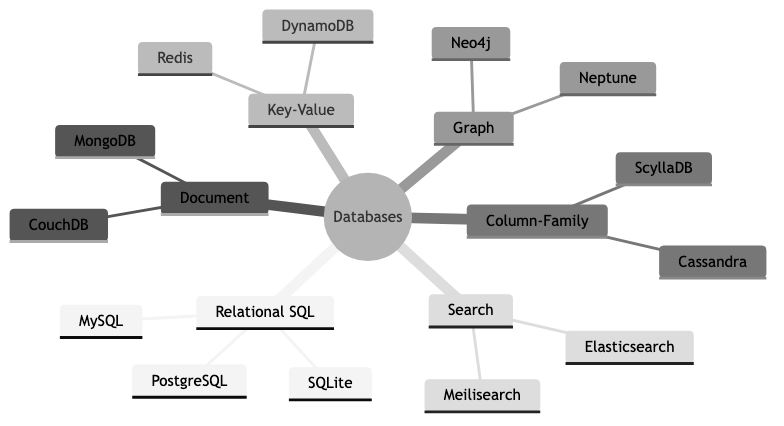
- Choosing the Right Database — Relational, document, key-value, column-family, graph, and search databases. Decision framework for when to use each.
- Schema Design & Migrations — Normalization, denormalization, constraints, migration tools in Rust, and zero-downtime migration patterns.
- SQL Deep Dive — Joins, window functions, CTEs, subqueries, and advanced SQL techniques with practical examples.
- Query Optimization — EXPLAIN ANALYZE, indexing strategies (B-tree, GIN, partial, covering), the N+1 problem, and connection pooling.
- NoSQL Data Modeling — DynamoDB single-table design, Redis patterns (caching, pub/sub, sorted sets), MongoDB document modeling. Discord's migration from Mongo to Cassandra to ScyllaDB.
- ORMs vs Raw SQL — sqlx, diesel, and sea-orm compared with identical queries. Trade-offs, N+1 problem, and when to use which.
Diagrams

Key Takeaways
- PostgreSQL is the right default for most applications. It handles relational data, JSON, full-text search, and scales further than most companies need.
- Design schemas for your read patterns. Write patterns are usually simpler than read patterns.
- Always use database migrations. Manual schema changes in production are a recipe for disaster.
- Index foreign keys and columns used in WHERE/JOIN/ORDER BY clauses. A missing index is the most common performance problem.
- Use EXPLAIN ANALYZE to understand query performance. Don't guess — measure.
- Connection pooling is mandatory for production. Size the pool based on database capacity, not application demand.
- Choose between ORM and raw SQL based on your team and complexity. sqlx's compile-time checking gives you the best of both worlds in Rust.
- Model NoSQL tables around access patterns, not entities. List every query before designing the schema.
- Use Redis as a cache and coordination layer, never as a primary database.
Further Reading
-
Books:
- Designing Data-Intensive Applications — Martin Kleppmann (2017) — The definitive guide to database concepts and trade-offs
- PostgreSQL: Up and Running — Regina Obe & Leo Hsu (3rd edition) — Practical PostgreSQL guide
- The Art of PostgreSQL — Dimitri Fontaine (2020) — Advanced SQL techniques
-
Papers & Articles:
- Use The Index, Luke — Comprehensive guide to database indexing
- Figma's PostgreSQL Scaling — Real-world PostgreSQL scaling
- Discord's Database Migrations — Migration journey through three databases
-
Crates:
- sqlx — Async SQL with compile-time checking
- diesel — Type-safe ORM and query builder
- sea-orm — Async ORM built on sqlx
- deadpool-postgres — Connection pooling