
Error Handling, Resilience & Fault Tolerance
Diagrams
Concepts
The Reality of Failure
In production systems, failure is not exceptional — it's normal. Networks drop packets. Disks fill up. Services go down. Databases time out. External APIs return errors. Memory runs out.
The question is not whether your system will encounter failures, but how it will behave when they occur.
Two approaches:
- Fragile systems: Assume everything works. When something fails, the entire system crashes or returns garbage.
- Resilient systems: Assume things will fail. Design for it. Degrade gracefully. Recover automatically.
Error Handling in Rust
Rust's type system forces you to handle errors at compile time. You can't ignore errors — the compiler won't let you.
Result<T, E> — Recoverable errors:
FUNCTION READ_CONFIG(path: string) -> Config or ConfigError
    content <- READ_FILE_TO_STRING(path)
        ON ERROR: RETURN ConfigError::FileNotFound(path, error)

    config <- PARSE_TOML(content) AS Config
        ON ERROR: RETURN ConfigError::ParseError(error)

    IF config.port = 0
        RETURN Err(ConfigError::InvalidPort)

    RETURN Ok(config)
Option<T> — Absence of value:
FUNCTION FIND_USER(users: list of User, email: string) -> optional User
    RETURN FIND user IN users WHERE user.email = email

// Caller must handle the None case
MATCH FIND_USER(users, "alice@example.com")
    CASE Some(user): PRINT "Found: " + user.name
    CASE None: PRINT "User not found"
The ? operator — Error propagation:
The ? operator propagates errors up the call stack. If the expression is Err, it returns early. This eliminates nested match statements and keeps the happy path readable.
FUNCTION PROCESS_ORDER(order_id: unsigned integer) -> Receipt or OrderError
    order <- FETCH_ORDER(order_id)?           // Returns early if Err
    payment <- CHARGE_PAYMENT(order)?         // Returns early if Err
    receipt <- GENERATE_RECEIPT(order, payment)?  // Returns early if Err
    SEND_CONFIRMATION_EMAIL(order)?           // Returns early if Err
    RETURN Ok(receipt)
Error Hierarchies & Custom Error Types
thiserror — Defining error types:
ENUMERATION OrderError
    NotFound(id)
        // "Order {id} not found"
    InsufficientInventory { item_id, requested, available }
        // "Insufficient inventory for item {item_id}: need {requested}, have {available}"
    PaymentFailed(PaymentError)
        // "Payment failed: {error}"
    Database(SqlError)
        // "Database error: {error}"

ENUMERATION PaymentError
    CardDeclined { reason: string }
        // "Card declined: {reason}"
    GatewayTimeout
        // "Payment gateway timeout"
    InvalidAmount(amount: float)
        // "Invalid amount: {amount}"
anyhow — For application code:
anyhow is for application-level code where you don't need callers to match on specific error variants — you just need to propagate errors with context.
FUNCTION LOAD_AND_PROCESS() -> void or Error
    config <- READ_CONFIG("config.toml")
        ON ERROR: add context "Failed to load configuration"

    db <- CONNECT_TO_DATABASE(config.database_url)
        ON ERROR: add context "Failed to connect to database"

    PROCESS_PENDING_ORDERS(db)
        ON ERROR: add context "Failed to process pending orders"

    RETURN Ok
When to use which:
thiserror— Libraries, APIs, code where callers need to match on error variantsanyhow— Application code, CLI tools, where you just need errors to bubble up with context
Retry Strategies
Transient failures (network blips, temporary overload) often resolve themselves. Retrying is appropriate when:
- The failure is likely temporary
- The operation is idempotent (safe to retry)
- You won't make things worse by retrying
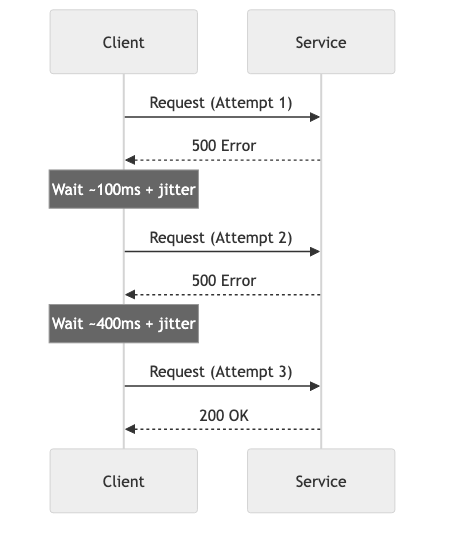
Exponential backoff with jitter:
Attempt 1: wait 0ms (immediate)
Attempt 2: wait ~100ms  (base * 2^1 + random jitter)
Attempt 3: wait ~400ms  (base * 2^2 + random jitter)
Attempt 4: wait ~1600ms (base * 2^3 + random jitter)
Attempt 5: give up
Why jitter matters: Without jitter, if 1,000 clients all start retrying at the same time (after a service recovers), they'll all retry at the same intervals, creating periodic "thundering herd" spikes. Jitter randomizes the retry timing, spreading the load.
ASYNC FUNCTION RETRY_WITH_BACKOFF(operation, max_retries, base_delay) -> T or Error
    rng <- NEW random number generator

    FOR attempt FROM 0 TO max_retries - 1
        MATCH operation()
            CASE Ok(result): RETURN Ok(result)
            CASE Err(e) IF attempt = max_retries - 1: RETURN Err(e)
            CASE Err(_):
                delay <- base_delay * 2^attempt
                jitter <- RANDOM duration between 0 and 100ms
                SLEEP(delay + jitter)
When NOT to retry:
- The error is permanent (404, 401, validation error)
- The operation is not idempotent (double-charging a payment)
- You're already in a retry loop (retrying retries = exponential request amplification)
Circuit Breakers
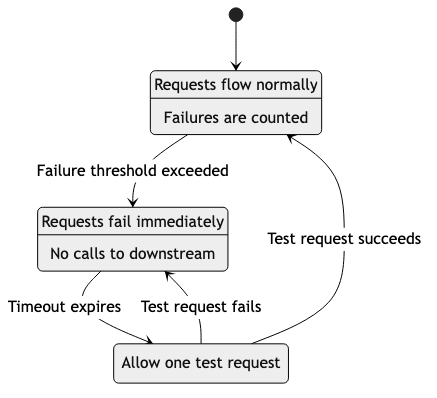
A circuit breaker prevents a failing service from being called repeatedly, giving it time to recover.
States:
         success threshold met
  ┌──────────────────────────────┐
  ↓                              │
CLOSED ──(failures exceed)──→ OPEN ──(timeout)──→ HALF-OPEN
  ↑                                                   │
  └──────────────(success)────────────────────────────┘
                                                      │
                                  OPEN ←──(failure)───┘
- Closed: Requests flow normally. Failures are counted.
- Open: Requests are immediately rejected (fail fast). No calls to the failing service.
- Half-Open: After a timeout, allow one test request through. If it succeeds, close the circuit. If it fails, open again.
Why it matters: Without a circuit breaker, a slow downstream service causes your service to accumulate waiting threads/connections, eventually overwhelming your own system. The circuit breaker "fails fast" — returning an error immediately instead of waiting 30 seconds for a timeout.
Bulkheads
Named after ship bulkheads that prevent a leak in one compartment from sinking the entire ship.
In software, bulkheads isolate components so that failure in one doesn't cascade to others:
- Separate thread pools: Database queries use one pool, external API calls use another. If the API is slow, database queries aren't affected.
- Separate connection pools: Each downstream service gets its own connection pool.
- Process isolation: Critical services run in separate processes/containers.
Without bulkhead:
[All requests] → [Shared thread pool] → Service A (slow!)
                                       → Service B (starved!)
                                       → Service C (starved!)

With bulkhead:
[Requests for A] → [Pool A: 10 threads] → Service A (slow, but contained)
[Requests for B] → [Pool B: 10 threads] → Service B (working fine)
[Requests for C] → [Pool C: 10 threads] → Service C (working fine)
Timeouts
Every external call must have a timeout. Without timeouts, a hung service can cause your entire system to hang as threads/connections wait indefinitely.
Types of timeouts:
| Type | Purpose | Example | |------|---------|---------| | Connection timeout | How long to wait to establish a connection | 1-5 seconds | | Read timeout | How long to wait for a response after connecting | 5-30 seconds | | Total timeout | Maximum time for the entire operation including retries | 30-60 seconds | | Idle timeout | How long to keep an unused connection alive | 60-300 seconds |
The cascade problem:
User request timeout: 30s
  → API Gateway timeout: 25s
    → Service A timeout: 20s
      → Service B timeout: 15s
        → Database timeout: 10s
Each layer should have a shorter timeout than its caller. If Service B's timeout is longer than Service A's, Service A will give up while Service B is still working — wasting resources.
Graceful Degradation
When a component fails, the system continues working with reduced functionality instead of completely failing.
Examples:
- Recommendation engine down → Show popular items instead of personalized recommendations
- Search index unavailable → Fall back to database queries (slower but works)
- Payment processor timeout → Queue the order for retry, tell the user "we'll confirm shortly"
- Profile image service down → Show a default avatar instead of an error
Feature flags enable graceful degradation: You can pre-build fallback behaviors and activate them instantly when a service fails, without deploying new code.
Chaos Engineering
Chaos engineering deliberately introduces failures into production systems to verify resilience.
Principles:
- Define "steady state" — what does normal look like? (latency, error rate, throughput)
- Hypothesize that steady state will continue during a failure
- Introduce the failure (kill an instance, inject latency, block network)
- Observe: did the system maintain steady state?
- If not: fix the weakness, then re-test
Types of chaos experiments:
| Experiment | What it tests | |-----------|---------------| | Kill a random instance | Auto-scaling, load balancing | | Inject network latency | Timeout configuration, circuit breakers | | Fill a disk | Log rotation, alerting | | Block DNS | DNS caching, fallback behavior | | Corrupt a database response | Error handling, data validation | | Spike CPU on one node | Load balancing, autoscaling |
Business Value
- Revenue protection: Circuit breakers and graceful degradation keep the system generating revenue even when components fail. A fully crashed system earns $0; a degraded system still earns 80-90%.
- Reduced incident severity: Resilience patterns (timeouts, retries, bulkheads) prevent cascading failures that turn a minor issue into a total outage.
- Customer trust: Systems that degrade gracefully preserve user experience. Users tolerate "recommendations unavailable" better than a 500 error page.
- Lower on-call burden: Self-healing systems (retries, circuit breakers, autoscaling) resolve many issues without human intervention, reducing alert fatigue and on-call stress.
- Compliance: In regulated industries, error handling and resilience are auditable requirements. Documented failure modes and recovery procedures satisfy auditors.
Real-World Examples
Netflix's Resilience Stack
Netflix built an entire suite of resilience tools: Hystrix (circuit breaker — now deprecated in favor of resilience4j patterns), Zuul (API gateway with fault tolerance), and Chaos Monkey. Their philosophy: "Everything fails, all the time." Every service is designed to degrade gracefully when its dependencies fail. When AWS US-EAST-1 had a major outage in 2011, Netflix was one of the few large services to stay up — their resilience architecture routed traffic to other regions automatically.
Amazon's Retry Storm (2013)
In 2013, Amazon experienced a cascading failure caused by retries. A minor issue in a dependency caused one service to start retrying. The retries overwhelmed the dependency, which caused more failures, which caused more retries — a feedback loop that took down multiple services. Amazon's post-mortem led to company-wide adoption of exponential backoff with jitter, circuit breakers, and request shedding. This incident is why retry strategies with backoff are now industry standard.
Stripe's Idempotency Keys
Stripe's API uses idempotency keys to make retries safe. When you send a payment request with an idempotency key, Stripe guarantees that the payment is only processed once — even if the request is retried due to a network timeout. This solved a critical problem: is it safe to retry a failed payment request? With idempotency keys, the answer is always yes.
How Google Handles Cascading Failures
Google's SRE book documents their approach to cascading failures. Key practices: every RPC has a deadline (timeout), services implement load shedding (rejecting requests when overloaded), and critical services have "emergency mode" (serving cached/stale data when backends are unavailable). They run regular "DiRT" (Disaster Recovery Testing) exercises to verify these mechanisms work.
Common Mistakes & Pitfalls
-
Catching all errors and ignoring them —
catch_all { /* do nothing */ }hides bugs. If you catch an error, log it, handle it, or propagate it. Never swallow it silently. -
Retrying non-idempotent operations — Retrying a "create order" without idempotency can create duplicate orders. Only retry operations that are safe to repeat.
-
No timeout on external calls — A single hung service can exhaust all your threads/connections. Every external call needs a timeout. No exceptions.
-
Retry storms — When every client retries at the same time, the combined load can be 3-5x normal traffic, making a bad situation worse. Always use exponential backoff with jitter.
-
Circuit breaker with wrong thresholds — Opening too aggressively (one failure opens the circuit) or too slowly (100 failures before opening). Tune based on your service's actual failure patterns.
-
Using panic/unwrap in production —
unwrap()in Rust panics onNone/Err, crashing the thread. Use?for error propagation, and reserveunwrap()for cases where the value is guaranteed to exist. -
Not testing failure paths — Testing only the happy path. If you haven't tested what happens when the database is down, you don't know what happens when the database is down.
Trade-offs
| Approach | Pros | Cons | |----------|------|------| | Aggressive retries | Recovers from transient failures automatically | Can amplify load during outages | | Circuit breakers | Prevents cascading failures, fails fast | Added complexity, needs tuning | | Graceful degradation | Users still get partial value during failures | More code to maintain, may mask underlying issues | | Chaos engineering | Proves resilience works in real conditions | Risk of causing actual incidents, requires mature monitoring | | Strict error types (thiserror) | Callers handle each error explicitly | More boilerplate, harder to evolve error types | | Dynamic errors (anyhow) | Flexible, less boilerplate | Callers can't pattern match on error types |
When to Use / When Not to Use
Retries — use for:
- Network calls to external services
- Transient database errors (connection reset, deadlock)
- Message queue publish failures
Retries — avoid for:
- Validation errors (will fail every time)
- Authentication errors (retrying won't help)
- Non-idempotent operations without idempotency keys
Circuit breakers — use for:
- Calls to external services that may go down
- Database connections during failover
- Any dependency where "fail fast" is better than "wait and timeout"
Graceful degradation — use for:
- Non-critical features (recommendations, analytics, personalization)
- Features with reasonable fallbacks (cached data, default values)
Chaos engineering — use when:
- You have monitoring and alerting in place
- You have the maturity to handle experiment-induced issues
- You need to verify resilience of critical systems
Key Takeaways
- In Rust,
ResultandOptionforce you to handle errors at compile time. Usethiserrorfor libraries,anyhowfor applications. - Every external call needs a timeout. No exceptions. Without timeouts, one hung service can take down your entire system.
- Retry with exponential backoff and jitter. Never retry without backoff — you'll amplify the problem.
- Circuit breakers prevent cascading failures by failing fast instead of waiting for timeouts.
- Design for graceful degradation: partial functionality is better than total failure.
- Chaos engineering validates your resilience. If you haven't tested a failure scenario, you don't know how your system handles it.
- Idempotency keys make retries safe. If an operation can't be safely retried, add idempotency.
Further Reading
-
Books:
- Release It! — Michael T. Nygard (2nd edition, 2018) — The essential guide to building resilient production systems
- Site Reliability Engineering — Google (2016) — Chapter on handling overload and cascading failures
- Chaos Engineering — Casey Rosenthal & Nora Jones (2020) — Building confidence in system resilience
-
Papers & Articles:
- Exponential Backoff and Jitter — AWS Architecture Blog
- Circuit Breaker Pattern — Martin Fowler's explanation
- Google SRE Book — Addressing Cascading Failures — Google's approach
-
Crates: