
Software Architecture
Diagrams
Contents
-
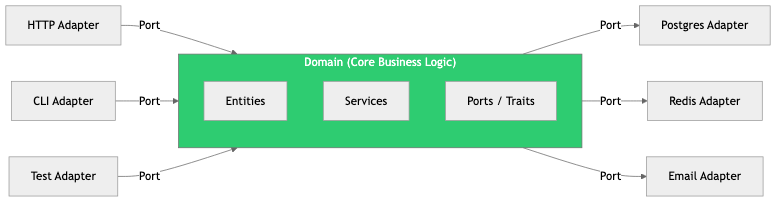
Architectural Styles — Layered, Hexagonal (Ports & Adapters), and Clean Architecture. How each works, when to use them, Rust project structures, and real-world examples.
-
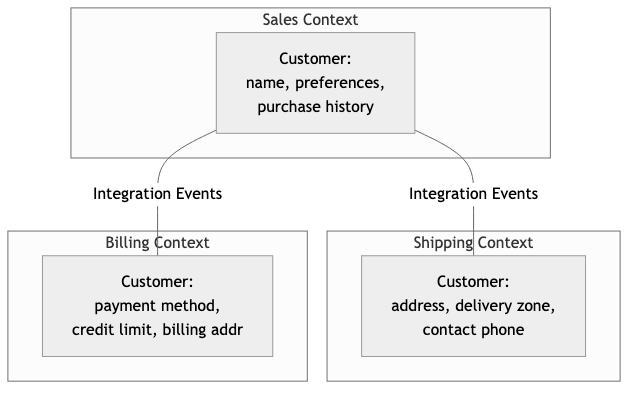
Domain-Driven Design — Bounded Contexts, Aggregates, Entities vs. Value Objects, Domain Events, Context Mapping, and the Anti-Corruption Layer pattern.
-
Modular Monolith — Why start with a monolith, module boundaries, Rust visibility enforcement with Cargo workspaces, synchronous vs. asynchronous inter-module communication, and the path to microservices.
-
Architecture Decision Records — What ADRs are, the standard template (Context, Decision, Alternatives, Consequences), sample ADRs, writing guidelines, adr-tools, storage conventions, and common mistakes.
-
Dependency Inversion and Separation of Concerns — Separation of concerns at the architecture level, the Dependency Inversion Principle, dependency injection in Rust using traits and trait objects, the composition root pattern, Conway's Law, and Amazon's API mandate.
Key Takeaways
- Architecture is the set of decisions that are expensive to change. Invest in getting them right, but do not over-invest.
- Start with a modular monolith. Extract microservices only when you have a concrete scaling or organizational reason.
- The Dependency Rule: dependencies point inward, toward the domain. The domain never depends on infrastructure.
- Bounded Contexts prevent the God Object problem. The same word can mean different things in different parts of the system.
- Conway's Law is unavoidable. Design your teams to match the architecture you want.
- Write ADRs. Fifteen minutes of writing saves months of archaeology.