
Software Economics & Cost Engineering
Diagrams
Concepts
Software economics and cost engineering is the discipline of applying financial reasoning to software development decisions. It treats engineering work not as a pure craft but as an investment with quantifiable costs, returns, and trade-offs. The goal is not to reduce all engineering to spreadsheets, but to ensure that technical leaders can articulate the financial consequences of their decisions and that organizations allocate engineering resources where they generate the most value.
Build vs Buy Decisions
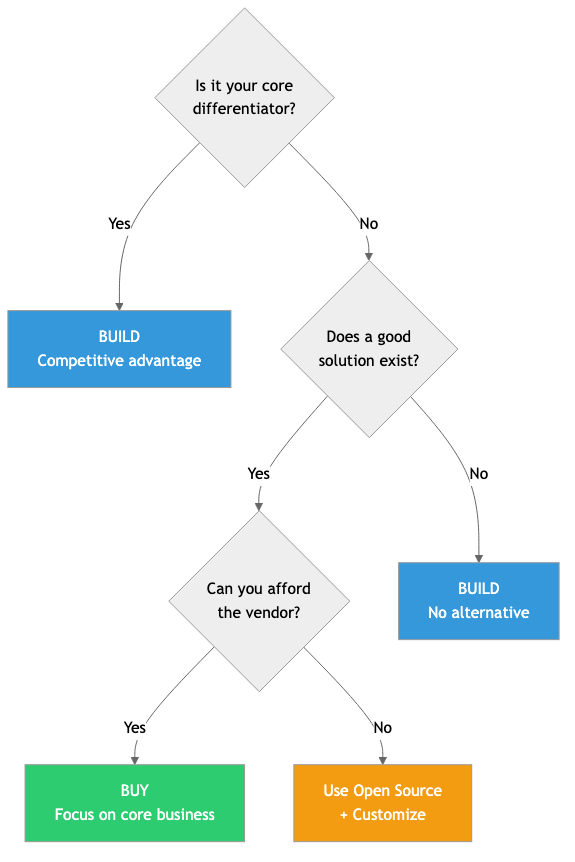
The build-versus-buy decision is one of the most consequential economic choices a software team makes. Building in-house gives you full control, deep customization, and no vendor lock-in. Buying (or adopting an open-source solution) gives you faster time to market, lower initial investment, and access to the vendor's ongoing R&D.
The real cost of building is almost always underestimated. Teams tend to account for initial development time but overlook ongoing maintenance, on-call burden, documentation, onboarding costs for new engineers, and the opportunity cost of not working on core product features. A common heuristic is that the first version of an internal tool costs X, but maintaining it over five years costs 3X to 5X.
The real cost of buying is also frequently underestimated. License fees are only the beginning. Integration work, data migration, workflow adaptation, training, vendor management overhead, and the risk of the vendor changing direction or going out of business all factor into total cost. Additionally, commercial products often impose constraints on your architecture that ripple outward.
A structured approach to build-versus-buy involves:
- Define the problem precisely. What are the functional and non-functional requirements? What is the expected lifespan of the solution?
- Enumerate candidates. What commercial products, open-source projects, and managed services exist?
- Estimate total cost of ownership (TCO) for each option over 3-5 years. Include development, integration, maintenance, licensing, infrastructure, training, and opportunity cost.
- Assess strategic alignment. Is the capability a core differentiator for your business, or is it commodity infrastructure? Build what differentiates you; buy what does not.
- Evaluate risk. What happens if the vendor raises prices by 300%? What happens if your internal team that built it leaves?
Total Cost of Ownership (TCO)
Total cost of ownership is the full lifecycle cost of a software system, from inception through decommissioning. TCO analysis prevents teams from making decisions based solely on upfront costs while ignoring the far larger ongoing expenses.
The components of software TCO include:
- Development costs: Salaries, benefits, and overhead for the engineering team during initial build. This includes design, implementation, testing, documentation, and deployment.
- Infrastructure costs: Servers, cloud resources, networking, storage, CDN, monitoring tools, CI/CD pipelines, and development environments.
- Operational costs: On-call rotations, incident response, performance tuning, security patching, compliance audits, and capacity planning.
- Maintenance costs: Bug fixes, dependency updates, framework migrations, API version upgrades, and adaptation to changing requirements.
- Opportunity costs: What the team could have built instead. This is the hardest to quantify but often the largest component.
- Migration and decommissioning costs: Data migration, user retraining, parallel running periods, and cleanup when the system is eventually replaced.
- Knowledge costs: Documentation, onboarding new team members, maintaining institutional knowledge, and the risk of knowledge loss when key engineers leave.
A useful rule of thumb: for every dollar spent building a system, expect to spend three to four dollars maintaining it over its lifetime. This ratio shifts depending on the domain -- regulated industries and safety-critical systems have even higher maintenance-to-build ratios.
FinOps and Cloud Cost Management
FinOps (Financial Operations) is the practice of bringing financial accountability to cloud spending. As organizations moved from capital expenditure (buying servers) to operational expenditure (paying for cloud by the hour), the need for a new discipline emerged. Cloud spending is variable, granular, decentralized, and fast-moving -- characteristics that traditional IT budgeting was not designed to handle.
The FinOps lifecycle has three phases:
- Inform: Gain visibility into cloud spending. Tag resources by team, project, and environment. Build dashboards that show cost trends, unit economics, and anomalies. Allocate shared costs fairly.
- Optimize: Right-size instances, eliminate waste (idle resources, orphaned storage, over-provisioned databases), leverage reserved instances and savings plans, use spot instances for fault-tolerant workloads, and architect for cost efficiency.
- Operate: Establish governance processes. Set budgets and alerts. Conduct regular cost reviews. Embed cost awareness into engineering culture so that developers consider cost implications during design.
Key FinOps metrics include:
- Cost per transaction / request / user: Unit economics that tie infrastructure spending to business output.
- Cloud spend as a percentage of revenue: A high-level indicator of efficiency. For SaaS companies, this typically ranges from 15% to 30% of revenue in early stages and should decrease as the company scales.
- Waste percentage: The fraction of cloud spend that delivers no value (idle resources, over-provisioning, unused licenses).
- Reserved instance coverage: The percentage of steady-state workloads covered by committed-use discounts.
ROI of Engineering Decisions
Return on investment for engineering decisions can be calculated, though it requires careful framing. The formula is straightforward:
ROI = (Value Gained - Cost of Investment) / Cost of Investment
The challenge lies in quantifying "value gained." For revenue-generating features, this may be estimable from A/B tests, conversion funnels, or sales data. For infrastructure improvements, value might be measured in reduced incident frequency, faster deployment cycles, or decreased time-to-market for future features. For developer experience investments, value shows up as reduced onboarding time, higher retention, and increased velocity.
Some engineering investments have compounding returns. A CI/CD pipeline improvement that saves each developer 15 minutes per day across a 50-person team saves over 3,000 engineer-hours per year. At a fully loaded cost of 450,000 annually -- likely far exceeding the cost of the improvement.
Conversely, some investments have diminishing returns. Optimizing a service from 50ms to 10ms response time may cost as much as the original optimization from 500ms to 50ms, while delivering far less user-perceptible improvement.
Technical Debt as Financial Debt
The metaphor of technical debt, coined by Ward Cunningham, maps directly to financial concepts and becomes most powerful when treated with financial rigor.
- Principal: The cost of reworking the system to its ideal state. This is the remediation cost.
- Interest: The ongoing cost of working around the debt. Slower feature development, more bugs, longer onboarding, higher incident rates. This is the carrying cost.
- Interest rate: How quickly the debt compounds. Debt in a rapidly-changing area of the codebase compounds faster than debt in stable, rarely-touched code.
- Default: When the debt becomes so severe that the system must be rewritten or abandoned entirely.
Not all technical debt is bad, just as not all financial debt is bad. Strategic debt -- taking a shortcut to hit a market window with a plan to pay it down -- can be a rational economic decision. The problem arises when debt is taken on unknowingly, when there is no plan to repay it, or when the interest payments are not tracked.
Quantifying technical debt requires measuring its carrying cost. Common proxies include:
- Ratio of time spent on unplanned work versus planned work.
- Defect density and mean time to resolution in debt-heavy areas.
- Developer surveys on friction and productivity blockers.
- Deployment frequency and lead time trends in affected components.
An engineering leader who can say "we are spending 30% of our capacity servicing technical debt, which translates to $2M per year in engineering cost that delivers no new value" has a far stronger case for remediation than one who says "our code is messy."
Pricing Engineering Time
The fully loaded cost of an engineer is substantially higher than their salary. It includes:
- Base salary and bonuses
- Benefits: Health insurance, retirement contributions, equity compensation, paid time off.
- Payroll taxes and insurance
- Equipment and software: Laptops, monitors, IDEs, SaaS tools, cloud development environments.
- Facilities: Office space, utilities, amenities (or remote work stipends).
- Management and overhead: The fraction of management, HR, finance, and administrative costs attributable to each engineer.
- Recruiting costs: Amortized cost of sourcing, interviewing, and hiring, including recruiter fees.
- Training and development: Conferences, courses, books, and the productivity ramp-up period for new hires.
In the United States, a common multiplier is 1.5x to 2.0x base salary for fully loaded cost. A senior engineer with a 300,000 to $400,000 per year when all factors are included.
This matters because it changes how you evaluate time investments. A meeting with eight engineers for one hour does not cost "one hour." At 1,600. A two-week project with three engineers is not "two weeks of work" -- it is roughly 48,000 in engineering cost.
Business Value
Understanding software economics creates value at multiple levels of an organization.
For engineering leaders, it provides the vocabulary and evidence to participate in business discussions as equals. When an engineering VP can translate a refactoring proposal into projected cost savings, reduced risk, and faster feature delivery, the proposal gets funded. When they cannot, it gets deprioritized.
For product teams, cost awareness leads to better prioritization. If a feature requires 50,000 in annual revenue, the math does not work regardless of how exciting the feature is. Conversely, a seemingly boring infrastructure improvement that saves $300,000 per year in cloud costs pays for itself quickly.
For the business as a whole, software cost engineering enables:
- More accurate project estimation and budgeting.
- Data-driven make-versus-buy decisions that avoid both over-building and vendor lock-in.
- Cloud cost optimization that directly improves margins. For a SaaS company spending 1M per year -- pure margin improvement.
- Strategic technical debt management that prevents the slow erosion of engineering productivity.
- Defensible headcount planning based on capacity models and unit economics rather than gut feel.
- Alignment between engineering investments and business outcomes, reducing the perception of engineering as a "cost center."
Companies that treat engineering economics seriously tend to have higher engineering efficiency, better margins, and faster growth because they systematically allocate resources to the highest-value work.
Real-World Examples
Amazon and the Two-Pizza Team Economics
Amazon's famous "two-pizza team" structure (teams small enough to be fed by two pizzas) is fundamentally an economic optimization. Jeff Bezos recognized that communication overhead scales quadratically with team size (per Brooks's Law), meaning that larger teams have higher coordination costs per unit of output. By constraining team size, Amazon reduced coordination overhead and increased the ratio of productive work to communication work. This structural decision also enabled Amazon's service-oriented architecture, as each small team could own and operate an independent service. The economic insight -- that smaller teams have better cost-to-output ratios for most software work -- drove an architectural decision that became one of Amazon's defining technical advantages.
Spotify's Build-vs-Buy for Internal Tools
Spotify famously built Backstage, an internal developer portal, rather than buying an existing solution. The economic reasoning was instructive. Spotify had over 1,800 engineers working across hundreds of microservices. Developer productivity was a core competitive concern. The cost of each engineer spending even 30 minutes per week searching for documentation, understanding service ownership, or navigating internal tooling was enormous at that scale. No commercial product met their specific needs for integrating with their internal systems. Spotify invested in building Backstage, and later open-sourced it, turning an internal cost center into a tool that attracted engineering talent and industry goodwill. The decision made economic sense because developer productivity at their scale was a differentiator, not a commodity.
Netflix and Cloud Cost Engineering
Netflix has been one of the most public practitioners of cloud cost engineering. Operating one of the largest AWS deployments in the world, Netflix built extensive internal tooling for cost visibility, anomaly detection, and optimization. Their engineering blog has detailed how they use reserved instances strategically, how they right-size instances based on actual utilization data, and how they built cost-aware autoscaling that balances performance with spend. Netflix treats cloud cost as an engineering problem, not just a procurement problem. Engineers are expected to understand the cost implications of their architectural decisions, and cost metrics are reviewed alongside performance and reliability metrics. This approach has allowed Netflix to scale to over 200 million subscribers while keeping infrastructure costs as a manageable percentage of revenue.
Knight Capital Group: The Cost of Technical Debt
In August 2012, Knight Capital Group deployed new trading software that contained a critical bug related to improperly decommissioned code. Old, dead code that should have been removed was accidentally reactivated by a deployment configuration error. In 45 minutes, the bug caused Knight Capital to execute 440 million loss. The company, which had been profitable and had a market capitalization of $365 million the day before, was effectively destroyed. This is an extreme example of the cost of technical debt: dead code that was never cleaned up, deployment processes that lacked adequate safeguards, and test coverage gaps that allowed the error to reach production. The "savings" from not investing in code cleanup and deployment automation were dwarfed by the catastrophic loss.
Common Mistakes and Pitfalls
1. Ignoring Opportunity Cost
Teams frequently evaluate projects based on their direct costs without considering what else those engineers could be working on. A six-month project that uses five engineers does not just cost $600,000 in engineering time -- it also costs the value of whatever those five engineers would have built instead. Opportunity cost is invisible but real, and failing to account for it leads to systematic over-investment in low-value work.
2. Underestimating Maintenance Costs
The initial build is the tip of the iceberg. Teams budget for a three-month project and then are surprised when the resulting system requires ongoing maintenance, on-call support, dependency updates, and feature enhancements for years. A realistic TCO analysis must extend well beyond the initial delivery date. The general ratio of build cost to lifetime maintenance cost is roughly 1:3 to 1:5, and ignoring this leads to chronic underinvestment in operational excellence.
3. Treating All Technical Debt Equally
Not all technical debt carries the same interest rate. Debt in a hot path that is modified weekly is far more expensive than debt in a stable module that is rarely touched. Teams that treat all debt equally either waste time remediating low-impact debt or fail to prioritize high-impact debt. A financial framing helps: estimate the carrying cost (interest) of each debt item and prioritize remediation based on ROI, not on aesthetic preferences about code quality.
4. Optimizing Cloud Costs Prematurely
Some teams obsess over cloud cost optimization before they have product-market fit. If the company's survival depends on finding customers, not on saving $5,000 per month on AWS, then engineering time spent on cost optimization is misallocated. The right time to invest heavily in FinOps is when cloud costs are material relative to revenue and when the workload patterns are stable enough that optimizations will persist. Premature optimization of cloud costs is just as wasteful as premature optimization of code performance.
5. Making Build-vs-Buy Decisions Based on Ego
Engineers often prefer to build because it is more interesting than integrating a vendor product. This bias leads to "Not Invented Here" syndrome, where teams build inferior versions of commercially available tools at great expense. The reverse bias also exists: some organizations default to buying everything, leading to a patchwork of poorly integrated vendor products that do not fit their workflows. The correct approach is to let the economics and strategic alignment guide the decision, not the personal preferences of the team.
6. Failing to Track and Attribute Costs
You cannot manage what you do not measure. Many organizations have no idea how much a particular service, feature, or team costs to operate. Without cost attribution -- tagging cloud resources, tracking engineering time by project, measuring the operational burden of each system -- there is no basis for making informed economic decisions. Implementing cost visibility is a prerequisite for cost optimization, and it should be done early, before spending becomes entrenched and hard to change.
Trade-offs
| Decision | Lower Cost / Faster Now | Higher Cost / Investment Now | Key Consideration | |---|---|---|---| | Build vs Buy | Buy a SaaS product; lower upfront cost, faster deployment | Build in-house; higher upfront cost, more control | Is the capability a core differentiator or commodity infrastructure? | | Cloud vs On-Premises | Cloud; no capital expenditure, pay-as-you-go flexibility | On-premises; lower unit cost at scale, full control | At what scale does owning hardware become cheaper than renting? | | Monolith vs Microservices | Monolith; lower operational cost, simpler infrastructure | Microservices; higher infra cost, better team scaling | Do you have enough teams to justify the operational overhead? | | Fix Tech Debt vs Ship Features | Ship features; immediate business value, defer remediation | Fix debt; reduce carrying cost, improve future velocity | How high is the interest rate on the debt? Is it compounding? | | Senior vs Junior Hiring | Junior engineers; lower salary cost per headcount | Senior engineers; higher salary but more output per person | What is the mentorship capacity? What is the cost of mistakes? | | Reserved vs On-Demand Cloud | On-demand; flexibility, no commitment risk | Reserved instances; 30-60% cost savings, commitment required | How predictable is your workload? Can you forecast 1-3 years out? | | Thorough Testing vs Speed | Less testing; faster delivery, lower immediate cost | Comprehensive testing; higher upfront cost, fewer production issues | What is the cost of a production defect in this system? | | Single Cloud vs Multi-Cloud | Single cloud; simpler operations, deeper discounts | Multi-cloud; reduced vendor lock-in risk, higher complexity cost | How realistic is the vendor lock-in risk vs the operational overhead? | | In-house Expertise vs Consultants | Consultants; no long-term commitment, immediate expertise | In-house; higher fixed cost, but retained knowledge and culture | Is this a one-time need or an ongoing capability requirement? |
When to Use / When Not to Use
When to Apply Rigorous Cost Engineering
- Headcount planning and budgeting cycles. When requesting or allocating engineering resources, cost models provide the justification and accountability that leadership needs.
- Major architectural decisions. Choosing between a monolith and microservices, selecting a database, or deciding on a cloud provider are decisions with multi-year cost implications. TCO analysis is essential.
- Build-versus-buy evaluations. Any time the team is considering building something that could be purchased, a structured economic comparison should be performed.
- Cloud cost optimization at scale. When cloud spending exceeds $100,000 per month, dedicated FinOps practices begin to pay for themselves many times over.
- Technical debt prioritization. When deciding which debt to pay down, a financial framing ensures that remediation effort is directed where it generates the greatest return.
- Post-incident reviews. After a significant outage or defect, quantifying the financial impact (lost revenue, engineering time spent on response, customer compensation) helps justify preventive investments.
- Vendor contract negotiations. Understanding your true cost baseline gives you leverage and clarity when negotiating renewals, expansions, or replacements.
When Not to Apply Rigorous Cost Engineering
- Early-stage startups searching for product-market fit. When survival depends on finding a viable product, the overhead of detailed cost modeling is not justified. Speed and learning are more valuable than cost optimization.
- Small-scale decisions. Spending two hours on a cost analysis for a decision that involves $500 in annual cost is itself a waste. Apply proportional rigor.
- Purely exploratory or research work. Innovation and experimentation do not lend themselves to upfront ROI calculations. Some investments must be made on conviction, with returns that are uncertain and long-term.
- When it becomes an excuse for inaction. If every proposal requires a six-page business case, the organization will move too slowly. Cost engineering should accelerate good decisions, not create bureaucratic barriers.
- When the data does not exist. A cost model built on fabricated numbers is worse than no model at all because it creates false confidence. If you cannot measure the inputs, acknowledge the uncertainty rather than pretending precision.
Key Takeaways
-
The fully loaded cost of engineering is 1.5x to 2.0x salary. Every engineering decision -- from meetings to architecture choices -- should be evaluated against this real cost, not the nominal salary cost. An eight-person meeting for one hour costs over $1,500 in engineering time.
-
Build what differentiates; buy what is commodity. The most reliable heuristic for build-versus-buy decisions is whether the capability is a source of competitive advantage. If it is, building gives you control and customization. If it is not, buying lets you focus engineering effort on what matters.
-
Total cost of ownership extends far beyond initial development. For every dollar spent building a system, expect to spend three to five dollars maintaining it over its lifetime. Any cost analysis that stops at initial delivery is fundamentally misleading.
-
Technical debt should be managed with financial discipline. Quantify the carrying cost (interest), prioritize remediation by ROI, and make strategic decisions about when to take on debt and when to pay it down. Not all debt is bad, but untracked debt is always dangerous.
-
Cloud cost management is an engineering discipline, not a procurement function. FinOps requires engineers to understand the cost implications of their architectural and operational decisions. Visibility, optimization, and governance must be embedded in engineering culture.
-
Opportunity cost is the largest hidden cost in software engineering. Every project you pursue is a project you do not pursue. The best engineering organizations are disciplined about saying no to good ideas in order to focus on great ones.
-
Measure before you optimize. Cost visibility -- through resource tagging, time tracking, and cost attribution -- is a prerequisite for cost optimization. Without measurement, optimization is guesswork.
Further Reading
Books
- "The Art of Business Value" by Mark Schwartz. Explores what "business value" actually means in the context of software delivery and how engineering leaders can align technical work with business outcomes.
- "Accelerate: The Science of Lean Software and DevOps" by Nicole Forsgren, Jez Humble, and Gene Kim. Provides empirical evidence linking engineering practices to organizational performance, with clear implications for where engineering investment generates the highest returns.
- "The Phoenix Project" by Gene Kim, Kevin Behr, and George Spafford. A novel that illustrates how IT and engineering work can be managed with the same rigor as manufacturing, including cost and flow optimization.
- "Software Engineering at Google" by Titus Winters, Tom Manshreck, and Hyrum Wright. Contains detailed discussions of how Google approaches the economics of software maintenance, technical debt, and long-term code health at scale.
- "Waltzing with Bears: Managing Risk on Software Projects" by Tom DeMarco and Timothy Lister. Addresses the economics of risk in software projects, including how to quantify and manage uncertainty in cost and schedule estimates.
- "Measuring and Managing Performance in Organizations" by Robert D. Austin. Examines the economics and dysfunction of measurement in software organizations, including when measurement helps and when it distorts behavior.
- "An Elegant Puzzle: Systems of Engineering Management" by Will Larson. Covers engineering management topics including headcount planning, organizational design, and the economics of team structure.
Articles and Resources
- "Cloud FinOps" by J.R. Storment and Mike Fuller (O'Reilly). The definitive guide to FinOps practices, covering organizational models, tooling, and cultural change for cloud cost management.
- "Designing Data-Intensive Applications" by Martin Kleppmann. While primarily a systems design book, it contains valuable analysis of the cost and performance trade-offs inherent in different data architecture choices.
- The FinOps Foundation (finops.org). The industry body for cloud financial management, offering frameworks, training, and community resources.
- "Is High Quality Software Worth the Cost?" by Martin Fowler. An essay that reframes software quality as an economic investment rather than a luxury, arguing that quality reduces total cost over time.
- "Technical Debt" by Martin Fowler. The canonical essay on the technical debt metaphor, including the debt quadrant (reckless/prudent, deliberate/inadvertent) that helps categorize different types of debt.
- "The SPACE Framework" by Forsgren et al. A framework for measuring developer productivity that acknowledges the multidimensional nature of engineering output, useful for connecting productivity metrics to cost analysis.
- InfoQ and LeadDev articles on engineering economics. Both publications regularly feature case studies and practitioner perspectives on the financial aspects of software engineering leadership.