
Radical Candor
Radical Candor is not a single script; it is a diagnostic framework for how you show up in feedback relationships. It answers the question: why does my feedback land badly even when I think I'm being honest? The answer, per Kim Scott, is that honesty without care becomes brutality, and care without honesty becomes dishonest — and most managers are unknowingly living in one of those failure modes.
Radical Candor sits behind tactical frameworks like SBI, COIN, and CEDAR. Those are how you deliver feedback; Radical Candor is what kind of feedback it should be in the first place.
Origin
Kim Scott developed the framework at Google (where she ran AdSense online sales and operations) and refined it at Apple (as a faculty member at Apple University). Her 2017 book Radical Candor became a runaway bestseller in tech management circles and has shaped how most Silicon Valley companies train managers. The core observation came from her boss at Google, Sheryl Sandberg, who told her after a presentation: "When you say 'um' every third word, it makes you sound stupid" — the kind of blunt, caring feedback that Scott had not experienced before and that changed her career.
The Framework
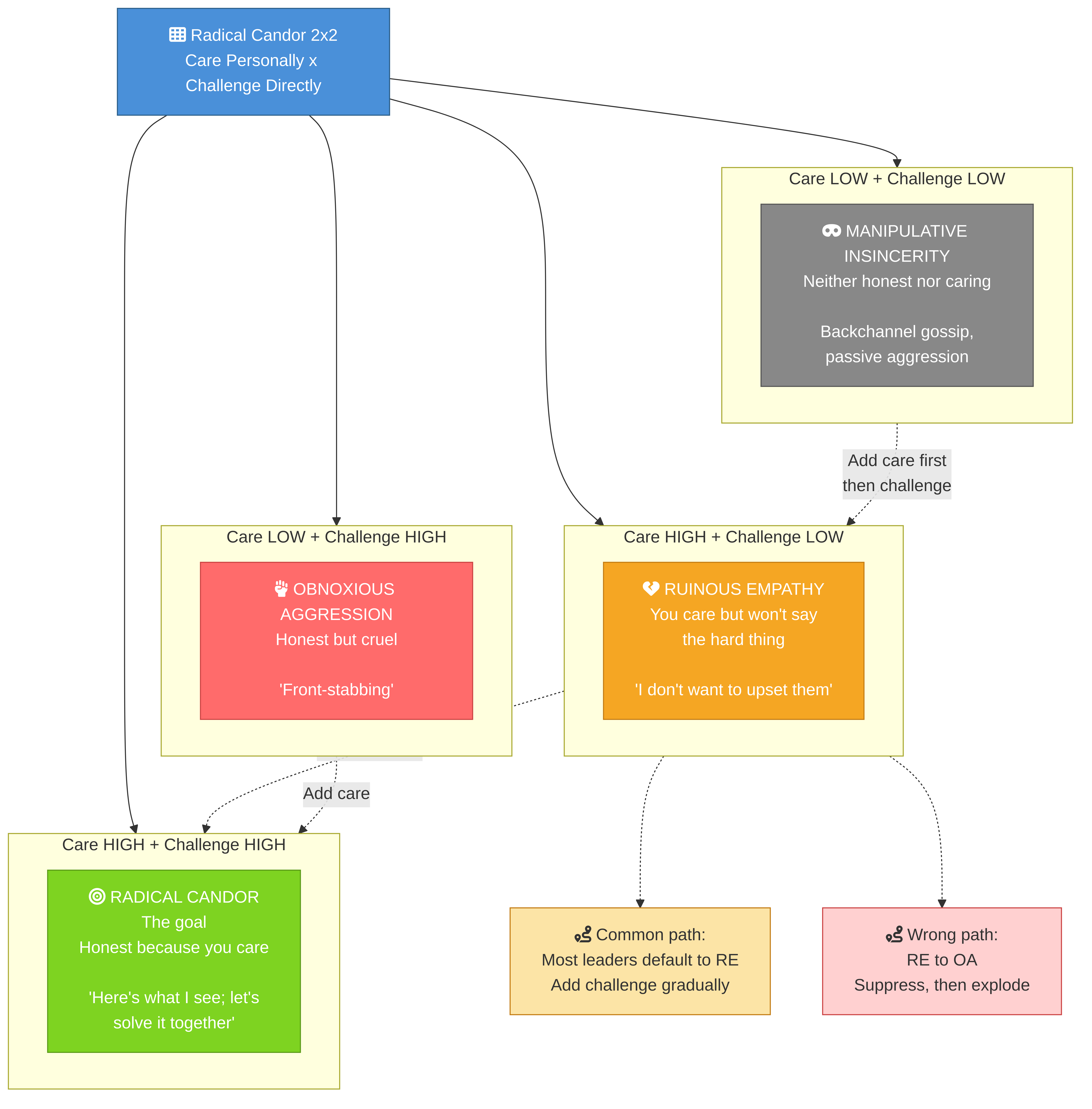
Radical Candor is plotted on a 2x2 grid:
                      CARE PERSONALLY
                              ^
                              |
          Ruinous Empathy     |     Radical Candor
          (nice but useless)  |     (the goal)
                              |
        ----------------------+----------------------> CHALLENGE DIRECTLY
                              |
          Manipulative        |     Obnoxious Aggression
          Insincerity         |     (honest but cruel)
          (fake and useless)  |
                              |
The two axes:
Care Personally:     Do I actually give a damn about this person as a
                     human being, including their career and life
                     outside of work?

Challenge Directly:  Am I telling them the truth about their work and
                     performance, even when it's uncomfortable?
The four quadrants:
Radical Candor:          High care, high challenge.
                         "I care about you, and here's the hard truth."

Obnoxious Aggression:    Low care, high challenge.
                         "This is trash. Do better."
                         (Feedback is accurate but brutal.)

Ruinous Empathy:         High care, low challenge.
                         "You're doing great! [Quiet concern].
                         Great job!"
                         (Kindness that prevents growth; the most
                         common failure mode in tech.)

Manipulative Insincerity: Low care, low challenge.
                         "Sounds good." [Says something else later.]
                         (Backchanneling, political avoidance.)
The core claim: Radical Candor is the only quadrant that actually helps people grow. The other three harm people in different ways.
How to Use It
Radical Candor is not something you do; it is something you cultivate.
Caring Personally
- Learn what matters to each person: career goals, family, hobbies
- Show up when they are struggling, not just when they are producing
- Be honest about your own struggles; vulnerability is reciprocal
- Invest time in their growth beyond the immediate ticket or sprint
Challenging Directly
- Say the thing. In the moment. In private for individual feedback.
- Be specific (SBI, COIN, CEDAR are your tactics here).
- Solicit criticism of your own work first. Modeling receipt of hard
  truths makes giving them easier.
- When you notice yourself softening the message, ask: am I being
  kind to them, or kind to myself?
The Order Matters
Scott is explicit: care first, challenge second. Without care, challenge is just aggression with a framework. The Care dimension is built over weeks and months; the Challenge dimension gets deployed in specific conversations. If you have not invested in Care, do not attempt Radical Candor — your feedback will land as Obnoxious Aggression regardless of technique.
Tech & Company Example
Consider four versions of the same feedback — "the architecture doc is not landing with the team":
Manipulative Insincerity (low-low):
  [Says nothing in the review. Tells a third party afterward
   the doc is unclear. Gives a mediocre performance rating next
   cycle citing "communication".]

Ruinous Empathy (high care, low challenge):
  "Sam, the doc is really detailed. I can see you put a ton of
   work into it. Maybe we could add a TL;DR? No pressure, only
   if you have time."
  [The team is actually confused and is quietly rewriting things
   on their own. Sam does not know and the problem compounds.]

Obnoxious Aggression (high challenge, low care):
  "Sam, this doc is a mess. Nobody understands it. This is
   exactly the problem I flagged six months ago. Fix it."
  [Sam becomes defensive, defensive becomes disengaged, disengaged
   becomes exits. Accurate criticism; unusable delivery.]

Radical Candor (high care, high challenge):
  [Grabs 30 minutes in private.]
  "Sam, I want to talk about the arch doc — this is going to be
   direct because I think you can handle it and I think it matters.
   The doc is not landing with the team. Specifically, Priya,
   Jordan, and Alex have all come to me privately asking questions
   the doc was supposed to answer. The pattern I'm seeing is that
   you structured it around the technical decisions, but the
   audience needs the business context first. I know writing-for-
   audience is something you've wanted to get better at — I think
   this is a chance to work on it. Want to pair on a revision
   this week? I can flag specific sections and you can take a
   pass."
The fourth version works because (a) Sam knows the tech lead cares — they grabbed time in private, referenced Sam's growth goals, offered to pair — and (b) the tech lead actually said the thing: the doc is not landing, and here is why.
Radical Candor ≠ Brutal Honesty
A critical and frequent misunderstanding: Radical Candor is not permission to be blunt. Blunt-without-care is Obnoxious Aggression. People who read the book title but not the book routinely use "I'm just being radically candid" to justify unkindness — and that itself is an anti-pattern Scott explicitly warns against.
The Radical in Radical Candor refers to the combination, not the bluntness. Radical = doing both Care and Challenge simultaneously, which is rare.
When It Works
- Long-term manager-report relationships
- High-trust peer relationships
- Environments where growth and performance are explicit values
- Teams that have invested in psychological safety
- Individual 1:1s (almost never in groups)
When It Does Not Work
- Before you have built the Care dimension — Radical Candor from a new manager you have known for 2 weeks lands as Obnoxious Aggression, regardless of intent.
- Across large power gaps — A staff-engineer Radically Candid with a VP-3-levels-up often has different stakes than the reverse; structural safety matters.
- Across cultural contexts that punish directness — Some cultures have strong norms against direct challenge; the framework needs local adaptation.
- In crisis moments — Immediately after layoffs, during an outage, right after a personal tragedy: defer the challenge, lead with the care.
- When the issue is not behavioral — If the problem is a broken system, Radical Candor aimed at an individual misdirects the fix.
Common Failure Modes
- Candor-washing — Labeling ordinary rudeness as "Radical Candor." The quadrant tells you this is Obnoxious Aggression.
- Care performance — Performative check-ins ("How's your weekend?") with no real interest, followed by harsh feedback. People read the performance and discount the care.
- Hoarding feedback — Saving up months of criticism for a review. By the time you deliver it, Care is gone; you now have a list of grievances.
- Only-up feedback — Being Radically Candid with reports but never soliciting the same from them. Without reciprocal receiving, the culture is one-way and brittle.
- Skipping the praise — Scott emphasizes that Radical Candor applies to praise as well as criticism, and most managers are short on the praise side. Specific, sincere praise is as much a Radical Candor move as specific, sincere criticism.
- Mistaking discomfort for courage — "I was brave and told them the hard truth!" — sometimes. Other times, you were just uncomfortable and unloaded. The test is whether the receiver felt cared for and heard.
Variants & Related Frameworks
- SBI, COIN, CEDAR — These are the tactical delivery mechanisms for Radical Candor conversations.
- Netflix "Keeper Test" — Reed Hastings' related concept on honest talent conversations ("Would I fight to keep this person if they tried to leave?"). Compatible with Radical Candor but more extreme.
- Nonviolent Communication (NVC) — Marshall Rosenberg's framework; pairs well with Radical Candor for the Care dimension.
- Crucial Conversations — Pattern for delivering Radical Candor in high-stakes scenarios.
- Start-Stop-Continue — Tactical complement for retros.
Further Reading
- Kim Scott — Radical Candor (the foundational book; read the full book, not just the summaries)
- Kim Scott — Just Work (sequel that addresses power dynamics and bias; essential for applying RC across difference)
- Ray Dalio — Principles (Bridgewater's "radical transparency" is a related, more extreme adjacent framework)
- Edgar Schein — Helping (on the caring side that grounds challenge)
- Reed Hastings & Erin Meyer — No Rules Rules (Netflix's version; useful comparison)