
AIM Framework
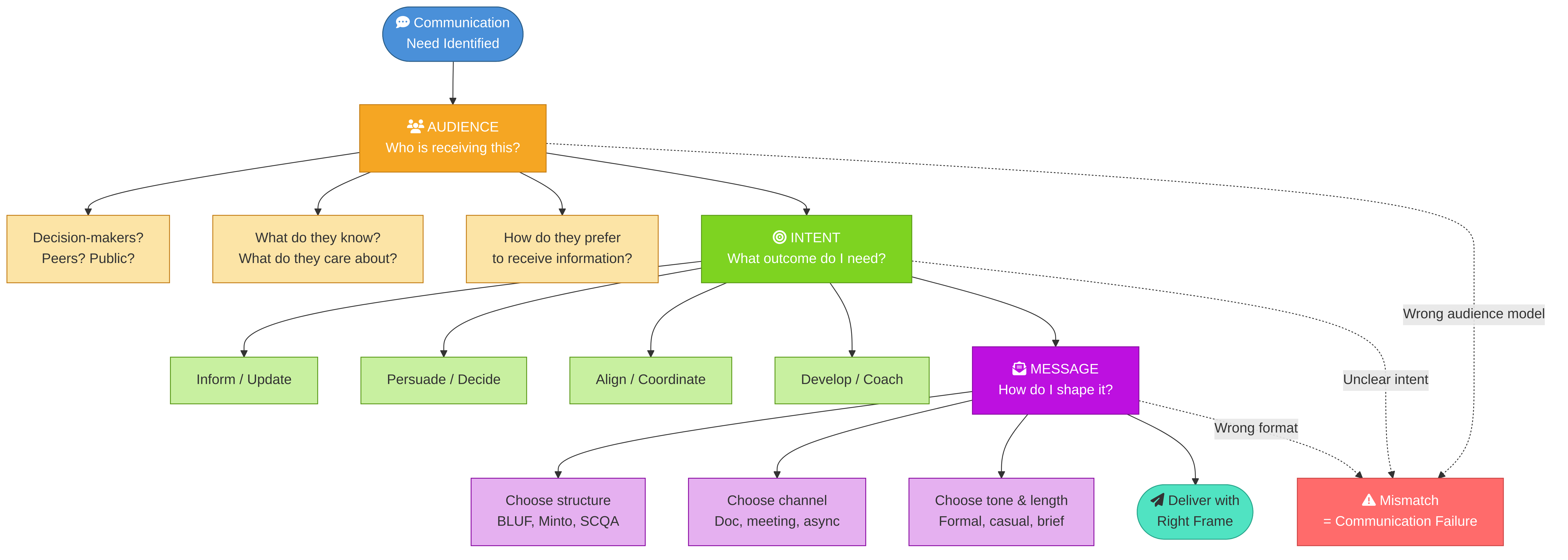
The AIM framework is a pre-flight checklist for any communication. Before writing an email, starting a meeting, or giving a presentation, AIM forces you to answer three questions: Who is my audience, what is my intent, and what is my message? It is the simplest useful meta-framework for communication, and it underlies almost every other framework in this catalog.
Origin
AIM was popularized by Mary Munter in her 1982 book Guide to Managerial Communication, used at Dartmouth's Tuck School of Business. It has since become a staple of MBA programs and is widely taught in corporate communication courses. The model is explicitly audience-first, which was unusual at the time — most business writing guides focused on the writer's content rather than the reader's needs.
The Framework
AIM stands for three elements, applied in order:
A - Audience: Who are they? What do they know, need, believe, fear?
I - Intent:   What do you want them to think, feel, or do afterward?
M - Message:  What is the single most important thing they must take away?
Audience
Answering "audience" well requires more than identifying the recipient. You need to understand:
- What they already know — avoid repeating or assuming too much
- What they care about — tie your message to their goals, not yours
- Their level of technical fluency — adjust vocabulary and abstraction
- Their attention budget — an exec has 3 minutes; a peer can read 3 pages
- Their likely objections — pre-empt them, do not ignore them
Intent
Intent is not "share information." That is too vague. Intent is what you want the audience to do or decide after encountering your communication. Be specific:
Weak intent:   "Inform the team about the new deployment process."
Strong intent: "Get the team to adopt the new deployment process by next sprint."

Weak intent:   "Update leadership on Q3."
Strong intent: "Get leadership approval to hire 2 more engineers in Q4."
If you cannot state intent as an observable outcome (a decision, an action, a shift in belief), your message does not have a point.
Message
The message is the single most important sentence the audience will remember if they forget everything else. Force yourself to write it in one sentence before writing anything longer.
Message examples:
  "We need to migrate off Kafka because our ops cost tripled."
  "The design review is blocked on security sign-off."
  "I recommend we hire internally instead of using contractors."
Everything else in the communication — paragraphs, slides, appendices — exists to support this one sentence.
How to Use It
Apply AIM before you start drafting. Literally write the three answers at the top of your document or notes.
Pre-writing checklist:
  A: CTO and VP Engineering. They know the architecture at a high level
     but not the tradeoffs we've been debating for the last 2 weeks.
  I: Approval to allocate 2 engineers to the migration for Q4.
  M: The current system will hit a hard capacity ceiling in 6 months;
     migrating now is cheaper than emergency scaling later.
Now the rest of the document writes itself: lead with the message, provide the evidence the audience needs, and structure everything toward the intent.
Tech & Company Example
Consider two versions of the same Slack message from an engineer:
Version A (no AIM):
  "Hey team, I've been looking into the caching layer and noticed some
   interesting patterns. There are a few different approaches we could
   take, each with tradeoffs. Happy to discuss more in our next meeting."

Version B (AIM applied):
  A: Backend team. Knows the codebase, does not know the specific
     cache miss pattern I found.
  I: Get 2 engineers to volunteer to pair on the fix this week.
  M: Cache hit rate dropped from 94% to 71% after the last deploy;
     we need to fix it before the next traffic spike.

  Message posted:
  "Our cache hit rate dropped to 71% after Friday's deploy, causing
   3x more DB load. I've narrowed it down to the new user-settings
   endpoint. Need 2 engineers to pair with me this week — who's in?"
Version B gets an immediate response. Version A gets a thumbs-up reaction and no action.
When It Works
- Any written communication to more than one person
- Emails, memos, status updates, design docs, exec summaries
- Presentation prep (force yourself to write AIM before opening Keynote)
- Tricky conversations where you need to stay on-purpose
When It Does Not Work
- Pure exploratory discussion (brainstorming, early-stage ideation)
- Casual social chat (forcing structure makes it weird)
- When the intent genuinely is just to share information with no action expected — but this is rarer than people think
Common Failure Modes
- Audience-of-one thinking — writing as if the only reader is the person you are directly addressing, when the message will be forwarded, screenshotted, or re-read months later
- Fake intent — "inform" or "update" masquerading as intent; these are not intents, they are channels
- Multiple messages — trying to communicate three messages in one document, so none of them land
- Message that is actually a question — if your "message" ends in a question mark, you have not done the thinking yet
Variants & Related Frameworks
- PACMD — Purpose, Audience, Channel, Message, Delivery (adds channel selection and delivery planning)
- Minto Pyramid Principle — natural next step: once AIM is clear, Minto structures the supporting content
- BLUF — Bottom Line Up Front; a delivery-focused cousin that emphasizes leading with the message
Further Reading
- Mary Munter — Guide to Managerial Communication (foundational textbook)
- Barbara Minto — The Minto Pyramid Principle (complementary structural framework)
- Nancy Duarte — Resonate (extends AIM thinking to presentations)