
BATNA, ZOPA & Stakeholder Mapping
BATNA, ZOPA, and the Power-Interest Grid are negotiation and stakeholder-analysis tools that pair naturally. BATNA and ZOPA are the vocabulary for understanding any negotiation — what is the alternative, what is the possible agreement space. The Power-Interest Grid is the stakeholder-mapping tool that tells you which negotiations matter and how to approach each stakeholder. Together, they are the analytical backbone of influence work in tech: vendor negotiations, internal resource allocation, cross-team agreements, compensation discussions, and any situation with genuine competing interests.
Origin
- BATNA and ZOPA — Introduced by Roger Fisher and William Ury in Getting to Yes (1981), the foundational text of principled negotiation. Fisher and Ury led the Harvard Negotiation Project. Their work fundamentally reshaped how negotiation is taught, replacing "positional bargaining" (haggling) with "interest-based negotiation" (understanding what each party actually needs).
- Power-Interest Grid (Stakeholder Mapping) — Developed by Aubrey Mendelow at Kent State University in 1991 and further refined in project-management literature. Now standard in PMP certification, product management, strategy consulting, and change management.
BATNA & ZOPA
BATNA — Best Alternative to a Negotiated Agreement
BATNA = What will I do if this negotiation fails?
Your BATNA is the actual outcome you have if you walk away. Not your aspiration, not your reservation price — what you will actually do Monday morning if you do not close this deal.
Examples:

Hiring negotiation:
  Your BATNA: Accept the other job offer ($180k).
  The new offer's BATNA: Keep recruiting (2-3 more weeks, uncertain).

Vendor negotiation:
  Your BATNA: Stay with current vendor for another year.
  Their BATNA: Close one of the deals in their pipeline instead.

Internal resource negotiation:
  Your BATNA: Descope the project; ship half the features.
  Their BATNA: Reallocate their team to a different priority.
The BATNA disciplines:
1. Know your BATNA precisely. Not "I might have options" but "here
   is exactly what I do on Monday."
2. Know the other side's BATNA. This is the harder half and where
   preparation pays off.
3. Strengthen your BATNA before entering the negotiation. Shop the
   alternative. Line up the fallback.
4. Only accept terms better than your BATNA.
Reservation Price
Your reservation price is the minimum (or maximum) deal terms at which you are indifferent between accepting and walking to your BATNA.
BATNA: The actual alternative action.
Reservation price: The deal terms that are equivalent in value to the BATNA.
If your BATNA is a job at 180k total comp (adjusted for role differences).
ZOPA — Zone of Possible Agreement
ZOPA = The range of deals that both parties would prefer to their BATNAs.
If your reservation price is "at least 195k," the ZOPA is 195k. Any deal in that range is mutually preferred to no deal.
If their max < your min: No ZOPA exists; negotiation fails or one
                         party changes their BATNA.
If their max > your min: ZOPA exists; the question is where in the
                         zone the deal lands.
Negotiation tactics largely determine where in the ZOPA the deal lands. But if no ZOPA exists, no tactic closes the deal — you need to change the underlying conditions.
Tech & Company Example
A staff engineer is negotiating with their manager for a leveling promotion to Principal.
Engineer's analysis:

BATNA: Accept an offer from a peer company at Principal level
       ($340k total comp).

Reservation price at current company: Principal title + $340k total
       comp, OR a credible 6-month path to Principal with a retention
       bonus that makes up the spread.

Manager's position:
  Wants to retain. Can approve Principal but has to convince the
  promotion committee. Budget is tight.

Manager's BATNA: Backfill at Senior level ($280k range), recruit over
       6-9 months, take risk that another senior wants to follow
       the departing engineer.

ZOPA analysis:
  Engineer min:   Principal or Principal-path + equivalent comp.
  Manager max:    Principal if committee approves; Senior + retention
                  bonus if not.

  ZOPA exists if manager can get committee approval or afford a
  significant retention bonus. Does not exist if neither is possible.

Negotiation strategy:
  1. Make BATNA credible (engineer has the offer in writing).
  2. Help manager make the internal case (prepare the promotion
     packet yourself).
  3. Distinguish "Principal title" from "Principal comp" — different
     constraints, both negotiable.
  4. Agree on a specific path-to-Principal with dates if title cannot
     move today.
This is a BATNA-ZOPA analysis in action. It replaces "I'd really like a promotion" with a structured conversation both sides can engage with honestly.
Power-Interest Grid (Stakeholder Mapping)
The Grid
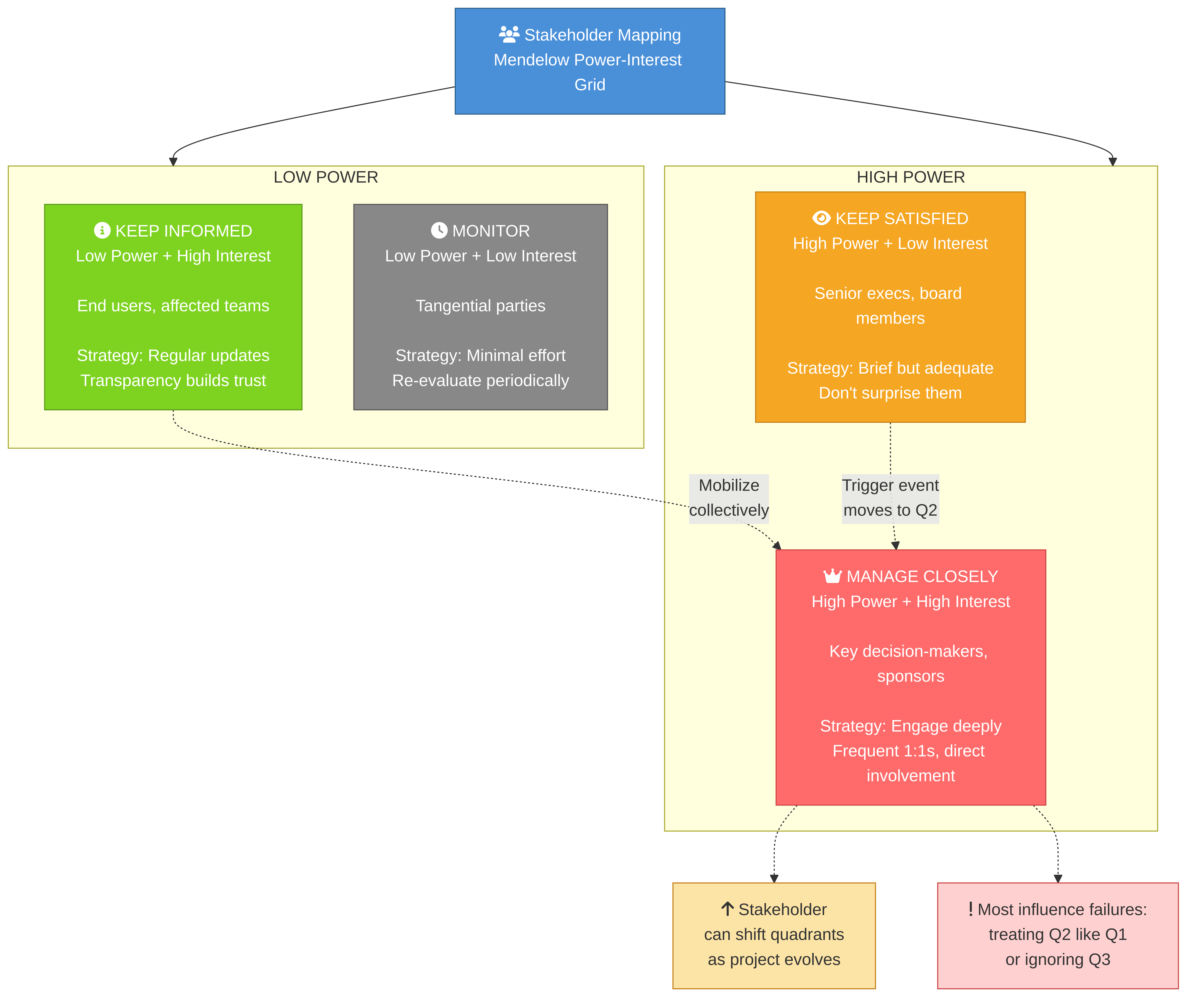
Plot every stakeholder on a 2x2:
                        HIGH POWER
                            ^
                            |
        Keep Satisfied      |      Manage Closely
        (low interest,      |      (high interest,
         high power)        |       high power)
                            |
   ----+-----------+--------+--------+-----------+----> HIGH INTEREST
                            |
        Monitor             |      Keep Informed
        (low interest,      |      (high interest,
         low power)         |       low power)
                            |
                       LOW POWER
How to Use It
1. List every stakeholder in the decision (individuals, not
   abstract groups when possible).

2. For each, rate their power (ability to affect the outcome) and
   interest (how much they care about it).

3. Place them in the grid.

4. Apply the quadrant strategy:

Manage Closely (high power, high interest):
  - Engage early, frequently, deeply
  - They must feel co-authors, not just reviewers
  - Weekly 1:1 touchpoints during critical phases

Keep Satisfied (high power, low interest):
  - Give them what they need, no more
  - Avoid surprises
  - Brief them on outcomes, not process
  - Do not over-engage or you create unwanted scrutiny

Keep Informed (high interest, low power):
  - Regular updates via digest, broadcast channel
  - Solicit input; you may need their expertise
  - Do not let them feel excluded, but do not give them decision
    rights

Monitor (low interest, low power):
  - Standard organizational comms is sufficient
  - Re-check if the situation changes; people can move quadrants
Dynamic Mapping
Stakeholders move. A low-interest stakeholder can become high-interest if the decision surprises them. A low-power stakeholder can become high-power if the situation changes (promotion, reorg, scope change). Re-map at major milestones.
Tech & Company Example
An eng director is pushing a platform-wide migration. Stakeholder map:
Manage Closely (high power, high interest):
  - CTO:                Executive sponsor, holds budget
  - Platform VP:        Owns the team doing the work
  - SRE lead:           Operates what gets migrated
  - Security lead:      Owns the migration's risk profile

Keep Satisfied (high power, low interest):
  - CFO:                Cares about cost, not mechanics
  - Legal:              Cares about data-handling compliance
  - GM of business X:   Cares about uptime; otherwise uninterested

Keep Informed (low power, high interest):
  - Senior engineers:   Not deciders, but strong views
  - Product leads:      Will feel the migration's impact
  - CS / Support:       Will field issues during transition

Monitor (low power, low interest):
  - Adjacent teams:     Distantly affected
  - New joiners:        Will inherit the outcome but have no current
                        skin in the game
The migration plan's comms plan follows directly from this:
Weekly: CTO, Platform VP, SRE lead, Security lead
Monthly exec summary: CFO, Legal, GM
Bi-weekly digest: Senior engineers, Product leads, CS
Standard org comms: Everyone else
Notice how the map prevents two classic mistakes:
1. Over-engaging the CFO (who is Keep Satisfied, not Manage Closely)
   creates friction you do not need.

2. Under-engaging the Senior engineers (who are Keep Informed)
   creates a rebellion at the technical layer, because they have
   real power to slow-walk adoption even if they do not formally
   decide.
How They Fit Together
1. Stakeholder Mapping:  Identifies who you are negotiating with
                         (and who you are not).

2. BATNA analysis:       For the "Manage Closely" and "Keep Satisfied"
                         stakeholders, what is their alternative?
                         What is yours with them?

3. ZOPA construction:    Where is the agreement space with each key
                         stakeholder? Does one exist?

4. Negotiation strategy: Apply SPIN, Cialdini, Ethos/Pathos/Logos
                         within the ZOPA for each stakeholder.
Together, they convert vague influence efforts into a structured plan.
When It Works
- Cross-functional initiatives with multiple stakeholders
- Vendor and partnership negotiations
- Compensation and role negotiations (internal or external)
- Internal resource allocation debates
- Change-management efforts involving many teams
- Major hiring or promotion decisions
When It Does Not Work
- Over-analyzed small decisions — Mapping stakeholders for a minor code change is absurd.
- Highly dynamic situations — If stakeholders are shifting daily, the map goes stale; use real-time judgment.
- Bad-faith counterparts — ZOPA analysis assumes both parties negotiate honestly. With a bad-faith actor, the analysis still helps (you know your BATNA), but the negotiation is different.
- Purely relationship-driven contexts — In some cultures or teams, an explicit BATNA conversation reads as cold or transactional; it may still inform your strategy internally, but not your spoken approach.
Common Failure Modes
- BATNA Inflation — Overstating your alternative to gain leverage. If the other side probes and discovers your BATNA is weaker than you claimed, your credibility collapses.
- No real BATNA — Entering a negotiation with "I'll figure something out if this fails." You will lose, every time. Strengthen your BATNA first.
- Position vs. interest — Arguing over stated positions ("I want a 30% raise") rather than underlying interests ("I need to feel I'm growing faster than inflation"). Fisher and Ury's central teaching: negotiate interests, not positions.
- Flat stakeholder map — Treating all stakeholders the same (often over-engaging Monitor quadrant and under-engaging Manage Closely).
- Stale map — Mapping once at kickoff and not re-mapping when people move roles or priorities shift.
- Ignoring the in-group — Mapping external stakeholders while assuming internal alignment. Internal stakeholders often need the most Manage Closely treatment.
- Unnamed stakeholders — Mapping roles ("the legal team") instead of individuals ("Priya in Legal"). Roles do not decide; people do.
Variants & Related Frameworks
- Mendelow's Matrix — The original academic naming of the Power-Interest Grid.
- Influence-Interest-Impact (III) Grid — Three-dimensional variant used in program management.
- Salience Model — Mitchell-Agle-Wood classification by Power, Legitimacy, Urgency (more nuanced but complex).
- RACI / RAPID — Covered in Decisions & Alignment; pair with stakeholder mapping to assign decision rights.
- Getting to Yes principles — Separate people from problem, focus on interests not positions, invent options for mutual gain, insist on objective criteria.
- Getting Past No (Ury) — Follow-up to Getting to Yes for hard negotiations.
- Never Split the Difference (Voss) — Hostage-negotiation-derived approach; complementary but different philosophical stance.
Further Reading
- Roger Fisher, William Ury — Getting to Yes (canonical; read this before anything else)
- William Ury — Getting Past No (for negotiations with difficult counterparts)
- Chris Voss — Never Split the Difference (tactical, psychology-heavy; contrasts with Fisher/Ury)
- Max Bazerman, Margaret Neale — Negotiating Rationally (analytical/quantitative approach)
- Malhotra & Bazerman — Negotiation Genius (applied case studies)
- Aubrey Mendelow — Environmental Scanning (1991) for the Power-Interest Grid origin