
Dependent Types
Core Idea
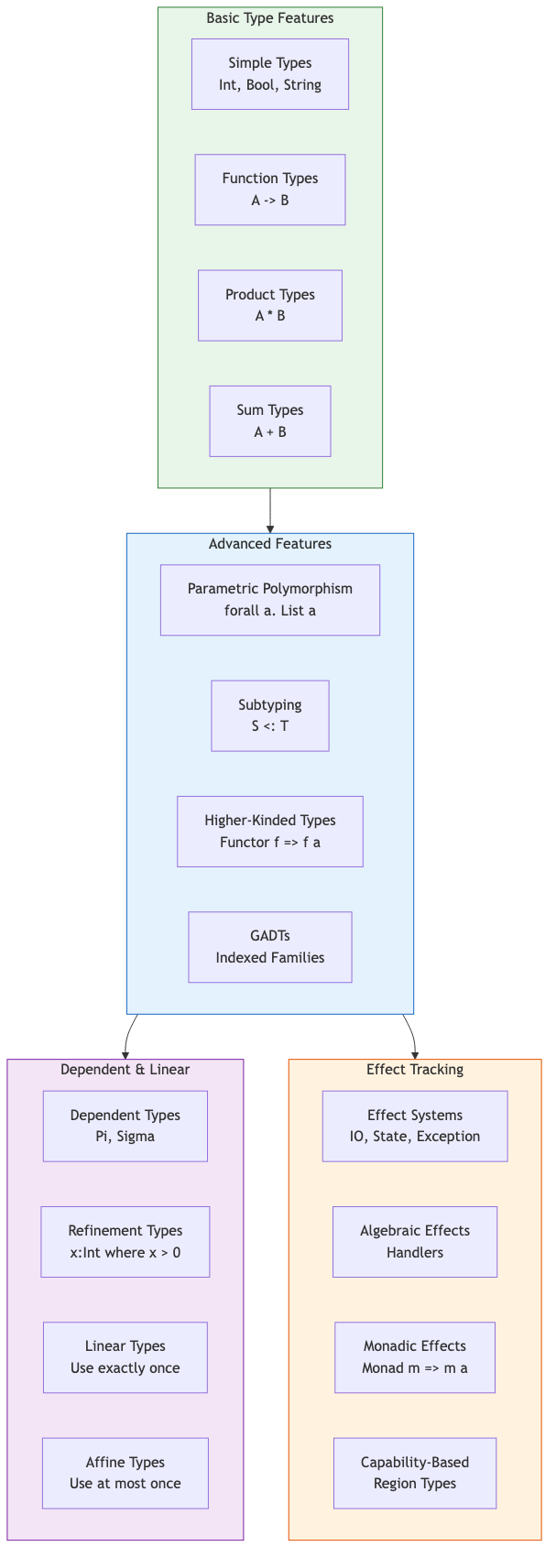
Dependent types are types that depend on values. This unifies the term and type levels, allowing types to express precise specifications.
In simple types, A -> B says "given any A, produce a B." With dependent types, (x : A) -> B(x) says "given x of type A, produce a value of type B(x)" where B may mention x. The type of the output depends on the value of the input.
Pi Types (Dependent Function Types)
The Pi type (product type) generalizes function types:
Pi (x : A). B(x) or (x : A) -> B(x)
An inhabitant of Pi (x : A). B(x) is a function that, given x : A, returns a value of type B(x).
Typing rules:
Gamma |- A : Type    Gamma, x:A |- B : Type
--------------------------------------------  (Pi-Form)
Gamma |- Pi (x:A). B : Type

Gamma, x:A |- M : B
--------------------------------------------  (Pi-Intro / Lambda)
Gamma |- lambda x. M : Pi (x:A). B

Gamma |- M : Pi (x:A). B    Gamma |- N : A
--------------------------------------------  (Pi-Elim / App)
Gamma |- M N : B[x := N]
Special case: When B does not mention x, Pi (x:A). B degenerates to A -> B (ordinary function type).
Examples:
vector_head : Pi (n : Nat). Vec A (n + 1) -> A-- type ensures non-empty vectormatrix_mult : Pi (m n p : Nat). Mat m n -> Mat n p -> Mat m p-- dimensions must match
Sigma Types (Dependent Pair Types)
The Sigma type (sum type) generalizes pairs:
Sigma (x : A). B(x) or (x : A) * B(x)
An inhabitant is a pair (a, b) where a : A and b : B(a). The type of the second component depends on the value of the first.
Typing rules:
Gamma |- A : Type    Gamma, x:A |- B : Type
--------------------------------------------  (Sigma-Form)
Gamma |- Sigma (x:A). B : Type

Gamma |- a : A    Gamma |- b : B[x := a]
--------------------------------------------  (Sigma-Intro / Pair)
Gamma |- (a, b) : Sigma (x:A). B

Gamma |- p : Sigma (x:A). B
Gamma, x:A, y:B |- C : Type
Gamma, x:A, y:B |- M : C[(x,y) := p]        (Sigma-Elim)
--------------------------------------------
Gamma |- let (x, y) = p in M : C[p]
Special case: When B does not mention x, Sigma (x:A). B = A * B (ordinary pair type).
As logical connective: Under Curry-Howard, Sigma types correspond to existential quantification: Sigma (x:A). B(x) = "there exists x:A such that B(x)."
Universes
Universes are "types of types," resolving the paradox of "Type : Type" (which leads to Girard's paradox / inconsistency).
Universe hierarchy: Type_0 : Type_1 : Type_2 : ...
Each Type_i contains types at level i but not itself. The rules:
- If A : Type_i, then A : Type_{i+1} (cumulativity)
- If A : Type_i and B : Type_i, then A -> B : Type_i
- Type_i : Type_{i+1}
Universe polymorphism: To avoid duplicating definitions at each level, modern systems support universe-polymorphic definitions: id : forall {i}. (A : Type_i) -> A -> A.
Typical ambiguity: Coq and Lean allow omitting universe levels, inferring them automatically and checking consistency.
Prop vs Type: Some systems (Coq) distinguish Prop (propositions, proof-irrelevant) from Type (data). Prop : Type_0, and Prop is impredicative (forall A:Prop. A is in Prop), while Type levels are predicative.
Inductive Types
Inductive types define types by specifying constructors. The elimination principle (recursion/induction) is derived.
Basic Examples
Inductive Nat : Type :=
  | zero : Nat
  | succ : Nat -> Nat

Inductive List (A : Type) : Type :=
  | nil : List A
  | cons : A -> List A -> List A
Indexed Inductive Types (Inductive Families)
Types can be indexed by values, enabling precise specifications:
Inductive Vec (A : Type) : Nat -> Type :=
  | vnil : Vec A 0
  | vcons : forall n, A -> Vec A n -> Vec A (n + 1)
The type Vec A n enforces the length invariant at the type level.
Inductive Fin : Nat -> Type :=    -- finite sets {0, ..., n-1}
  | fzero : forall n, Fin (n + 1)
  | fsucc : forall n, Fin n -> Fin (n + 1)
W-Types (Well-Founded Trees)
W-types are a general form of inductive types in type theory:
Given A : Type and B : A -> Type, the W-type W(x:A). B(x) consists of well-founded trees where:
- Each node is labeled with a : A
- Each node has |B(a)| children
W (x : A). B(x) has constructor:
  sup : (a : A) -> (B(a) -> W(x:A).B(x)) -> W(x:A).B(x)
Examples:
- Natural numbers: A = Bool, B(true) = Empty (zero has no children), B(false) = Unit (successor has one child)
- Binary trees: A = Bool, B(true) = Empty (leaf), B(false) = Bool (internal node has two children)
- Lists of A: A' = Unit + A, B(inl tt) = Empty (nil), B(inr a) = Unit (cons has one child)
W-types, together with Pi, Sigma, identity types, and universes, suffice to derive all inductive types in extensional type theory.
The Calculus of Constructions (CoC)
The Calculus of Constructions (Coquand-Huet, 1988) is at the apex of the lambda cube, combining dependent types, polymorphism, and type operators.
Sorts: Prop, Type (or *, Box in original notation) Core rules (PTS formulation):
- Axiom: Prop : Type
- Rules: (Prop, Prop, Prop), (Prop, Type, Type), (Type, Prop, Prop), (Type, Type, Type)
This allows:
- Terms depending on terms (ordinary functions): (Prop, Prop)
- Terms depending on types (polymorphism): (Type, Prop)
- Types depending on terms (dependent types): (Prop, Type) -- wait, actually this is (Type, Prop)
- Types depending on types (type operators): (Type, Type)
Prop is impredicative: forall (P : Prop). P is itself in Prop. This enables encoding of inductive types via Church-style encodings within the theory.
Strong normalization: CoC is strongly normalizing (Coquand, 1986), hence consistent as a logic.
The Calculus of Inductive Constructions (CIC)
CIC (Paulin-Mohring, 1993) extends CoC with primitive inductive types, forming the basis of Coq (now Rocq). Key additions:
- Inductive definitions with strict positivity checking (ensures consistency)
- Pattern matching with dependent elimination
- Universe hierarchy Type_0 : Type_1 : ... (predicative)
- Prop remains impredicative (for proof irrelevance)
- Fixpoint definitions with structural recursion (termination checking via guard condition)
Strict Positivity
An inductive type T must appear only strictly positively in its constructors:
- T can appear as the final return type
- T can appear to the right of arrows, but NOT to the left of an arrow in a negative position
Allowed: cons : A -> List A -> List A (List appears positively)
Forbidden: bad : (Nat -> Nat) -> Nat is fine, but bad : (T -> Nat) -> T is rejected because T appears negatively (to the left of an arrow leading to T)
Violating strict positivity allows encoding paradoxes (Curry's paradox / non-termination).
Definitional vs Propositional Equality
Definitional equality (judgmental, computational): M =_def N, checked automatically by the type checker via computation (beta-reduction, delta-unfolding, iota-reduction for match).
Propositional equality: Id_A(M, N) or M =_A N, a type that may or may not be inhabited. Requires an explicit proof term (typically refl : Id_A(M, M)).
The gap between definitional and propositional equality is a fundamental tension:
- More definitional equalities make type checking more convenient but harder to decide
- Extensional type theory (ETT): Makes propositional equality imply definitional equality (reflection rule). Type checking becomes undecidable.
- Intensional type theory (ITT): Keeps them separate. Type checking is decidable but proofs require explicit equality reasoning (transport/rewrite).
Decidability and Type Checking
| System | Type Checking | Type Inference |
|---|---|---|
| CoC | Decidable | Partially decidable (elaboration with unification) |
| CIC (Coq) | Decidable | Partial (holes, implicit arguments) |
| ETT | Undecidable | Undecidable |
| ITT | Decidable | Partial |
Termination checking: CIC requires all recursive functions to be structurally decreasing (or satisfy a more sophisticated termination criterion). This is conservative -- some terminating functions are rejected.
Proof Assistants Based on Dependent Types
| System | Theory | Key Features |
|---|---|---|
| Coq/Rocq | CIC | Tactics, extraction, universe polymorphism |
| Lean 4 | CIC variant | Metaprogramming, type class inference |
| Agda | ITT with pattern matching | Cubical mode, sized types |
| Idris 2 | Quantitative TT | Linear types, elaboration reflection |
| F* | Dependent + effects | SMT integration, refinement types |
Logical Strength
The proof-theoretic strength of these systems varies:
- STLC: Intuitionistic propositional logic
- System F: Second-order arithmetic (PA_2)
- CoC: Higher-order intuitionistic logic
- CIC + universes: Comparable to ZFC with inaccessible cardinals (depending on the universe structure)
Adding more universe levels increases proof-theoretic strength. Coq with its full universe hierarchy can encode significant portions of mathematics, though it cannot prove its own consistency (by Godel's theorem).