
Cloud Computing Fundamentals
NIST Definition
The National Institute of Standards and Technology defines cloud computing through five essential characteristics:
- On-demand self-service - Provision resources without human interaction with provider
- Broad network access - Available over the network via standard mechanisms
- Resource pooling - Multi-tenant model with dynamic assignment of resources
- Rapid elasticity - Scale out/in quickly, appearing unlimited to the consumer
- Measured service - Metered usage with pay-per-use billing transparency
Service Models
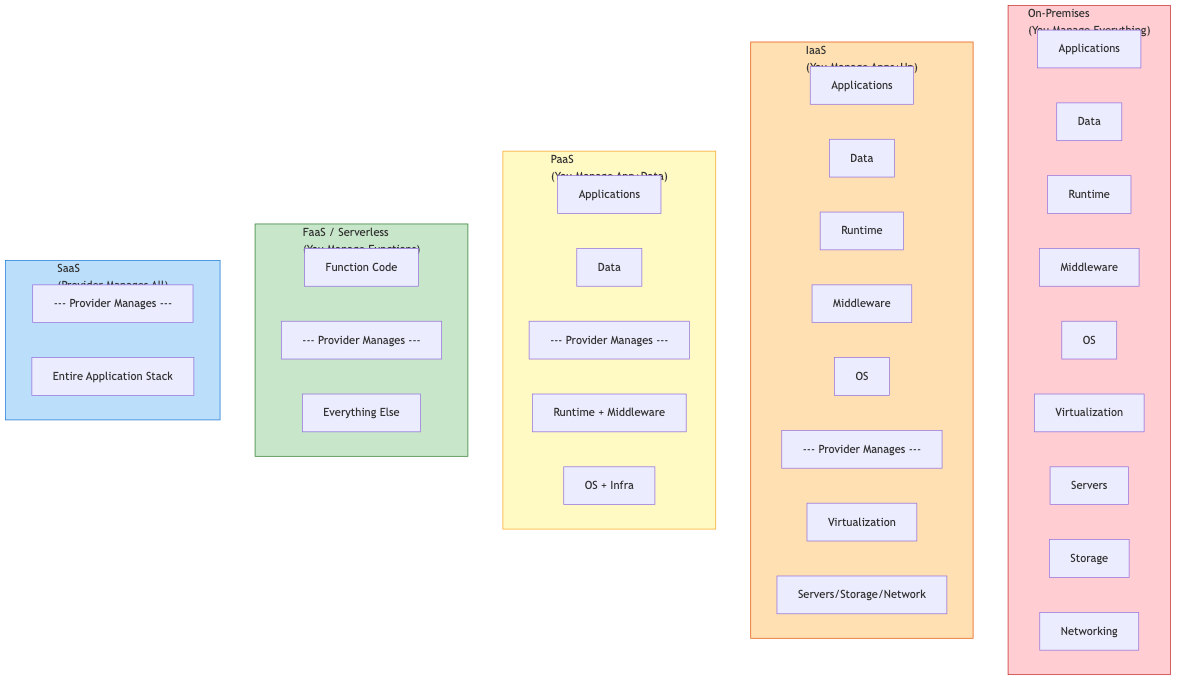
Infrastructure as a Service (IaaS)
Provides virtualized computing resources over the internet. The consumer manages OS, storage, and applications.
| Provider | Service | Description |
|---|---|---|
| AWS | EC2 | Virtual servers with instance type families |
| GCP | Compute Engine | VMs with per-second billing |
| Azure | Virtual Machines | Windows/Linux VMs with hybrid benefit |
Platform as a Service (PaaS)
Provides a platform for developing, running, and managing applications without infrastructure complexity.
- AWS Elastic Beanstalk - Deploy and scale web apps
- Google App Engine - Fully managed serverless platform
- Azure App Service - Build and host web apps
- Heroku - Developer-focused PaaS with buildpacks
Software as a Service (SaaS)
Complete applications delivered over the internet. Users consume the software; the provider manages everything.
Examples: Gmail, Salesforce, Slack, Microsoft 365, Snowflake.
Function as a Service (FaaS)
Event-driven, ephemeral compute that executes single-purpose functions.
Event Source → Function Invocation → Response
   (S3 upload)    (resize image)      (save thumbnail)
- AWS Lambda, Google Cloud Functions, Azure Functions
- Pay only for execution time (per-millisecond billing)
- No server management, automatic scaling to zero
Deployment Models
Public Cloud
Resources owned and operated by a third-party provider, delivered over the internet.
- Advantages: No upfront cost, global scale, managed services
- Concerns: Data sovereignty, vendor lock-in, shared tenancy
Private Cloud
Cloud infrastructure operated solely for a single organization, on-premises or hosted.
- OpenStack - Open-source private cloud platform
- VMware vSphere - Enterprise virtualization
- Use cases: Regulated industries, data-sensitive workloads
Hybrid Cloud
Combines public and private clouds with orchestration between them.
┌──────────────┐     ┌──────────────┐
│ Private Cloud│◄───►│ Public Cloud  │
│ (sensitive   │ VPN │ (burst       │
│  workloads)  │     │  capacity)   │
└──────────────┘     └──────────────┘
- AWS Outposts - AWS infrastructure on-premises
- Azure Arc - Manage resources across environments
- Anthos - Google's hybrid/multi-cloud platform
Multi-Cloud
Using multiple public cloud providers simultaneously.
- Motivation: Avoid vendor lock-in, best-of-breed services, resilience
- Challenges: Operational complexity, data transfer costs, skill requirements
- Tools: Terraform, Pulumi, Crossplane for cross-cloud abstraction
Shared Responsibility Model
┌─────────────────────────────────────────────────────────┐
│                    Customer Responsibility               │
│  IaaS: OS, apps, data, networking, access control       │
│  PaaS: Apps, data, access control                       │
│  SaaS: Data, access control                             │
├─────────────────────────────────────────────────────────┤
│                    Provider Responsibility               │
│  Physical security, network infrastructure, hypervisor  │
│  Hardware, facilities, global infrastructure            │
└─────────────────────────────────────────────────────────┘
The dividing line shifts upward as you move from IaaS to SaaS:
| Layer | IaaS | PaaS | SaaS |
|---|---|---|---|
| Data | Customer | Customer | Customer |
| Application | Customer | Customer | Provider |
| Runtime | Customer | Provider | Provider |
| OS | Customer | Provider | Provider |
| Virtualization | Provider | Provider | Provider |
| Hardware | Provider | Provider | Provider |
Cloud Economics
OpEx vs CapEx
| Aspect | CapEx (Traditional) | OpEx (Cloud) |
|---|---|---|
| Cost model | Large upfront investment | Pay-as-you-go |
| Depreciation | Assets depreciate over time | No asset ownership |
| Flexibility | Locked into hardware cycles | Scale on demand |
| Risk | Over/under-provisioning | Right-sizing possible |
| Tax treatment | Capitalized, amortized | Operating expense |
Total Cost of Ownership (TCO)
TCO analysis must account for hidden on-premises costs:
- Direct: Hardware, software licenses, power, cooling, floor space
- Indirect: IT staff, training, downtime, opportunity cost
- Cloud-specific: Data egress fees, reserved vs on-demand pricing, support tiers
Cost Optimization Strategies
- Reserved Instances / Savings Plans - 30-72% discount for 1-3 year commitments
- Spot / Preemptible Instances - Up to 90% discount for interruptible workloads
- Right-sizing - Match instance types to actual utilization
- Auto-scaling - Scale to zero during off-hours
- Storage tiering - Move infrequently accessed data to cheaper classes
Regions and Availability Zones
Regions
Geographically distinct locations, each containing multiple data centers.
- Selection criteria: Latency to users, data residency laws, service availability, pricing
- AWS: 30+ regions, GCP: 40+ regions, Azure: 60+ regions
Availability Zones (AZs)
Isolated data centers within a region, connected by low-latency links.
Region: us-east-1
├── AZ: us-east-1a  ─── Data Center(s)
├── AZ: us-east-1b  ─── Data Center(s)
├── AZ: us-east-1c  ─── Data Center(s)
└── AZ: us-east-1d  ─── Data Center(s)

Each AZ has independent power, cooling, and networking.
Cross-AZ latency: < 2ms
High Availability Design
- Deploy across multiple AZs for fault tolerance within a region
- Deploy across multiple regions for disaster recovery
- Use global load balancing for geo-routing users to nearest region
Edge Locations
Points of presence (PoPs) for content delivery and edge computing.
- CDN: CloudFront (200+ edge locations), Cloud CDN, Azure CDN
- Edge compute: Lambda@Edge, CloudFront Functions, Cloudflare Workers
Key Takeaways
- Cloud computing is defined by on-demand, elastic, metered resource delivery
- Service models (IaaS/PaaS/SaaS/FaaS) represent increasing abstraction levels
- The shared responsibility model defines who secures what
- Cloud economics favor OpEx flexibility over CapEx rigidity
- Multi-AZ and multi-region architectures provide resilience at different scales