
Model Checking
Overview
Model checking is an automated verification technique that exhaustively explores the state space of a finite-state system to determine whether a given property holds. If the property is violated, the model checker produces a counterexample -- a concrete execution trace demonstrating the violation.
State Space Exploration
A system is modeled as a Kripke structure M = (S, S0, R, L):
S: finite set of statesS0 ⊆ S: initial statesR ⊆ S × S: transition relation (must be total)L : S → 2^AP: labeling function mapping states to sets of atomic propositions
Model checking asks: does M ⊨ φ (does model M satisfy property φ)?
Explicit-state exploration enumerates states one by one (BFS or DFS). Works well for asynchronous systems with moderate state spaces. Main challenge: state explosion -- the state space grows exponentially with the number of components.
Temporal Logics
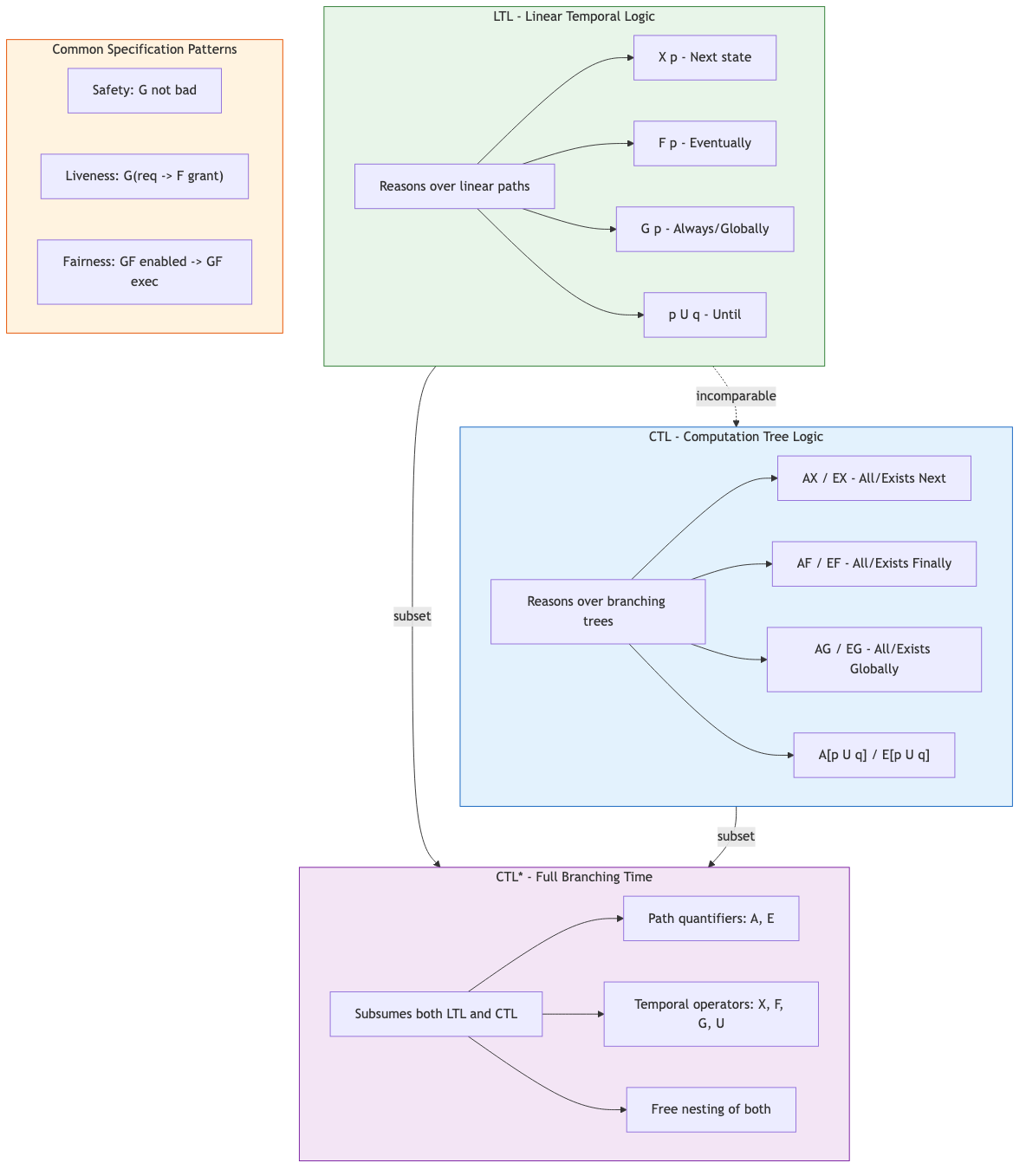
Temporal logics express properties about how system behavior evolves over time.
LTL (Linear Temporal Logic)
LTL reasons over linear paths (sequences of states). Formulas are evaluated over infinite execution traces.
Operators:
| Operator | Meaning | Example |
|---|---|---|
X φ |
Next: φ holds in the next state | X ready |
F φ |
Finally: φ holds eventually | F terminated |
G φ |
Globally: φ holds forever | G ¬error |
φ U ψ |
Until: φ holds until ψ becomes true | waiting U granted |
φ R ψ |
Release: dual of Until | φ R ψ ≡ ¬(¬φ U ¬ψ) |
Common patterns:
- Safety:
G ¬bad(bad thing never happens) - Liveness:
G(request → F grant)(every request is eventually granted) - Fairness:
GF enabled → GF executed(if infinitely often enabled, infinitely often executed)
LTL model checking works by converting ¬φ to a Buchi automaton, composing with the system,
and checking for emptiness of the product automaton.
CTL (Computation Tree Logic)
CTL reasons over branching computation trees. Path quantifiers (A = all paths,
E = exists a path) must immediately precede temporal operators.
Operators: AX, EX, AF, EF, AG, EG, AU, EU
AG ¬deadlock           -- no deadlock on any path (safety)
AG(request → AF grant) -- every request is granted on all paths
EF goal                -- there exists a path reaching goal
AG EF restart          -- from any state, restart is reachable
CTL model checking uses fixpoint computation on the state set:
EF φ = μZ. φ ∨ EX Z(least fixpoint)EG φ = νZ. φ ∧ EX Z(greatest fixpoint)
CTL*
CTL* subsumes both LTL and CTL. Path quantifiers and temporal operators can be freely mixed.
Example: A(FG p) (on all paths, p eventually holds forever) -- expressible in CTL* but
not in CTL. Model checking CTL* is PSPACE-complete (vs PSPACE for LTL, P for CTL).
Expressiveness Comparison
        CTL*
       /    \
     LTL    CTL
       \    /
       common
F G pis in LTL but not CTLAG EF pis in CTL but not LTL- Neither LTL nor CTL subsumes the other
Symbolic Model Checking
BDD-Based (Binary Decision Diagrams)
Represent state sets and transition relations as Ordered BDDs rather than enumerating individual states. BDDs provide a canonical, often compact representation of Boolean functions.
- Transition relation
R(s, s')encoded as a BDD - Image computation: given current states
S, computePost(S) = ∃s. S(s) ∧ R(s, s') - Fixpoint iterations compute reachable states or verify CTL formulas
- Can handle systems with 10^20+ states (when BDDs stay compact)
Limitations: BDD variable ordering critically affects size. Some functions (e.g., multiplication) have exponential BDDs regardless of ordering.
SAT-Based / Bounded Model Checking (BMC)
Unroll the system for k steps and encode the property violation as a SAT formula:
BMC(k): I(s0) ∧ T(s0,s1) ∧ T(s1,s2) ∧ ... ∧ T(s_{k-1},s_k) ∧ ¬φ(s0,...,s_k)
If the formula is satisfiable, the satisfying assignment is a counterexample of length ≤ k.
Advantages:
- Leverages powerful modern SAT/SMT solvers (CDCL, etc.)
- Finds shortest counterexamples
- No BDD blowup issues
Completeness: BMC alone is incomplete (cannot prove properties without a bound). Combined with k-induction or interpolation, it achieves completeness.
Major Tools
SPIN (Simple Promela Interpreter)
- Models written in Promela (Process Meta Language)
- Explicit-state, on-the-fly LTL model checking
- Verifies safety, liveness, absence of deadlocks
- Supports partial order reduction, bitstate hashing
mtype = { request, grant };
chan ch = [1] of { mtype };

active proctype Client() {
  do :: ch!request; ch?grant; od
}

active proctype Server() {
  do :: ch?request; ch!grant; od
}

ltl liveness { [] (Client@request -> <> Client@grant) }
NuSMV
- Symbolic model checker (BDD-based and SAT-based BMC)
- Supports CTL and LTL
- Input language describes finite-state machines
MODULE main
VAR state : {idle, busy, done};
ASSIGN
  init(state) := idle;
  next(state) := case
    state = idle : busy;
    state = busy : {busy, done};
    state = done : idle;
  esac;
SPEC AG(state = busy -> AF state = done)
TLA+ TLC Model Checker
- Explicit-state model checker for TLA+ specifications
- Evaluates all reachable states against invariants and temporal properties
- Handles symmetry reduction via symmetry sets
- Used extensively at AWS, Microsoft, and other companies for distributed protocols
State Space Reduction
Partial Order Reduction (POR)
In concurrent systems, many interleavings are equivalent. POR exploits independence of transitions: if two transitions in different processes do not affect each other, only one ordering needs to be explored.
Conditions (ample set method):
- Emptiness: if the ample set is empty, the full set is used
- Dependency: if a transition outside the ample set is dependent on one inside, it appears later
- Invisibility: transitions in the ample set do not affect the property
- Cycle: every cycle in the reduced graph contains a fully expanded state
Reduces exponential blowup to manageable sizes for many practical concurrent systems.
Symmetry Reduction
Exploit structural symmetries (e.g., identical processes) to collapse equivalent states into
a single representative. Reduces state space by up to n! for n symmetric components.
CEGAR (Counterexample-Guided Abstraction Refinement)
- Start with a coarse abstraction of the system
- Model-check the abstraction
- If property holds in abstraction, it holds in the concrete system
- If a counterexample is found, check if it is spurious (infeasible in concrete system)
- If spurious, refine the abstraction to eliminate it; repeat
CEGAR bridges the gap between finite model checking and infinite-state systems by automatically constructing appropriate abstractions.
         ┌──────────┐
    ┌───>│ Abstract  │──── property holds ──> Done
    │    │  Model    │
    │    └────┬──────┘
    │         │ counterexample
    │    ┌────▼──────┐
    │    │ Spurious?  │──── real ──> Bug found
    │    └────┬──────┘
    │         │ yes
    │    ┌────▼──────┐
    └────┤  Refine   │
         │ Abstraction│
         └───────────┘
Practical Considerations
State explosion mitigation strategies:
- Compositional verification: verify components separately
- Abstraction: remove irrelevant detail
- Partial order and symmetry reduction
- Bounded model checking for bug finding
When to use model checking:
- Control-heavy systems (protocols, controllers, workflows)
- Concurrent and distributed systems
- Hardware design verification (industry standard)
- Security protocol analysis
Limitations:
- State explosion remains the fundamental barrier
- Requires a finite (or finitizable) model
- Environment modeling requires care -- over-approximation may hide bugs, under-approximation may produce false alarms
Key Takeaways
- Model checking is fully automatic -- no proofs, no annotations, just a model and a property
- LTL and CTL are complementary temporal logics with incomparable expressiveness
- Symbolic methods (BDDs, SAT) push the scalability frontier far beyond explicit enumeration
- CEGAR enables model checking of systems that are too large to explore directly
- Counterexamples are the killer feature: concrete, actionable evidence of violations