
Formal Semantics
Overview
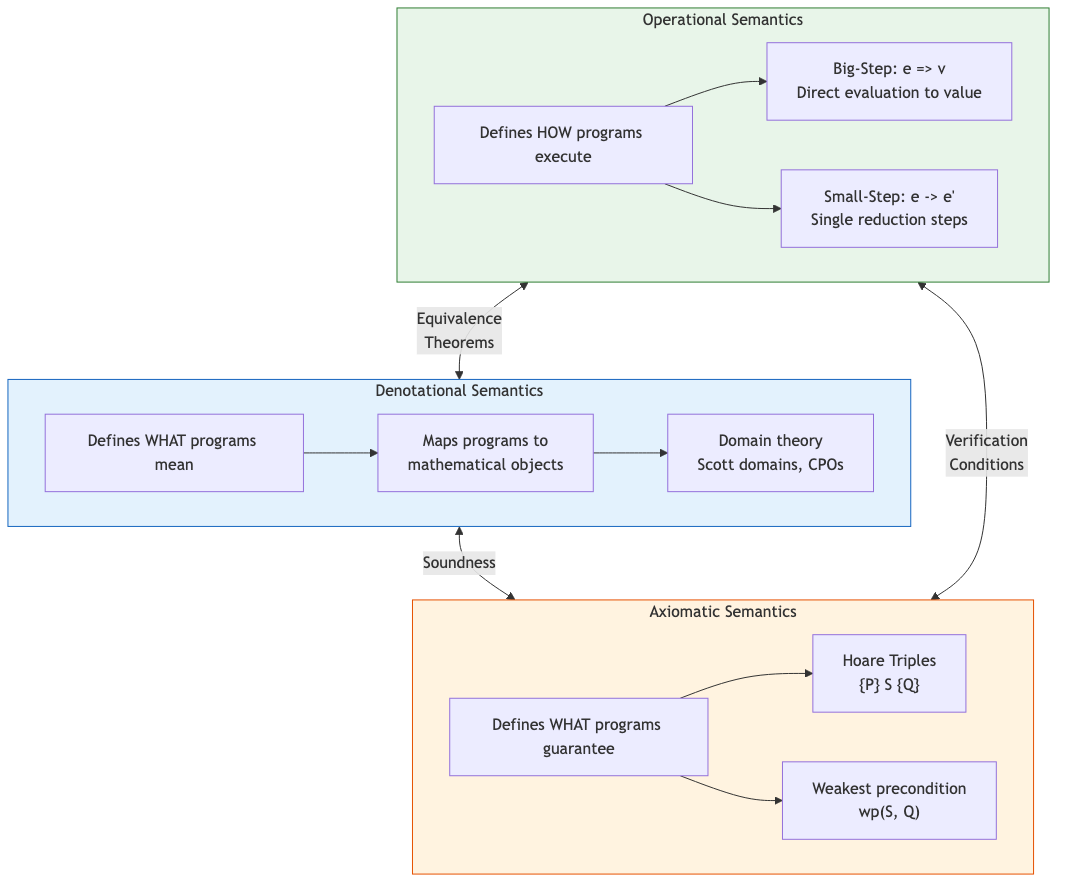
Formal semantics assigns rigorous mathematical meaning to programs, enabling reasoning about correctness, equivalence, and behavior. Three major frameworks exist: operational, denotational, and axiomatic semantics.
Operational Semantics
Operational semantics defines meaning by describing how programs execute on an abstract machine.
Big-Step (Natural) Semantics
Relates an expression directly to its final value. Judgments take the form e => v (expression e evaluates to value v).
          e1 => n1    e2 => n2    n1 + n2 = n
          ─────────────────────────────────────
                    e1 + e2 => n
- Advantages: clean, compositional rules; natural for interpreters
- Limitations: cannot express non-termination (no derivation tree exists); cannot observe intermediate states
- Co-big-step semantics extends the framework to handle divergence via coinductive derivations
Small-Step (Structural) Semantics
Defines a single-step reduction relation e -> e'. Execution is the reflexive-transitive closure ->*.
          e1 -> e1'                    v1 value, e2 -> e2'
          ──────────────               ──────────────────────
          e1 + e2 -> e1' + e2         v1 + e2 -> v1 + e2'
- Evaluation contexts: factor out congruence rules. Define
E ::= [] | E + e | v + E, then one rule:E[r] -> E[r']whenr -> r' - Advantages: models intermediate states, non-termination is an infinite reduction sequence, composable with concurrency
- Relates to abstract machines: reflexive-transitive closure of small-step gives the same result as big-step (when both are defined)
Relating Big-Step and Small-Step
Theorem (equivalence): e => v if and only if e ->* v and v is a value. Proved by induction on derivation/reduction length.
Denotational Semantics
Maps programs to mathematical objects (denotations) in a semantic domain, typically using domain theory.
Semantic Domains
- Flat domains: discrete values lifted with a bottom element.
Z_bot = {bot, ..., -1, 0, 1, ...} - Function domains: continuous functions between domains.
D -> Eis the space of Scott-continuous functions - Recursive domains: solved via domain equations.
D ≅ D -> Drequires techniques from domain theory (inverse limit construction)
Semantic Functions
A compositional mapping [[·]] from syntax to domains:
[[n]]         = n
[[e1 + e2]]   = [[e1]] +_Z [[e2]]
[[if e1 then e2 else e3]] = cond([[e1]], [[e2]], [[e3]])
Compositionality: the meaning of a compound expression depends only on the meanings of its subexpressions.
Fixed Points and Recursion
Recursive definitions are interpreted as least fixed points:
[[while b do c]] = fix(F)
  where F(f) = lambda sigma. if [[b]]sigma then f([[c]]sigma) else sigma
- Kleene's fixed-point theorem: every Scott-continuous function on a pointed CPO has a least fixed point, computed as
sup{F^n(bot) | n >= 0} - Scott continuity:
Fpreserves directed suprema. Required for the fixed-point theorem to hold
Adequacy and Full Abstraction
- Adequacy: if
[[e]] != bot, theneterminates operationally - Full abstraction:
[[e1]] = [[e2]]iffe1ande2are observationally equivalent. PCF's standard denotational semantics is adequate but not fully abstract (parallel-or problem)
Axiomatic Semantics
Specifies program behavior through logical assertions, abstracting away execution details.
Hoare Logic
Judgments (Hoare triples): {P} c {Q} means if precondition P holds before c, and c terminates, then postcondition Q holds after.
Core rules:
Assignment:    {Q[e/x]} x := e {Q}

Sequence:      {P} c1 {R}    {R} c2 {Q}
               ──────────────────────────
                     {P} c1; c2 {Q}

Conditional:   {P ∧ b} c1 {Q}    {P ∧ ¬b} c2 {Q}
               ─────────────────────────────────────
                   {P} if b then c1 else c2 {Q}

While:         {P ∧ b} c {P}
               ─────────────────────────
               {P} while b do c {P ∧ ¬b}
               (P is the loop invariant)

Consequence:   P' => P    {P} c {Q}    Q => Q'
               ──────────────────────────────────
                        {P'} c {Q'}
- Partial correctness:
{P} c {Q}assumes termination - Total correctness:
[P] c [Q]additionally requires termination; the while rule needs a variant (decreasing measure)
Weakest Precondition (wp)
Dijkstra's predicate transformer semantics. wp(c, Q) is the weakest precondition such that executing c establishes Q.
wp(x := e, Q)              = Q[e/x]
wp(c1; c2, Q)              = wp(c1, wp(c2, Q))
wp(if b then c1 else c2, Q) = (b => wp(c1,Q)) ∧ (¬b => wp(c2,Q))
wp(while b do c, Q)         = requires finding invariant
Properties: wp(c, Q) is the strongest condition P such that {P} c {Q} holds. It is monotone, conjunctive, and (for deterministic programs) disjunctive.
Separation Logic
Extends Hoare logic for heap-manipulating programs:
- Separating conjunction
P * Q: heap splits into disjoint parts satisfyingPandQ - Frame rule:
{P} c {Q}implies{P * R} c {Q * R}whencdoes not modifyR's footprint - Enables local reasoning about mutable state and concurrency (concurrent separation logic)
Definitional Interpreters
Use a metalanguage (often a functional language) as the semantic framework.
Reynolds' Approach
Write an interpreter in a well-understood language; the semantics of the object language is defined by the interpreter plus the semantics of the metalanguage.
eval (Num n)     env = n
eval (Var x)     env = lookup env x
eval (Add e1 e2) env = eval e1 env + eval e2 env
eval (Lam x e)   env = Closure x e env
eval (App e1 e2) env = let Closure x body cenv = eval e1 env
                           arg = eval e2 env
                       in eval body (extend cenv x arg)
Key Considerations
- If the metalanguage is call-by-value, the interpreter naturally defines call-by-value semantics. Using thunks in the interpreter shifts to call-by-name/need
- Defunctionalization of the interpreter yields an abstract machine (connection to CEK, SECD)
- Monadic interpreters: parameterize over effects (state, exceptions, nondeterminism) by abstracting the interpreter into a monad
Mechanized Semantics
Modern practice uses proof assistants (Coq, Isabelle, Lean) to define semantics and prove properties:
- CompCert: verified C compiler with formal semantics in Coq
- CakeML: verified ML compiler with big-step semantics
- K Framework: executable semantics from rewriting rules
Connections Between Frameworks
| Property | Operational | Denotational | Axiomatic |
|---|---|---|---|
| Focus | How programs execute | What programs compute | What programs guarantee |
| Abstraction | Low (step-by-step) | High (mathematical) | Specification-level |
| Compositionality | Structural rules | By construction | Via proof rules |
| Concurrency | Natural extension | Challenging | Separation logic |
The frameworks are complementary. Soundness results connect them: Hoare logic is sound with respect to operational semantics; denotational semantics is adequate for operational semantics. A complete understanding typically uses all three.