
Quantum Gates and Circuits
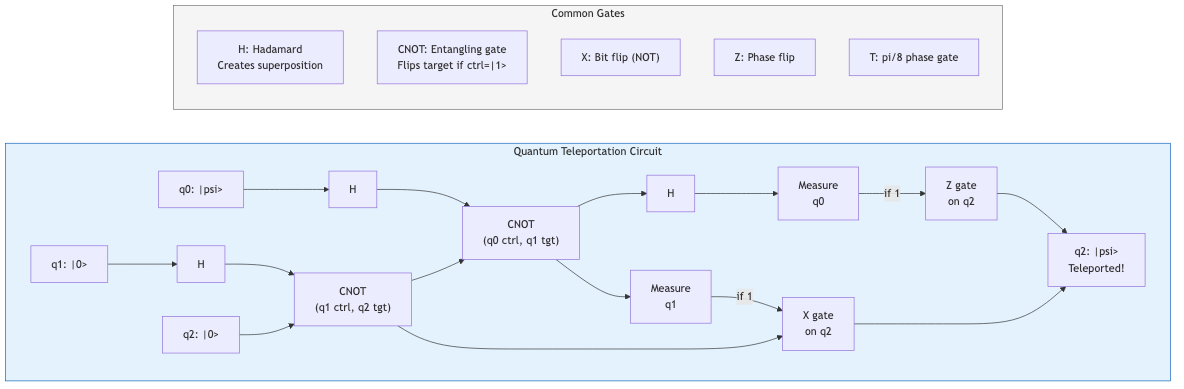
Single-Qubit Gates
All single-qubit gates are 2x2 unitary matrices acting on C^2. They correspond to rotations and reflections on the Bloch sphere.
Pauli Gates
The Pauli matrices form a basis for 2x2 Hermitian traceless matrices:
- I = [[1,0],[0,1]] -- identity
- X = [[0,1],[1,0]] -- bit flip (NOT), pi rotation about X-axis
- Y = [[0,-i],[i,0]] -- combined bit and phase flip, pi rotation about Y-axis
- Z = [[1,0],[0,-1]] -- phase flip, pi rotation about Z-axis
Key properties: X^2 = Y^2 = Z^2 = I, XYZ = iI, all are Hermitian and unitary. They anticommute pairwise: {X,Y} = {Y,Z} = {X,Z} = 0.
Hadamard Gate
H = (1/sqrt(2)) [[1,1],[1,-1]]
Maps |0> -> |+> = (|0>+|1>)/sqrt(2) and |1> -> |-> = (|0>-|1>)/sqrt(2). Self-inverse: H^2 = I. Creates uniform superposition -- foundational for most quantum algorithms. H = (X+Z)/sqrt(2), which is a pi rotation about the (X+Z)/sqrt(2) axis.
Phase Gates
- S = [[1,0],[0,i]] -- pi/2 phase gate, sqrt(Z). S^2 = Z.
- T = [[1,0],[0,e^{i*pi/4}]] -- pi/8 gate, sqrt(S). T^2 = S.
The T gate is crucial because {H, T} generates a dense subset of SU(2). T gates are expensive in fault-tolerant quantum computing, typically requiring magic state distillation.
Rotation Gates
Parameterized single-qubit rotations about Bloch sphere axes:
- R_x(theta) = exp(-ithetaX/2) = cos(theta/2)I - i*sin(theta/2)X
- R_y(theta) = exp(-ithetaY/2) = cos(theta/2)I - i*sin(theta/2)Y
- R_z(theta) = exp(-ithetaZ/2) = [[e^{-itheta/2}, 0], [0, e^{itheta/2}]]
Euler decomposition: Any U in SU(2) can be written as R_z(alpha) R_y(beta) R_z(gamma) for appropriate angles. This provides a canonical parameterization for arbitrary single-qubit gates.
Multi-Qubit Gates
CNOT (Controlled-NOT)
The fundamental two-qubit entangling gate:
CNOT = |0><0| tensor I + |1><1| tensor X
Action: |a,b> -> |a, a XOR b>. Flips the target qubit conditioned on the control being |1>. Combined with single-qubit gates, CNOT is sufficient for universal quantum computation.
CNOT creates entanglement: CNOT(H tensor I)|00> = |Phi+> (Bell state).
Toffoli (CCNOT)
Three-qubit gate: |a,b,c> -> |a,b, c XOR (a AND b)>. Controlled-controlled-NOT. Universal for classical reversible computation. Can be decomposed into 6 CNOTs and single-qubit gates.
The Toffoli gate is not sufficient alone for universal quantum computation (it generates only real amplitudes), but Toffoli + H is universal.
SWAP Gate
SWAP|a,b> = |b,a>. Decomposes into three CNOTs: CNOT_{12} CNOT_{21} CNOT_{12}.
sqrt(SWAP) is an entangling gate. iSWAP = SWAP * (CZ) arises naturally in superconducting architectures.
Controlled-U and Controlled-Phase
- CZ (controlled-Z): diagonal gate diag(1,1,1,-1). Symmetric between control and target. CZ = (I tensor H) CNOT (I tensor H).
- CU: |0><0| tensor I + |1><1| tensor U for arbitrary single-qubit U.
- CP(theta): controlled phase, diag(1,1,1,e^{i*theta}). CZ = CP(pi).
Universal Gate Sets
A gate set is universal if it can approximate any unitary to arbitrary precision.
Common universal sets:
- {CNOT, H, T} -- standard for fault-tolerant QC
- {CNOT, R_y, R_z} -- continuous parameterization
- {Toffoli, H} -- discrete set
- {sqrt(SWAP), single-qubit gates}
The Clifford group (generated by {H, S, CNOT}) is NOT universal -- it can be efficiently classically simulated (Gottesman-Knill theorem). Adding any non-Clifford gate (e.g., T) restores universality.
Circuit Model
Quantum circuits represent computations as sequences of gates applied to qubits (wires). Key conventions:
- Time flows left to right
- Wires represent qubits
- Gates are boxes or standard symbols on wires
- Measurement is depicted as a meter symbol
- Classical wires (double lines) carry measurement outcomes
Circuit depth: maximum number of gate layers (parallelized). Circuit width: number of qubits. Circuit complexity relates to the total gate count.
Circuit Identities
Essential identities for circuit optimization:
- HXH = Z, HYH = -Y, HZH = X (Hadamard conjugation swaps X<->Z)
- CNOT_{12} (I tensor H) CNOT_{12} = (I tensor H) CZ (I tensor H) -- relating CNOT and CZ
- (H tensor H) CNOT_{12} (H tensor H) = CNOT_{21} -- CNOT direction reversal
- CNOT_{12} CNOT_{21} CNOT_{12} = SWAP
- Two successive CNOTs with same control/target cancel: CNOT^2 = I
- (A tensor B)(C tensor D) = (AC) tensor (BD) -- tensor product of independent gates
- Controlled-U = (I tensor V) CNOT (I tensor V^dagger) when U = V sigma_z V^dagger -- decomposition pattern
Phase kickback: If U|u> = e^{iphi}|u>, then controlled-U with target |u> kicks the phase onto the control: |+>|u> -> (|0> + e^{iphi}|1>)|u> / sqrt(2). This is the mechanism behind phase estimation.
Bloch Sphere
The Bloch sphere provides geometric visualization for single-qubit states. Pure state |psi> = cos(theta/2)|0> + e^{i*phi}sin(theta/2)|1> maps to the point (sin(theta)cos(phi), sin(theta)sin(phi), cos(theta)) on the unit sphere.
- |0> is the north pole, |1> is the south pole
- |+>, |-> are on the X-axis equator
- |+i>, |-i> are on the Y-axis equator
- Gates correspond to rotations: R_n(theta) rotates by angle theta about axis n
- Mixed states lie inside the sphere (|r| < 1)
- Orthogonal states are antipodal (not perpendicular)
- Measurement along axis n projects to one of two antipodal points
The Bloch sphere does not generalize simply to multi-qubit systems (the state space grows exponentially, not linearly).
Solovay-Kitaev Theorem
Theorem: If a finite gate set G generates a dense subgroup of SU(2), then any target gate U in SU(2) can be approximated to precision epsilon using O(log^c(1/epsilon)) gates from G, where c ~ 3.97 (improved to ~1.44 with modern techniques).
Significance: The overhead of compiling arbitrary rotations into a discrete universal gate set is only polylogarithmic -- exponentially better than naive approaches.
Algorithm outline:
- Precompute all gate sequences up to a base length, forming an epsilon_0-net over SU(2)
- Recursively refine: express the residual error U_target * U_approx^dagger using group commutators [V, W] = VWV^dagger W^dagger
- Each recursion level roughly squares the approximation precision
Practical implications: In fault-tolerant QC, gates like R_z(theta) for arbitrary theta must be synthesized from {H, T}. The T-count (number of T gates) is the dominant cost metric. Optimal synthesis algorithms (e.g., Ross-Selinger) achieve T-count ~ 3*log_2(1/epsilon) for single-qubit Z-rotations.
Gate Synthesis and Compilation
Beyond Solovay-Kitaev, practical gate compilation involves:
- Unitary decomposition: Any n-qubit unitary decomposes into O(4^n) CNOT gates and single-qubit rotations (Knill's theorem, optimal asymptotically)
- KAK decomposition: Any two-qubit gate decomposes into at most 3 CNOTs and single-qubit gates, with the interaction characterized by three parameters
- Clifford+T synthesis: Exact synthesis when angles are multiples of pi/4; approximate otherwise
- Template matching: Identify and replace subcircuits with equivalent shorter sequences
- Peephole optimization: Merge adjacent gates acting on the same qubits
Hardware constraints add further compilation challenges: limited connectivity requires SWAP insertion, native gate sets vary by platform, and noise characteristics influence optimal decomposition choices.