
Advanced Approximation Algorithms
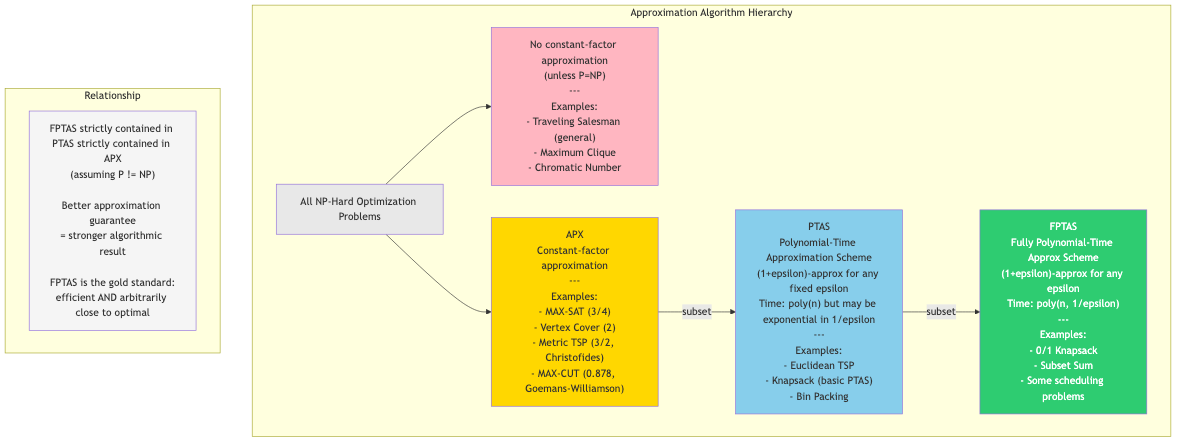
Overview
For NP-hard optimization problems, approximation algorithms provide solutions with provable guarantees on solution quality. The approximation ratio alpha measures how far the output can be from optimal: for minimization, cost(ALG) <= alpha * OPT.
LP Relaxation and Rounding
Framework
- Formulate the problem as an integer linear program (ILP)
- Relax integrality constraints to get a linear program (LP)
- Solve the LP in polynomial time
- Round the fractional solution to an integral one
Vertex Cover via LP Rounding
ILP for minimum vertex cover:
minimize  sum(x_v for v in V)
subject to  x_u + x_v >= 1   for each edge (u,v)
            x_v in {0, 1}
LP relaxation: replace x_v in {0,1} with 0 <= x_v <= 1.
Rounding: set x_v = 1 if x*_v >= 1/2, else x_v = 0.
- Every edge constraint is satisfied (at least one endpoint >= 1/2)
- Cost of integral solution <= 2 * LP_OPT <= 2 * OPT
- 2-approximation for vertex cover
Randomized Rounding
Include vertex v in the solution with probability x*_v (the LP value).
- Expected cost = LP_OPT
- Each constraint satisfied with probability >= 3/4 for set cover variants
- Repeat O(log n) times and take the union for high probability feasibility
- Achieves O(log n)-approximation for set cover (matching hardness)
Integrality Gap
The ratio between the optimal integer solution and the optimal LP solution.
- Vertex cover LP has integrality gap exactly 2 (complete bipartite graph K_{n,n})
- Set cover LP has integrality gap Theta(log n)
- The integrality gap is a barrier: no rounding scheme can beat it
Primal-Dual Method
Simultaneously build a feasible primal solution and a feasible dual solution. Use complementary slackness conditions (possibly relaxed) to guide construction.
Primal-Dual for Vertex Cover
Dual LP: maximize sum(y_e for e in E) subject to sum(y_e : e incident to v) <= 1 for all v, y_e >= 0.
Algorithm:
- Initialize all y_e = 0
- While there exists an uncovered edge e = (u,v):
- Raise y_e until some endpoint's dual constraint becomes tight
- Add that vertex to the cover
- Return the cover
- Dual feasible by construction
- Each selected vertex v has sum of dual = 1 (tight constraint)
- OPT >= dual value, cover cost <= 2 * dual value
- 2-approximation, runs in nearly linear time (no LP solver needed)
Applications of Primal-Dual
- Steiner tree and Steiner forest (2-approximation)
- Facility location (3-approximation, improvable to 1.488)
- Feedback vertex set, network design problems
Semidefinite Programming (SDP)
SDP Relaxation
Generalize LP by optimizing over positive semidefinite matrices. Variables become vectors; constraints involve dot products.
maximize  sum(w_ij * (1 - v_i . v_j) / 2)
subject to  v_i . v_i = 1   for all i
            v_i in R^n       (unit vectors)
Solved in polynomial time via interior-point methods or ellipsoid method.
MAX-CUT: Goemans-Williamson Algorithm
- Solve the SDP relaxation (vectors on unit sphere)
- Choose a random hyperplane through the origin
- Partition vertices by which side of the hyperplane their vector lies on
Approximation ratio: alpha_GW = min (2/pi) * (1/(1 - cos(theta))) * theta = 0.878... (over all angles theta)
- Best known polynomial-time guarantee for MAX-CUT
- Assuming the Unique Games Conjecture, 0.878 is optimal
- Generalizes to MAX-2SAT (0.940 approximation)
SDP Rounding Techniques
- Random hyperplane (Goemans-Williamson)
- RPR^2 rounding for constraint satisfaction
- Threshold rounding for coloring problems
Local Search
Start from a feasible solution, repeatedly improve by local modifications.
k-Opt Local Search for TSP
- A solution is k-opt if no improvement possible by swapping k edges
- 2-opt: O(n^2) neighborhood, practical and fast convergence
- Lin-Kernighan: variable-depth search, best practical heuristic
Local Search for k-Median
- Open k facilities, assign each client to nearest facility
- Swap operation: close one facility, open another
- Single-swap local search: 5-approximation
- Multi-swap (p swaps): (3 + 2/p)-approximation
Facility Location
- Local search with open/close/swap operations
- 3-approximation via local search (matches LP-based results)
Submodular Function Maximization
A set function f: 2^V -> R is submodular if: f(A union {e}) - f(A) >= f(A union {e}) - f(B) whenever A subset B (diminishing returns).
Monotone Submodular Maximization with Cardinality Constraint
Greedy algorithm: repeatedly add the element with largest marginal gain.
- Achieves (1 - 1/e) ~ 0.632 approximation ratio
- This is optimal unless P = NP [Nemhauser-Wolsey-Fisher 1978]
- Applies to: maximum coverage, influence maximization, sensor placement
Non-Monotone Submodular Maximization
- Unconstrained: randomized local search gives 1/2 approximation
- Matroid constraint: continuous greedy + pipage rounding gives 1 - 1/e
Continuous Extensions
- Multilinear extension: F(x) = E[f(R(x))] where R(x) is random rounding
- Lovasz extension: connects submodularity to convexity
- Continuous greedy: follow gradient of multilinear extension on matroid polytope
PTAS Design Techniques
A Polynomial-Time Approximation Scheme (PTAS) gives (1+epsilon) approximation for any fixed epsilon > 0, with runtime polynomial in n (but possibly exponential in 1/epsilon).
Shifting/Partitioning (Baker's Technique)
- For planar graph problems (independent set, vertex cover, dominating set)
- Partition plane into strips of width 1/epsilon
- Solve optimally on each strip (bounded treewidth)
- Try all shifts, take the best
Dynamic Programming Based PTAS
- Knapsack PTAS: round profits, DP on rounded values
- Scale profits by epsilon * p_max / n, solve DP in O(n^2 / epsilon) time
- Euclidean TSP (Arora/Mitchell): quad-tree decomposition, DP on portals
EPTAS and FPTAS
- FPTAS: runtime polynomial in both n and 1/epsilon (e.g., Knapsack)
- EPTAS: runtime f(1/epsilon) * poly(n) — FPT in 1/epsilon
- No FPTAS for strongly NP-hard problems (unless P = NP)
Hardness of Approximation
| Problem | Best Ratio | Hardness Threshold |
|---|---|---|
| Vertex Cover | 2 | 2 - epsilon (UGC) |
| Set Cover | ln n | (1-epsilon) ln n |
| MAX-CUT | 0.878 | 0.878+ (UGC) |
| TSP (general) | Inapprox. | Any finite ratio |
| Metric TSP | 3/2 | 123/122 (unconditional) |
| Clique | n^(1-epsilon) | Unless P = NP |
| k-Median | 2.675 | 1 + 2/e |
Summary
Advanced approximation techniques form a rich toolkit. LP and SDP relaxations provide lower bounds and structure for rounding. Primal-dual methods yield combinatorial algorithms without solving LPs. Submodular optimization captures diminishing returns in many applications. The choice of technique depends on problem structure and the desired approximation-complexity tradeoff.