
Software-Defined Networking
SDN Architecture
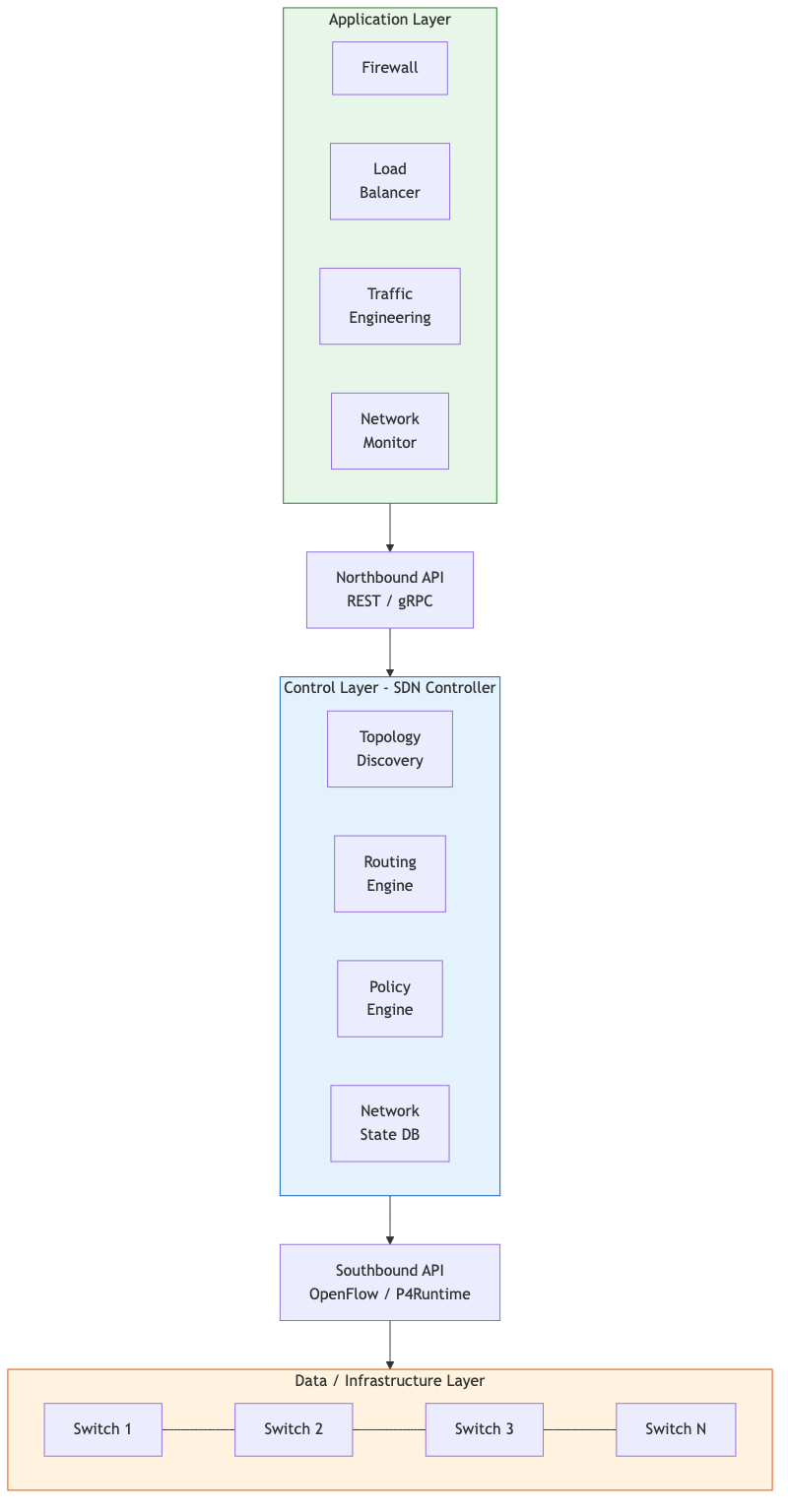
SDN decouples the control plane (routing decisions) from the data plane (packet forwarding), centralizing network intelligence in a software controller.
Three-Layer Model
+---------------------------+
|    Application Layer       |  (network apps: firewall, load balancer, TE)
|    Northbound API (REST)   |
+---------------------------+
|    Control Layer           |  (SDN controller / NOS)
|    Southbound API (OF/P4)  |
+---------------------------+
|    Data/Infrastructure     |  (switches, routers - forwarding only)
+---------------------------+
Key Properties
| Property | Description |
|---|---|
| Centralized control | Logically centralized controller has global network view |
| Programmability | Network behavior defined in software, not device firmware |
| Open interfaces | Standardized APIs between layers |
| Abstraction | Applications operate on abstract network model |
Benefits and Challenges
Benefits:
- Rapid innovation in control logic without vendor firmware changes.
- Global optimization using complete topology and traffic knowledge.
- Simplified management through automation and programmability.
- Vendor-neutral forwarding hardware.
Challenges:
- Controller scalability and availability (single point of failure if not distributed).
- Latency of control plane interactions for reactive forwarding.
- Security of the controller (attractive attack target).
- Migration from legacy infrastructure.
OpenFlow
OpenFlow (v1.0 through v1.5) is the original and most widely known southbound protocol for SDN.
OpenFlow Switch Model
A switch contains one or more flow tables, each with flow entries:
Flow Entry:
  Match Fields | Priority | Counters | Instructions | Timeouts | Cookie
Match fields (subset): ingress port, Ethernet src/dst/type, VLAN ID, IP src/dst, IP protocol, TCP/UDP src/dst port, MPLS label.
Instructions/Actions:
OUTPUT(port)- forward to a portDROP- discard packetSET_FIELD- modify header fieldsGROUP- apply group table entry (multicast, ECMP, failover)GOTO_TABLE(n)- continue processing at table n
Pipeline Processing
Packet In → Table 0 → Table 1 → ... → Table N → Execute Action Set
            (match?)   (match?)         (match?)
              ↓ miss      ↓ miss           ↓ miss
           Table-miss  Table-miss       Table-miss
           entry       entry            entry
If no match and no table-miss entry: packet dropped. Table-miss can send to controller (Packet-In message).
OpenFlow Messages
| Category | Messages |
|---|---|
| Controller→Switch | Features Request, Flow Mod, Packet Out, Barrier |
| Switch→Controller | Packet In, Flow Removed, Port Status, Error |
| Symmetric | Hello, Echo Request/Reply |
OpenFlow Limitations
- Fixed match fields (not extensible without protocol revision).
- Limited programmability of the data plane itself.
- Performance overhead of Packet-In for unknown flows.
- Complexity of multi-table pipelines.
SDN Controllers
ONOS (Open Network Operating System)
- Designed for service provider and mission-critical networks.
- Distributed architecture using Atomix for distributed state management.
- Intent framework: applications express desired connectivity, ONOS computes forwarding rules.
- Written in Java; supports OpenFlow, gNMI, P4Runtime, NETCONF.
OpenDaylight (ODL)
- Modular, plugin-based architecture using OSGi/Karaf.
- Model-Driven Service Abstraction Layer (MD-SAL) for unified data model.
- Supports a wide range of southbound protocols.
- Strong enterprise and service provider ecosystem.
Comparison
| Feature | ONOS | OpenDaylight |
|---|---|---|
| Target | SP/carrier-grade | Enterprise/multi-protocol |
| Clustering | Built-in (Atomix/Raft) | Akka-based clustering |
| Intent framework | Core feature | Available via plugins |
| Community | ON.Lab / Linux Foundation | Linux Foundation |
| Data store | Distributed, strongly consistent | In-memory + persistence |
Controller Scalability
Distributed controllers partition the network among instances:
- Flat distribution: Each controller manages a subset of switches; synchronizes state.
- Hierarchical: Local controllers handle fast decisions; root controller handles global policy.
- Typical capacity: single instance handles 1-6 million flow setups/second (varies by implementation).
P4: Programming Protocol-Independent Packet Processors
P4 is a domain-specific language for programming the data plane, making the forwarding behavior itself programmable (not just the flow rules).
P4 Architecture
P4 Program → P4 Compiler → Target-specific binary
                              ↓
                         Programmable Switch
                         (ASIC, FPGA, SmartNIC, software)
Core P4 Abstractions
// 1. Header definitions
header ipv4_t {
    bit<4>  version;
    bit<4>  ihl;
    bit<8>  tos;
    bit<16> totalLen;
    bit<16> identification;
    bit<3>  flags;
    bit<13> fragOffset;
    bit<8>  ttl;
    bit<8>  protocol;
    bit<16> hdrChecksum;
    bit<32> srcAddr;
    bit<32> dstAddr;
}

// 2. Parser (state machine)
parser MyParser(packet_in pkt, out headers hdr) {
    state start {
        pkt.extract(hdr.ethernet);
        transition select(hdr.ethernet.etherType) {
            0x0800: parse_ipv4;
            default: accept;
        }
    }
    state parse_ipv4 {
        pkt.extract(hdr.ipv4);
        transition accept;
    }
}

// 3. Match-action tables
table ipv4_lpm {
    key = { hdr.ipv4.dstAddr: lpm; }
    actions = { forward; drop; }
    size = 1024;
}

// 4. Control flow (apply tables)
apply { ipv4_lpm.apply(); }

// 5. Deparser (reassemble packet)
P4 vs. OpenFlow
| Aspect | OpenFlow | P4 |
|---|---|---|
| Header awareness | Fixed set of known headers | User-defined arbitrary headers |
| Forwarding model | Vendor-defined pipeline | Programmer-defined pipeline |
| New protocols | Requires spec update | Just write new parser/tables |
| Target | OpenFlow-compatible switches | Any programmable target |
Network Functions Virtualization (NFV)
NFV replaces dedicated network appliances (firewalls, load balancers, NATs) with software running on commodity servers.
NFV Architecture (ETSI)
+-------------------------------------------+
|  OSS/BSS                                  |
+-------------------------------------------+
|  NFV Orchestrator (NFVO)                  |
|    ├── VNF Manager (VNFM)                 |
|    └── Virtual Infrastructure Manager (VIM)|
+-------------------------------------------+
|  NFVI: compute, storage, network          |
|  (servers, switches, hypervisors)         |
+-------------------------------------------+
- VNF (Virtual Network Function): Software implementation of a network function (e.g., vFirewall, vRouter).
- NFVI: Infrastructure that hosts VNFs.
- MANO: Management and Orchestration framework.
Performance Considerations
- Traditional kernel networking is too slow for VNFs at line rate.
- Solutions: DPDK (kernel bypass), SR-IOV (hardware-assisted I/O), SmartNICs.
- Container-based VNFs (CNFs) replacing VM-based for lower overhead.
Service Function Chaining (SFC)
SFC steers traffic through an ordered sequence of network functions.
Traffic → Classifier → Firewall → IDS → Load Balancer → Destination
                        (SF1)      (SF2)     (SF3)
NSH (Network Service Header) - RFC 8300
| NSH Base | Service Path | Service Index | Metadata |
           (24-bit SPI)    (8-bit SI)
- SPI (Service Path Identifier): Identifies the chain.
- SI (Service Index): Decremented at each SF; indicates position in chain.
- SFC-aware SFs process and decrement SI; SFC-unaware SFs use a proxy.
Intent-Based Networking (IBN)
IBN abstracts network configuration into high-level business intent, automating the translation to device-level configuration.
IBN Workflow
Intent: "Server A must be able to reach Database B on port 3306 with encrypted traffic"
   ↓
Translation Engine (decomposes intent into network policies)
   ↓
Activation (configures switches, firewalls, VPNs)
   ↓
Assurance (continuously monitors compliance, remediates drift)
Intent Levels
| Level | Example |
|---|---|
| Business | "Finance department traffic is isolated" |
| Service | "VLAN 100 has no path to VLAN 200 except via firewall" |
| Network | "ACL on switch X port 5 deny traffic from 10.0.1.0/24 to 10.0.2.0/24" |
Network Verification
Formal methods applied to ensure network correctness.
Approaches
| Tool/Approach | Method | Checks |
|---|---|---|
| Header Space Analysis (HSA) | Models forwarding as geometric operations on header space | Reachability, loops, isolation |
| Veriflow | Real-time verification of rule insertions | Invariant violations on updates |
| Batfish | Configuration analysis (offline) | Reachability, routing correctness |
| Minesweeper | SMT-based analysis of control plane | Policy compliance under all failures |
| P4v | Verification of P4 programs | Data plane program correctness |
Data Plane vs. Control Plane Verification
- Data plane: Verify the forwarding state at a point in time (fast, snapshot-based).
- Control plane: Verify that routing protocols produce correct forwarding under all possible failures (more thorough, computationally expensive).
Practical Verification Checks
- Reachability: Can host A reach host B?
- Isolation: Can VLAN X traffic never reach VLAN Y?
- Loop freedom: Are there any forwarding loops?
- Black holes: Are any destinations unreachable?
- Waypointing: Does traffic always traverse a required middlebox?
- Equivalence: Do two configurations produce identical forwarding behavior?