
Application Layer
The application layer provides network services directly to end users and applications. This file covers the major application-layer protocols.
DNS (Domain Name System)
DNS translates human-readable names (www.example.com) to IP addresses (93.184.216.34).
Hierarchy
Root (.)
├── com.
│   ├── google.com.
│   │   ├── www.google.com.
│   │   └── mail.google.com.
│   └── example.com.
├── org.
│   └── wikipedia.org.
├── net.
├── io.
└── uk.
    └── co.uk.
Resolution Process
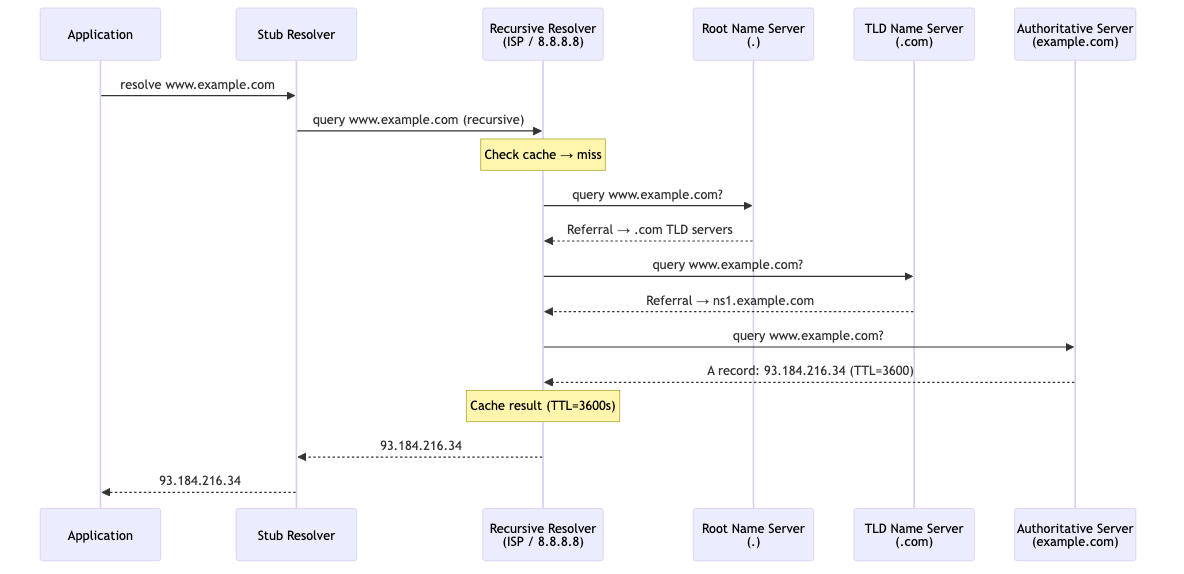
1. Client queries local resolver (recursive resolver, typically ISP or 8.8.8.8)
2. Resolver checks cache → if cached, return immediately
3. Resolver queries root name server → "Ask .com TLD server"
4. Resolver queries .com TLD server → "Ask ns1.example.com"
5. Resolver queries ns1.example.com (authoritative) → "93.184.216.34"
6. Resolver caches the result (TTL-based) and returns to client
Iterative: Resolver does the walking. Recursive: Each server queries the next.
Record Types
| Type | Purpose | Example |
|---|---|---|
| A | IPv4 address | example.com → 93.184.216.34 |
| AAAA | IPv6 address | example.com → 2606:2800:220:1:248:... |
| CNAME | Canonical name (alias) | www.example.com → example.com |
| MX | Mail exchange | example.com → mail.example.com (priority 10) |
| NS | Name server | example.com → ns1.example.com |
| TXT | Text (SPF, DKIM, verification) | "v=spf1 include:_spf.google.com ~all" |
| SRV | Service location | _sip._tcp.example.com → sipserver.example.com:5060 |
| SOA | Start of authority | Zone metadata (serial, refresh, retry) |
| PTR | Reverse lookup (IP → name) | 34.216.184.93.in-addr.arpa → example.com |
Caching and TTL
Each record has a Time-To-Live (TTL). Resolvers cache records until TTL expires. Lower TTL = faster propagation of changes but more queries. Typical: 300s - 86400s.
DNSSEC
Cryptographic signing of DNS records. Prevents DNS spoofing/cache poisoning.
Chain of trust: Root → TLD → domain. Each level signs the next level's keys. Client can verify the entire chain.
HTTP (HyperText Transfer Protocol)
The protocol of the World Wide Web.
HTTP/1.1
Request:
GET /index.html HTTP/1.1
Host: www.example.com
User-Agent: Mozilla/5.0
Accept: text/html
Connection: keep-alive
Response:
HTTP/1.1 200 OK
Content-Type: text/html; charset=UTF-8
Content-Length: 1234
Cache-Control: max-age=3600

<!DOCTYPE html>...
Methods: GET (read), POST (create), PUT (replace), PATCH (update), DELETE, HEAD, OPTIONS.
Status codes:
| Range | Meaning | Examples |
|---|---|---|
| 1xx | Informational | 100 Continue, 101 Switching Protocols |
| 2xx | Success | 200 OK, 201 Created, 204 No Content |
| 3xx | Redirection | 301 Moved Permanently, 302 Found, 304 Not Modified |
| 4xx | Client error | 400 Bad Request, 401 Unauthorized, 403 Forbidden, 404 Not Found |
| 5xx | Server error | 500 Internal Server Error, 502 Bad Gateway, 503 Service Unavailable |
Persistent connections (keep-alive): Reuse TCP connection for multiple requests. Default in HTTP/1.1.
Pipelining: Send multiple requests without waiting for responses. Limited adoption due to head-of-line blocking (responses must be in order).
Cookies: Server sets cookies (Set-Cookie header). Client sends them back on subsequent requests (Cookie header). Used for session management, personalization, tracking.
HTTP/2
Binary framing: Requests/responses split into binary frames (not text). More efficient parsing.
Multiplexing: Multiple streams (requests/responses) over a single TCP connection. No head-of-line blocking at the HTTP level (but still at TCP level).
Server push: Server proactively sends resources the client hasn't requested yet (e.g., CSS after receiving an HTML request).
Header compression (HPACK): Compresses HTTP headers using a shared dictionary and Huffman encoding. Significant savings (headers can be 500+ bytes).
Stream prioritization: Client indicates priority of streams. Server can serve important resources first.
HTTP/3
Built on QUIC (UDP-based). Eliminates TCP's head-of-line blocking.
Benefits over HTTP/2:
- No TCP head-of-line blocking (QUIC streams are independent)
- 0-RTT connection setup (for repeat connections)
- Connection migration (survives network changes)
- Mandatory encryption
HTTPS / TLS
HTTPS = HTTP over TLS (Transport Layer Security).
TLS 1.3 handshake (1-RTT):
Client                          Server
  │── ClientHello ─────────────→│  (supported ciphers, key share)
  │                              │
  │←── ServerHello, Certificate──│  (selected cipher, key share, cert)
  │    Finished                  │
  │                              │
  │── Finished ────────────────→│
  │                              │
  │  Application data (encrypted) │
Certificate validation: Server presents X.509 certificate signed by a Certificate Authority (CA). Client verifies the chain to a trusted root CA.
Cipher suites (TLS 1.3): TLS_AES_256_GCM_SHA384, TLS_CHACHA20_POLY1305_SHA256, TLS_AES_128_GCM_SHA256.
Other Protocols
FTP (File Transfer Protocol)
Two connections: control (port 21) and data (port 20 or ephemeral). Active vs passive mode. Being replaced by SFTP/SCP.
SMTP / POP3 / IMAP (Email)
SMTP (port 25/587): Send email. Push protocol.
POP3 (port 110/995): Download and delete email from server.
IMAP (port 143/993): Access email on server. Sync across devices. Folders, search, flags.
SSH (Secure Shell)
Encrypted remote access. Port 22. Key-based or password authentication.
Uses: Remote shell, file transfer (SCP/SFTP), port forwarding (tunneling), Git transport.
WebSocket
Full-duplex communication over a single TCP connection. Upgrade from HTTP.
Client: GET /chat HTTP/1.1
        Upgrade: websocket
        Connection: Upgrade

Server: HTTP/1.1 101 Switching Protocols
        Upgrade: websocket
After handshake: bidirectional message passing. No HTTP overhead per message.
Use cases: Chat, real-time notifications, live dashboards, multiplayer games, collaborative editing.
Applications in CS
- Web development: Understanding HTTP methods, status codes, headers, cookies is essential for building web APIs.
- System design: DNS for service discovery. HTTP for APIs. WebSocket for real-time. TLS for security.
- Performance: HTTP/2 multiplexing, HTTP/3 (QUIC), DNS prefetch, CDN cache headers.
- Security: HTTPS everywhere. HSTS headers. Certificate management. DNSSEC.
- DevOps: DNS configuration, certificate management (Let's Encrypt), reverse proxy setup (nginx).
- Debugging: curl, httpie, Wireshark, browser DevTools network tab.