
Binary Trees
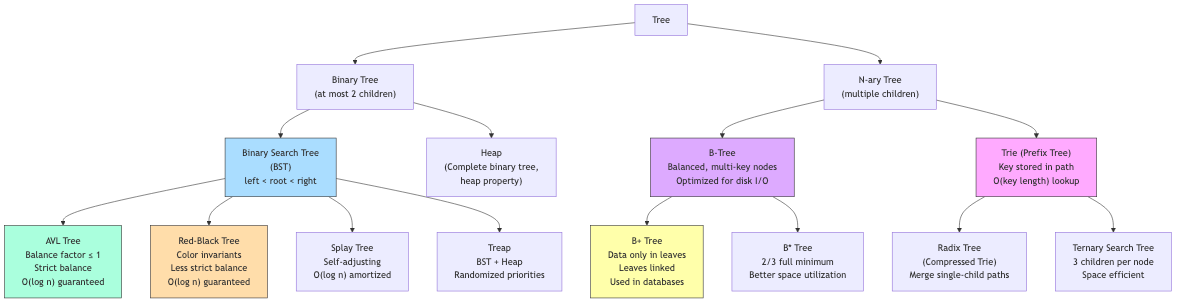
Binary trees are hierarchical structures where each node has at most two children. They provide the foundation for search trees, expression trees, and many algorithms.
Traversals
Depth-First Traversals
In-order (Left, Root, Right): Visits nodes in sorted order for BSTs.
     4
    / \
   2   6
  / \ / \
 1  3 5  7
In-order: 1, 2, 3, 4, 5, 6, 7
Pre-order (Root, Left, Right): Root is visited first. Used for serialization, copying.
Pre-order: 4, 2, 1, 3, 6, 5, 7
Post-order (Left, Right, Root): Root is visited last. Used for deletion, expression evaluation.
Post-order: 1, 3, 2, 5, 7, 6, 4
Level-order (BFS): Visit level by level, left to right. Uses a queue.
Level-order: 4, 2, 6, 1, 3, 5, 7
Morris Traversal
In-order traversal with O(1) space (no stack, no recursion). Temporarily modifies the tree using threaded pointers.
Algorithm:
- If no left child: visit current, go right.
- If left child exists: Find the in-order predecessor (rightmost node in left subtree).
- If predecessor's right is null: set it to current (create thread), go left.
- If predecessor's right is current: remove thread, visit current, go right.
Time: O(n). Space: O(1). Tree is restored to original state.
Binary Search Trees (BST)
A BST maintains the BST property: For every node, all values in the left subtree are less, and all values in the right subtree are greater.
Operations
| Operation | Average | Worst |
|---|---|---|
| Search | O(log n) | O(n) |
| Insert | O(log n) | O(n) |
| Delete | O(log n) | O(n) |
| Min/Max | O(log n) | O(n) |
| Successor/Predecessor | O(log n) | O(n) |
Worst case occurs when the tree degenerates into a linked list (e.g., inserting sorted data).
Deletion
Three cases:
- Leaf: Simply remove.
- One child: Replace with the child.
- Two children: Replace with the in-order successor (smallest in right subtree) or predecessor (largest in left subtree). Then delete the successor/predecessor.
Self-Balancing BSTs
Automatically maintain O(log n) height after insertions and deletions.
AVL Trees
Balance factor = height(left) - height(right). Must be {-1, 0, 1} for every node.
Rotations to restore balance after insert/delete:
Right Rotation (for left-heavy):
      z              y
     / \            / \
    y   T4   →    x    z
   / \           / \  / \
  x   T3        T1 T2 T3 T4
 / \
T1  T2
Left Rotation (mirror of right rotation).
Four cases:
- Left-Left: Right rotation.
- Right-Right: Left rotation.
- Left-Right: Left rotation on child, then right rotation.
- Right-Left: Right rotation on child, then left rotation.
Properties: Height ≤ 1.44 log₂(n+2). Strictly balanced (height difference ≤ 1). Faster lookup than red-black trees (shorter height). More rotations on insert/delete.
Red-Black Trees
Each node is colored red or black. Rules:
- Root is black.
- Leaves (NIL) are black.
- Red node's children are both black (no consecutive reds).
- Every path from root to leaf has the same number of black nodes (black-height).
Properties: Height ≤ 2 log₂(n+1). Less strictly balanced than AVL. Fewer rotations on insert/delete (at most 2 rotations for insert, 3 for delete).
Insert fixup: Recolor and rotate (at most 2 rotations + O(log n) recoloring).
Delete fixup: More complex. Recolor and rotate (at most 3 rotations).
Used in: Linux kernel (CFS scheduler, memory maps), Java TreeMap, C++ std::map/std::set, Rust BTreeMap (uses B-tree actually, but red-black is the classic choice).
Splay Trees
Self-adjusting: Recently accessed nodes are moved to the root via splaying (a sequence of rotations).
Splay operation: Move node x to the root using rotations:
- Zig: x is child of root → single rotation.
- Zig-zig: x and parent are both left (or both right) children → two rotations (same direction).
- Zig-zag: x is left child, parent is right child (or vice versa) → two rotations (different directions).
Amortized O(log n) per operation. No extra storage (no balance factor or color).
Properties:
- Adapts to access patterns (frequently accessed items stay near root).
- Working set property: If only k distinct items are accessed, operations take O(log k).
- Static optimality: Within O(1) of the best static BST for any access sequence.
- Worst case for a single operation: O(n).
Treaps
Combine BST property (on keys) with heap property (on random priorities).
Each node has a key (BST order) and a random priority (heap order — parent priority > children priorities).
Insert: BST insert, then rotate up to maintain heap property. Delete: Rotate down (like removing from a heap), then remove.
Expected height: O(log n) (random priorities ensure balance with high probability).
Advantages: Simple to implement. Randomized — no worst case for any key sequence. Easy split/merge operations.
Scapegoat Trees
Maintain a loose balance invariant: height ≤ log_{3/2}(n). When a node is inserted and its depth exceeds this bound, find a scapegoat — an ancestor where the subtree is sufficiently unbalanced — and rebuild that subtree perfectly balanced.
Amortized O(log n). No extra storage per node (no color, balance factor, or priority). Simple rebuild operation.
Tree Properties
Height: Longest path from root to leaf.
- Balanced BST: Θ(log n)
- Degenerate: Θ(n)
Number of nodes: For a full binary tree of height h: 2^(h+1) - 1.
Number of leaves: For a full binary tree: 2^h.
Relation: For any binary tree, leaves = internal_nodes + 1 (for full trees).
Augmented Trees
Add extra information to tree nodes to support additional operations.
Order-statistic tree: Each node stores the size of its subtree. Supports:
- Select(k): Find the k-th smallest element in O(log n).
- Rank(x): Find the rank of element x in O(log n).
Interval tree: Augmented BST for interval operations (covered in advanced data structures).
Applications in CS
- Databases: B-trees and variants for indexing (covered separately). Red-black trees for in-memory indexes.
- Language runtimes: Balanced BSTs for ordered maps/sets (C++ std::map, Java TreeMap).
- Operating systems: Red-black trees for scheduling (CFS), memory management (VM areas), I/O scheduling.
- Compilers: Abstract syntax trees (ASTs). Expression trees for code generation.
- File systems: Directory trees. Btrfs uses B-trees extensively.
- Networking: IP routing tables, firewall rules (interval trees).
- Computational geometry: Range trees, k-d trees (covered separately).