
Propositional Logic
What is a Proposition?
A proposition (or statement) is a declarative sentence that is either true or false, but not both.
Examples of propositions:
- "The earth is round." (true)
- "2 + 3 = 6" (false)
- "There are infinitely many prime numbers." (true)
Non-propositions:
- "What time is it?" (question)
- "Close the door." (command)
- "x + 1 = 2" (depends on x — not a proposition until x is bound)
We typically use lowercase letters p, q, r, ... to denote propositional variables.
Logical Connectives
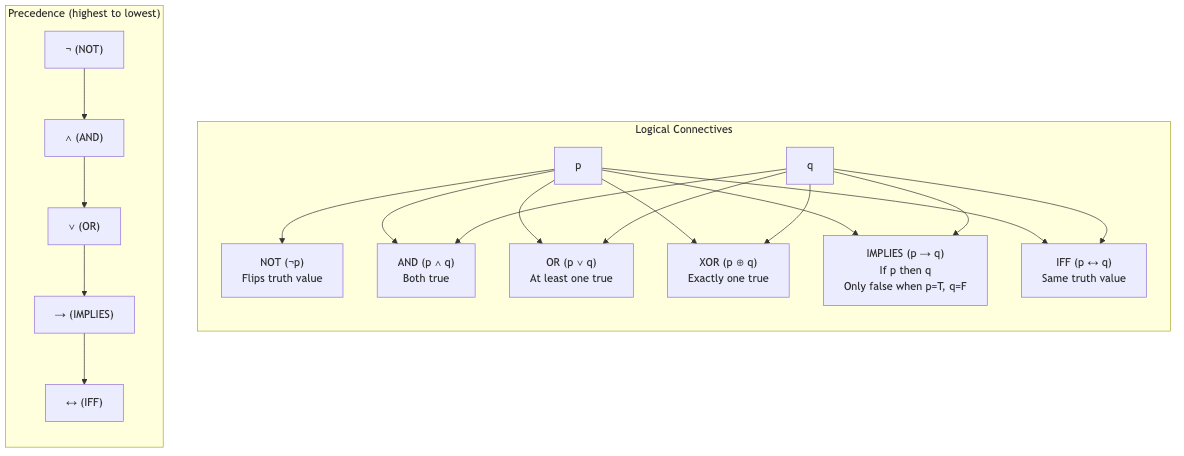
Connectives combine propositions into compound propositions.
| Connective | Symbol | Name | Meaning |
|---|---|---|---|
| NOT | ¬p | Negation | "not p" |
| AND | p ∧ q | Conjunction | "p and q" |
| OR | p ∨ q | Disjunction | "p or q" (inclusive) |
| XOR | p ⊕ q | Exclusive Or | "p or q, but not both" |
| IMPLIES | p → q | Implication | "if p then q" |
| IFF | p ↔ q | Biconditional | "p if and only if q" |
Negation (¬)
Flips the truth value.
| p | ¬p |
|---|---|
| T | F |
| F | T |
Conjunction (∧)
True only when both operands are true.
| p | q | p ∧ q |
|---|---|---|
| T | T | T |
| T | F | F |
| F | T | F |
| F | F | F |
Disjunction (∨)
True when at least one operand is true (inclusive or).
| p | q | p ∨ q |
|---|---|---|
| T | T | T |
| T | F | T |
| F | T | T |
| F | F | F |
Exclusive Or (⊕)
True when exactly one operand is true.
| p | q | p ⊕ q |
|---|---|---|
| T | T | F |
| T | F | T |
| F | T | T |
| F | F | F |
Equivalently: p ⊕ q ≡ (p ∨ q) ∧ ¬(p ∧ q)
Implication (→)
p → q is false only when p is true and q is false.
| p | q | p → q |
|---|---|---|
| T | T | T |
| T | F | F |
| F | T | T |
| F | F | T |
Key terminology:
- p is the hypothesis (antecedent)
- q is the conclusion (consequent)
Related forms:
- Converse: q → p
- Inverse: ¬p → ¬q
- Contrapositive: ¬q → ¬p (logically equivalent to p → q)
The implication p → q is logically equivalent to ¬p ∨ q.
Biconditional (↔)
True when both operands have the same truth value.
| p | q | p ↔ q |
|---|---|---|
| T | T | T |
| T | F | F |
| F | T | F |
| F | F | T |
p ↔ q ≡ (p → q) ∧ (q → p)
Truth Tables
A truth table lists all possible combinations of truth values for the propositional variables and the resulting truth value of the compound proposition.
For n propositional variables, there are 2^n rows.
Example: Evaluate (p → q) ∧ (q → r)
| p | q | r | p → q | q → r | (p → q) ∧ (q → r) |
|---|---|---|---|---|---|
| T | T | T | T | T | T |
| T | T | F | T | F | F |
| T | F | T | F | T | F |
| T | F | F | F | T | F |
| F | T | T | T | T | T |
| F | T | F | T | F | F |
| F | F | T | T | T | T |
| F | F | F | T | T | T |
Tautologies, Contradictions, and Contingencies
- Tautology: A compound proposition that is always true regardless of the truth values of its components. Example: p ∨ ¬p
- Contradiction: A compound proposition that is always false. Example: p ∧ ¬p
- Contingency: A proposition that is neither a tautology nor a contradiction. Example: p → q
Logical Equivalences
Two propositions p and q are logically equivalent (written p ≡ q) if they have the same truth value in every possible interpretation.
Fundamental Equivalences
Identity Laws:
- p ∧ T ≡ p
- p ∨ F ≡ p
Domination Laws:
- p ∨ T ≡ T
- p ∧ F ≡ F
Idempotent Laws:
- p ∨ p ≡ p
- p ∧ p ≡ p
Double Negation:
- ¬(¬p) ≡ p
Commutative Laws:
- p ∨ q ≡ q ∨ p
- p ∧ q ≡ q ∧ p
Associative Laws:
- (p ∨ q) ∨ r ≡ p ∨ (q ∨ r)
- (p ∧ q) ∧ r ≡ p ∧ (q ∧ r)
Distributive Laws:
- p ∨ (q ∧ r) ≡ (p ∨ q) ∧ (p ∨ r)
- p ∧ (q ∨ r) ≡ (p ∧ q) ∨ (p ∧ r)
Absorption Laws:
- p ∨ (p ∧ q) ≡ p
- p ∧ (p ∨ q) ≡ p
Negation Laws:
- p ∨ ¬p ≡ T
- p ∧ ¬p ≡ F
De Morgan's Laws
Two of the most important equivalences in logic:
¬(p ∧ q) ≡ ¬p ∨ ¬q
¬(p ∨ q) ≡ ¬p ∧ ¬q
In words:
- The negation of a conjunction is the disjunction of the negations.
- The negation of a disjunction is the conjunction of the negations.
Generalized De Morgan's Laws (for n propositions):
¬(p₁ ∧ p₂ ∧ ... ∧ pₙ) ≡ ¬p₁ ∨ ¬p₂ ∨ ... ∨ ¬pₙ
¬(p₁ ∨ p₂ ∨ ... ∨ pₙ) ≡ ¬p₁ ∧ ¬p₂ ∧ ... ∧ ¬pₙ
Example: Simplify ¬(p → q)
¬(p → q)
≡ ¬(¬p ∨ q)        (implication equivalence)
≡ ¬(¬p) ∧ ¬q       (De Morgan's)
≡ p ∧ ¬q            (double negation)
So the negation of "if p then q" is "p and not q".
Implication Equivalences
Several useful equivalences involving implication:
p → q ≡ ¬p ∨ q                     (material implication)
p → q ≡ ¬q → ¬p                    (contrapositive)
p ∨ q ≡ ¬p → q                     (disjunction as implication)
p ∧ q ≡ ¬(p → ¬q)                  (conjunction via implication)
p ↔ q ≡ (p → q) ∧ (q → p)         (biconditional)
p ↔ q ≡ ¬p ↔ ¬q                   (biconditional negation)
Operator Precedence
From highest to lowest:
- ¬ (negation)
- ∧ (conjunction)
- ∨ (disjunction)
- → (implication)
- ↔ (biconditional)
So p ∨ q ∧ r means p ∨ (q ∧ r), not (p ∨ q) ∧ r.
Functional Completeness
A set of connectives is functionally complete if every Boolean function can be expressed using only connectives from that set.
Functionally complete sets:
- {¬, ∧}
- {¬, ∨}
- {¬, →}
- {↓} (NOR alone — also called Peirce's arrow)
- {↑} (NAND alone — also called Sheffer stroke)
NAND (↑): p ↑ q ≡ ¬(p ∧ q)
Expressing all connectives with NAND:
¬p      ≡ p ↑ p
p ∧ q   ≡ (p ↑ q) ↑ (p ↑ q)
p ∨ q   ≡ (p ↑ p) ↑ (q ↑ q)
p → q   ≡ p ↑ (q ↑ q)
Propositional Satisfiability
A compound proposition is satisfiable if there exists an assignment of truth values that makes it true.
- Every tautology is satisfiable.
- No contradiction is satisfiable.
- A contingency is satisfiable.
The Boolean satisfiability problem (SAT) asks: given a propositional formula, is it satisfiable? This is the foundational NP-complete problem (Cook-Levin theorem — covered in topic 11).
Normal Forms
Conjunctive Normal Form (CNF)
A formula is in CNF if it is a conjunction of clauses, where each clause is a disjunction of literals.
(p ∨ ¬q ∨ r) ∧ (¬p ∨ q) ∧ (q ∨ r)
Disjunctive Normal Form (DNF)
A formula is in DNF if it is a disjunction of terms, where each term is a conjunction of literals.
(p ∧ q ∧ r) ∨ (¬p ∧ q) ∨ (p ∧ ¬r)
Every propositional formula can be converted to both CNF and DNF.
Conversion to DNF: Read off the rows of the truth table where the result is T. Each row gives a minterm (conjunction of all variables, negated if F in that row).
Conversion to CNF: Read off the rows where the result is F. Each row gives a maxterm (disjunction of all variables, negated if T in that row).
Real-World Applications
- Digital circuit design: Logic gates implement propositional connectives directly. Circuit simplification uses logical equivalences.
- Database queries: SQL WHERE clauses are propositional formulas over conditions.
- Programming: Boolean expressions in if-statements, loop conditions, and assertions.
- SAT solvers: Used in hardware verification, software testing, AI planning, and scheduling. Modern SAT solvers (DPLL, CDCL) can handle millions of variables.
- Type checking: Compilers use propositional reasoning to verify type constraints.