
Set Theory
Set theory is the foundation of modern mathematics and computer science. Nearly every mathematical concept can be expressed in terms of sets.
Sets
A set is an unordered collection of distinct objects called elements (or members).
Notation:
a ∈ S— a is an element of Sa ∉ S— a is not an element of S
Specifying Sets
Roster notation (listing elements):
A = {1, 2, 3, 4, 5}
B = {a, b, c}
Set-builder notation (describing a property):
C = {x | x is a positive even integer}
D = {x ∈ ℤ | x² < 20} = {-4, -3, -2, -1, 0, 1, 2, 3, 4}
Interval notation (for real numbers):
[a, b] = {x ∈ ℝ | a ≤ x ≤ b}    (closed)
(a, b) = {x ∈ ℝ | a < x < b}     (open)
[a, b) = {x ∈ ℝ | a ≤ x < b}     (half-open)
Important Sets
| Symbol | Set |
|---|---|
| ∅ or {} | Empty set |
| ℕ | Natural numbers {0, 1, 2, 3, ...} (sometimes starts at 1) |
| ℤ | Integers {..., -2, -1, 0, 1, 2, ...} |
| ℤ⁺ | Positive integers {1, 2, 3, ...} |
| ℚ | Rational numbers {p/q | p, q ∈ ℤ, q ≠ 0} |
| ℝ | Real numbers |
| ℂ | Complex numbers |
| 𝔹 | {0, 1} or {true, false} |
Set Properties
- Unordered: {1, 2, 3} = {3, 1, 2}
- No duplicates: {1, 1, 2} = {1, 2}
- Elements can be anything: sets of numbers, sets of sets, sets of functions, etc.
Subsets
Subset: A ⊆ B if every element of A is also in B.
A ⊆ B ⟺ ∀x (x ∈ A → x ∈ B)
Proper subset: A ⊂ B if A ⊆ B and A ≠ B (i.e., B has at least one element not in A).
Set equality: A = B if and only if A ⊆ B and B ⊆ A.
Key facts:
- ∅ ⊆ A for every set A (vacuously true)
- A ⊆ A for every set A
Power Set
The power set of S, written P(S) or 2^S, is the set of all subsets of S.
S = {a, b, c}
P(S) = {∅, {a}, {b}, {c}, {a,b}, {a,c}, {b,c}, {a,b,c}}
If |S| = n, then |P(S)| = 2ⁿ.
Proof by induction: Adding one element x to S doubles the subsets — for each existing subset T, we get both T and T ∪ {x}.
Cartesian Product
The Cartesian product of A and B:
A × B = {(a, b) | a ∈ A, b ∈ B}
Example:
A = {1, 2}, B = {x, y}
A × B = {(1,x), (1,y), (2,x), (2,y)}
Properties:
- |A × B| = |A| · |B|
- A × B ≠ B × A in general (unless A = B or one is empty)
- A × ∅ = ∅
n-ary Cartesian product:
A₁ × A₂ × ... × Aₙ = {(a₁, a₂, ..., aₙ) | aᵢ ∈ Aᵢ for all i}
The Cartesian product ℝ × ℝ = ℝ² is the familiar 2D coordinate plane.
Set Operations
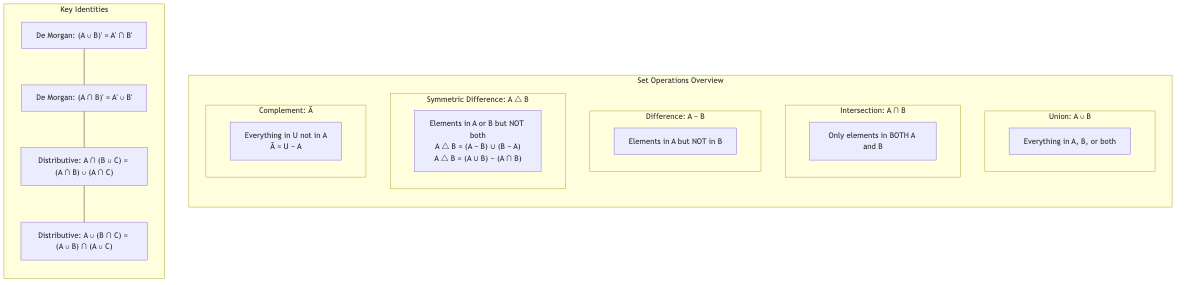
Union (∪)
A ∪ B = {x | x ∈ A ∨ x ∈ B}
Elements in A or B (or both).
Intersection (∩)
A ∩ B = {x | x ∈ A ∧ x ∈ B}
Elements in both A and B.
Two sets are disjoint if A ∩ B = ∅.
Difference (\)
A \ B = {x | x ∈ A ∧ x ∉ B}
Elements in A but not in B. Also written A - B.
Complement (A̅ or Aᶜ)
Aᶜ = U \ A = {x ∈ U | x ∉ A}
Everything in the universal set U that is not in A.
Symmetric Difference (△)
A △ B = (A \ B) ∪ (B \ A) = (A ∪ B) \ (A ∩ B)
Elements in exactly one of A or B.
Venn Diagrams
Venn diagrams visually represent set operations. Each set is a circle, and the universal set is the enclosing rectangle.
    ┌───────────────────────┐
    │         U             │
    │    ┌─────┬─────┐      │
    │    │  A  │ A∩B │      │
    │    │only │     │      │
    │    │     │     │ B    │
    │    └─────┤only │      │
    │          └─────┘      │
    └───────────────────────┘
- A ∪ B: everything inside either circle
- A ∩ B: the overlapping region
- A \ B: left crescent only
- A △ B: both crescents
Set Identities
These parallel the logical equivalences from propositional logic:
Identity:
A ∪ ∅ = A
A ∩ U = A
Domination:
A ∪ U = U
A ∩ ∅ = ∅
Idempotent:
A ∪ A = A
A ∩ A = A
Complement:
A ∪ Aᶜ = U
A ∩ Aᶜ = ∅
(Aᶜ)ᶜ = A
Commutative:
A ∪ B = B ∪ A
A ∩ B = B ∩ A
Associative:
(A ∪ B) ∪ C = A ∪ (B ∪ C)
(A ∩ B) ∩ C = A ∩ (B ∩ C)
Distributive:
A ∪ (B ∩ C) = (A ∪ B) ∩ (A ∪ C)
A ∩ (B ∪ C) = (A ∩ B) ∪ (A ∩ C)
Absorption:
A ∪ (A ∩ B) = A
A ∩ (A ∪ B) = A
De Morgan's Laws for Sets:
(A ∪ B)ᶜ = Aᶜ ∩ Bᶜ
(A ∩ B)ᶜ = Aᶜ ∪ Bᶜ
Proving Set Identities
Method 1: Element-chasing — Show x ∈ LHS ⟹ x ∈ RHS and vice versa.
Example: Prove A ∩ (B ∪ C) = (A ∩ B) ∪ (A ∩ C).
(⊆): Let x ∈ A ∩ (B ∪ C). Then x ∈ A and x ∈ B ∪ C. So x ∈ B or x ∈ C.
- If x ∈ B: then x ∈ A ∩ B, so x ∈ (A ∩ B) ∪ (A ∩ C).
- If x ∈ C: then x ∈ A ∩ C, so x ∈ (A ∩ B) ∪ (A ∩ C).
(⊇): Let x ∈ (A ∩ B) ∪ (A ∩ C). Then x ∈ A ∩ B or x ∈ A ∩ C.
- Either way, x ∈ A. Also x ∈ B or x ∈ C, so x ∈ B ∪ C.
- Therefore x ∈ A ∩ (B ∪ C). ∎
Method 2: Algebraic proof — Use known identities to transform one side into the other.
Method 3: Membership table — Like a truth table, assign 1 if element is in the set, 0 otherwise.
Generalized Operations
For a collection of sets A₁, A₂, ..., Aₙ:
⋃ᵢ₌₁ⁿ Aᵢ = A₁ ∪ A₂ ∪ ... ∪ Aₙ = {x | ∃i, x ∈ Aᵢ}
⋂ᵢ₌₁ⁿ Aᵢ = A₁ ∩ A₂ ∩ ... ∩ Aₙ = {x | ∀i, x ∈ Aᵢ}
Generalized De Morgan's:
(⋃ᵢ Aᵢ)ᶜ = ⋂ᵢ Aᵢᶜ
(⋂ᵢ Aᵢ)ᶜ = ⋃ᵢ Aᵢᶜ
Russell's Paradox
Naive set theory allows constructing "the set of all sets that don't contain themselves":
R = {S | S ∉ S}
Is R ∈ R?
- If R ∈ R, then by definition R ∉ R. Contradiction.
- If R ∉ R, then by definition R ∈ R. Contradiction.
This paradox showed that unrestricted set comprehension leads to contradictions. It motivated the development of axiomatic set theory (ZFC).
Axiomatic Set Theory (ZFC)
Zermelo-Fraenkel set theory with the Axiom of Choice (ZFC) provides a rigorous foundation. Key axioms:
- Extensionality: Two sets are equal iff they have the same elements.
- Empty Set: ∅ exists.
- Pairing: For any a, b, the set {a, b} exists.
- Union: For any set S, the union ⋃S exists.
- Power Set: For any set S, the power set P(S) exists.
- Separation (Comprehension): For any set S and property P, {x ∈ S | P(x)} exists. (Note: requires x ∈ S, avoiding Russell's paradox.)
- Replacement: The image of a set under a definable function is a set.
- Infinity: An infinite set exists (e.g., ℕ).
- Foundation (Regularity): Every non-empty set has a ∈-minimal element (prevents x ∈ x).
- Choice: For any collection of non-empty sets, there exists a function choosing one element from each.
Axiom of Choice
The Axiom of Choice (AC) states: Given any collection of non-empty sets, it is possible to select exactly one element from each set.
Formally: For any set S of non-empty sets, there exists a function f: S → ⋃S such that f(A) ∈ A for all A ∈ S.
AC seems intuitively obvious for finite collections, but for infinite collections it is non-trivial and independent of the other ZFC axioms.
Equivalent statements:
- Zorn's Lemma: Every partially ordered set in which every chain has an upper bound contains a maximal element.
- Well-Ordering Theorem: Every set can be well-ordered (Zermelo).
- Every surjection has a right inverse.
- Every vector space has a basis.
- The product of non-empty sets is non-empty.
Controversial consequences:
- The Banach-Tarski paradox: A solid ball can be decomposed into finitely many pieces and reassembled into two balls of the same size.
Zorn's Lemma
Zorn's Lemma: If every chain (totally ordered subset) in a partially ordered set P has an upper bound in P, then P has at least one maximal element.
Applications in CS and math:
- Every vector space has a basis.
- Every proper ideal in a ring is contained in a maximal ideal.
- Proving the existence of certain graph colorings and matchings.
Multisets
A multiset (bag) is like a set but allows repeated elements.
M = {a, a, b, c, c, c}
The multiplicity of an element is how many times it appears: mult(a) = 2, mult(b) = 1, mult(c) = 3.
Multiset operations extend set operations by considering multiplicities.
Real-World Applications
- Type theory: Types are essentially sets of values. Union types correspond to set union, intersection types to set intersection.
- Databases: Relations are sets of tuples. SQL operations (UNION, INTERSECT, EXCEPT) correspond directly to set operations. (SQL bags/multisets allow duplicates by default.)
- Access control: User permissions are sets. Access = UserRoles ∩ RequiredRoles.
- Data structures: Sets are implemented as hash sets, tree sets, bit sets. Set operations are fundamental to algorithms.
- Formal verification: Specifications describe sets of valid states. Model checking explores sets of reachable states.
- Programming: Collection types in most languages (HashSet, BTreeSet, frozenset) implement mathematical sets.