
Imperative Programming
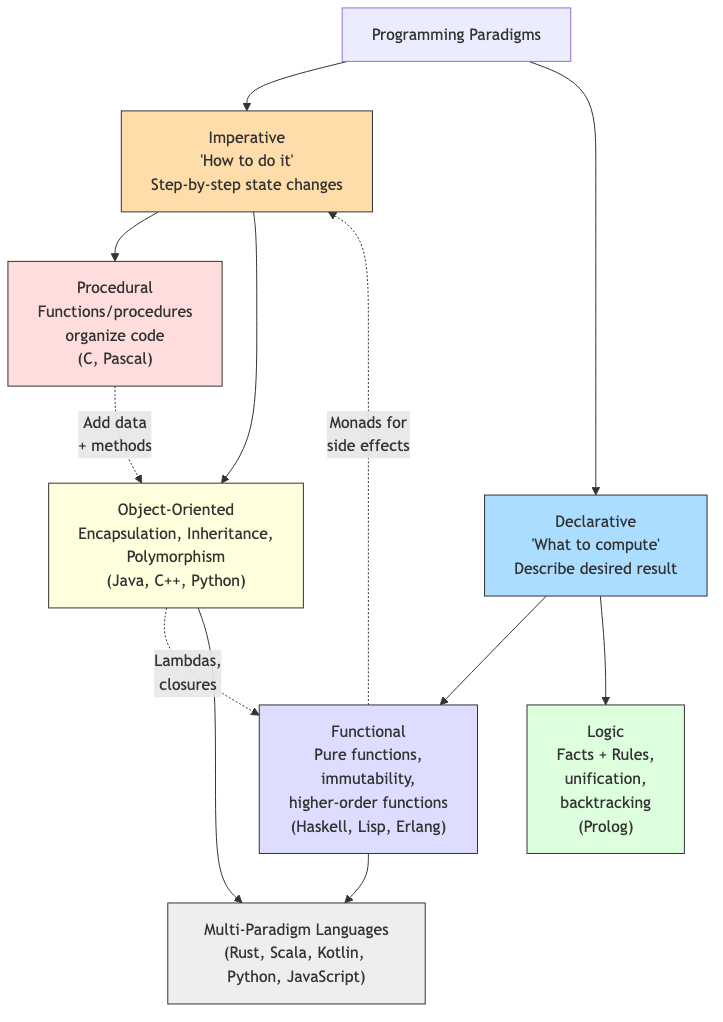
Imperative programming describes computation as a sequence of statements that change program state. It directly maps to how hardware executes — the von Neumann model of fetch-decode-execute.
Core Concepts
Statements and State
A program is a sequence of commands that modify the state (values stored in memory).
x ← 5             // state: x = 5
x ← x + 1         // state: x = 6
x ← x * 2         // state: x = 12
State: The collection of all variable values at a given point in execution. Execution proceeds by transforming state step by step.
Variables and Assignment
A variable is a named location in memory. Assignment changes its value.
x = expression // evaluate expression, store result in x
Key distinction from math: In math, x = x + 1 is a contradiction. In imperative programming, it means "compute x + 1 and store the result back in x."
Control Flow
Sequential Execution
Statements execute one after another, top to bottom.
Conditional (Selection)
IF condition
    // executed if condition is true
ELSE IF other_condition
    // executed if other_condition is true
ELSE
    // executed otherwise
Match / Switch:
MATCH value
    1:        PRINT "one"
    2 OR 3:   PRINT "two or three"
    4 TO 10:  PRINT "four to ten"
    DEFAULT:  PRINT "other"
Loops (Iteration)
While loop: Repeat while condition is true.
WHILE condition
    // body
For loop: Iterate over a range or collection.
FOR i ← 0 TO n - 1
    // body executes n times
FOR EACH item IN collection
    // iterate over collection
Do-while / loop: Execute at least once.
LOOP
    // body
    IF condition THEN BREAK
Loop control: break exits the loop. continue skips to the next iteration.
Structured Programming Theorem (Böhm-Jacopini)
Any computable function can be expressed using only three control structures:
- Sequence (one statement after another)
- Selection (if-else)
- Iteration (while loops)
No goto needed. This was revolutionary — it established that structured programming is sufficient for all computation.
Procedures and Functions
Procedural decomposition: Break a program into named, reusable units.
FUNCTION CALCULATE_AREA(width, height)
    RETURN width * height

PROCEDURE PRINT_RECTANGLE(width, height)
    area ← CALCULATE_AREA(width, height)
    PRINT "Area: ", area
Parameters: Pass data into functions.
- By value: Copy the data. Callee's changes don't affect caller.
- By reference: Pass a pointer/reference. Callee can modify caller's data.
- By move: Transfer ownership (Rust's default for non-Copy types).
Return values: Functions produce results.
Side effects: A function has a side effect if it modifies state outside its local scope (global variables, I/O, mutable references). Pure functions have no side effects.
Mutation and Side Effects
Mutable State
counter ← 0

PROCEDURE INCREMENT()
    counter ← counter + 1   // side effect: modifies external state
Advantages: Efficient (modify in place, no copies). Natural for some algorithms (sorting, graph traversal).
Disadvantages: Hard to reason about (what's the value of x?). Bugs from unexpected mutations. Difficult to parallelize (data races). Order-dependent.
Aliasing
Two references pointing to the same memory location.
data ← [1, 2, 3]
a ← mutable reference to data
// b ← reference to data   // ERROR: can't have mutable and immutable ref simultaneously
Aliasing + mutation = bugs. Rust's borrow checker prevents this at compile time.
Structured Programming
Dijkstra's "Go To Statement Considered Harmful" (1968)
goto creates unreadable "spaghetti code." Structured control flow (if/while/for) makes programs easier to understand and prove correct.
Modern stance: goto is rarely used but not universally banned. It's occasionally useful for error handling in C (cleanup on failure) and performance-critical inner loops. Most languages don't even have goto (Rust, Python, Java).
Block Structure
Variables have scope — they exist only within their enclosing block.
BEGIN BLOCK
    x ← 10        // x exists here
    BEGIN BLOCK
        y ← 20    // y exists here
        // x is also accessible
    END BLOCK
    // y no longer exists
END BLOCK
// x no longer exists
Lifetime: How long a variable's memory is valid. Rust makes lifetimes explicit to prevent use-after-free.
Procedural Abstraction
Hide implementation details behind a function interface. The caller doesn't need to know how — only what.
// The caller doesn't care about the sorting algorithm
PROCEDURE SORT(data)   // ... implementation hidden ...
Imperative Patterns
Accumulator Pattern
Build a result by iterating and accumulating.
FUNCTION SUM(arr)
    total ← 0
    FOR EACH x IN arr
        total ← total + x
    RETURN total
Search Pattern
Scan through data looking for a match.
FUNCTION FIND(arr, target)
    FOR i ← 0 TO length(arr) - 1
        IF arr[i] = target THEN RETURN i
    RETURN NOT_FOUND
State Machine
Track state explicitly and transition based on input.
STATES: Start, InWord, InSpace

FUNCTION COUNT_WORDS(s)
    state ← InSpace
    count ← 0
    FOR EACH c IN characters of s
        IF state = InSpace AND c is not whitespace
            state ← InWord
            count ← count + 1
        ELSE IF state = InWord AND c is whitespace
            state ← InSpace
    RETURN count
Imperative Languages
| Language | Era | Key Features |
|---|---|---|
| Fortran (1957) | First high-level language. Scientific computing. | |
| COBOL (1959) | Business data processing. Verbose, English-like. | |
| C (1972) | Systems programming. Close to hardware. | |
| Pascal (1970) | Teaching structured programming. | |
| Ada (1983) | Safety-critical systems. Strong typing. | |
| Go (2009) | Concurrent systems programming. Simple imperative core. | |
| Rust (2015) | Systems programming with safety guarantees. Imperative + functional. |
Applications in CS
- Systems programming: OS kernels, drivers, embedded systems — imperative style maps directly to hardware.
- Performance-critical code: Direct control over memory layout and mutation enables optimization.
- Game development: Game loops are fundamentally imperative (update state each frame).
- Scripting: Shell scripts, build scripts — sequences of commands.
- State machines: Network protocols, parsers, UI controllers — naturally imperative.