
Processes
A process is a program in execution — the fundamental unit of work in an operating system. Each process has its own address space, execution state, and system resources.
Process Concept
Process vs Program
A program is a static file on disk (executable binary). A process is a running instance of a program with:
- Code (text segment)
- Data (global/static variables)
- Heap (dynamically allocated memory)
- Stack (function calls, local variables)
- Execution state (registers, program counter)
- OS resources (open files, sockets, signal handlers)
Multiple processes can run the same program simultaneously (each with its own state).
Memory Layout
High addresses
┌──────────────┐
│    Stack     │ ↓ grows downward
│     ...      │
│              │
│     ...      │
│    Heap      │ ↑ grows upward
├──────────────┤
│    BSS       │ uninitialized global data (zeroed)
├──────────────┤
│    Data      │ initialized global data
├──────────────┤
│    Text      │ program code (read-only)
└──────────────┘
Low addresses
Process States
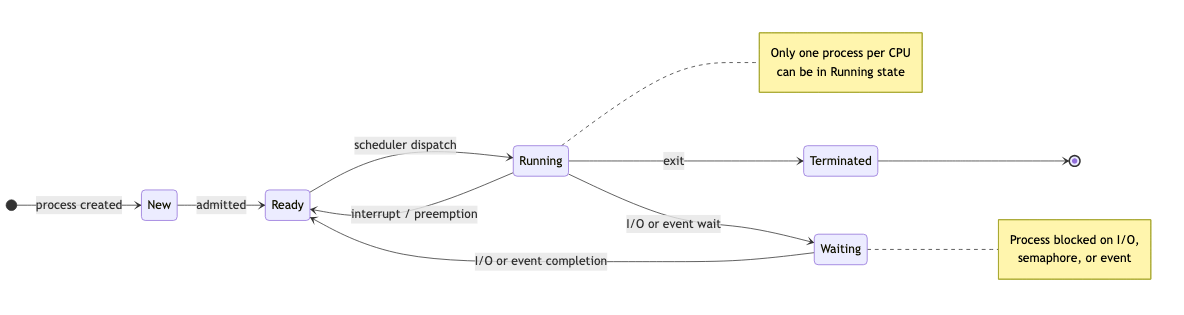
        ┌──────────┐
        │   New    │
        └────┬─────┘
             │ admitted
             ▼
        ┌──────────┐   dispatch    ┌──────────┐
    ┌──→│  Ready   │─────────────→│ Running  │──┐
    │   └──────────┘              └──────────┘  │
    │        ↑                    │    │    │    │
    │        │              interrupt  │    │    │
    │        │                    │    │    │    │
    │   I/O complete              │    │    │    │
    │   or event                  │    │    │    │
    │        │                    │    │ exit│    │
    │   ┌──────────┐              │    │    │    │
    └───│ Waiting  │←─────────────┘    │    │    │
        │(Blocked) │    I/O or wait    │    │    │
        └──────────┘                   │    │    │
                                       ▼    │    │
                                 ┌──────────┐   │
                                 │Terminated│   │
                                 └──────────┘   │
                                       ↑────────┘
| State | Description |
|---|---|
| New | Process being created |
| Ready | Waiting for CPU assignment |
| Running | Currently executing on CPU |
| Waiting/Blocked | Waiting for I/O or event |
| Terminated | Finished execution |
Process Control Block (PCB)
The OS maintains a PCB for each process containing:
| Field | Content |
|---|---|
| PID | Process identifier |
| State | Current state (ready, running, etc.) |
| Program counter | Address of next instruction |
| CPU registers | Saved register values |
| Memory info | Page table pointer, memory limits |
| Scheduling info | Priority, scheduling queue pointers |
| I/O info | Open file descriptors, I/O status |
| Accounting | CPU time used, time limits |
| Parent/children | PID of parent, list of children |
Context Switching
Switching the CPU from one process to another:
- Save the current process's state (registers, PC) to its PCB.
- Update the current process's state (running → ready/blocked).
- Select the next process (scheduler decision).
- Load the next process's state from its PCB.
- Switch the memory context (page table, TLB flush).
- Jump to the next process's saved PC.
Cost: ~1-10 μs on modern hardware. Dominated by:
- Saving/restoring registers
- TLB flush (especially costly — must refill on cache misses)
- Cache pollution (new process's data replaces old process's cached data)
Process Creation
fork() (UNIX/Linux)
Creates a copy of the current process.
pid ← FORK()
IF pid = 0
    // Child process
    PRINT "Child PID: ", GETPID()
ELSE IF pid > 0
    // Parent process
    PRINT "Parent created child ", pid
    WAITPID(pid)
ELSE
    ERROR "fork failed"
After fork():
- Child is an exact copy of parent (code, data, heap, stack, file descriptors).
- Copy-on-write (COW): Pages are shared until one process writes — then the page is copied.
- Child gets a new PID. fork() returns 0 to child, child's PID to parent.
exec() Family
Replaces the current process's code and data with a new program.
execvp("ls", args);  // Replace current process with "ls"
// If exec succeeds, the code below never executes
fork() + exec(): The standard pattern for creating a new process running a different program.
Shell:
1. fork() → child process
2. Child: exec("program") → replaces child's code with program
3. Parent: wait() → waits for child to finish
posix_spawn()
Combined fork+exec in one call. More efficient (avoids unnecessary copying).
Windows: CreateProcess()
Single API call that creates a process with a new program (no fork/exec split).
Process Termination
Normal exit: Process calls exit() or returns from main().
Error exit: Process encounters a fatal error and exits with non-zero status.
Killed: Another process sends a signal (kill, SIGTERM, SIGKILL).
Parent notification: Parent calls wait() or waitpid() to collect the child's exit status.
Zombie Process
A terminated child whose parent hasn't called wait(). The PCB remains in the process table (holding the exit status). Cleaned up when parent calls wait() or parent terminates.
Orphan Process
A child whose parent has terminated. Adopted by init (PID 1) or systemd, which will wait() for it.
Inter-Process Communication (IPC)
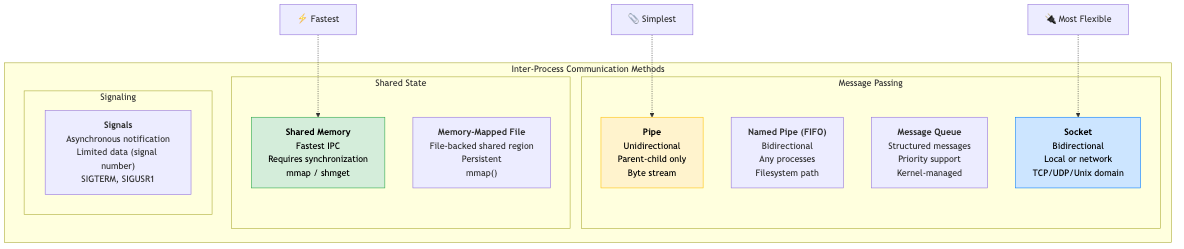
Pipes
Anonymous pipe: Unidirectional byte stream between related processes (parent-child).
ls | grep ".txt" | wc -l
(read_fd, write_fd) ← PIPE()
IF FORK() = 0
    // Child: writes to pipe
    CLOSE(read_fd)
    WRITE(write_fd, data)
ELSE
    // Parent: reads from pipe
    CLOSE(write_fd)
    READ(read_fd, buffer)
Named pipe (FIFO): Has a name in the file system. Unrelated processes can communicate.
mkfifo /tmp/myfifo
echo "hello" > /tmp/myfifo &   # writer
cat /tmp/myfifo                  # reader
Message Queues
Processes send and receive discrete messages. Messages can be prioritized.
POSIX: mq_open, mq_send, mq_receive. System V: msgget, msgsnd, msgrcv.
Shared Memory
Fastest IPC — processes map the same physical memory into their address spaces.
int shm_fd = shm_open("/my_shm", O_CREAT | O_RDWR, 0666);
ftruncate(shm_fd, SIZE);
void *ptr = mmap(NULL, SIZE, PROT_READ | PROT_WRITE, MAP_SHARED, shm_fd, 0);
// Now ptr is shared between processes
Requires synchronization (semaphores, mutexes) since multiple processes access the same memory.
Memory-Mapped Files
Map a file into the address space. Changes to the mapping are written back to the file (for MAP_SHARED). Efficient for large file access and IPC.
Sockets
Communication endpoint. Supports both local (Unix domain sockets) and network (TCP/UDP) communication.
Unix domain sockets: IPC on the same machine. Faster than TCP (no network stack overhead). Used by Docker, X11, systemd.
Signals
Asynchronous notifications sent to a process.
| Signal | Default Action | Meaning |
|---|---|---|
| SIGINT (2) | Terminate | Ctrl+C |
| SIGTERM (15) | Terminate | Polite kill request |
| SIGKILL (9) | Terminate | Unconditional kill (can't be caught) |
| SIGSEGV (11) | Core dump | Segmentation fault |
| SIGCHLD (17) | Ignore | Child process terminated |
| SIGSTOP (19) | Stop | Pause process (can't be caught) |
| SIGCONT (18) | Continue | Resume stopped process |
| SIGUSR1/2 | Terminate | User-defined |
Processes can catch signals (install a signal handler) for most signals. SIGKILL and SIGSTOP cannot be caught.
Process Hierarchy
UNIX Process Tree
init (PID 1) or systemd
├── login
│   └── bash
│       ├── vim
│       └── gcc
├── sshd
│   └── bash
│       └── python
├── cron
└── httpd
    ├── httpd (worker)
    └── httpd (worker)
Every process (except init) has a parent. The process tree is rooted at init/systemd.
pstree command shows the process tree. ps aux lists all processes.
Applications in CS
- Shells: The shell is a process that fork+exec's commands. Pipes connect processes.
- Web servers: Fork a child for each request (Apache prefork), or use threads/async (nginx).
- Databases: PostgreSQL forks a backend process per connection. MySQL uses threads.
- Build systems: Make/Bazel spawn compiler processes in parallel.
- Containers: Containers are processes with isolated namespaces (PID, network, mount, etc.).
- Init systems: systemd manages the lifecycle of all system services as processes.