
Cross-Functional Partnerships
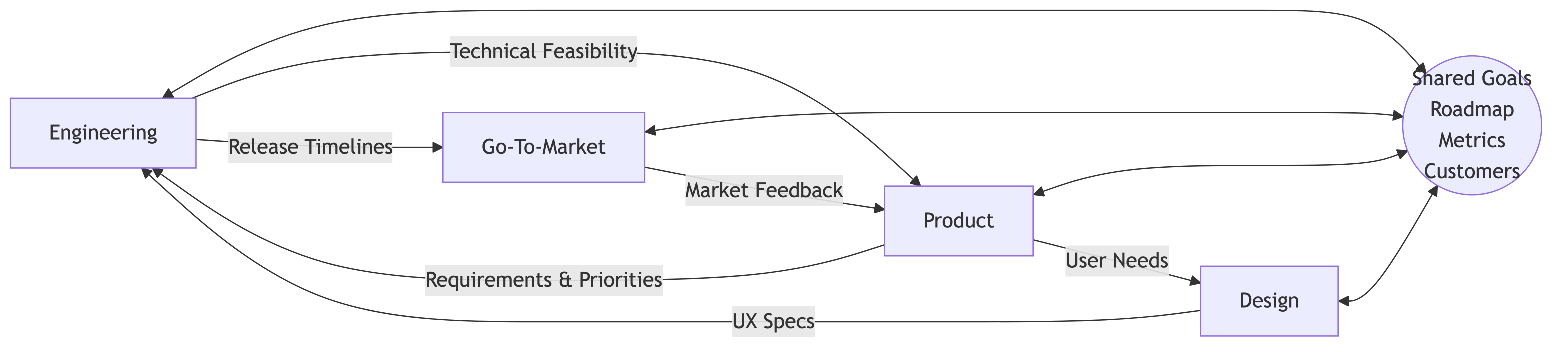
Why This Matters at the Director/VP Level
I want to start with a claim that might sound dramatic but that I believe deeply: the single biggest revenue leak in most technology companies is misalignment between functions. Not bad code. Not poor architecture. Not even wrong product decisions. It is the gap between engineering, product, design, sales, marketing, and customer success -- the friction, the miscommunication, the conflicting priorities that cause organizations to build the wrong things, build them at the wrong time, or build them and fail to bring them to market effectively.
At the IC and first-line manager level, cross-functional work means collaborating well with your product manager and designer on your specific team. At the Director/VP level, the game is entirely different. You are responsible for how engineering as a function partners with other functions at the organizational level. You are the one who sits in the room with the VP of Product, the CMO, the Head of Sales, and the CEO, and you are the one who has to make these relationships work.
This is where careers are made or broken. The Director/VP who is technically brilliant but cannot partner effectively across functions will hit a ceiling. The one who builds deep trust and productive partnerships will have outsized impact.
Product-Engineering Alignment at the Org Level
The Fundamental Challenge
At the team level, product-engineering alignment is relatively straightforward: one PM and one engineering lead work together on a shared roadmap. At the org level, it gets much harder because you are dealing with:
- Multiple product managers with competing priorities
- Shared engineering resources (platform teams, infrastructure, etc.) that need to be allocated across product lines
- Strategic bets that do not map cleanly to any single product team
- Technical investments (debt reduction, platform migrations, reliability improvements) that product may not fully appreciate
- Time horizons that differ -- product often thinks in quarters, engineering often needs to think in years
Making the Partnership Work
The most effective product-engineering partnerships I have seen at the org level share these characteristics:
Shared planning processes. Product and engineering should plan together, not sequentially. The anti-pattern is: product creates a roadmap, hands it to engineering, and engineering estimates it. The better pattern is: product and engineering together identify the highest-value problems, explore solution approaches, and jointly commit to a plan that balances customer value, technical health, and business needs.
Explicit allocation conversations. Be transparent about how engineering capacity is allocated. I have found that a model like this works well:
- 60-70% on product roadmap features (driven primarily by product priorities)
- 15-20% on technical health (debt reduction, platform improvements, reliability)
- 10-15% on engineering-driven innovation and exploration
- 5% on unplanned work buffer
The exact percentages matter less than the fact that they are explicit, agreed upon, and visible. When product knows that 20% of engineering capacity is going to technical health, they can plan for it. When engineering knows that 70% of capacity is committed to product priorities, they can commit to it.
Regular strategic alignment. You and your product counterpart should meet weekly, but not to review status. Status should be visible in dashboards and written updates. Your weekly time together should be spent on strategic alignment: what is changing in the market, what are we learning from customers, where are our bets not paying off, what should we double down on or cut.
Joint accountability for outcomes. Product and engineering should be measured on the same outcomes. If product is measured on feature delivery and engineering is measured on system reliability, their incentives will diverge. Better: both are measured on customer outcomes (adoption, retention, satisfaction) and delivery quality (speed, reliability, security).
Handling the "Technical Debt" Conversation
This is one of the most common friction points between product and engineering, so let me spend some time on it.
Engineers talk about technical debt in terms that product people often find abstract or unconvincing: "The codebase is a mess." "We need to refactor the data layer." "Our deployment pipeline is too slow."
Product people hear: "Engineering wants to spend time on things that do not deliver customer value."
The fix is to translate technical debt into business impact:
-
Instead of "we need to refactor the data layer," say "our current data architecture means that building the customer analytics feature will take 12 weeks instead of 4. Investing 6 weeks in the data layer now will save us time on this feature and the next three features that depend on similar data access patterns."
-
Instead of "our deployment pipeline is too slow," say "we can currently deploy twice a week. Our competitors are deploying multiple times a day. This means we are 5x slower at getting bug fixes and new features to customers. Investing in our pipeline will accelerate everything we build for the next two years."
-
Instead of "we have too much tech debt," say "40% of our engineering time is currently spent on unplanned work caused by the fragility of our older systems. Reducing that to 15% would free up the equivalent of 8 engineers for new feature development."
When you frame technical investments in terms of their business impact -- faster time to market, more capacity for feature work, reduced risk of outages that damage customer trust -- the conversation changes completely.
Design Collaboration
The Common Failure Mode
In many organizations, design is an afterthought in the engineering process. Designs get thrown over the wall to engineers, who discover that they are technically infeasible or prohibitively expensive to build. Or engineering builds something without sufficient design input, and the result is functional but unusable.
At the Director/VP level, your job is to ensure that the design-engineering relationship is structurally sound, not just dependent on individual relationships at the team level.
What Good Looks Like
Embedded design. Designers should be embedded in product teams, not in a separate design department that takes requests. When designers sit with engineers and participate in sprint planning, technical constraints get surfaced early and design quality goes up.
Design system investment. At scale, a shared design system is one of the highest-leverage investments you can make. It gives designers and engineers a common vocabulary, reduces the cost of building new UIs, ensures visual and interaction consistency, and frees designers to focus on novel problems instead of reinventing buttons and forms.
Early technical feasibility conversations. Before design goes deep on a solution, engineers should weigh in on technical feasibility and cost. This does not mean engineers get to veto design ideas -- it means designers make informed decisions about where to push boundaries and where to use simpler approaches.
Collaborative prototyping. For complex interactions, having a designer and engineer prototype together is far more effective than a sequential handoff. The designer brings the vision, the engineer brings the constraints, and the result is something that is both excellent and buildable.
Accessibility as a shared responsibility. Accessibility is not a design concern or an engineering concern -- it is both. At the org level, establish shared standards for accessibility and make sure both design and engineering are accountable for meeting them.
Design at the Strategic Level
At the Director/VP level, you should also be partnering with design leadership on strategic questions:
- How should we think about the overall user experience across our product suite?
- Where are the biggest UX pain points that are driving customer churn?
- How can we use design research to validate our product hypotheses before building?
- What design capabilities do we need to build for the future (e.g., mobile, AI-native interfaces, accessibility)?
These conversations often do not happen because engineering and design leaders are both too busy with tactical execution. Making time for them is a leadership responsibility.
GTM (Go-to-Market) Coordination
Why Engineers Need to Care About GTM
Many engineering leaders view sales, marketing, and customer success as "the business side" and keep them at arm's length. This is a mistake.
Here is why: if you build something great and the market does not know about it, or the sales team does not understand it, or customer success cannot support it, you have wasted your engineering investment. Conversely, if sales is making promises to customers that engineering cannot deliver, you have a trust problem that will eventually blow up.
At the Director/VP level, GTM coordination is part of your job, whether you like it or not.
Key GTM Partnerships
Sales engineering and pre-sales. Your sales engineers are on the front lines with customers. They know what customers are asking for, what competitors are offering, and where your product falls short. Build a structured feedback loop:
- Regular meetings between engineering leadership and sales engineering leadership
- A clear process for escalating customer technical requirements
- Joint prioritization of customer-facing capabilities
Marketing. Work with marketing to ensure they accurately represent your product's capabilities and technical differentiators. Provide engineering support for technical content: blog posts, whitepapers, conference talks. Your engineers are often the most credible voice for technical audiences.
Customer success. Customer success teams see how customers actually use your product, where they struggle, and where they get value. This data is gold for engineering. Establish regular channels for sharing customer usage patterns, common support issues, and feature requests.
Launch Coordination
One of the most common cross-functional failures is the botched product launch. Engineering finishes a feature, but:
- Documentation is not ready
- Sales has not been trained on the feature
- Marketing materials have not been updated
- Customer success does not know how to support it
- The feature is behind a flag that nobody turns on
To prevent this, establish a launch process that coordinates across all functions:
-
Launch planning starts when development starts. Not when development ends. Marketing, sales, and customer success should know what is coming and when, with enough lead time to prepare.
-
Launch tiers. Not every feature needs a full launch. Define tiers:
- Tier 1 (major): Full cross-functional launch -- marketing campaign, sales enablement, customer communications, documentation, potentially an event or webinar
- Tier 2 (significant): Updated documentation, sales training, targeted customer communication
- Tier 3 (incremental): Changelog entry, updated docs, no special launch activities
-
Launch readiness checklist. A shared checklist that covers every function's responsibilities. No feature launches until all items are checked.
-
Post-launch review. After major launches, review what went well and what did not across all functions. Was sales prepared? Did customers find the feature? Were there unexpected support issues?
The Biggest Revenue Leak: Misalignment Between Functions
Let me elaborate on the claim I made at the start of this chapter, because I think it is important enough to deserve its own section.
How Misalignment Destroys Value
Building the wrong things. When product and engineering are not aligned with sales and customer success, you build features that look good on a roadmap but do not solve real customer problems. I have seen engineering teams spend six months building a feature that sales never asked for and customers never adopted, while the feature that would have closed $10M in pipeline sat in the backlog.
Building at the wrong time. Even when you are building the right things, timing matters. If a major customer needs a capability by Q3 to renew their contract, and engineering delivers it in Q4, you lose the revenue. GTM coordination ensures that engineering priorities reflect business timing.
Building and failing to sell. You can build the best feature in the world, but if sales does not understand it, marketing does not position it, and customer success cannot help customers adopt it, the feature generates zero revenue. This is more common than most engineering leaders realize.
Conflicting narratives. When sales tells customers one thing, marketing says another, and the product does a third, customer trust erodes. Alignment means everyone is telling the same story.
Slow decision-making. When functions do not trust each other, every decision requires multiple meetings, escalations, and negotiations. The organization moves at the speed of its slowest cross-functional process.
Quantifying the Cost
Here is a rough framework for estimating the cost of misalignment in your organization:
-
Features built but not adopted. Look at your last year of feature releases. What percentage are actively used by customers? For the unused ones, calculate the engineering investment. In many organizations, 30-50% of features see minimal adoption. That is potentially millions in wasted engineering investment.
-
Deals lost due to missing capabilities. Talk to sales. What features are customers asking for that you do not have? What is the pipeline value associated with those gaps? Now look at whether those features were deprioritized in favor of something less commercially valuable.
-
Customer churn due to poor experience. Talk to customer success. What are the top reasons customers leave? How many of those are engineering-solvable problems that were not prioritized?
-
Time spent on cross-functional friction. Estimate how much leadership time is spent in meetings resolving cross-functional disputes, re-negotiating priorities, and managing escalations. That time has an opportunity cost.
When you add it all up, the number is often startlingly large. I have seen organizations where misalignment was costing them 20-30% of their total engineering investment.
Building Trust Across Functions
Trust is the foundation of effective cross-functional partnerships. Without it, every interaction becomes a negotiation, every commitment is questioned, and every problem becomes a blame game.
How Trust Gets Built
Reliability. Do what you say you will do. If engineering commits to delivering a feature by a certain date, deliver it. If you cannot, communicate early and explain why. Nothing destroys cross-functional trust faster than missed commitments with no communication.
Transparency. Share information openly, even when it is uncomfortable. If a project is behind schedule, say so. If a technical decision has tradeoffs that affect other functions, explain them. When other functions feel like engineering is hiding information, they stop trusting.
Empathy. Take the time to understand what other functions are dealing with. Sales has quarterly targets and customer pressure. Marketing has campaign timelines and brand concerns. Customer success has churn goals and support volume. When you demonstrate that you understand their constraints, they are more willing to understand yours.
Competence. Other functions trust engineering when engineering delivers high-quality work. Every bug, every outage, every missed deadline erodes that trust. Engineering excellence (covered in the previous chapter) is not just an internal concern -- it is the foundation of your cross-functional credibility.
Generosity. Be willing to help other functions even when it is not strictly your job. An engineer who helps a sales engineer debug a customer issue, or who volunteers to present at a marketing webinar, builds goodwill that pays dividends.
How Trust Gets Destroyed
- Blaming other functions when things go wrong. "Product gave us the wrong requirements" or "Sales overpromised" may be true, but saying it publicly poisons the relationship.
- Making unilateral decisions that affect other functions. Changing an API without telling the integrations team. Deprecating a feature without telling customer success. Changing the deployment schedule without telling marketing. These are trust-destroying moves.
- Using technical complexity as a shield. When engineering says "you would not understand why this is hard," other functions feel dismissed and condescended to. Find ways to explain technical constraints in business terms.
- Prioritizing engineering's preferences over business needs. Yes, you want to rewrite that service in Rust. But if the business needs three new features this quarter, your rewrite does not matter. Demonstrating that you put business needs first builds trust.
Joint Planning and Shared Goals
The Annual Planning Process
Annual planning is where cross-functional alignment either gets established or falls apart. Here is how to make it work:
-
Start with shared context. Before anyone proposes priorities, make sure all functions are working from the same understanding of business goals, market dynamics, customer feedback, and competitive landscape.
-
Bottom-up and top-down. Teams propose what they think is most important. Leadership provides strategic direction. The planning process reconciles these two inputs. If planning is purely top-down, you miss important ground-level insights. If it is purely bottom-up, you lack strategic coherence.
-
Cross-functional review. Before plans are finalized, each function's plan should be reviewed by the other functions for alignment. Does the engineering plan support the product roadmap? Does the product roadmap support the sales strategy? Does the sales strategy reflect what engineering can actually deliver?
-
Explicit dependencies. Identify and document cross-functional dependencies. If marketing's launch plan depends on engineering delivering a feature by March, that dependency needs to be visible to everyone and actively managed.
-
Quarterly recalibration. The annual plan is a starting point, not a contract. Every quarter, review what has changed, what you have learned, and adjust the plan accordingly. Do this together across functions, not in isolation.
OKRs and Shared Goals
OKRs (Objectives and Key Results) are a common framework for goal-setting, and they work well for cross-functional alignment when used correctly.
The key principle: shared OKRs should focus on outcomes, not outputs.
Bad shared OKR: "Launch the new onboarding flow by Q2." This is an output. It does not tell you whether the onboarding flow actually improved anything.
Good shared OKR: "Improve new user activation from 35% to 50% by Q2." This is an outcome that product, engineering, design, and marketing all contribute to. It focuses everyone on the result rather than on their individual deliverables.
When functions share outcome-oriented OKRs, several good things happen:
- They naturally align their work toward the same goal
- They are motivated to help each other succeed (because they share the goal)
- They focus on whether their work is actually achieving the desired result, not just whether they shipped something
- Accountability is shared, which reduces finger-pointing
The Quarterly Business Review
A quarterly cross-functional review is one of the most valuable rituals you can establish. In this meeting:
- Each function presents their key results from the previous quarter and their plan for the next quarter
- Cross-functional dependencies are reviewed and updated
- Misalignments are identified and resolved
- The leadership team makes joint decisions about prioritization changes
This meeting should be facilitated by someone who can keep it focused and productive -- often the COO or chief of staff. It should not devolve into a status update or a political negotiation.
Handling Conflict Between Functions
Cross-functional conflict is inevitable. The question is not whether it happens, but how you handle it.
Productive vs. Destructive Conflict
Productive conflict is about ideas, priorities, and approaches. It sounds like: "I think we should prioritize reliability over new features this quarter, because our churn data shows that outages are a top reason customers leave." This kind of conflict is healthy and should be encouraged.
Destructive conflict is personal, political, or territorial. It sounds like: "Sales always overpromises and engineering has to clean up the mess." This kind of conflict is toxic and needs to be addressed immediately.
Conflict Resolution Approaches
Clarify the decision framework. Many conflicts arise because it is unclear who has decision rights. Use a framework like RACI or DACI to clarify: who is Responsible, who is Accountable, who is Consulted, and who is Informed. Many cross-functional disputes evaporate once decision rights are clear.
Separate positions from interests. When product says "we need this feature by March" and engineering says "that is impossible," they are both stating positions. Dig into interests: Why March? Because there is a customer commitment? A competitive threat? A marketing campaign? Once you understand the interest, you can often find a solution that satisfies both sides -- maybe a reduced scope that hits the March deadline, with the full feature following in April.
Escalate early, not late. When cross-functional conflict cannot be resolved at the working level, escalate it. Do not let it fester. The worst outcome is two functions quietly resenting each other for months. Bring it to a joint meeting of the function leaders, lay out the disagreement clearly, and make a decision.
Use data to de-personalize. When you can point to customer usage data, revenue impact, or reliability metrics, the conversation shifts from "my opinion vs. your opinion" to "what does the evidence suggest?" Invest in making cross-functional data accessible to everyone.
Assume good intent. When you are in conflict with another function, start from the assumption that they are trying to do what is best for the company, even if you disagree with their approach. This assumption is correct far more often than the alternative.
Real-World Examples
Example 1: The Launch That Almost Was Not
A VP of Engineering at a B2B SaaS company discovered, two weeks before a major product launch, that sales had not been trained on the new feature, marketing materials still described the old workflow, and customer success had no documentation for supporting the new experience.
Engineering had done its job -- the feature was built, tested, and ready. But the launch was going to fail because no one had coordinated across functions.
The VP called an emergency cross-functional meeting, delayed the launch by three weeks, and used the time to properly enable all functions. After the launch, she established a launch coordination process with clear cross-functional checkpoints at 8 weeks, 4 weeks, 2 weeks, and 1 week before each major launch.
The lesson: engineering "shipping" is not the same as a feature being "launched." Launch is a cross-functional activity, and engineering leaders need to ensure the coordination happens.
Example 2: The Product-Engineering Partnership Reset
A Director of Engineering joined a company where the product-engineering relationship was deeply broken. Product felt that engineering was slow and unresponsive. Engineering felt that product kept changing requirements and did not understand technical constraints.
He took three steps:
-
Joint retro. He and the VP of Product ran a joint retrospective with their combined leadership teams. Each side shared their frustrations openly, and they identified the top three systemic issues: unclear requirements, mid-sprint priority changes, and lack of technical context in product decisions.
-
Structural changes. They co-created a planning process where product and engineering leads built roadmaps together. They established a "technical context" session where engineering presented the current system architecture and constraints to product leadership quarterly. They agreed on a policy: no mid-sprint priority changes without both the PM and the engineering lead agreeing.
-
Relationship investment. He and the VP of Product started having a weekly dinner. Not a working session -- a relationship-building dinner. They talked about their backgrounds, their challenges, their aspirations. They built the personal trust that made professional disagreements productive rather than destructive.
Within six months, the product-engineering NPS (how each function rated the other) went from -15 to +40.
Example 3: Aligning Engineering Capacity with Revenue Impact
A VP of Engineering was frustrated that engineering was being asked to build one-off features for individual enterprise customers, driven by sales commitments. These features consumed significant engineering capacity but benefited only one customer each.
Instead of simply saying no to sales, she worked with the VP of Sales to create a framework:
- Tier 1 requests (features that would benefit multiple customers): prioritized through the normal product process
- Tier 2 requests (single-customer features worth more than $500K ARR): evaluated jointly by product and engineering, with the customer paying for custom development
- Tier 3 requests (single-customer features worth less than $500K ARR): declined, with sales receiving talking points about the product roadmap and alternative solutions
This framework reduced one-off customer feature requests by 70 percent, freed up significant engineering capacity for roadmap work, and actually improved the sales relationship because sales had a clear framework instead of getting ad-hoc "no" responses.
Common Mistakes
-
Treating cross-functional partnership as optional. Some engineering leaders believe their job is purely technical and that "the business side" is someone else's problem. At the Director/VP level, cross-functional partnership is at least 30-40% of your job. If you are not doing it, you are not doing your job.
-
Only engaging with other functions when there is a problem. If the only time you talk to sales is when they escalate a customer issue, you do not have a partnership. Build the relationship before you need it.
-
Letting engineers opt out of cross-functional work. Engineers who refuse to work with product, design, or sales are limiting their impact and the organization's effectiveness. Make cross-functional collaboration an explicit expectation and factor it into performance evaluations.
-
Over-rotating on one function's needs. If you always prioritize what sales wants, product strategy suffers. If you always prioritize what engineering wants, commercial needs go unmet. Balance is essential.
-
Delegating all cross-functional work to program managers. Program managers are valuable for coordination, but they cannot substitute for direct relationships between function leaders. You need to be in the room.
-
Assuming alignment exists because it was established once. Alignment is not a one-time achievement. It is an ongoing process that requires constant maintenance. Market conditions change, priorities shift, and new leaders join. Regularly check and re-establish alignment.
-
Using jargon as a barrier. Every function has its own jargon. Sales talks about ARR, pipeline, and win rates. Marketing talks about MQLs, CAC, and brand awareness. Engineering talks about microservices, CI/CD, and tech debt. Learn other functions' language and translate your own.
-
Not celebrating cross-functional wins. When a launch goes well because all functions executed together, celebrate that explicitly. Highlight the cross-functional collaboration, not just the engineering achievement. This reinforces the behavior you want to see.
-
Ignoring the emotional dimension. Cross-functional relationships have an emotional component. People feel disrespected, unheard, or undervalued. Ignoring these feelings and focusing only on process and structure will not fix a broken relationship. Sometimes you need to have the uncomfortable conversation about how people are feeling before you can make structural progress.
Business Value
Cross-functional alignment has a direct and measurable impact on business outcomes.
Revenue acceleration. When engineering, product, sales, and marketing are aligned, features are built that customers want, launched effectively, and sold successfully. The time from "customer need identified" to "revenue generated" shrinks dramatically. I have seen companies cut this cycle from 12 months to 4 months simply by improving cross-functional coordination.
Reduced waste. As I mentioned earlier, 30-50% of features in many organizations see minimal adoption. Much of this waste comes from misalignment -- building what internal stakeholders asked for instead of what customers need, or building the right thing but failing to launch and sell it effectively. Better alignment means more of your engineering investment translates into customer value and revenue.
Faster decision-making. When functions trust each other and have established decision-making frameworks, decisions happen faster. The cost of slow decision-making is enormous -- it is not just the delay itself but the opportunity cost of what you could have been doing with that time.
Customer trust. When all customer-facing functions tell a consistent story, deliver on promises, and respond to issues coherently, customers trust you more. Trust leads to renewals, expansion, and referrals. Every cross-functional misfire -- a sales promise that engineering cannot deliver, a feature launch that customer success cannot support -- erodes that trust.
Employee satisfaction and retention. Engineers (and people in every function) are more engaged when they feel their work has impact. Cross-functional alignment means engineers see their features being used by real customers, getting positive feedback from sales, and driving business results. This connection between effort and impact is one of the strongest drivers of engagement.
Competitive advantage. Most of your competitors have similar technical talent and similar technology. The companies that win are the ones that execute better -- and execution at scale is fundamentally a cross-functional challenge. The ability to align an entire organization around a shared goal and execute coherently is a durable competitive advantage that is very hard to replicate.
Organizational scalability. As companies grow, cross-functional coordination becomes harder. The companies that invest in alignment processes, shared goals, and trust-building scale more smoothly. The ones that do not hit a wall where adding more people actually makes things slower because the coordination overhead overwhelms the additional capacity.
The bottom line: every dollar you invest in cross-functional alignment -- in shared planning, in launch coordination, in building trust across functions -- returns multiples in revenue, efficiency, and organizational effectiveness. It is one of the most underleveraged opportunities in most engineering organizations.
Common Pitfalls
- Treating cross-functional partnership as optional. Engineering leaders who believe their job is purely technical and that "the business side" is someone else's problem are not doing 30-40% of their actual job at this level.
- Only engaging with other functions during crises. Building relationships only when there is a problem to solve means you never have the trust foundation needed to navigate disagreements productively.
- Using technical jargon as a barrier. Speaking in terms of microservices, CI/CD, and tech debt when talking to sales, marketing, or finance alienates partners and makes engineering seem disconnected from business reality.
- Letting engineers opt out of cross-functional work. Engineers who refuse to collaborate with product, design, or sales limit both their own impact and the organization's effectiveness. Make it an explicit expectation.
- Assuming alignment is a one-time achievement. Market conditions change, priorities shift, and new leaders join. Failing to continuously re-establish alignment means drifting apart without realizing it.
- Delegating all cross-functional work to program managers. Program managers are valuable for coordination, but they cannot substitute for direct relationships between function leaders. You need to be in the room.
Key Takeaways
- Cross-functional partnership is not optional at the Director/VP level. It is 30-40% of your job.
- The biggest revenue leak in most companies is misalignment between functions, not technical problems.
- Translate technical concepts into business impact when talking to other functions. Speak their language.
- Build trust through reliability, transparency, empathy, and competence. Trust takes months to build and moments to destroy.
- Plan jointly across functions. Sequential planning (product plans, then engineering estimates) leads to misalignment.
- Share outcome-oriented goals, not output-oriented goals. This naturally aligns incentives.
- Establish launch coordination processes. Engineering shipping is not the same as a feature launching.
- Handle conflict productively by separating positions from interests, clarifying decision rights, and using data.
- Invest in relationships before you need them. The time to build trust is not during a crisis.