
Handling Layoffs & Reorgs
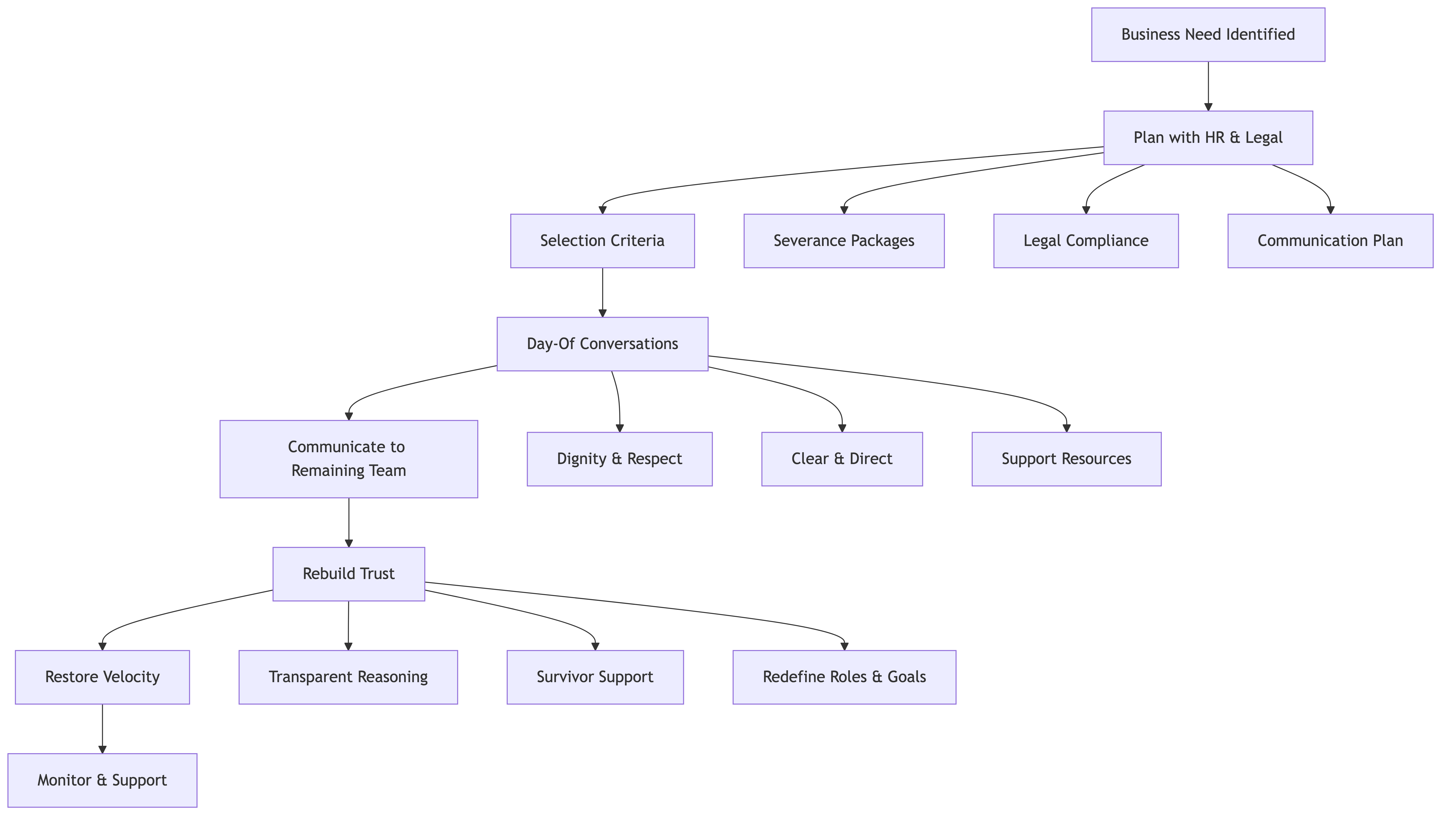
The Hardest Part of the Job
I'm going to be straight with you: this is the chapter I wish didn't need to exist. But if you're at the Director or VP level long enough, you will face this. Layoffs and reorgs affect real people's lives — their mortgages, their families, their sense of identity and self-worth. This isn't an abstraction. You're going to sit across from someone you respect, someone who did nothing wrong, and tell them their job is gone.
Take it seriously. If you ever get comfortable doing this, something has gone wrong with you.
The leaders who handle these moments well aren't the ones who are emotionless about it. They're the ones who feel the weight of it fully and still make the hard calls with clarity, compassion, and integrity. You owe it to every person affected — including yourself — to prepare thoroughly, act humanely, and follow through completely.
There's no playbook that makes this painless. But there is a difference between doing it well and doing it badly, and that difference echoes through your organization for years.
When Layoffs Are Necessary
Not every cost-cutting measure needs to result in layoffs, and your first job is to push back when layoffs are premature or avoidable. But sometimes they're genuinely necessary. The common triggers:
Business downturns. Revenue drops, funding dries up, the market shifts. The company needs to extend its runway or protect profitability. You can argue about how you got here, but once you're here, the math is the math.
Over-hiring. This one stings because it's a leadership failure. The company hired ahead of revenue that didn't materialize, or built teams for projects that got cancelled. You're unwinding someone else's optimism, and the people paying the price didn't make the decision.
Strategy pivots. The business decides to exit a market, sunset a product, or fundamentally change direction. Entire teams built around the old strategy may no longer have a role.
M&A. Mergers and acquisitions almost always create redundancy. Two platform teams, two DevOps orgs, two of everything. Integration means consolidation, and consolidation means cuts.
When to push back. Before you accept a layoff as inevitable, ask hard questions. Can you reduce contractor spend instead? Can you slow hiring rather than cut? Can you redeploy people to other teams? Can you reduce scope instead of headcount? Are there non-headcount costs that can be cut first? Push hard on these. You're the advocate for your people, and you should exhaust alternatives before agreeing to cuts.
When to accept. Sometimes the alternatives aren't sufficient. If the business genuinely cannot sustain the current headcount, delaying only makes things worse. A company that runs out of money lays off everyone. If the decision is made and you've had your say, commit to executing it well. Half-hearted execution helps no one.
One more thing: if leadership is asking for layoffs to "send a message" about performance culture or to juice short-term stock price, push back hard. Layoffs as performance management is a sign of broken systems, not strong leadership.
Planning a Layoff
Once the decision is made, planning is everything. Sloppy planning leads to legal risk, unnecessary cruelty, and lasting organizational damage.
Who's in the Room
- HR/People Ops. They'll guide the process, ensure legal compliance, manage benefits and severance, and help with communications. Lean on them heavily.
- Legal. Especially for larger layoffs that trigger WARN Act requirements, or when you're dealing with employees in multiple jurisdictions. You need legal review before any list is finalized.
- Finance. They'll define the budget targets — how much headcount needs to come out, what severance costs are approved, what the post-layoff run rate needs to be.
- Your peer leaders. If the layoff crosses organizations, you need alignment on criteria, timing, and messaging. Inconsistency across orgs creates chaos.
Keep the circle tight. The more people who know before the announcement, the higher the risk of leaks. Leaks are devastating — they create panic, rumor, and a loss of control over the narrative.
Selection Criteria
This is where it gets real. How do you decide who goes? Common approaches:
- Role elimination. Entire functions or teams are cut because the work is going away. This is the cleanest — it's about the role, not the person.
- Business need. Which skills and roles are critical to the go-forward strategy? Work backward from what the organization needs to look like, then identify the gaps.
- Performance. Using recent performance data to inform decisions. Be careful here — if your performance management system is inconsistent (and most are), you're on shaky ground.
Avoiding Bias
This is critically important and legally required. Before you finalize a list, do an adverse impact analysis. Look at the demographics of who's being cut versus who's staying. Are you disproportionately affecting any protected group — by age, gender, race, disability status? HR and legal will help with this analysis, but you need to understand it too.
Watch for subtle bias in selection. "Culture fit" concerns that correlate with demographics. Performance ratings that reflect manager bias rather than actual output. Recency bias that penalizes people who had a rough quarter but are strong overall.
If the numbers look skewed, go back and re-examine your criteria. This isn't just about legal protection — it's about doing the right thing.
Documentation
Document everything. The rationale for each decision. The business justification. The alternatives you considered. The criteria you used. Keep it factual and professional. Assume that every document you create could end up in front of a judge or a journalist. Because it might.
The Day-Of
You've done the planning. Now you have to execute. This is the day people will remember for years. Do it right.
Logistics
Timing. Do it early in the week, ideally Tuesday or Wednesday. Not Friday — that's cruel, leaving people alone with their shock over a weekend with no access to HR or support. Not Monday — you want a day to do final prep. Early in the day is better than late; it gives people time to process and ask questions.
1:1 conversations. Every affected person hears it directly from their manager in a private conversation. Not in a group. Not via email. Not by finding their access revoked before anyone told them. Their manager, face to face (or video if remote), with an HR representative present.
The conversation itself. Be direct. Don't bury the lead in small talk. Something like: "I have difficult news. Your position is being eliminated as part of a reduction in force. This is not a reflection of your performance — this is a business decision. I'm sorry."
Then: listen. Let them react. Answer what you can. Don't make promises you can't keep. Have the severance details, benefits information, and next steps ready in writing. Hand them the packet. Let them know who to contact with questions.
What not to say:
- "I know how you feel." You don't.
- "This is harder for me than it is for you." It isn't.
- "You'll land on your feet." Maybe, but that's not comforting right now.
- "It's not personal." It feels extremely personal to them.
- Anything about how this is actually an "opportunity."
What to say:
- "I'm sorry."
- "This is a business decision, not a performance decision." (Only if that's true.)
- "Here's what we're providing in terms of severance and support."
- "I'm happy to serve as a reference for you."
- "Here's who to contact with questions about benefits, severance, and logistics."
Security considerations. Work with IT to have access revocation happen simultaneously with notifications — not before. Finding out you've been laid off because your laptop is bricked is dehumanizing. Have a plan for returning equipment that doesn't involve a perp walk past former colleagues.
Remote considerations. For distributed teams, do it over video with cameras on. Mail a prepaid shipping label for equipment. Don't just disable their accounts and send an email.
Communications
After all individual conversations are done, communicate to the broader organization within hours. Don't let the rumor mill run overnight. The CEO or most senior leader should address the full company. Your engineering-specific communication should follow shortly after.
Legal Considerations
I'm not a lawyer, and neither are you. That's why you work closely with legal on every aspect of this. But you should understand the landscape.
WARN Act. The Worker Adjustment and Retraining Notification Act requires 60 days' advance notice for plant closings and mass layoffs (generally 100+ employees at a single site). Some states have their own versions with lower thresholds and longer notice periods. California's WARN Act, for example, kicks in at 50 employees. Violating WARN creates significant legal liability.
Severance. There's generally no legal requirement to offer severance (varies by jurisdiction and any existing agreements), but you should advocate strongly for it. It's the right thing to do, it reduces legal risk (severance agreements typically include a release of claims), and it affects how the remaining team views the company. Fight for the most generous package you can get — weeks of pay per year of service, benefits continuation, outplacement support.
Non-competes. If you're laying someone off and trying to enforce a non-compete, think hard about that. Many jurisdictions are restricting non-competes anyway, and enforcing one against someone you just let go is a bad look.
Benefits continuation. COBRA provides continued health insurance access, but it's expensive for the former employee. If you can extend company-paid benefits for a period beyond the last day, do it.
International employees. If you have people in other countries, the rules are completely different and often much more protective of employees. Statutory notice periods, mandatory severance, works council consultations. Get local legal counsel. Do not assume US practices apply elsewhere.
Visa holders. Employees on work visas face an especially difficult situation — they may have limited time to find new employment or face leaving the country. Work with immigration counsel to understand their options and provide additional support where possible.
Communication to Remaining Team
The people who keep their jobs are watching everything you do. They're scared, angry, sad, and guilty. They just watched friends and colleagues get walked out. They're wondering if they're next.
Your communication to the remaining team is one of the most important things you'll do as a leader. Get it right.
Be honest about what happened. "We reduced our engineering team by X people today because [honest reason]. This was a business decision driven by [actual cause]." Don't hide behind euphemisms like "right-sizing" or "optimizing our workforce." People see through corporate speak instantly, and it erodes trust.
Acknowledge the pain. "This is a hard day. We lost good people — people who contributed to what we've built. It's okay to be upset. It's okay to be angry. Take the time you need."
Explain what happens next. "Here's what we're providing to those affected: [severance, benefits, support]. Here's what the team looks like going forward. Here's what changes and what doesn't."
Address the unspoken question. "I know you're wondering if there will be more cuts. Here's what I can tell you honestly: [whatever is actually true]." If you can commit to no further cuts, do so. If you can't, say that. "I can't guarantee there won't be future changes, but this action was designed to be sufficient. We don't plan additional reductions." Honesty here is non-negotiable. If you say "no more cuts" and then do another round in three months, you will lose your team's trust permanently.
Make yourself available. Hold office hours. Do skip-levels. Be present and visible. Don't hide in your office or go dark on Slack. People need to see you, ask you questions, and feel heard.
Give people space. Don't immediately pivot to "okay, back to work!" Give people a day or two to process. Cancel non-essential meetings. Let teams talk among themselves. Grief needs room.
Rebuilding Trust and Velocity
Here's what actually happens after a layoff: productivity drops significantly for two to three months, sometimes longer. People are distracted, demoralized, and updating their resumes. The survivors are doing their own work plus absorbing work from departed colleagues. Knowledge has walked out the door. The org chart has holes in it.
This is normal. Don't panic about it. But do be intentional about rebuilding.
Provide clear direction. The single most important thing you can do is give people clarity about what matters now. Reduce the number of priorities. Kill projects that no longer make sense with the smaller team. Don't try to do the same amount of work with fewer people — that's how you burn out your survivors and trigger voluntary attrition on top of the layoff.
No more surprises. Over-communicate for the next several months. Share context you'd normally keep at the leadership level. Be transparent about business metrics, runway, and strategy. People need to feel like they can see around corners.
Invest in the remaining team. Now is the time to double down on development, recognition, and support for the people who stayed. Adjust compensation if the market or their expanded responsibilities warrant it. Promote people who are ready. Show the team that staying was the right choice.
Demonstrate stability. Avoid unnecessary process changes, tool migrations, or reorgs for a while. People crave stability after upheaval. Every additional change, no matter how well-intentioned, feels like another shoe dropping.
Watch for delayed attrition. The real cost of a layoff often comes 3-6 months later, when your strongest people — the ones with the most options — decide to leave. They were loyal enough to stay through the immediate crisis, but they've been interviewing quietly. Stay close to your key people. Have honest conversations. Address concerns before they become resignations.
Rebuild institutional knowledge. Some of what left with departed employees is in people's heads, not in docs or code. Identify the knowledge gaps and systematically fill them. This is also a good time to improve documentation practices so you're less vulnerable to knowledge loss in the future.
Reorgs Without Layoffs
Not all organizational change involves cutting people. Sometimes you need to restructure teams, change reporting lines, shift scope, or consolidate functions — without anyone losing their job. This is less dramatic than a layoff but still highly disruptive. Don't underestimate it.
Why reorgs happen. The current structure doesn't match the current strategy. Teams have grown organically and the boundaries don't make sense anymore. You need to break dependencies, consolidate platforms, or create new cross-functional teams. A new leader joins and needs to build their organization.
Communication is everything. The number one mistake in reorgs is announcing the new structure without explaining the why. People need to understand the problem the reorg is solving. If they don't understand the rationale, they'll assume it's arbitrary — or worse, political.
Walk people through the reasoning: "Here's what's not working in the current structure. Here's what we're trying to enable. Here's how the new structure addresses that." Be specific. "We're combining the platform and infrastructure teams because the current separation creates handoff overhead that's slowing down every product team" is much better than "we're streamlining for efficiency."
Involve people in the design. Where possible, get input from the people who'll be affected before finalizing the structure. You don't need consensus, but you do need to listen. People who feel consulted handle change much better than people who feel it was done to them.
Address manager changes directly. Changing someone's manager is a big deal. The manager relationship is the single biggest factor in someone's day-to-day experience. When reporting lines change, have the current manager and new manager both talk to the person. Acknowledge the transition. Don't act like it's nothing.
Handle scope changes carefully. Taking scope away from a team feels like a vote of no confidence, even if it's not. Be explicit about why scope is moving and what the team's new focus is. Frame it as a strategic choice, not a punishment.
Give it time. Reorgs take 3-6 months to fully settle. There's a period of confusion, duplicated effort, and unclear ownership that's unavoidable. Plan for it. Check in regularly and adjust as you learn what's working and what isn't.
Taking Care of Yourself
I want to talk to you directly for a moment. Laying people off takes a toll on you. Leading through a reorg is exhausting. And the expectation — sometimes spoken, sometimes not — is that you should be stoic about it. You're the leader. You need to be strong for the team.
That's partly true. Your team does need you to be steady. But "steady" doesn't mean "unaffected." You're going to carry the weight of those conversations for a long time. The look on someone's face when you told them. The person who cried. The person who got angry. The person who just went quiet.
Process it. Talk to someone — a therapist, a coach, a trusted peer outside your company, a partner. Don't bottle it up. Don't pretend you're fine when you're not.
Give yourself grace. You might not sleep well for a while. You might be short-tempered or withdrawn. You might question whether you're in the right career. All of this is normal. It means you're human.
Watch for burnout. The period after a layoff is often the busiest — you're rebuilding, re-planning, managing through the emotional aftermath. It's easy to run yourself into the ground. Take your weekends. Take your vacation. Model the sustainable behavior you want from your team.
Find meaning in doing it well. You can't change the fact that layoffs happened. But you can take real pride in handling them with dignity and compassion. That matters. The people who were let go will remember how they were treated. The people who stayed will remember how you led through it. Doing hard things well is what leadership is.
Real-World Examples
Scenario 1: The Layoff That Preserved Trust
A mid-stage startup needed to cut 20% of engineering after a funding round fell through. The VP of Engineering pushed back on the initial plan, negotiating the cut down to 15% by identifying contractor spend and non-essential projects to eliminate first. She spent a week with HR carefully building the list, running adverse impact analysis twice, and securing 12 weeks of severance plus 3 months of benefits continuation.
On the day, every affected person heard from their direct manager in a private conversation. The VP personally spoke with every senior engineer and tech lead who was impacted. The CEO addressed the company that afternoon with a clear, honest explanation. The VP followed up with an engineering-specific message acknowledging the loss and outlining the path forward.
She committed publicly to no further cuts — and kept that commitment. She cancelled two low-priority projects to ensure the remaining team wasn't overloaded. She held weekly office hours for a month. Three months later, the team had stabilized. Voluntary attrition over the next year was actually below the pre-layoff rate. People trusted that leadership had been honest and humane, and they chose to stay.
Scenario 2: The Layoff That Triggered an Exodus
A growth-stage company decided to cut 10% of engineering to hit profitability targets before a potential IPO. The CEO wanted it done fast. The list was built in two days with minimal HR involvement. Several managers found out their reports were on the list only the morning of the cuts. Severance was two weeks regardless of tenure.
Affected employees were notified in back-to-back 15-minute meetings. Several found their access revoked before their manager could reach them. The company-wide communication was a brief email full of corporate jargon about "right-sizing for the next chapter." No engineering-specific communication followed.
The VP of Engineering, who had disagreed with the approach but didn't fight hard enough, tried to move on quickly — "let's focus on the future." The remaining team read this as callousness. Within a month, the internal whisper network was in full swing. Within three months, four senior engineers and two engineering managers had resigned. The company ended up backfilling three of those roles at higher salaries. The "cost savings" from the layoff were largely wiped out by the attrition it caused, and the IPO timeline slipped by two quarters due to delivery slowdowns.
Scenario 3: The Reorg That Unlocked Growth
A Director of Engineering inherited an organization of 60 engineers split across eight teams, organized by technology layer — frontend, backend, data, infrastructure, mobile, QA, DevOps, and a "special projects" team. Every feature required coordination across 3-4 teams. Velocity was terrible. Engineers were frustrated by constant handoffs and context-switching.
The Director spent six weeks studying the problem. She interviewed every tech lead and most senior engineers. She mapped the actual communication patterns against the org chart and found massive misalignment. She proposed a move to cross-functional product teams — each team would own a product area end-to-end, with embedded frontend, backend, and mobile engineers.
She shared the proposal with the team before finalizing it, ran two feedback sessions, and incorporated meaningful changes based on input. She kept a small platform team for shared infrastructure but moved most engineers into product-aligned squads. She was transparent about the awkward transition period and set expectations that it would take a quarter to fully settle.
The first month was messy. Ownership was unclear in edge cases, and teams were still figuring out their boundaries. By month three, things were clicking. By month six, feature delivery velocity had increased by roughly 40%. Engineers reported higher satisfaction because they could see the impact of their work end-to-end. The reorg worked because the Director invested in the rationale, involved the team, and was patient with the transition.
Common Mistakes
Poor communication. Vague, corporate-speak announcements that don't explain why. Saying "right-sizing" instead of "layoffs." Leaving the remaining team without clear information about what happens next.
No severance (or insulting severance). Two weeks of severance for someone who gave you five years is a slap in the face. It also sends a clear message to the remaining team about how the company values people. Fight for generous severance. It's one of the highest-ROI investments you can make in terms of goodwill and retention.
Surprise layoffs. Layoffs that come with zero warning, in an organization that was just celebrating record growth last week. If leadership saw this coming and didn't signal it, that's a trust violation. You can't always give advance warning about specific cuts, but you can be honest about business challenges as they develop.
Not addressing survivors. Focusing all your energy on the logistics of departing employees and forgetting that the people who stayed need attention, reassurance, and a path forward. The survivors are your future. Invest in them.
Rushing back to "normal." Pushing for "business as usual" the day after a layoff. Scheduling ambitious sprint planning sessions. Setting aggressive targets. People need time to absorb what happened. Give them that time, or they'll take it anyway — just while also resenting you.
Doing multiple rounds. This is the cardinal sin. Doing a layoff, telling people it's over, and then doing another one three months later. Each subsequent round destroys exponentially more trust than the last. If you have to cut, cut once and cut deep enough. It's better to over-correct in one round than to put the team through repeated trauma. After a second round, your best people will leave because they no longer trust that it's over.
Letting managers be blindsided. Managers should never find out their reports are being let go at the same time as (or after) the affected employees. Managers need time to prepare, process, and plan the conversations. Surprising them undermines their authority and makes the delivery worse for everyone.
Ignoring the knowledge loss. Every person who leaves takes institutional knowledge with them. If you don't plan for knowledge transfer — even abbreviated, even imperfect — you'll spend months rediscovering things that someone could have documented in an afternoon.
Business Value
Let's talk about why handling layoffs and reorgs well isn't just a moral imperative — it's a business imperative.
Preserving team capability. A layoff done poorly doesn't just lose the people who were cut — it loses the people who choose to leave afterward. Thoughtful execution, generous severance, and strong communication to survivors are your best tools for keeping the team you need.
Maintaining delivery through transitions. Every week of organizational chaos is a week of missed deliverables, delayed features, and lost revenue. The faster you can stabilize — through clear priorities, realistic expectations, and emotional support — the less business impact you absorb. A well-executed layoff might cost you one quarter of reduced velocity. A poorly-executed one can cost you three or four.
Retention of key talent. Your strongest engineers are always the ones with the most options. They're watching how you handle adversity more closely than how you handle success. The way you treat departing colleagues tells them everything they need to know about how they'll be treated. A leader who handles layoffs with compassion and integrity earns loyalty that no retention bonus can buy.
Rebuilding velocity. After cuts, you're working with a smaller team. You cannot afford to lose additional people or have the remaining team operating at half capacity due to fear and demoralization. The investments you make in communication, stability, and team development in the months after a layoff directly translate to how quickly you recover your delivery capability.
Reputation. Word travels. How you handle layoffs becomes part of your company's reputation in the talent market. Former employees talk. Glassdoor reviews get written. Your ability to hire great people in the future depends partly on how you treated people on their way out. Companies known for handling hard times well actually gain a recruiting advantage — candidates trust that they'll be treated fairly no matter what happens.
The bottom line: the way you handle the hardest moments of leadership has more long-term impact on your organization's performance than almost any technical or strategic decision you'll make. Invest the time, emotional energy, and resources to do it right. The business results will follow.
Checklist: Before, During, and After
Before:
- Exhaust alternatives to layoffs (contractor cuts, hiring freezes, scope reduction)
- Assemble planning team: HR, legal, finance, peer leaders
- Define clear, defensible selection criteria
- Run adverse impact analysis
- Secure severance and benefits continuation budget
- Prepare manager talking points and FAQ documents
- Brief all managers who will deliver the news
- Coordinate IT access changes to align with notification timing
- Prepare company-wide and team-specific communications
During:
- Every person hears from their direct manager, privately, with HR present
- Deliver the news directly and with compassion
- Provide written details on severance, benefits, and next steps
- Complete all individual conversations before broader announcement
- Senior leader addresses the full company
- Engineering leader addresses the engineering organization
- Make leadership available for questions
After:
- Hold office hours and skip-levels in the first two weeks
- Reduce priorities to match reduced capacity
- Cancel or postpone non-essential initiatives
- Monitor for signs of burnout and voluntary attrition risk
- Invest in development and recognition for remaining team
- Address knowledge gaps from departures
- Check in regularly with managers on team morale
- Take care of your own well-being
Common Pitfalls
- Doing multiple rounds of layoffs. Telling people it is over and then cutting again three months later destroys trust exponentially. Cut once, cut deep enough, and commit to the decision.
- Rushing back to "normal" immediately. Pushing aggressive sprint planning and targets the day after a layoff signals callousness and guarantees the remaining team will disengage or leave.
- Poor communication using corporate euphemisms. Saying "right-sizing" instead of "layoffs" and failing to explain the real reasons erodes trust instantly because everyone sees through the language.
- Letting managers be blindsided. Managers who find out their reports are being let go at the same time as the affected employees cannot prepare emotionally or logistically, making the delivery worse for everyone.
- Not addressing the surviving team. Focusing all energy on departing employees while neglecting the people who stayed -- who are scared, grieving, and wondering if they are next -- leads to delayed voluntary attrition.
- Ignoring knowledge loss. Every departing person takes institutional knowledge with them. Failing to plan for even abbreviated knowledge transfer means spending months rediscovering what could have been documented in hours.
Key Takeaways
- Layoffs and reorgs are the hardest part of the Director/VP role. If you ever get comfortable doing them, something has gone wrong.
- Exhaust alternatives before agreeing to layoffs: contractor cuts, hiring freezes, scope reduction, non-headcount cost savings.
- Planning is everything. Work closely with HR, legal, and finance. Run adverse impact analysis. Secure generous severance.
- Every affected person hears from their direct manager in a private conversation -- never via email, group meeting, or revoked access.
- Communicate honestly and promptly to the remaining team. Address the unspoken question about whether more cuts are coming.
- After a layoff, reduce priorities to match reduced capacity. Do not try to do the same work with fewer people.
- Watch for delayed attrition 3-6 months later, especially among your strongest people. Stay close to key talent.
- Take care of yourself. Process the emotional toll with a therapist, coach, or trusted peer. Steady leadership does not mean being unaffected.