
Financial Management at Scale
Why This Matters at the Director/VP Level
Here's a truth that surprises many engineering leaders when they step into director or VP roles: you're now responsible for millions of dollars. Not just in the abstract "engineering salaries are expensive" sense. You own a budget. You make allocation decisions. You'll defend your spending to the CFO. You'll be asked to cut costs. You'll need to justify why that new platform initiative deserves $2M in investment.
Most engineers never trained for this. We learned algorithms and system design, not financial modeling and ROI analysis. But financial management is one of the most impactful levers you have at this level. How you allocate budget directly determines what your organization can build and how fast it can move.
The engineering leaders who master financial management earn enormous trust from the business. They get more budget, more headcount, and more autonomy — because they've demonstrated they can steward resources wisely. The ones who can't speak the language of finance get treated like a cost center to be minimized rather than an investment to be optimized.
Business Value
Financial literacy for engineering leaders isn't about becoming an accountant. It's about connecting engineering decisions to business outcomes in a language the whole company understands.
Resource optimization. When you understand your costs deeply, you can reallocate from low-impact work to high-impact work. I've seen VPs unlock the equivalent of 10 new hires simply by identifying and stopping work that wasn't contributing to business goals. No hiring needed — just better allocation.
Strategic credibility. When you can present an engineering initiative with a clear ROI model — "this 3M annually starting in year 2" — you get taken seriously in the C-suite. You move from being a budget line item to being a strategic partner.
Defensible budgets. Budget cuts happen. When they do, the leaders who can articulate exactly what each dollar produces are better positioned to protect critical investments. "If you cut this team, we'll lose $4M in projected revenue from the product they're building" is much more effective than "we need these people."
Growth enablement. Understanding the financial model lets you identify where additional investment would have the highest return. Instead of asking for headcount and hoping the CFO says yes, you present an investment thesis: "Here's what we'll produce with 5 additional engineers, here's the expected return, and here's when it pays back."
Efficiency gains. Cloud costs, tooling licenses, contractor spending — these add up fast. A director who actively manages these costs can free up budget for additional headcount or strategic investments without asking for more money.
Department Budgets
Let's start with the basics of what an engineering department budget looks like:
People costs (typically 70-85% of budget):
- Salaries and wages
- Benefits (health insurance, retirement contributions)
- Bonuses and equity compensation
- Contractors and consultants
- Recruiting costs (agency fees, job board subscriptions, interview expenses)
Infrastructure costs (typically 10-20% of budget):
- Cloud hosting (AWS, GCP, Azure)
- SaaS tools and licenses (GitHub, Jira, Datadog, etc.)
- Hardware and equipment
- On-premises infrastructure (if applicable)
Other costs (typically 5-10% of budget):
- Training and development (conferences, courses, books)
- Travel
- Team events and offsites
- Office space allocation (sometimes charged to engineering)
How to build a budget from scratch:
- Start with your current state. What are you spending today, across all categories?
- Layer in your strategic plan. What new investments does the roadmap require?
- Account for inflation. Salaries increase, cloud costs creep up, tool prices rise.
- Add contingency. Things always cost more than planned. A 5-10% contingency buffer is prudent.
- Create scenarios. What does the budget look like if you grow 20%? What if you need to cut 10%? Having these ready makes you look prepared and thoughtful.
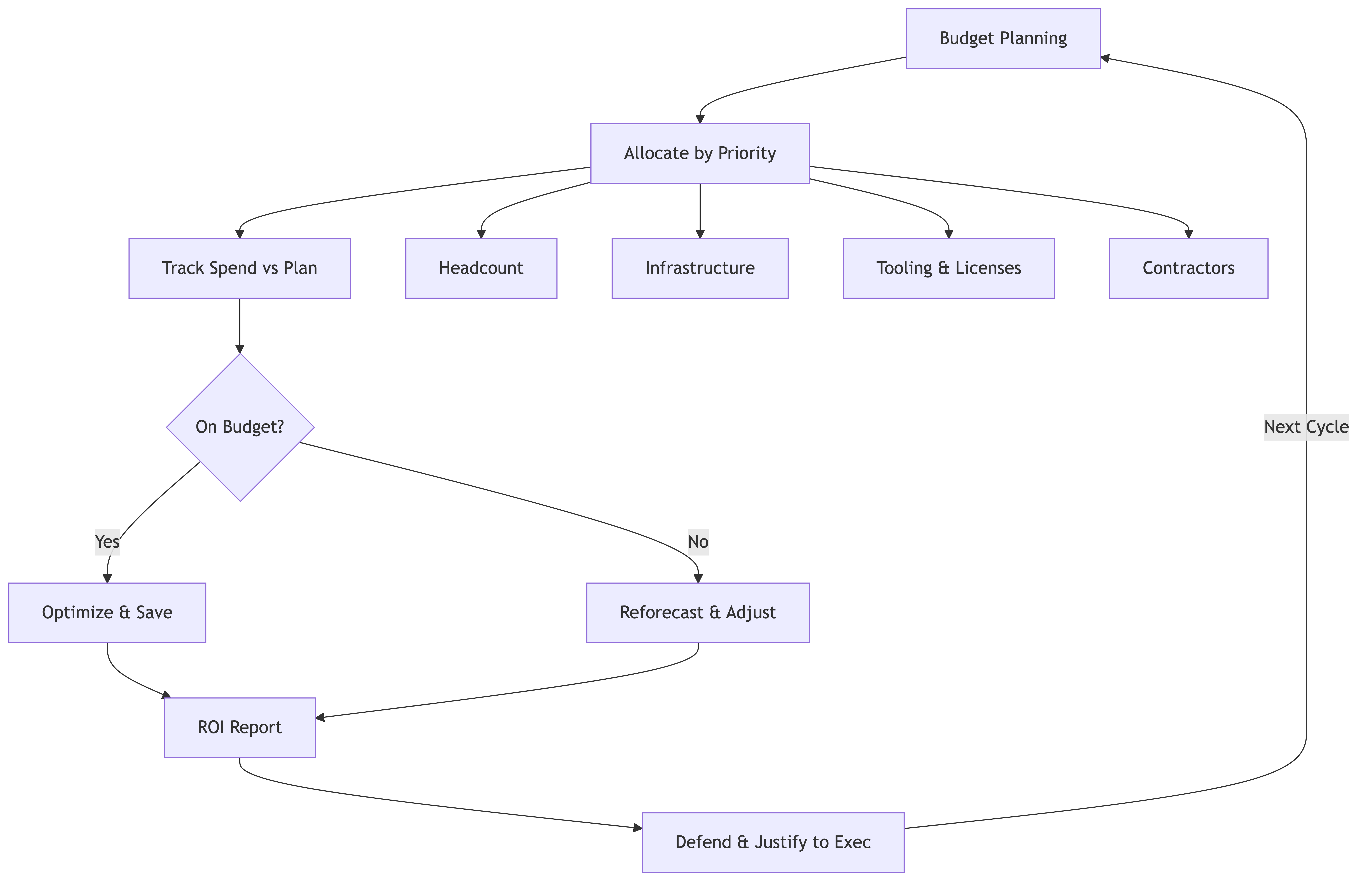
Monthly tracking matters. Don't just set a budget and forget it. Review actual spending against budget monthly. Look for variances. Are you overspending on cloud? Underspending on training? Catch trends early so you can adjust course, not scramble at year-end.
Cost Optimization Across Teams
Cost optimization isn't about cutting for its own sake. It's about getting the maximum output from every dollar you spend.
Cloud cost optimization is usually the low-hanging fruit. In almost every organization I've worked with, cloud costs are 20-40% higher than they need to be. Common culprits:
- Oversized instances running at 10-20% utilization
- Development and staging environments running 24/7 when they're only used during business hours
- Orphaned resources nobody remembers creating
- Missing reserved instance commitments for predictable workloads
- Data transfer costs nobody's monitoring
- Storage costs for data nobody's accessing
Designate an owner for cloud costs. Give them a dashboard and a mandate. Even a part- time focus on this typically yields 15-30% savings within the first quarter.
Tool consolidation. Large engineering orgs accumulate tools like moss. Three different CI/CD systems, two monitoring platforms, four different ways to manage secrets. Audit your tooling spend annually. Consolidate where you can. Negotiate enterprise agreements where you have leverage.
Contractor and vendor management. Contractors often start as temporary help and become permanent fixtures at 2-3x the cost of a full-time employee. Regularly review your contractor roster. For roles that will exist long-term, convert to FTE. For project-based work, ensure there's a clear end date and scope.
Efficiency through automation. Sometimes spending money saves money. Investing in CI/CD, automated testing, and developer tooling can dramatically increase engineering productivity. A 2M+ per year in engineering time.
Don't optimize what doesn't matter. I've seen leaders spend weeks negotiating a 500K cloud waste problem. Prioritize optimization efforts by dollar impact, not by what's easiest to cut.
ROI Frameworks for Engineering Initiatives
This is where financial management gets strategic. When you propose a new initiative — a platform rebuild, a new product, a developer experience investment — you need to be able to articulate the return on investment.
The basic ROI framework:
- Investment: What will this cost? Include people's time (usually the biggest cost), infrastructure, tools, and opportunity cost (what those people won't be building).
- Return: What do we get back? This could be revenue, cost savings, productivity gains, risk reduction, or strategic positioning.
- Timeline: When does the return materialize? A project that pays back in 6 months is very different from one that pays back in 3 years.
- Confidence: How certain are we in these estimates? Be honest about what's proven vs. what's hypothesized.
Types of returns to quantify:
Revenue impact: "This feature will enable us to enter the mid-market segment, which our sales team estimates at $5M ARR in year one."
Cost reduction: "This migration will reduce our cloud bill from 500K/month, saving $3.6M annually."
Productivity gains: "This developer platform will save each engineer 5 hours per week, equivalent to adding 12 FTEs at our current team size."
Risk mitigation: "Our current system has a 10% annual probability of a major outage that would cost $2M. This investment reduces that to less than 1%."
How to present ROI to non-engineers:
- Lead with the business outcome, not the technical solution
- Use dollars, not story points or velocity
- Show the cost of doing nothing (this is often more persuasive than the benefit of doing something)
- Acknowledge uncertainty explicitly — provide ranges, not point estimates
- Compare to alternatives — "We could also do X, which costs less but delivers less"
Engineering as Investment, Not Cost Center
This is a mindset shift you need to drive in your organization, and it's one of the most important things you can do as an engineering leader.
The cost center mindset says: "Engineering costs us $20M per year. How do we reduce that?" It leads to headcount cuts, offshore outsourcing to the lowest bidder, and constant pressure to do more with less. It treats engineers like interchangeable resources and engineering like a commodity.
The investment mindset says: "We invest $20M per year in engineering. What return are we getting, and how do we improve that return?" It leads to strategic allocation, investment in high-ROI initiatives, and thoughtful decisions about where to increase or decrease investment.
How to drive this shift:
- Always tie engineering work to business outcomes. Don't present your roadmap as a list of features — present it as a portfolio of investments with expected returns.
- Proactively share metrics that show engineering's impact on revenue, customer satisfaction, and cost efficiency.
- When presenting budgets, use investment language. "I'm requesting 8M in outage-related customer churn" hits differently than "I need $3M for reliability improvements."
- Celebrate engineering wins in business terms. "The search team's work increased conversion by 12%, adding $4M in annual revenue" is more impactful than "the search team shipped 47 features."
The compound effect: When the business sees engineering as an investment, they invest more. When they invest more, engineering delivers more. When engineering delivers more, the business sees engineering as an investment. This is the virtuous cycle you want to create.
Funding Models
How you fund engineering work has profound implications for how work gets done. There are two primary models, each with significant trade-offs.
Project-Based Funding
How it works: Budget is allocated to specific projects or initiatives. Teams are assembled for each project and dissolved (or reassembled) when it's done.
Advantages:
- Clear connection between spending and outcomes
- Easy to prioritize — fund the highest-value projects
- Flexibility to shift resources as priorities change
- Finance teams like it because it maps to business cases
Disadvantages:
- Creates constant team churn as people move between projects
- Discourages investment in long-term capabilities (no project to charge it to)
- Makes it hard to build deep expertise in a domain
- Ramp-up costs are high when teams reform for each project
- Technical debt accumulates because nobody "owns" the codebase long-term
Team-Based Funding
How it works: Budget is allocated to stable teams that own a domain or capability. Teams have a persistent mission and choose work that advances it.
Advantages:
- Teams build deep expertise and ownership
- Lower coordination costs — no constant team reformation
- Encourages long-term thinking (investing in quality, paying down tech debt)
- Better for retention — people build relationships and identity with their team
- Higher productivity due to accumulated context
Disadvantages:
- Harder to tie spending to specific outcomes
- Risk of teams becoming territorial or working on low-value items
- Less flexibility to shift resources to hot priorities
- Can feel like "feeding the machine" without clear ROI
The Pragmatic Approach
Most successful organizations use a hybrid. The majority of engineering (70-80%) is team-funded, providing stability and deep ownership. A smaller portion (20-30%) is project-funded, creating the flexibility to staff up cross-cutting initiatives, explore new opportunities, or respond to urgent competitive threats.
The key insight: team-based funding doesn't mean teams do whatever they want. Teams still have OKRs, roadmaps, and priorities set in collaboration with product and business leadership. But the team persists even as the specific work changes, which preserves context, relationships, and efficiency.
Budget Defense During Cuts
At some point, you will be asked to cut your budget. An economic downturn, a missed quarter, a strategic pivot — the reason varies, but the experience is universal. How you handle it determines whether you protect your critical capabilities or get cut indiscriminately.
Preparation is everything. The time to prepare for budget cuts is before they happen. If you've been tracking ROI, maintaining clear priority frameworks, and communicating engineering's value in business terms, you're in a much stronger position when cuts come.
Know your tiers. Before you're asked to cut, know what you'd cut. Categorize your spending into tiers:
- Tier 1 — Must keep: Work that directly generates revenue, keeps the lights on, or addresses critical risks. Cutting this would directly impact the business.
- Tier 2 — Should keep: Work that improves efficiency, reduces future costs, or positions you for growth. Valuable but deferrable.
- Tier 3 — Nice to have: Exploratory work, nice-to-have improvements, speculative investments. Valuable if you can afford it, but survivable without.
Present options, not protests. When the CFO says "cut 15%," don't argue that you can't. Present options: "Here are three ways to cut 15%, with the impact of each." This shows maturity and gives decision-makers the information they need. Include:
- What work stops
- What revenue or capability is at risk
- What the timeline for recovery looks like if investment is restored
Protect people over projects. Laying off engineers is the most expensive kind of cut because you lose knowledge, relationships, and recruiting investment. Before cutting headcount, look for other places to save: reduce cloud costs, cut contractor spend, consolidate tools, defer equipment purchases, reduce travel. These are all reversible. Layoffs are not.
Be transparent with your team. Engineers are smart and they'll figure out that cuts are happening whether you tell them or not. Be honest about the situation, the decisions you've made, and why. People can handle hard news. They can't handle uncertainty and dishonesty.
Use cuts as an opportunity to focus. This sounds like corporate BS, but there's truth in it. Many engineering orgs are spread too thin across too many initiatives. A budget cut forces you to prioritize ruthlessly, which sometimes results in higher impact despite fewer resources. The constraint breeds focus.
Financial Literacy for Engineering Leaders
You don't need an MBA, but you need to speak the language. Here are the concepts every director and VP should understand:
CapEx vs. OpEx. Capital expenditure (CapEx) is spending on long-term assets and gets amortized over time. Operating expenditure (OpEx) is ongoing spending that's expensed immediately. This matters because CapEx and OpEx affect financial statements differently, and your CFO cares a lot about which category your spending falls into. Cloud computing shifted a lot of engineering spend from CapEx (buying servers) to OpEx (renting compute), which had major financial reporting implications.
Software capitalization. Under accounting rules (ASC 350-40), some software development costs can be capitalized — treated as an asset on the balance sheet rather than an expense on the income statement. This is relevant because it affects how your engineering spend shows up in financial reporting. Talk to your finance team about what qualifies; it varies by activity type and project stage.
Unit economics. Understand the cost to acquire a customer (CAC), the lifetime value of a customer (LTV), and the gross margin of your product. These numbers help you frame engineering investments in business terms. "This initiative reduces our cost to serve by 15%, improving gross margin by 3 points" is a language the board understands.
Burn rate and runway. Especially important at startups and growth-stage companies. How fast are you spending money, and how long until it runs out? Engineering is usually the largest cost center, so your spending directly impacts runway. Understand how your decisions affect the company's financial position.
Total cost of ownership (TCO). When evaluating build-vs-buy decisions, technology choices, or infrastructure investments, consider the full cost over time: initial development, ongoing maintenance, operational costs, opportunity cost, and eventual migration or replacement cost. The cheapest option upfront is rarely the cheapest option over 3-5 years.
Depreciation and amortization. When you capitalize software development costs, they get amortized over a useful life (typically 3-5 years). Understanding this helps you understand how today's investments affect future financial statements.
Real-World Examples
Example 1: The Cloud Cost Wake-Up Call
A VP of Engineering at a Series C startup was burning $1.2M per month on AWS. The board was asking questions. She launched a focused cloud optimization initiative:
Week 1-2: Audit. Turned out 35% of EC2 instances were running at less than 10% utilization. Eight development environments from old projects were still running 24/7. Nobody had bought reserved instances for their predictable production workloads.
Week 3-4: Quick wins. Right-sized instances, shut down orphaned environments, set up auto-scaling for development environments (on during business hours, off at night and weekends).
Month 2: Strategic moves. Committed to 1-year reserved instances for production workloads. Migrated three services from expensive managed databases to more appropriate options. Implemented cost tagging so every dollar could be attributed to a team.
Month 3: Governance. Set up cost budgets and alerts by team. Added cloud cost review to monthly engineering reviews. Created a "cloud cost champion" rotation where engineers took turns optimizing their team's spending.
Result: Monthly cloud spend dropped from 740K — a 38% reduction. The $5.5M in annual savings funded 15 additional engineering hires without increasing the overall budget. The board was thrilled.
Example 2: Engineering as Investment
A director at an enterprise SaaS company was frustrated that engineering was always seen as a cost to be minimized. Every budget cycle was a fight. His approach:
He started tracking and reporting "engineering ROI" quarterly. For every initiative, he tracked the investment (engineering hours at loaded cost) and the return (revenue attributed, costs saved, or efficiency gained). He presented these in business review meetings alongside sales and marketing ROI.
After two quarters, the narrative shifted. The CEO started talking about "investing in engineering" instead of "engineering costs." When the next budget cycle came, the director presented his top 5 proposed investments with expected ROI, ranked by return. He got a 20% budget increase — while other departments were asked to cut — because he could show that every dollar invested in engineering produced $3-4 in value.
Example 3: Surviving a 25% Budget Cut
A VP at a public tech company was told to reduce engineering spend by 25% after a missed earnings quarter. Her approach:
She had already categorized her portfolio into tiers. Tier 3 work (exploratory projects, low-priority improvements) represented about 10% of spend. She cut all of it immediately.
For the remaining 15%, she negotiated: she'd reduce contractor spend (converting two critical contractors to FTE at lower total cost and ending three others), renegotiate three major tool contracts (saving 30% by consolidating and committing to multi-year deals), and optimize cloud costs. This got her to about 20%.
For the final 5%, she proposed delaying one product initiative by a quarter (not canceling it), which freed up the team to absorb work from a team she was sunsetting.
Total headcount impact: 4 layoffs (from the sunsetted team) out of 120 engineers. Compared to the company average of 15% headcount reduction, her org lost 3%. She achieved this because she could show the business impact of every cut and propose alternatives that preserved capability while hitting the financial target.
Common Mistakes
Mistake 1: Not knowing your numbers. If your CFO asks "what does your team cost per quarter?" and you can't answer within 5 minutes, you're not managing your finances — they're managing you. Know your total spend, your cost per engineer (loaded), your infrastructure costs, and your major vendor commitments.
Mistake 2: Treating budget as someone else's job. "Finance handles the budget" is an abdication. You are the business owner of your engineering spend. Finance provides the framework and governance, but you own the allocation and optimization.
Mistake 3: Ignoring infrastructure costs because they're "small." They creep up. I've watched cloud bills go from 500K/month over two years without anyone noticing because nobody was watching. Infrastructure cost growth should be tracked against revenue growth. If costs are growing faster than revenue, you have a problem.
Mistake 4: Making headcount the only lever. When asked to save money, many leaders immediately jump to "I need to lay people off." Headcount is the most expensive line item, but it's also the hardest to reverse and the most damaging to cut. Always explore non-headcount savings first.
Mistake 5: Not building relationships with finance. Your CFO and FP&A team are allies, not adversaries. Build relationships with them. Understand their pressures and constraints. When you have a strong relationship with finance, budget conversations are collaborative rather than adversarial.
Mistake 6: Gold-plating ROI estimates. If you inflate the expected returns of your initiatives and then don't deliver, you lose credibility. Be honest and conservative in your projections. It's better to under-promise and over-deliver. If you said an initiative would save 1.5M, you look like a hero. If you said it would save 1.5M, you look unreliable.
Mistake 7: Failing to account for opportunity cost. Every engineer working on Project A is an engineer not working on Project B. When evaluating initiatives, don't just ask "is this worth doing?" Ask "is this the most valuable thing these people could be doing?" The answer is sometimes no, even for genuinely good projects.
Mistake 8: Annual budgeting as a one-time event. A budget set in January is based on January's assumptions. By June, the world has changed. Review and adjust quarterly at minimum. Build relationships with finance that allow for mid-year reallocation when priorities shift.
Mistake 9: Not investing in financial literacy for your managers. Your front-line managers should understand the basics too — the cost of their team, the value their team produces, and how to make cost-conscious decisions. If only you understand the financials, you become a bottleneck for every spending decision.
Closing Thought
Financial management at the director and VP level is ultimately about one thing: ensuring that every dollar your organization spends creates more than a dollar of value. That's the standard. Not "we spent less than last year" — but "we generated more value per dollar than last year."
When you master this, something remarkable happens. Budget conversations stop being adversarial negotiations and start being strategic planning sessions. You stop defending your costs and start proposing investments. The business stops seeing engineering as an expense to be managed and starts seeing it as a capability to be grown.
That shift — from cost center to investment engine — is one of the most impactful things you can accomplish as an engineering leader. It changes not just how your org is funded, but how your people feel about their work. Engineers in a cost-center culture feel like overhead. Engineers in an investment culture feel like they matter. And they deliver accordingly.
Common Pitfalls
- Not knowing your numbers. If you cannot answer basic questions about team cost, cost per engineer, and major vendor commitments within minutes, you are not managing your finances -- they are managing you.
- Treating budget as someone else's job. Deferring financial management to the finance team is an abdication of your role as the business owner of engineering spend.
- Making headcount the only cost-cutting lever. Jumping to layoffs when asked to save money, without first exploring cloud optimization, contractor reduction, and tool consolidation, destroys capability unnecessarily.
- Gold-plating ROI estimates. Inflating expected returns to get initiatives approved and then under-delivering destroys credibility with finance and executives. Be honest and conservative.
- Ignoring infrastructure cost creep. Cloud bills that grow faster than revenue without anyone noticing create a crisis that could have been prevented with regular tracking.
- Annual budgeting as a one-time event. A budget set in January is based on January's assumptions. Failing to review and adjust quarterly means operating on stale data for most of the year.
Key Takeaways
- Financial management is one of the highest-leverage skills at the Director/VP level. How you allocate budget directly determines what your organization can build.
- People costs are 70-85% of engineering budget. Infrastructure is 10-20%. Track both rigorously.
- Cloud cost optimization is almost always the lowest-hanging fruit, typically yielding 20-40% savings.
- Frame engineering work as investment with expected returns, not as a cost to be minimized. This shifts the entire organizational narrative.
- Build ROI frameworks for every major initiative: investment, return, timeline, and confidence level.
- Use a hybrid funding model: 70-80% team-based for stability, 20-30% project-based for flexibility.
- Prepare for budget cuts before they happen by categorizing spending into must-keep, should-keep, and nice-to-have tiers.
- Build strong relationships with finance. When the CFO trusts you, budget conversations become collaborative instead of adversarial.