
Organizational Politics & Influence
Why This Matters at the Director/VP Level
Here is the uncomfortable truth that nobody tells you on the way up: the quality of your technical decisions stopped being the primary factor in your success a while ago. At the Director/VP level, your ability to navigate organizational politics and wield influence determines whether your best ideas ever see the light of day. You can have the most brilliant engineering strategy in the company, but if you cannot get it funded, staffed, and supported by your peers, it dies in a slide deck.
This is not about being manipulative. This is about understanding how large organizations actually function and learning to operate effectively within that reality.
1. Politics Is Not a Dirty Word
Let's get this out of the way early: if you recoil at the word "politics," you are going to have a very difficult time at this level.
Politics, at its core, is simply the process by which groups of people make decisions. Every organization has limited resources — headcount, budget, executive attention, runway. Politics is the mechanism through which those resources get allocated. It is not inherently good or bad. It just is.
Here is what happens when engineering leaders decide they are "above politics":
- Their teams get underfunded because nobody advocated for them in the budget meeting.
- Their initiatives get deprioritized because a peer VP who does engage politically framed their project as more strategically important.
- Reorgs happen to them rather than being shaped by them.
- They are the last to know about major company decisions.
Ignoring politics does not make it go away. It just means decisions happen without you. And those decisions — about headcount, about priorities, about organizational structure — directly affect every person on your team. You owe it to them to be in the room and to be effective when you are there.
The shift in mindset you need to make is this: engaging in organizational politics is not a distraction from your job. At this level, it is a core part of your job.
2. Power Dynamics
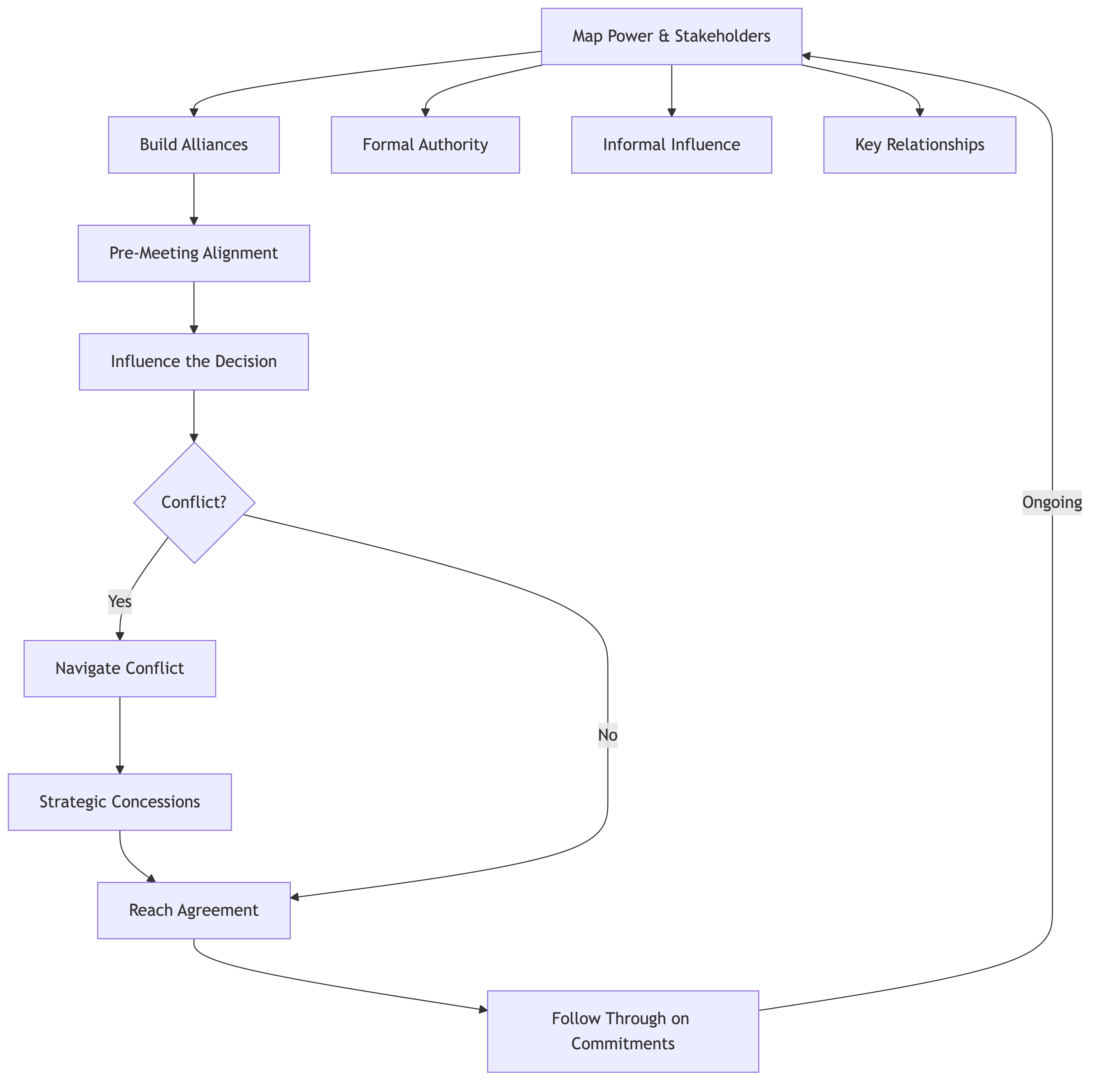
Before you can navigate the political landscape, you need to understand it. And that starts with mapping power — both formal and informal.
Formal Power
Formal power is the org chart. It is titles, reporting lines, budget authority, and decision rights. It is easy to see and straightforward to understand. The CEO has formal power over VPs. The CFO has formal power over budgets. Your skip-level has formal power over their direct reports.
But if you think the org chart tells you how decisions actually get made, you are missing most of the picture.
Informal Power
Informal power is where things get interesting. Ask yourself:
- Who does the CEO actually listen to? It is not always the most senior person. Sometimes it is a founder who stepped back from an executive role but still has enormous influence. Sometimes it is a board member who weighs in on Slack.
- Who controls information flow? The chief of staff who manages the CEO's calendar and pre-reads has enormous informal power. So does the person who runs the weekly metrics review.
- Who has relationship capital? The VP of Product who has been at the company for eight years and hired half the leadership team has a kind of influence that a newly hired VP of Engineering simply does not, regardless of title.
- Who has expertise authority? The principal engineer who is the only person who deeply understands the core platform has power that no org chart reflects.
Mapping the Landscape
Spend your first 90 days in any new role (and periodically after that) mapping both formal and informal power:
- Who makes the decisions you care about? Not who should make them — who actually does.
- Who influences those decision-makers? Who do they go to for advice? Who do they trust?
- Where are the alliances? Which executives tend to support each other? Which ones are in tension?
- What are the incentives? How are your peers measured? What are they trying to achieve this year? Understanding their goals helps you understand their behavior.
Write this down. Keep it updated. It is one of the most valuable artifacts you will create, and it is one you will never share with anyone.
3. Building Alliances
At the Director/VP level, you cannot accomplish anything of significance alone. Your biggest initiatives will require buy-in from product leadership, support from finance, alignment with other engineering leaders, and often the explicit backing of the CEO. You need allies.
Why Alliances Matter
The most important thing about allies is this: they support you in rooms you are not in.
You will not be in every meeting where your team's work is discussed. You will not be present for every budget conversation, every prioritization debate, every reorg discussion. Your allies are the people who will say, "Actually, I think what the engineering team is proposing makes a lot of sense, and here is why," when you are not there to say it yourself.
Key Relationships to Build
Your peer engineering leaders. If you are one of several engineering Directors or VPs, your relationship with your peers is critical. You need to be able to disagree in private and present a unified front in public. You need to be able to trade favors — you support their initiative this quarter, they support yours next quarter.
Product leadership. Your relationship with the VP/CPO of Product is arguably your most important peer relationship. When engineering and product leadership are aligned, things get done. When they are in conflict, the whole organization suffers. Invest heavily here. Have regular one-on-ones. Build genuine trust.
The CFO and finance team. They control the budget. If the CFO does not understand the value of your engineering investments, you will lose every resource negotiation. Learn to speak their language. Translate engineering work into business outcomes and financial impact.
The CEO. Understand what the CEO cares about. Align your messaging to those priorities. Be the engineering leader who makes the CEO feel confident that technology is in good hands. That confidence translates into trust, and trust translates into resources and autonomy.
HR/People leadership. When you need to restructure your org, retain critical talent with out-of-cycle compensation, or navigate a difficult personnel situation, your relationship with the head of People matters enormously.
How to Build These Relationships
- Be genuinely curious about their problems. Do not approach every interaction with an agenda. Learn what keeps them up at night.
- Deliver on your commitments. Nothing builds trust faster than consistently doing what you said you would do.
- Share information generously. Give people early warning about things that will affect them. Nobody likes surprises.
- Be helpful without keeping score. Help when you can, even when there is no immediate benefit to you. Over time, this creates a reservoir of goodwill.
- Have real conversations. Grab coffee. Have dinner. Talk about things other than work. Relationships built on genuine human connection are far stronger than transactional ones.
4. Influence at the Executive Level
Getting your initiatives prioritized in a room full of smart, ambitious executives with their own priorities is an art. Here are the levers you have.
Data
Come with evidence, not opinions. "I think we should invest in platform reliability" is weak. "We lost $2.3M in revenue last quarter due to outages, and our reliability metrics are trending in the wrong direction — here is the data" is strong.
But data alone is not enough. Everyone at the executive level can marshal data to support their position. What matters is how you frame the data and what story you tell with it.
Relationships
If you have invested in building alliances (see above), you can walk into a meeting knowing that two or three other executives already understand and support your position. This changes the dynamic completely. Instead of one person pitching against headwinds, you have a coalition.
Timing
Timing matters more than most people realize. The best time to pitch a major infrastructure investment is right after a high-profile outage, when the pain is fresh. The best time to ask for additional headcount is when the company just closed a strong quarter and leadership is feeling optimistic. The worst time to ask for anything is when the company just missed its numbers and everyone is in cost-cutting mode.
Read the room. Read the moment. Adjust your timing accordingly.
Framing
How you frame an initiative determines how people react to it. Compare:
- "We need to rewrite our payment system" (sounds expensive and risky).
- "We can unlock $15M in annual revenue by modernizing our payment infrastructure to support the three new markets the business wants to enter" (sounds like a growth investment).
Same project. Completely different reception. Frame your initiatives in terms of the outcomes that matter to your audience. For the CEO, that might be growth. For the CFO, that might be cost efficiency. For the CPO, that might be customer experience. Adjust your framing based on who you are talking to.
The Art of the Pre-Meeting
This is important enough that it gets its own section below, but it bears mentioning here: the most effective influencing happens before the meeting where the decision is made, not during it.
5. Navigating Conflict Between Executives
You will disagree with your peer executives. The VP of Product will want to ship faster than you think is safe. The VP of Sales will promise features to clients that your team cannot deliver on the timeline they committed to. The CFO will want to cut your budget in ways you think are shortsighted.
This is normal. How you handle these disagreements defines your reputation and your effectiveness.
Principles for Navigating Peer Conflict
Assume good intent. Your peer VP of Product is not trying to sabotage engineering. They are trying to hit their targets, just like you are trying to hit yours. Start from the assumption that you are both trying to do the right thing and you simply see the situation differently.
Engage directly. When you disagree with a peer, go talk to them directly. Do not complain about them to the CEO. Do not send a passive-aggressive email to a broad distribution list. Walk over to their office (or get on a call) and have an honest conversation.
Seek to understand before seeking to be understood. Before you make your case, genuinely try to understand theirs. What are they optimizing for? What constraints are they operating under that you might not see? Often, the disagreement looks different once you understand the full picture.
Find the shared objective. You and your peer VP almost certainly share a higher-level goal — growing the business, serving customers well, building a great company. Reframe the disagreement in terms of that shared objective. "We both want to grow revenue. I am concerned that if we ship at this quality level, we will actually lose customers. Can we find an approach that lets us move fast and maintain the quality bar?"
Escalate thoughtfully. Sometimes you cannot resolve a disagreement with a peer, and you need to involve your shared manager (often the CEO). This is okay, but do it sparingly and do it right. Before you escalate, make sure you have genuinely tried to resolve it directly. When you do escalate, present both perspectives fairly. Say, "Here is what Sarah and I have been discussing. We see it differently, and we need your help deciding." Do not ambush your peer by escalating without telling them.
Disagree and commit. If a decision goes against you, commit to it fully. Do not sabotage. Do not say "I told you so" if it goes wrong. Execute with the same energy you would have if it had been your idea. This builds enormous trust and political capital.
6. Protecting Your Organization
Part of your job as a Director/VP is protecting your team from organizational forces that could harm them — budget cuts, poorly conceived reorgs, scope grabs by other teams, arbitrary mandates from above.
This is a delicate balance. You need to protect your team without being seen as territorial, defensive, or obstructionist.
Budget Cuts
When budget cuts come (and they will), your job is to ensure your team takes a fair share of the pain — not more and not less. This requires:
- Having a clear narrative about the value your team delivers. If you cannot articulate why your team exists and what business outcomes it drives, you are vulnerable.
- Knowing which of your projects are must-haves versus nice-to-haves. When cuts come, you should already know what you would cut. Having a thoughtful plan makes you look competent and makes it less likely that someone else will make those decisions for you.
- Building relationships with finance before you need them. If the CFO trusts you and believes you run an efficient organization, they will work with you rather than impose cuts on you.
Reorgs
Reorgs are one of the most politically charged events in any organization. When a reorg is coming, you want to be involved in shaping it, not reacting to it. This means:
- Having your ear to the ground. If you have built strong relationships across the organization, you will usually hear about a reorg before it is announced.
- Proposing rather than reacting. If you sense a reorg is coming, proactively propose a structure that serves both the business and your team well. It is much easier to influence a reorg when you are proposing the plan than when you are trying to modify someone else's plan.
Scope Grabs
Sometimes another team will try to take over work that your team currently owns. This might be explicit ("We think the data team should own the ML platform") or subtle (they just start building it without telling you).
Handle this by having a direct conversation with the other leader. Understand their motivation. Often, a scope grab happens because they feel your team is not meeting their needs. If that is the case, you have a product problem to solve, not a political one. Sometimes the right answer is to let them have the scope — if it makes sense for the business and you can redeploy your team to higher-value work.
But if you believe the scope grab is wrong for the organization, make your case clearly and escalate if needed. Frame it in terms of what is best for the company, not in terms of protecting your turf.
7. The Pre-Meeting
If there is one tactical skill that separates effective executive leaders from ineffective ones, it is the pre-meeting.
The pre-meeting is simple in concept: before any important meeting where a decision will be made, you meet individually with the key stakeholders to discuss the topic, understand their perspective, share yours, and work through objections.
Why Pre-Meetings Work
They eliminate surprises. Nobody likes being surprised in a meeting. When someone hears a proposal for the first time in a large group, their instinct is often to push back or ask for more time. When they have heard it before and had a chance to process it, they are much more likely to be supportive.
They let you iterate on your proposal. When you pre-meet with the CFO and she raises a concern about the cost model, you can adjust your proposal before the big meeting. When you pre-meet with the VP of Product and he suggests a different framing, you can incorporate it. By the time you present in the actual meeting, your proposal has already been refined by the input of the key stakeholders.
They reveal opposition early. If the VP of Sales is going to oppose your proposal, you want to know that before the meeting, not during it. A pre-meeting lets you either address their concerns or at least prepare for the objection.
They build commitment. When someone has contributed to shaping a proposal in a pre-meeting, they feel ownership of it. They are much more likely to support it in the actual meeting because it is partly their idea.
How to Pre-Meet Effectively
- Identify the key stakeholders. Who has a vote (formal or informal) on this decision? Who could block it? Who could champion it?
- Meet with them one-on-one. Share your thinking. Be genuinely open to their input. Ask questions. Listen.
- Incorporate their feedback. Adjust your proposal based on what you learn. Let them know you did. "I updated the timeline based on your feedback" makes them an ally.
- If you discover a blocker, resolve it before the meeting. If you cannot resolve it, at least go into the meeting knowing it is coming.
- In the actual meeting, there should be no surprises. The decision should feel almost pre-ordained, because in a sense, it has been made through the series of pre-meetings.
The most effective executives I have worked with rarely make a major proposal without having pre-met with every key stakeholder. The meeting itself becomes a formality — a place to ratify a decision that has already been effectively made. This is not manipulation. This is good leadership.
8. When to Fight and When to Concede
You will face many battles at the executive level. Resource allocation, technical strategy, organizational structure, hiring priorities, vendor decisions — the list goes on. You cannot fight every battle and win. More importantly, you should not try.
When to Fight
Fight when:
- The decision directly affects your team's ability to deliver on their commitments. If someone is trying to take away resources you need to hit your goals, that is worth fighting for.
- You have deep conviction backed by evidence. If you genuinely believe a decision will harm the company, and you have the data and experience to support your position, fight for it.
- The precedent matters. Sometimes a small decision sets a precedent that will cause bigger problems later. It might be worth fighting a small battle to prevent a larger one.
When to Concede
Concede when:
- The issue is not strategically important to you. If the outcome does not significantly affect your team or your priorities, let it go. Let someone else win.
- You are going to lose anyway. If the decision-maker has already made up their mind and you do not have enough support to change the outcome, concede gracefully. Fighting a losing battle just spends political capital with no return.
- The relationship matters more than the outcome. Sometimes conceding to a peer on something they care deeply about builds goodwill that you can draw on later for something you care about.
- You are wrong. Be honest with yourself. Sometimes the other person has the better argument. Conceding when you realize you are wrong builds enormous credibility.
Strategic Concessions
The most politically sophisticated leaders treat concessions as investments. They concede on things that matter less to them in order to build political capital for when something really matters.
"I supported your initiative last quarter even though it cost my team significant effort. Now I need your support on this one." You never say it this directly, of course. But the dynamic is real, and effective leaders understand it.
The key is to be intentional. Know what you are willing to concede on before you enter a negotiation. Know what your non-negotiables are. And when you concede, do it generously — do not make the other person feel like they had to drag it out of you.
9. Real-World Examples
The Leader Who Navigated Politics Well
Maria was the VP of Engineering at a mid-stage company that had just hired a new CEO. The new CEO came from a sales background and was skeptical of the engineering team's velocity. Several of Maria's peers were positioning themselves to take over parts of her scope.
Maria did three things. First, she did not get defensive. She met with the new CEO weekly and asked genuine questions about what he needed from engineering. She listened to his concerns about velocity and presented data that contextualized the team's output — not to argue, but to educate.
Second, she built an alliance with the new VP of Product, who had been hired around the same time. They aligned their roadmaps and presented a unified front to the CEO. Instead of engineering and product being in tension, they were a coalition.
Third, she proactively proposed a restructuring of her own organization that addressed several of the CEO's concerns. By proposing the change herself, she controlled the narrative and the outcome. The reorg improved velocity, the CEO's confidence in engineering grew, and the scope grabs from her peers quietly went away because there was no longer a perceived problem to solve.
The Leader Who Ignored Politics and Lost Their Team
David was a brilliant engineering leader who had built an exceptional platform team. He believed his work should speak for itself. He rarely attended cross-functional leadership meetings, did not invest in relationships with the product or sales leadership, and openly expressed disdain for "office politics."
When the company hit a rough quarter and needed to cut costs, David's platform team was an easy target. The VP of Product, who David had never built a relationship with, argued that the platform work could be absorbed by the product engineering teams. The CFO, who did not understand the value of the platform team because David had never explained it in business terms, agreed.
David's team was disbanded. Not because the work was not valuable — it was critical infrastructure that the product teams struggled to maintain for years afterward. But because David had no allies in the room where the decision was made. Nobody advocated for his team because he had never invested in the relationships that would have given him advocates.
The Alliance That Enabled a Major Initiative
Chen, a VP of Engineering, wanted to invest heavily in a new data platform that would take 18 months to build and require a significant headcount investment. He knew he could not get this approved through a straightforward budget request.
He started by having coffee with the VP of Sales, who had been complaining about the quality of customer data available to the sales team. Chen showed her how the new data platform would solve her problem. She became an enthusiastic advocate.
Next, he worked with the VP of Product to identify three product features that were currently impossible but would become straightforward with the new platform. The VP of Product incorporated those features into her product roadmap, which meant the data platform became a dependency for product commitments that had already been socialized with the CEO.
Finally, he met with the CFO and presented the initiative not as an engineering infrastructure project (which would have been seen as a cost center) but as the foundation for a data-driven sales strategy and a new product capability. He brought the VP of Sales and VP of Product to the meeting, and they co-presented the business case.
The initiative was approved. Chen got even more headcount than he originally planned to ask for, because the business case, supported by three executives, was so compelling. This did not happen because of a great slide deck. It happened because of months of relationship building, pre-meetings, and strategic alliance formation.
10. Common Mistakes
Ignoring Politics Entirely
"I just want to build great software and let my work speak for itself." This is noble, and it works when you are an individual contributor or a first-line manager. At the Director/VP level, it is career-limiting and, more importantly, harmful to your team. Your team needs you to be politically effective. Their headcount, their projects, their career growth all depend on your ability to secure resources and support from the broader organization.
Being Too Political
The opposite failure mode is being perceived as manipulative, self-serving, or untrustworthy. If people feel like every interaction with you is transactional, if you are constantly maneuvering for advantage, if you take credit for others' work or throw people under the bus, you will destroy your credibility. Effective organizational politics is built on genuine relationships, not manipulation. There is a line, and you need to stay on the right side of it.
Not Building Relationships Proactively
Many leaders only invest in relationships when they need something. This is too late. The time to build a relationship with the CFO is not when you need a budget increase — it is six months before that, when you have nothing to ask for and can simply be curious about their world. Relationships built under pressure feel transactional. Relationships built over time feel genuine, because they are.
Fighting Every Battle
Some leaders treat every disagreement as a hill to die on. They fight for every headcount, push back on every request, escalate every conflict. Over time, this makes them exhausting to work with. Their peers stop engaging, their manager stops listening, and their influence erodes. Save your fights for the things that truly matter.
Going Around Peers
When you disagree with a peer, it is tempting to go straight to your shared manager (usually the CEO) and plead your case. Do this more than once or twice and you will develop a reputation for being difficult and politically immature. Always try to resolve disagreements directly with your peer first. Escalate only when you have genuinely tried and failed, and even then, be transparent with your peer that you are escalating. Ambushing a peer by going to the CEO behind their back is a relationship-destroying move that you will pay for many times over.
Business Value
Why does all of this matter? Because organizational politics and influence directly drive business outcomes.
Decisions go your way. When you are politically effective, the decisions that matter most to your organization tend to go in your favor. Not because you are gaming the system, but because you have done the work to build support, frame the issues clearly, and align stakeholders before decisions are made.
Resource allocation. Engineering is expensive, and there is never enough headcount or budget to do everything. The leaders who get the resources they need are the ones who make a compelling case, have allies who support them, and have built trust with the people who control the purse strings.
Organizational influence. As your influence grows, you have more ability to shape the company's direction. You can advocate for technical investments that others might not understand. You can protect your team from short-sighted cost-cutting. You can ensure that engineering has a seat at the strategic table.
Strategic initiatives get funded. The big bets — the multi-quarter platform investments, the architectural transformations, the build-versus-buy decisions — only happen when an engineering leader has the political skill to build a broad coalition of support. Without that skill, these initiatives die in prioritization discussions, no matter how technically sound they are.
The bottom line is this: organizational politics and influence are not distractions from your work as an engineering leader. They are force multipliers. Every hour you invest in building relationships, pre-meeting with stakeholders, and understanding the political landscape pays dividends in the form of better outcomes for your team and your company.
Learn to play the game. Play it with integrity. Your team is counting on you.
Common Pitfalls
- Ignoring politics entirely. Believing your work should "speak for itself" at the Director/VP level means decisions about your team's headcount, projects, and organizational structure happen without your input.
- Being perceived as manipulative. Over-indexing on political maneuvering, taking credit for others' work, or making every interaction transactional destroys credibility and isolates you from allies.
- Building relationships only when you need something. Investing in relationships under pressure feels transactional. Building them months before you need them creates genuine trust that holds up when stakes are high.
- Fighting every battle. Treating every disagreement as a hill to die on makes you exhausting to work with and drains political capital that should be reserved for truly important issues.
- Going around peers to the CEO. Escalating disagreements without first trying to resolve them directly develops a reputation for political immaturity and damages peer relationships permanently.
- Failing to map informal power. Relying on the org chart to understand how decisions actually get made means missing the informal influencers, information gatekeepers, and relationship networks that drive real outcomes.
Key Takeaways
- Organizational politics is the process by which groups allocate limited resources. Engaging in it is a core part of your job, not a distraction.
- Map both formal and informal power structures. Understand who actually makes decisions, who influences them, and where alliances exist.
- Build alliances proactively with product leadership, finance, the CEO, HR, and peer engineering leaders. Allies support you in rooms you are not in.
- The pre-meeting is the single most important tactical skill for executive influence. Resolve objections and build commitment before the decision meeting.
- Frame initiatives in terms of outcomes your audience cares about. The same project can be positioned as growth, cost efficiency, or customer experience depending on the stakeholder.
- Know when to fight and when to concede. Treat concessions as strategic investments in political capital for future battles that matter more.
- Protect your organization from budget cuts, scope grabs, and poorly conceived reorgs by having a clear value narrative and strong relationships with finance.
- Disagree and commit. Executing fully on decisions that go against you builds enormous trust and political capital.