
Executive Reporting and QBRs
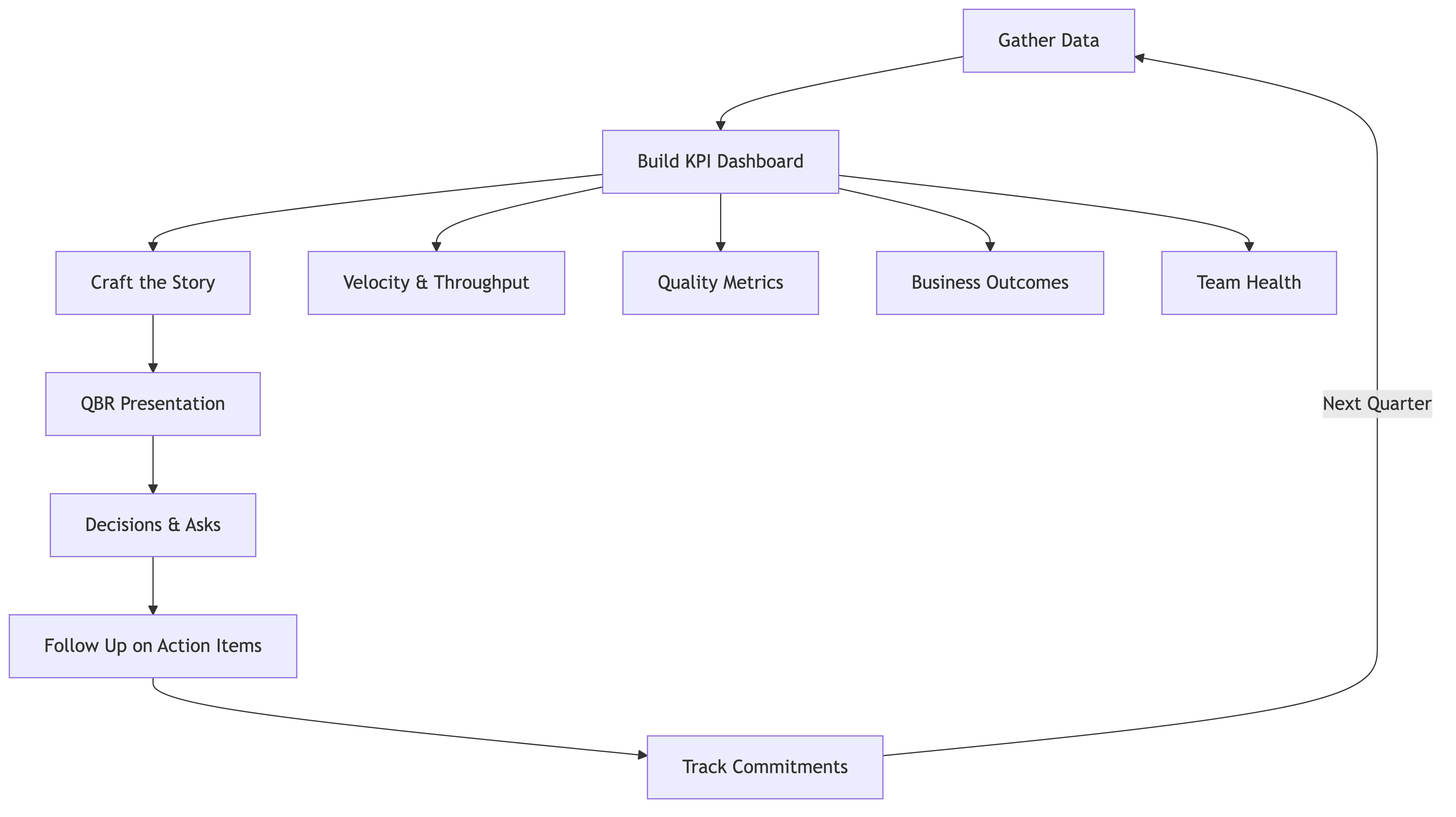
Why This Matters at the Director/VP Level
Here's a truth that nobody tells you when you become a director: your engineering organization's reputation — and its budget — depends as much on how you communicate as on what you build. You can have the best engineering team in the world, but if you can't articulate their impact to executives and the board, you'll be treated like a cost center. And cost centers get cut.
Executive reporting isn't about status updates. It's about building trust, securing resources, and ensuring that engineering has a seat at the strategic table. The directors and VPs who do this well become genuine partners to the CEO and the board. The ones who do it poorly get sidelined, micromanaged, or replaced.
This is a skill. It can be learned. Let me show you how.
Quarterly Business Reviews (QBRs)
What a QBR Actually Is
A QBR is a structured look back at the previous quarter and a look forward at the next one. For engineering, it typically covers:
- What did we accomplish and what was the business impact?
- What didn't go as planned and what did we learn?
- What are we planning for next quarter and why?
- What do we need (budget, headcount, decisions) to execute?
A good QBR takes 30-60 minutes. If it's taking longer than that, you're either going into too much detail or not preparing well enough.
Structure That Works
Here's a QBR structure I've used at multiple companies that consistently works well:
1. Executive Summary (5 minutes)
One slide. Three to five bullet points. If the CEO had to leave the room after five minutes, what would you want them to know?
This should cover:
- The headline result (did engineering hit its goals?)
- The biggest win
- The biggest miss or risk
- The one thing you need from leadership
Most directors put the executive summary last. Put it first. Executives are busy and impatient. Give them the punchline immediately, then spend the rest of the time providing evidence and context.
2. Results Against Objectives (10-15 minutes)
Walk through each quarterly objective and its key results. For each one:
- What was the target?
- What did we achieve?
- What drove the result (good or bad)?
- What's the business impact?
Use a simple red/yellow/green status, but don't let the color do all the talking. A green status without context is meaningless. A red status with a clear explanation and recovery plan builds confidence.
3. Business Impact (10 minutes)
This is where you connect engineering work to business outcomes. Don't just say "we shipped feature X." Say "we shipped feature X, which has been adopted by 340 customers and is generating $180K in monthly recurring revenue."
If you can't quantify the business impact yet, say that too: "We shipped the new onboarding flow three weeks ago. Early data shows a 12% improvement in activation rate, but we need another month of data to confirm the trend."
Honesty about what you know and don't know builds more trust than false precision.
4. What Didn't Go Well (5-10 minutes)
This is the section most directors want to skip. Don't. Executives know that not everything goes perfectly. What they want to see is that you're aware of the problems, you understand why they happened, and you have a plan to address them.
Cover:
- Projects that missed deadlines and why
- Objectives you didn't hit and what you learned
- Incidents or reliability issues and what you're doing about them
- Risks you're watching for next quarter
5. Next Quarter Plan (10 minutes)
Present your plan for the upcoming quarter:
- Top 3-5 objectives and their key results
- How they connect to company priorities
- Major milestones and dependencies
- Resource allocation across your portfolio
6. The Ask (5 minutes)
If you need something — headcount, budget, a decision, executive support for a difficult tradeoff — this is where you make the ask. Be specific. "I need help" is not an ask. "I need approval to hire four senior engineers for the platform team by end of Q2, which requires a $400K increase to our quarterly budget" is an ask.
Board and Executive Summaries
Understanding Your Audience
Board members and C-suite executives are not engineers. They don't care about your tech stack, your architecture, or your deployment pipeline. They care about:
- Is engineering helping the company hit its goals?
- Are there any risks I should worry about?
- Is the engineering investment generating returns?
- What does engineering need to keep performing?
Everything in your board summary should answer one of these questions. Everything else is noise.
The One-Page Engineering Summary
For board meetings, you typically get one or two pages in the board deck and maybe five minutes of discussion time. Here's how to make the most of it:
Section 1: Scorecard
A simple table showing your top 5-7 metrics with current value, target, and trend. Keep it visual — use arrows or sparklines to show direction.
Example:
| Metric | Target | Actual | Trend |
|---|---|---|---|
| Engineering velocity (features shipped) | 12 | 14 | Up |
| Platform uptime | 99.95% | 99.97% | Stable |
| Customer-facing bug rate | <5/week | 3/week | Down |
| Time to deploy | <30 min | 22 min | Improved |
| Team engagement score | >80 | 78 | Flat |
Section 2: Key Accomplishments
Three to five bullet points highlighting the most impactful things engineering delivered. Frame everything in business terms:
- "Launched real-time collaboration, resulting in 23% increase in daily active usage among enterprise customers."
- "Reduced infrastructure costs by $1.2M annually through optimization project completed in Q3."
- "Achieved SOC 2 Type II certification, removing the top blocker in 8 active enterprise deals worth $3.4M."
Section 3: Risks and Mitigations
Two to three bullet points on things the board should be aware of. Don't bury bad news — surface it with your mitigation plan:
- "We're carrying $2M in technical debt on the payments system. We have a 2-quarter remediation plan starting Q1 that reduces the risk of payment processing failures."
- "Engineering hiring is running 30% behind target due to market competition. We're expanding our sourcing channels and have increased our referral bonus."
Section 4: Forward Look
Two to three sentences about what engineering is focused on next quarter and why.
Writing for Executives
A few principles that will dramatically improve your executive communication:
Lead with the conclusion. Don't build up to your point. State it immediately, then provide supporting evidence. "Engineering is on track to deliver all Q4 commitments. Here's the evidence."
Use business language, not engineering language. Don't say "we refactored the monolith into microservices." Say "we restructured our systems to enable teams to ship features independently, which has reduced our release cycle from two weeks to two days."
Quantify everything. "Improved performance" means nothing. "Reduced page load time by 60%, which correlates with a 15% improvement in conversion rate" means everything.
Be precise about uncertainty. Instead of "we think this will improve retention," say "based on our A/B test with 10,000 users, we expect this will improve 30-day retention by 5-8 percentage points." Executives respect precision and honesty about confidence levels.
Short sentences. Short paragraphs. White space. Executives are scanning, not reading. Make your documents scannable.
KPI Dashboards
Choosing the Right KPIs
The biggest mistake in KPI selection is tracking too many things. If you have 30 KPIs, you effectively have zero, because nobody can focus on 30 things.
Choose 5-7 KPIs that together tell the story of engineering health and impact. Here's a framework:
Business Impact KPIs (2-3)
- Revenue directly attributable to engineering-delivered features
- Customer satisfaction or NPS related to product quality
- Time-to-market for new capabilities
Operational Health KPIs (2-3)
- System reliability (uptime, error rates)
- Incident frequency and resolution time
- Deployment frequency and success rate
Team Health KPIs (1-2)
- Engineering engagement or satisfaction score
- Attrition rate
That's it. Seven KPIs total. You can have sub-metrics that feed into these, but at the executive level, keep it to seven or fewer.
Building Dashboards That Work
A good dashboard answers three questions at a glance:
- How are we doing right now?
- Are things getting better or worse?
- Where should I pay attention?
Design principles:
- Show trends, not just snapshots. A number in isolation is meaningless. Show the number over time — at least 4-6 data points so you can see the trend.
- Include targets. Every metric should have a target line or target value. Without a target, you can't tell whether a number is good or bad.
- Use color sparingly and consistently. Green means on target. Yellow means at risk. Red means off target. Don't use color for decoration.
- Put the most important thing in the top-left corner. That's where eyes go first in Western reading cultures.
- Update automatically. If someone has to manually update the dashboard, it will be stale within a month. Invest in automated data pipelines.
The Anti-Dashboard: What Not to Do
I've seen engineering dashboards with 47 charts tracking everything from code coverage to the number of Jira tickets closed. These dashboards are worse than useless because they create the illusion of measurement without actually informing decisions.
If you catch yourself adding a metric to a dashboard, ask: "If this number changed significantly, would I do something different?" If the answer is no, don't track it. Or at least don't put it on the executive dashboard.
Also avoid vanity metrics — numbers that always look good but don't tell you anything meaningful. "Number of commits" is a vanity metric. "Number of deploys that required a rollback" is a useful metric.
Storytelling with Data
Why Stories Matter More Than Numbers
Humans are wired for stories, not spreadsheets. If you present a table of numbers, executives will nod politely and forget everything within ten minutes. If you tell a story that uses numbers as evidence, they'll remember the key points for months.
A story has three parts:
- The situation: What was the problem or opportunity?
- The action: What did we do about it?
- The result: What happened because of what we did?
Example: Turning Data into a Story
Without a story: "Q3 results: API latency reduced from 800ms to 120ms. Uptime improved to 99.97%. Customer complaints about performance decreased by 73%."
With a story: "At the start of Q3, we were losing enterprise deals because our platform was too slow. Prospects were running benchmarks against competitors and we were consistently last. We made a strategic bet: dedicate our best infrastructure team to a 90-day performance sprint. The results exceeded expectations — we're now 3x faster than our nearest competitor. More importantly, we've already won two enterprise deals where performance was the deciding factor, worth $1.8M in combined ACV. And customer support tickets about performance have dropped by 73%, freeing up our support team to focus on onboarding."
Same data. Completely different impact. The story gives context, shows cause and effect, and connects engineering work to business outcomes.
The Narrative Arc for a QBR
Your entire QBR should follow a narrative arc:
- Here's what we set out to do and why (context)
- Here's what we accomplished (progress)
- Here's what we learned, including what went wrong (honesty)
- Here's what we're doing next based on what we learned (forward momentum)
- Here's what we need from you (the ask)
Each section flows naturally into the next. The executive walks away with a clear mental model of where engineering is, where it's going, and what they need to do.
Proving Engineering's Value to the Business
The Cost Center Problem
Engineering is expensive. In most tech companies, it's the largest line item on the P&L. And unlike sales, which has a direct revenue number attached to it, engineering's value is indirect and often hard to quantify.
This means engineering leaders have to actively prove their value. If you don't, someone else will define your value for you — and they'll probably define it as "costs too much."
Three Ways to Prove Value
1. Revenue Attribution
Connect engineering output to revenue as directly as possible. Examples:
- "The new pricing tier we built generated $2.3M in new ARR."
- "The API integrations we shipped unlocked the partner channel, which produced $5M in pipeline."
- "Our reliability improvements reduced churn by 1.2 percentage points, preserving $4.1M in ARR."
Not everything can be directly attributed, and that's okay. But make the connections wherever you can.
2. Efficiency Gains
Show how engineering work reduces costs or improves efficiency:
- "Our infrastructure optimization reduced our cloud bill by $800K annually."
- "The automated testing pipeline reduced QA cycle time from two weeks to two days, enabling us to ship features 5x faster."
- "Internal tool investments saved the customer success team 2,000 hours per quarter."
These are easy to measure and executives love them because they directly impact the bottom line.
3. Risk Reduction
Show how engineering investments protect the business:
- "Our security hardening eliminated the three most critical vulnerabilities identified in the penetration test. A breach in any of these could have cost $5-15M in damages and customer trust."
- "The disaster recovery system we built can restore full service in 4 hours, down from 3 days. Our SLA commitments to enterprise customers depend on this capability."
- "Completing SOC 2 certification removed the top objection from our enterprise sales pipeline."
What Executives Actually Want to See
I've worked with dozens of executives across my career, and here's what they consistently want from engineering reports:
-
Predictability. Can I count on engineering to deliver what they commit to? Show your track record of delivery against commitments.
-
Efficiency. Are we getting good output per dollar invested? Show how your team's productivity compares to industry benchmarks or to your own historical performance.
-
Alignment. Is engineering working on the right things? Show how your priorities map to company priorities.
-
Risks. What should I be worried about that I'm not? Surface risks proactively, with mitigation plans.
-
Progress. Are we getting better over time? Show improvement trends, not just absolute numbers.
Notice what's NOT on this list: technical details, architecture diagrams, sprint velocity, or the latest framework you're adopting. Those are engineering concerns. Executives want business outcomes.
Presenting Bad News
Why You Must Present Bad News Well
Bad news is inevitable. Projects will miss deadlines. Systems will go down. Key people will quit. What separates good leaders from great ones is how they handle bad news.
Here's the rule: executives should never be surprised by bad news. If your CEO learns about a major engineering problem from a customer, a board member, or a news article, you've failed. They should hear it from you first, with context and a plan.
The Framework for Bad News
Step 1: State the problem clearly.
Don't bury it. Don't minimize it. Don't use weasel words. "We have a problem" is better than "we have a slight challenge in one area."
"Our data pipeline has been producing incorrect reports for the last three weeks. Approximately 200 customers received inaccurate billing data."
Step 2: Explain the impact.
Help the executive understand why this matters in business terms.
"This affects $4.2M in monthly billing. We haven't lost revenue, but customer trust is damaged. Our support team has received 47 complaints so far."
Step 3: Explain what caused it.
Be honest. Don't blame people. Focus on systemic causes.
"Our data validation was insufficient for a new billing model we launched in March. We tested the new model but didn't test its interaction with legacy pricing tiers."
Step 4: Explain what you're doing about it.
Have a plan. Executives can handle bad news. What they can't handle is bad news with no plan.
"We've already corrected the data for all affected customers. We're sending personalized communications this week. We've implemented validation checks that will catch this type of error going forward. We're also doing a broader audit of our data pipeline, which will be complete by end of month."
Step 5: Explain what you're doing to prevent it from happening again.
This is what separates a one-time mistake from a systemic problem.
"We're adding automated reconciliation checks that compare our billing calculations against an independent source. We're also adding this class of integration test to our release checklist."
Timing Matters
Deliver bad news early. The earlier you share it, the more time everyone has to respond. A problem surfaced in week 3 of a quarter is a planning challenge. The same problem surfaced in week 12 is a crisis.
Also: never deliver bad news for the first time in a big meeting. Pull the executive aside beforehand. Let them process it privately. Nobody likes to be surprised in front of their peers.
Making the Ask
Why Asking Is Part of the Job
Many engineering leaders are uncomfortable asking for things — more budget, more headcount, more time, executive intervention on a blocker. They feel like they should be able to solve everything themselves.
This is wrong. Making well-reasoned asks is a core part of your job. Your organization depends on you to secure the resources and support it needs. If you don't ask, you don't get, and your teams suffer.
How to Make an Effective Ask
Be specific. "I need more engineers" is not an ask. "I need four senior backend engineers by end of Q2 to staff the platform reliability initiative, which will cost approximately $400K per quarter fully loaded" is an ask.
Tie it to business outcomes. "These four engineers will reduce our incident rate by 60%, which based on our analysis will prevent $2M in annual churn and eliminate the production support burden that's currently consuming 20% of our existing team's capacity."
Present alternatives. "If we can't hire four engineers, we could hire two and extend the timeline from one quarter to two. The tradeoff is that we'll continue to experience the current incident rate for an additional quarter, with an estimated cost of $500K in additional churn."
Make the risk of NOT acting clear. "If we don't invest in platform reliability, our current trajectory suggests we'll have a major outage within the next two quarters. Based on our analysis of similar outages, the cost would be $3-5M in customer credits, churn, and engineering time to recover."
Have a plan. Don't just ask for resources — show what you'll do with them. "Here's the 90-day plan for these four engineers. Here are the milestones. Here's how we'll measure success."
Common Mistakes When Making the Ask
Asking too late. If you need headcount for Q3, you should be asking in Q1, because hiring takes time. Don't show up in Q3 saying "I need people now."
Asking without data. "I feel like we need more people" won't fly. Come with utilization data, project timelines, and ROI analysis.
Asking for everything at once. If you need five things, prioritize. What's the one thing you need most? Lead with that. You can always come back for the rest.
Not following up. If you got approved for four headcount, report back on your hiring progress and, once they're onboarded, on the impact. This builds credibility for your next ask.
Real-World Examples
Example 1: The QBR That Changed Everything
A VP of Engineering was presenting quarterly results to the CEO and executive team. Historically, the engineering QBR was a 45-minute slog through project updates that nobody paid attention to.
The VP restructured the presentation. She opened with: "Last quarter, engineering generated 6.1M cost base. Here's the breakdown." She then walked through three stories — the biggest win, the biggest lesson, and the biggest risk — each with clear data. She closed with a specific ask for two additional teams to address the risk.
The CEO later told her it was the first time he truly understood what engineering was doing and why. She got her two teams.
The lesson: frame engineering in business terms, lead with the punchline, and tell stories.
Example 2: The Bad News That Built Trust
A Director of Engineering discovered that a critical data migration was going to take three months longer than promised. The migration was tied to a major product launch that the entire company was counting on.
Instead of hoping things would improve, he scheduled a meeting with the CEO the next morning. He explained the problem, the cause (they'd underestimated the complexity of legacy data formats), the impact (the product launch would need to be delayed by six weeks or launched with reduced functionality), and presented three options with tradeoffs.
The CEO was frustrated but appreciated the transparency and the options. They chose a middle path — launching on time with reduced scope and completing the full migration post-launch. It worked out well.
Six months later, when the same director needed to deliver more bad news about a different project, the CEO's first words were "okay, what are our options?" Trust had been established.
The lesson: delivering bad news early with a clear plan builds trust that pays dividends for years.
Example 3: The Dashboard That Nobody Used
An engineering org spent three months building an elaborate KPI dashboard with 40 metrics, real-time updates, and beautiful visualizations. The CTO was proud of it. He presented it in the executive meeting.
Nobody used it. Executives opened it once, were overwhelmed by the information density, and never came back. The dashboard became a monument to wasted effort.
They scrapped it and replaced it with a weekly email that had five numbers and a three-sentence summary. Executive engagement went from zero to 100% — the CEO started replying to the email with questions and comments.
The lesson: simplicity wins. Always.
Common Mistakes
Mistake 1: Engineering-Speak in Business Meetings
Talking about "microservices," "Kubernetes," "technical debt," or "sprint velocity" in a board meeting. Nobody outside engineering knows or cares what these things are. Translate everything into business impact. "Technical debt" becomes "accumulated maintenance burden that is slowing our ability to ship new features by approximately 30%."
Mistake 2: Data Without Narrative
Presenting a spreadsheet full of numbers without explaining what they mean, why they matter, or what action they imply. Data informs decisions, but only when it's wrapped in context. Every chart in your presentation should have a "so what" that connects it to a business outcome or a decision that needs to be made.
Mistake 3: Only Sharing Good News
If your QBR is all green metrics and success stories, executives will assume you're either not being honest or not taking on hard enough challenges. The most credible leaders share wins and losses with equal candor.
Mistake 4: Too Much Detail
A 60-slide deck for a 30-minute QBR. A dashboard with 40 metrics. A five-page narrative when one page would do. More detail does not equal more credibility. It equals less attention.
The most effective executive communicators I know can summarize their quarter in three sentences. They have backup detail available if someone asks, but they lead with the summary.
Mistake 5: No Ask
Presenting a great QBR and then ending without asking for anything. If engineering doesn't need anything from leadership, why are you presenting? You always need something — even if it's just continued support for your current plan. Make the ask.
Mistake 6: Reactive Instead of Proactive
Only communicating when you have results to share or problems to report. Great engineering leaders communicate proactively: setting expectations before a quarter starts, flagging risks before they materialize, sharing context before it's asked for. By the time you get to the QBR, there should be no surprises — the QBR is just the formal summary of things you've been communicating all along.
Mistake 7: Not Knowing Your Numbers
Getting asked a question about headcount costs, project ROI, or efficiency metrics and not knowing the answer. As a director or VP, you should know your top-line numbers cold: total team cost, cost per engineer, revenue per engineer, current utilization, major project costs, and key business metrics your teams influence. Being unable to answer these questions in a meeting destroys credibility fast.
Business Value
Executive reporting and QBRs directly impact engineering's ability to secure resources, maintain strategic influence, and operate effectively. Here's what's at stake:
-
Engineering organizations that communicate their value effectively receive 20-40% more favorable budget treatment during planning cycles compared to those that don't. When budget cuts come — and they always come — the organizations that can clearly articulate their ROI are the last to be cut.
-
Proactive risk communication (surfacing problems early with mitigation plans) reduces the business impact of engineering failures by an estimated 40-60%. A problem addressed in week 3 costs a fraction of the same problem addressed in week 12.
-
Executive trust — built through consistent, honest, business-oriented communication — compounds over time. A director who has built trust over several quarters of transparent reporting gets faster approvals, less micromanagement, and more autonomy. That autonomy translates directly into better engineering outcomes because teams spend less time on reporting overhead and politics and more time building.
-
The financial impact of poor executive communication is real and measurable. Engineering organizations that are perceived as "black boxes" by the executive team are consistently under-resourced relative to their potential impact. They also tend to lose their best leaders, who get frustrated by the lack of executive support and leave for organizations where engineering has a true seat at the table.
-
Perhaps most importantly, great executive communication changes how the entire company thinks about engineering. Instead of "those engineers are always behind schedule and over budget," the narrative becomes "engineering is a strategic capability that generates more value than it costs." That narrative shift changes hiring budgets, investment priorities, and the company's competitive position.
Your job is not just to build great software. It's to make sure the rest of the organization understands and values what your teams deliver. Do this well, and everything else gets easier — hiring, retention, budget, executive support, team morale. Do it poorly, and even a world-class engineering team will be undervalued and under-resourced.
Learn to tell your story. The business depends on it, and so does your team.
Common Pitfalls
- Using engineering jargon in business meetings. Talking about microservices, Kubernetes, or sprint velocity to non-technical executives alienates your audience and makes engineering look disconnected from business outcomes.
- Presenting data without narrative. Spreadsheets full of numbers without context, causation, or a "so what" leave executives uninformed and disengaged.
- Only sharing good news. QBRs that are all green metrics destroy credibility because executives know not everything is going perfectly -- they want to see honest assessment and recovery plans.
- Burying the lead. Building up to the conclusion instead of leading with it wastes executive attention and signals poor communication skills.
- Ending without an ask. Presenting a great QBR and walking away without requesting anything means missed opportunities for resources, decisions, or executive support your team needs.
- Letting executives be surprised by bad news. If your CEO learns about a major engineering problem from a customer or board member instead of from you, trust is severely damaged.
Key Takeaways
- Executive reporting is about building trust, securing resources, and earning engineering a seat at the strategic table -- not about status updates.
- Lead with the conclusion (BLUF). If the CEO had to leave after five minutes, make sure they have the essential information.
- Frame everything in business terms: revenue impact, cost savings, risk reduction, customer outcomes.
- Structure QBRs around results against objectives, business impact, what went wrong, next quarter's plan, and a specific ask.
- Board summaries should be one page with a scorecard, key accomplishments, risks, and forward look.
- Tell stories with data: situation, action, result. Stories are remembered; spreadsheets are forgotten.
- Deliver bad news early, directly, with impact assessment and a plan. Never let executives be surprised.
- Know your numbers cold: total team cost, cost per engineer, key business metrics your teams influence.