
Organizational Health
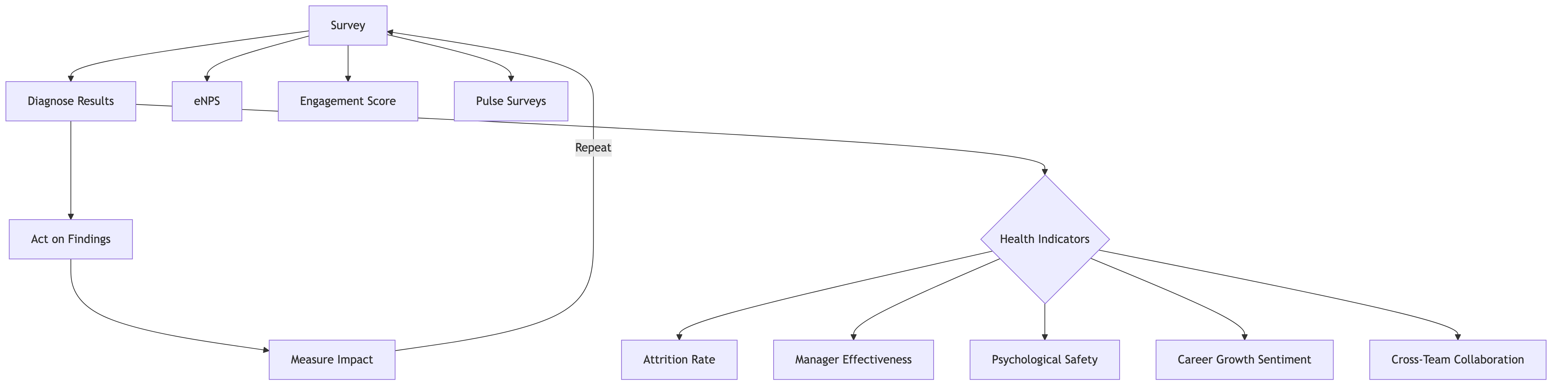
Why This Matters at the Director/VP Level
Here is a truth that takes most leaders too long to learn: organizational health is not a "soft" topic. It is the single strongest leading indicator of whether your engineering organization will deliver on its promises twelve months from now. You can have the best architecture, the sharpest engineers, and the most compelling product vision, but if people are disengaged, siloed, or quietly updating their resumes, none of that matters.
At the Director/VP level, you are no longer just managing a team's morale. You are responsible for the health of an entire system -- hundreds of people, dozens of teams, complex interdependencies. The signals are harder to read, the problems are slower to develop, and the consequences of ignoring them are far more severe.
This chapter is about building the muscles to diagnose, measure, and improve organizational health at scale.
Engagement Surveys: Your Organizational Nervous System
Designing Surveys That Actually Work
Most engagement surveys fail not because people refuse to take them, but because they ask the wrong questions or leaders do nothing with the answers. Let me walk you through what actually works.
First, keep it short. A survey with 60 questions gets abandoned halfway through or generates garbage responses. Aim for 15-25 questions max for your comprehensive annual or semi-annual survey. For pulse surveys, 5-8 questions is plenty.
Second, ask questions that are actionable. "I feel valued at work" is fine as a sentiment check, but it does not tell you what to fix. Better: "My manager gives me regular, useful feedback on my work." Now you know where to intervene.
Third, mix scale questions with open-ended ones. The quantitative data gives you trends and benchmarks. The qualitative comments give you the "why" behind the numbers. I have seen more organizational problems diagnosed from free-text survey comments than from any dashboard.
Here are the dimensions that matter most for engineering organizations:
- Manager effectiveness -- Do people feel supported, coached, and unblocked by their direct manager?
- Career growth -- Do people see a path forward? Do they believe they are developing?
- Autonomy and ownership -- Do people feel trusted to make decisions about their work?
- Cross-team collaboration -- Is it easy or painful to work across team boundaries?
- Strategic clarity -- Do people understand why their work matters and where the organization is headed?
- Psychological safety -- Can people take risks, ask questions, and admit mistakes without fear?
- Tooling and process -- Are people fighting their tools, or do the tools help them do great work?
Frequency: Finding the Right Cadence
The most common pattern I have seen work well:
- Annual comprehensive survey -- 20-25 questions, all dimensions, benchmarked year-over-year
- Quarterly pulse surveys -- 5-8 questions, rotating focus areas, tracking trends on your weakest dimensions
- Post-event surveys -- After reorgs, major launches, or incidents, a targeted 3-5 question check-in
The mistake is doing a big annual survey, publishing the results three months later, and then doing nothing until the next annual survey. By that point, people have stopped believing the survey matters.
Acting on Results: Where Most Organizations Fail
This is the hard part, and honestly, it is where I have seen more leaders stumble than anywhere else in this chapter.
Here is the pattern that works:
-
Share results transparently. Not just the highlights -- share the real picture, including the areas where you scored poorly. Your team already knows what is broken. Pretending otherwise destroys trust.
-
Pick 2-3 focus areas. You cannot fix everything at once. Choose the areas with the biggest gap between where you are and where you need to be, and where you can realistically make progress.
-
Create specific action plans with owners and timelines. "We will improve career growth" is not a plan. "We will launch a structured mentorship program by Q2, led by Sarah, with monthly check-ins" is a plan.
-
Report back on progress. Before the next survey, tell people what you did. Close the loop. This single step is what separates organizations where surveys drive change from organizations where surveys are performative.
-
Resurvey on your focus areas. Use your pulse surveys to track whether your interventions are working. Adjust if they are not.
I once took over an organization where survey participation had dropped to 40 percent. The reason was simple: the previous leader had run surveys for three years and never visibly acted on any of the feedback. It took two full cycles of transparent sharing, concrete action, and visible follow-through before participation climbed back above 80 percent.
eNPS: Simple, Useful, and Often Misunderstood
Employee Net Promoter Score asks one question: "How likely are you to recommend this company as a place to work?" Respondents rate 0-10, and you calculate the score by subtracting the percentage of detractors (0-6) from the percentage of promoters (9-10).
eNPS is useful as a high-level trend indicator. If your eNPS drops 15 points in a quarter, something significant happened and you need to dig in. If it has been steadily climbing over two years, your investments in organizational health are likely paying off.
Where leaders go wrong with eNPS:
- Treating it as the only metric. eNPS tells you the temperature, not the diagnosis. You need the engagement survey dimensions to understand what is actually driving the score.
- Comparing across companies. eNPS varies wildly by industry, region, and company stage. A Series B startup and a Fortune 500 company will have very different baselines. Compare against your own history.
- Optimizing for the number. I have seen leaders pressure managers to "make sure the team scores well." This is the fastest way to make the metric useless. People will either inflate scores to avoid the conversation or stop participating entirely.
The right way to use eNPS: track it quarterly, investigate significant changes, and use it as one input alongside richer engagement data.
Culture Audits: Going Deeper
Sometimes surveys are not enough. When you suspect deep cultural issues -- after an acquisition, a major leadership change, or when survey results do not match what you are hearing in hallway conversations -- a culture audit is warranted.
A culture audit typically involves:
- Structured interviews with a representative cross-section of the organization (15-30 people across levels, teams, and tenure)
- Focus groups around specific themes (e.g., "how decisions get made," "what happens when someone makes a mistake")
- Artifact analysis -- looking at what your organization actually rewards, celebrates, and punishes, not what it says it values
You can run culture audits internally if you have strong HR/People partners, but sometimes bringing in an external facilitator helps. People will say things to an outsider that they will not say to their VP.
The output should be a candid narrative, not a slide deck full of charts. Something like: "Engineers feel that promotion decisions are opaque and political. The perception is that visibility matters more than impact. This is driving senior engineers to leave, and it is making mid-level engineers risk-averse."
That kind of finding is worth more than a hundred data points.
DEI Metrics: Measuring What Matters
Diversity, equity, and inclusion work at the Director/VP level is not about running a single training session. It is about systemic measurement and accountability.
The metrics you should be tracking:
- Representation -- Demographics at each level (IC and management), by team, and over time. Pay attention to the "frozen middle" problem where diversity exists at entry level but disappears at senior levels.
- Hiring funnel conversion rates -- Where are candidates from underrepresented groups dropping out? Is it at the resume screen, the technical interview, the offer stage?
- Promotion rates -- Are promotion rates equitable across demographics? Control for level and tenure.
- Attrition rates -- Are people from underrepresented groups leaving at higher rates? If so, exit interviews and stay interviews are critical.
- Engagement survey cuts -- Slice your engagement data by demographics. If one group is consistently scoring lower on psychological safety or career growth, you have a targeted problem to solve.
- Pay equity -- Regular compensation audits to identify and close gaps.
The common mistake is collecting this data and not acting on it. The other common mistake is acting on it performatively -- making big announcements without changing the underlying systems.
Real change comes from examining your actual systems: how you hire, how you promote, how you assign high-visibility projects, how you run meetings, who gets heard and who does not.
Diagnosing Organizational Problems
Silos
Silos are one of the most common and most damaging organizational health problems. They manifest as:
- Teams that do not know what other teams are working on
- Duplicated effort across groups
- "Throw it over the wall" handoffs
- Knowledge hoarding
- An "us vs. them" mentality between groups
To diagnose silos, look at communication patterns. Where does information flow freely, and where does it get stuck? Look at your incident retrospectives -- how often is the root cause "Team A did not know that Team B was changing X"?
To fix silos, you need structural interventions, not just encouragement. Consider:
- Shared goals that require cross-team collaboration to achieve
- Rotation programs where engineers spend time on other teams
- Architecture that enforces clear interfaces rather than requiring constant coordination
- Regular cross-team demos and knowledge sharing
- Reorganizing when team boundaries no longer match the work
Low Morale
Low morale is tricky because it is contagious and self-reinforcing. One disengaged person lowers the energy of those around them, which lowers it further.
Common causes at the org level:
- Unclear or constantly shifting strategy
- Feeling that leadership does not listen or does not care
- Too many priorities and not enough focus
- Technical debt making daily work painful
- Lack of career growth or recognition
- Poor managers who have not been addressed
The fix depends on the cause, but the diagnostic approach is the same: listen at multiple levels. Skip-levels, surveys, exit interviews, stay interviews, and informal conversations all contribute to the picture.
Attrition Spikes
When attrition spikes, most leaders react to the symptom ("we need to hire faster") rather than the cause. Before you spin up recruiting, understand why people are leaving.
Analyze your attrition data:
- Is it concentrated in specific teams, levels, or demographics?
- What is the tenure distribution of departures? (Early attrition suggests hiring or onboarding problems. Mid-tenure attrition suggests career growth problems. Senior attrition suggests leadership or strategic problems.)
- What are exit interviews revealing? (And are you actually conducting them well, or are they a checkbox exercise?)
- Are there manager-level patterns? Sometimes one manager is driving a disproportionate share of departures.
One real-world example: I saw an organization where attrition spiked 40 percent in one quarter. Leadership assumed it was a compensation issue and threw money at retention bonuses. The actual problem, revealed through exit interviews, was that a reorg six months earlier had stripped teams of ownership and autonomy. The people leaving were the most senior and most capable -- exactly the ones with the most options. The retention bonuses did not work because the problem was not money. The fix was re-empowering teams with clear ownership boundaries.
Skip-Level Programs at Scale
Skip-levels -- where you meet with people who report to your direct reports -- are essential at the Director/VP level. They are your primary mechanism for understanding what is really happening on the ground.
Making Skip-Levels Work at Scale
When you have 100+ people in your organization, you cannot do one-on-ones with everyone. Here is what works:
- Regular rotation. Meet with a different set of 4-6 people each month. Over the course of a year, you should connect with most of your organization.
- Small group format. Skip-level lunches or coffee chats with 3-4 people can be more productive than one-on-ones because people build on each other's observations.
- Consistent questions. Ask the same core questions so you can spot patterns:
- "What is the biggest obstacle to your team doing great work?"
- "If you could change one thing about how we operate, what would it be?"
- "What should I know that I probably do not?"
- "Do you feel like you are growing in your role?"
- Follow through visibly. When a skip-level surfaces a real problem, fix it and tell the person you heard them. Word travels fast that "the VP actually listens."
Common Pitfalls
- Undermining your managers. Skip-levels are not an opportunity to go around your managers or second-guess their decisions. If someone raises a concern about their manager, handle it carefully. Talk to the manager separately.
- Only doing skip-levels when there is a crisis. If you only show up when things are bad, people associate your presence with bad news. Make it a regular cadence.
- Treating skip-levels as status updates. You do not need to know what everyone is working on. You need to know how the organization feels, what is getting in the way, and what you cannot see from your altitude.
Org Health as a Leading Indicator of Delivery
This is the point I want to drive home: organizational health predicts delivery outcomes.
Here is the pattern I have seen play out repeatedly:
- Engagement drops (visible in surveys, skip-levels, or informal signals)
- Collaboration quality decreases (more friction, slower decisions, more escalations)
- Attrition increases (best people leave first)
- Remaining team is understaffed and demoralized
- Delivery slows, quality drops, incidents increase
- Leadership notices the delivery problem and responds with pressure, which makes the health problem worse
By the time you see the delivery impact, you are 6-12 months behind on the health problem. This is why measuring org health proactively is not a "nice to have" -- it is an operational necessity.
The organizations I have seen perform best over sustained periods are the ones where leaders treat engagement scores, attrition trends, and culture health with the same seriousness as uptime metrics and sprint velocity.
Real-World Examples
Example 1: The Survey That Changed a Culture
A VP of Engineering at a mid-sized SaaS company ran their first real engagement survey and discovered that the lowest-scoring dimension was "I feel safe raising concerns with my manager." The score was 3.1 out of 5 across the org, but in two specific teams it was below 2.0.
The VP did three things:
- Shared the results org-wide, including the low scores, and acknowledged the problem publicly.
- Worked with HR to provide coaching to the two managers with the lowest scores. One improved significantly. The other did not, and was eventually moved to an IC role.
- Instituted a norm where every team retrospective included an explicit "what are we not talking about?" prompt.
Eighteen months later, the score was 4.2 org-wide. More importantly, incident response improved measurably because people were willing to escalate problems earlier.
Example 2: Diagnosing the Silo Problem
A Director of Engineering noticed that cross-team projects were consistently late, even though individual teams were hitting their sprint commitments. The problem was invisible in team-level metrics.
She ran a lightweight network analysis -- literally asking people "who do you need to coordinate with regularly, and how easy is that coordination?" The results revealed two bottleneck teams that every other team depended on but that had no formal coordination mechanisms with anyone.
The fix was structural: she created a "platform liaison" role in each product team and established weekly sync meetings between the bottleneck teams and their dependents. Cross-team project delivery improved by roughly 35 percent over the next two quarters.
Example 3: The Attrition Warning Sign
A VP noticed that eNPS had dropped 20 points over two quarters but attrition was still low. He was tempted to dismiss it -- "people are not actually leaving, so maybe it is not that bad."
His chief of staff convinced him to investigate. Skip-levels and stay interviews revealed that people were disengaged because a recent reorg had created confusion about team missions, and three popular senior engineers had been moved to a new initiative against their preferences.
He addressed it: clarified team missions in an org-wide document, and had honest conversations with the displaced engineers (one moved back, two stayed but with renewed context on why the initiative mattered). eNPS recovered over the next quarter, and the attrition spike that would have come never materialized.
Common Mistakes
-
Measuring without acting. The fastest way to make your engagement program useless is to collect data and do nothing with it. People stop believing in the process.
-
Only listening to the loudest voices. The people who complain the most are not always representative. Structured data collection ensures you hear from everyone, including the quiet ones who might be your best engineers.
-
Treating org health as HR's job. HR/People teams are partners, but organizational health is a leadership responsibility. You own it.
-
Ignoring lagging indicators until they become crises. By the time attrition spikes, the underlying problem has been brewing for months. Watch the leading indicators.
-
Copying another company's playbook. What works at Google does not necessarily work at your 200-person startup. Adapt frameworks to your context, culture, and stage.
-
Confusing happiness with health. A healthy organization is not one where everyone is happy all the time. It is one where people feel heard, supported, and able to do meaningful work. Sometimes healthy organizations make hard decisions that are temporarily unpopular.
-
Surveying too frequently without purpose. Survey fatigue is real. Every survey should have a clear purpose and a commitment to act on results.
-
Not segmenting data. Org-wide averages hide important differences between teams, levels, tenures, and demographics. Always cut the data.
Business Value
Let me be direct about the financial impact of organizational health.
Attrition costs are enormous. Replacing a senior engineer costs 1.5-2x their annual salary when you factor in recruiting, ramp-up time, and lost institutional knowledge. If you have 200 engineers and your attrition rate is 25 percent instead of 15 percent, that is 20 extra departures per year. At an average fully-loaded cost of 9-12M in annual replacement costs alone, not counting the delivery impact.
Engaged teams ship faster. Research consistently shows that highly engaged teams are 20-25 percent more productive than disengaged ones. For a 200-person engineering organization with 12-15M in effective output.
Healthy organizations attract better talent. Your employer brand is built by your current employees. Disengaged people tell their networks. Engaged people refer their best former colleagues. The recruiting cost difference between a strong and weak employer brand is substantial.
Organizational health predicts incidents. Teams with low psychological safety are less likely to raise concerns early, less likely to speak up during incidents, and less likely to write thorough retrospectives. The operational cost of this silence is real and measurable.
The compounding effect. Organizational health compounds over time in both directions. Healthy organizations get healthier because they attract great people who make the organization better. Unhealthy organizations get sicker because the best people leave first, which makes conditions worse for those who remain.
Investing in organizational health is not a cost center. It is one of the highest-leverage investments a Director or VP can make. The returns show up in retention, productivity, quality, and ultimately in the business outcomes your engineering organization exists to deliver.
Decision-making speed. Healthy organizations make decisions faster because people trust each other, information flows freely, and there is less political maneuvering. In unhealthy organizations, decisions get relitigated, escalated, and delayed because nobody trusts the process or the people involved. The difference in decision velocity between a high-trust and low-trust organization is enormous -- often the difference between responding to a market opportunity in weeks versus months.
Innovation capacity. Disengaged teams do not innovate. They do the minimum required to avoid negative attention. Engaged teams, in environments with high psychological safety, take risks, propose bold ideas, and challenge the status quo. The innovations that define your next product cycle are far more likely to emerge from healthy teams than from demoralized ones.
Customer experience. There is a direct line from employee engagement to customer experience. Engineers who care about their work build better products. Teams that collaborate well across boundaries create more coherent user experiences. Support teams that feel valued provide better service. The research on this is extensive and consistent: organizational health predicts customer satisfaction.
Resilience during crises. Every organization faces crises -- market downturns, competitive threats, major incidents, leadership transitions. Healthy organizations weather these storms because people trust each other, communicate openly, and pull together. Unhealthy organizations fracture under pressure because the existing cracks widen. The investment you make in organizational health during good times is what carries you through the bad times.
Common Pitfalls
- Measuring without acting. Collecting engagement survey data and doing nothing with it is worse than not surveying at all, because it teaches people that feedback is pointless and participation drops.
- Treating organizational health as HR's job. HR and People teams are partners, but you own organizational health as an engineering leader. Delegating it entirely means abdicating one of your most important responsibilities.
- Only listening to the loudest voices. The people who complain most are not always representative. Without structured data collection, you miss the quiet high-performers who may be your biggest attrition risk.
- Ignoring leading indicators until they become crises. By the time attrition spikes, the underlying engagement or culture problem has been brewing for 6-12 months. Watching eNPS trends and survey scores proactively prevents crises.
- Confusing happiness with health. A healthy organization is not one where everyone is happy all the time. Sometimes hard decisions are temporarily unpopular but necessary. Health means people feel heard, supported, and able to do meaningful work.
- Using org-wide averages without segmenting data. Aggregate scores hide critical differences between teams, levels, tenures, and demographics that require targeted intervention.
Key Takeaways
- Organizational health is a leading indicator of delivery. By the time you see the delivery impact, the health problem has been brewing for months.
- Design surveys that are short, actionable, and paired with a commitment to act on results.
- Use eNPS as a trend indicator, not a standalone metric.
- Diagnose silos, low morale, and attrition spikes with structured data, not assumptions.
- Skip-levels at scale are your window into ground truth. Make them regular and follow through.
- DEI metrics require systemic examination, not performative gestures.
- Close the loop. Always close the loop. Tell people what you heard and what you did about it.