
Talent Strategy
Why This Matters at the Director/VP Level
At the manager level, hiring means filling an open role on your team. You write a job description, interview candidates, and pick the best one. At the director and VP level, talent becomes a strategy. You're not filling seats — you're building an organization that can execute on a multi-year vision.
The difference matters because talent decisions at this level compound. Hire well across 30 roles and you build a self-reinforcing culture of excellence where great people attract more great people. Hire poorly across 30 roles and you create a mediocrity spiral that takes years to recover from.
I've watched organizations with brilliant strategies fail because they couldn't attract and retain the talent to execute. And I've watched organizations with mediocre strategies succeed because they had exceptional people who figured it out. Talent is the foundation everything else is built on.
Business Value
Talent strategy isn't an HR exercise. It directly drives business outcomes:
Execution capacity. You can't deliver your roadmap if you don't have the people to build it. And not just any people — the right people, with the right skills, in the right roles. Headcount planning that's disconnected from strategy means you'll either be understaffed where it matters or overstaffed where it doesn't.
Innovation. Diverse, skilled teams generate better ideas and solve problems more creatively. Study after study confirms this. Building teams that bring different perspectives isn't just the right thing to do — it produces measurably better products.
Cost efficiency. A great engineer produces 3-10x the output of an average one (the exact multiplier is debatable, but the directional truth is not). Investing in talent quality means you need fewer people to accomplish the same goals, which means lower burn rate, faster break-even on new initiatives, and better ROI on your engineering spend.
Competitive moat. In technology, your people ARE your competitive advantage. Your code can be copied, your features can be replicated, but a team of exceptional people who work well together is extremely hard to reproduce. Companies that build talent engines — organizations that consistently attract, develop, and retain great people — have a durable competitive advantage.
Velocity preservation. Attrition is expensive. Replacing an engineer costs 50-200% of their annual salary when you factor in recruiting, ramp-up time, lost productivity, and impact on team morale. A good talent strategy reduces unwanted attrition, which directly translates to sustained delivery velocity.
Workforce Planning
Workforce planning at the org level is fundamentally different from headcount requests at the team level. Here's how to think about it:
Start with strategy, not headcount. Don't ask "how many people do we need?" Ask "what do we need to be able to do in 12-24 months that we can't do today?" Then work backward to the capabilities, then to the roles, then to the numbers.
Build a capacity model. Map your current teams to the work streams they support. Identify where you're overloaded (teams that are the bottleneck for multiple initiatives) and where you have slack. This gives you a fact-based starting point for headcount conversations rather than just managers lobbying for more people.
Plan for attrition. If your org has 15% annual attrition, you need to hire just to stand still. Factor this in. A 100-person org with 15% attrition needs 15 replacement hires per year before you can even think about growth. If you're not planning for this, your "20 new hires" is really only 5 net new people.
Think in skills, not just roles. "We need 5 more backend engineers" is less useful than "we need distributed systems expertise, we're thin on data engineering, and we need someone who can own our ML infrastructure." Skills-based planning helps you hire more strategically and identify gaps you might not see in a role-based view.
Create a hiring plan timeline. Hiring takes longer than you think. From approval to job posting to sourcing to interviewing to offer to acceptance to start date to ramp-up, you're looking at 3-6 months for most roles. For senior and specialized roles, it can be 6-12 months. Plan accordingly. If you need someone productive in Q4, you should be sourcing in Q1 or Q2.
Scenario plan. What if your headcount gets cut by 20%? What if you get approval for 30% more? What's the minimum viable team for your critical initiatives? Having answers to these questions ready makes you more credible in budget conversations and more agile when conditions change.
Employer Branding
Why should an engineer join your company instead of the ten others trying to hire them? If you can't answer that clearly, your recruiting pipeline will always be a struggle.
Identify your genuine differentiators. Every company says they have "interesting problems" and "great culture." That's meaningless. What's actually different about working at your organization? Maybe it's:
- Technical challenges that are genuinely rare (scale, domain complexity, cutting-edge technology)
- Autonomy and ownership that engineers don't get at bigger companies
- Impact — engineers can see how their work affects real customers
- A specific engineering culture (strong testing culture, open source commitment, writing culture)
- Work-life balance that's genuinely respected, not just marketed
- Mission that engineers care about
Let your engineers be the brand. The most powerful employer branding comes from your own people. Encourage and support engineers to write blog posts, give conference talks, contribute to open source, and share their work on social media. One authentic blog post from an engineer about how they solved a hard problem does more than a hundred recruiting ads.
Invest in your engineering blog. This is consistently one of the highest-ROI employer branding investments. A well-maintained engineering blog that shows the real work, real challenges, and real culture of your engineering organization attracts candidates who are genuinely excited about what you're building.
Fix the candidate experience. Your interview process IS your brand for candidates. If it's disorganized, disrespectful of people's time, or opaque about timeline and feedback, word gets out. Engineer communities are small and interconnected. A bad candidate experience doesn't just lose you that candidate — it poisons your reputation with their entire network.
Be honest about trade-offs. Every company has downsides. Maybe you're a startup with less stability. Maybe you're a large company with more bureaucracy. Being upfront about trade-offs builds trust and attracts people who are a genuine fit rather than people who feel misled once they join.
University Partnerships and Internship Programs
If you're not investing in university relationships, you're missing one of the most powerful long-term talent pipelines available.
Why internships matter beyond cheap labor. A good internship program is a 10-12 week audition — for both sides. You get to evaluate someone in a real work environment, and they get to evaluate you. Conversion rates from intern to full-time are typically 50-80% at well-run programs, and those hires already know your codebase, your culture, and your people. They ramp up in weeks, not months.
How to build a program that works:
- Assign real projects, not busywork. Interns should ship code that matters.
- Pair each intern with a dedicated mentor (not their manager — someone technical who can help them grow).
- Create a cohort experience. Interns who bond with each other are more likely to convert and more likely to refer their friends.
- Give them visibility. Let interns present their work to leadership. It's motivating for them and informative for you.
- Pay competitively. This isn't the place to save money.
University partnerships beyond recruiting. Guest lectures, sponsored capstone projects, research collaborations, and hackathon sponsorship all build your brand on campus long before students are looking for jobs. The students you engage as sophomores become the candidates you recruit as seniors.
Don't just target elite schools. Yes, Stanford and MIT produce great engineers. But so do state universities, bootcamps, and community colleges. The best talent strategies cast a wide net and evaluate on capability, not pedigree. Some of the best engineers I've ever worked with came from schools nobody has heard of.
Build relationships with professors. One strong relationship with a CS professor who recommends your company to their best students is worth more than attending every career fair. Take the time to build these relationships authentically.
Talent Pipeline Development
Reactive hiring — posting a job when you need someone and hoping good candidates apply — is slow, expensive, and unreliable. You need pipelines.
Source continuously, not just when you have openings. Your recruiters and hiring managers should always be building relationships with potential candidates. Attend meetups, engage with open source communities, maintain relationships with people who weren't ready to move last year but might be this year.
Build a talent CRM. Track people you've met, impressed you, almost hired, or want to hire someday. When a role opens, your first move should be going to this list, not posting on a job board.
Employee referrals are gold. Referred candidates typically convert at 2-3x the rate of other sources and tend to stay longer. Invest in your referral program — not just the bonus, but making it easy for employees to refer people, keeping them informed about the status, and recognizing them when their referrals are hired.
Boomerang employees. People who leave on good terms and want to come back are incredibly valuable. They already know your codebase, your culture, and your people. Maintain relationships with alumni. Make it easy for people to come back. Never burn bridges with departing employees.
Conferences and communities. Sponsoring and speaking at relevant conferences puts your brand in front of exactly the right audience. But don't just set up a booth — send your engineers to give talks, run workshops, and engage authentically with the community.
Diversity in Hiring
Let me be direct: if your engineering organization looks homogeneous, you have a talent strategy problem, not just a diversity problem. You're fishing in a small pond and missing the vast ocean of talent that exists.
Start with the pipeline, not the hiring bar. The most common excuse I hear is "we'd love to hire more diverse candidates, but they don't apply." That's a pipeline problem, and it's your problem to solve. If your job postings, sourcing channels, and employer brand only reach one demographic, you'll only hire from one demographic.
Audit your job descriptions. Research consistently shows that certain language in job descriptions discourages underrepresented candidates from applying. Phrases like "rockstar developer" or "must have 10 years of React experience" (React has existed for about 12 years) signal an environment that may not be welcoming. Use tools like Textio or Gender Decoder to check your postings.
Expand your sourcing channels. Partner with organizations like /dev/color, Lesbians Who Tech, Code2040, AnitaB.org, and others that connect companies with underrepresented talent. Attend their events, sponsor their programs, build real relationships.
Structure your interviews. Unstructured interviews are basically a vibes check, and they're heavily biased toward candidates who look and sound like the interviewer. Use structured interviews with consistent questions, clear rubrics, and diverse interview panels. This doesn't just improve diversity — it improves hiring quality across the board.
Retention is half the equation. Hiring diverse candidates into a culture that doesn't support them is worse than not hiring them at all. Invest in inclusion: ERGs, mentorship programs, bias training, equitable promotion processes, and a genuine commitment to psychological safety. If your attrition rate is higher among underrepresented groups, you have an inclusion problem to address before you double down on recruiting.
Set goals, not quotas. There's a difference. Goals say "we want our candidate pipeline to reflect the available talent pool." Quotas say "hire X people from Y group regardless of qualification." Goals are legal, ethical, and effective. They force you to examine and fix your processes.
Competing for Talent in a Tight Market
The market for strong engineers is almost always tight. Even in downturn periods, the best people have options. Here's how to compete:
Compensation matters, but it's not everything. You need to be competitive on comp. If you're significantly below market, no amount of culture or mission will overcome it. But once you're in the competitive range, other factors matter more than an extra $20K. Engineers want interesting problems, good managers, career growth, and work-life balance.
Speed wins. The best candidates have a shelf life of about 10 days. If your interview process takes 6 weeks, you'll lose every top candidate to a company that moves in 2 weeks. Audit your hiring timeline and remove every unnecessary delay. Can you do the technical interview and hiring manager interview on the same day? Can you make offer decisions within 24 hours of the final interview? Speed is a competitive advantage.
Sell the opportunity, not just the role. Candidates are evaluating their career trajectory, not just their next job. Show them what they'll learn, what they'll build, how they'll grow. "You'll lead the migration from monolith to microservices and build expertise in distributed systems" is more compelling than "you'll be a senior backend engineer."
Manager quality is your secret weapon. Ask any engineer why they left their last job, and the most common answer involves their manager. If you have great engineering managers — people who genuinely develop their team members, give clear feedback, and create psychological safety — that's a powerful selling point. Let candidates talk to their potential manager early in the process.
Remote and flexibility. This is no longer a perk — it's an expectation for a large segment of the engineering talent pool. If you're requiring full-time in-office without a genuinely compelling reason, you're limiting your talent pool dramatically. Even if you believe in-office is better, being flexible on this gives you access to talent that rigid competitors can't reach.
Counter-offers are a symptom, not a strategy. If you're relying on counter-offers to retain people, you've already failed. By the time someone has an offer, they've emotionally moved on. Invest in retention proactively, not reactively.
Internal Mobility
One of the most underutilized talent strategies is moving people within your own organization. Internal mobility done well solves multiple problems at once.
Benefits of internal mobility:
- Engineers develop broader skills and deeper organizational knowledge
- You retain people who might leave because they're bored or want a change
- Cross-pollination of ideas and practices between teams
- Faster ramp-up compared to external hires (they already know the company)
- It signals that you invest in people's careers, which improves retention broadly
How to make it work:
- Create a norm that internal transfers are normal and welcomed, not a sign of failure or disloyalty
- Managers should not block transfers. If they are, you have a management problem.
- Make open roles visible internally before (or at the same time as) external posting
- Create lightweight processes for internal transfers that don't require the full external interview gauntlet
- Set expectations: people should generally stay in a role for 12-18 months before transferring, so they both contribute meaningfully and learn enough to bring value to their next role
Rotation programs. For newer engineers, structured rotation programs (6 months on 3 different teams, for example) help them find their passion, build a network, and develop a broad understanding of the organization. These are especially powerful combined with internship programs — offer new grads a rotation before they settle into a permanent team.
Leadership development through mobility. Want to develop your next generation of directors? Move promising managers across different types of teams — platform team, product team, infrastructure team. The breadth of experience is what prepares them for the scope of a director role.
Real-World Examples
Example 1: The Employer Brand Turnaround
A VP of Engineering at a fintech company was struggling to hire. Their Glassdoor rating was 2.8 stars, mostly due to complaints about a previous leadership regime. Despite having genuinely improved the culture, the old reviews were scaring away candidates.
Her approach:
- Launched an engineering blog with posts from actual engineers about real projects
- Encouraged (but didn't mandate) current employees to share honest Glassdoor reviews
- Sent engineers to three major conferences with talks about their technical work
- Created a "behind the scenes" video series showing daily engineering life
- Fixed the interview process to be respectful, fast, and transparent
Within 12 months, their Glassdoor rating was 4.1, inbound applications tripled, and offer acceptance rate went from 45% to 78%. The key insight was that authentic storytelling from real engineers was far more powerful than any corporate marketing.
Example 2: The Diversity Pipeline
A director at a healthcare tech company wanted to improve diversity but was hitting the "pipeline problem." After auditing their sourcing, they found that 90% of candidates came from three sources: LinkedIn recruiter outreach, employee referrals, and one job board — all of which reached a narrow demographic.
They partnered with four organizations focused on underrepresented groups in tech, sponsored two diversity-focused conferences, created a scholarship program at three state universities, and launched an apprenticeship program for career changers from bootcamps.
Over two years, the representation of underrepresented groups in their engineering org went from 18% to 34%. Critically, retention rates for these new hires were actually higher than the org average, because they'd also invested in inclusion programs alongside the recruiting efforts.
Example 3: Internal Mobility Saving a Retention Crisis
A VP noticed that attrition among engineers with 2-4 years of tenure was climbing to 25% annually. Exit interviews revealed a consistent theme: engineers felt stuck. They'd mastered their domain and wanted new challenges, but the only path was up (to management) or out.
He launched an internal mobility program:
- All open roles posted internally for one week before external posting
- Engineers could apply without their manager's permission (managers were notified, not asked for approval)
- A streamlined internal interview process (one technical conversation, no full loop)
- Quarterly "internal career fair" where teams presented their work and upcoming projects
Within a year, 15% of engineers had transferred to new teams. Attrition in the 2-4 year cohort dropped from 25% to 12%. And the cross-pollination of ideas between teams led to measurable improvements in code quality and architectural consistency.
Common Mistakes
Mistake 1: Treating hiring as an HR function. Recruiting is a partnership between engineering and HR/recruiting, but engineering leaders need to own the strategy. Your recruiters can execute, but they can't define what "great" looks like for your org. If you're not deeply involved in talent strategy, you're abdicating one of your most important responsibilities.
Mistake 2: Only hiring for immediate needs. If you only hire when a team is drowning, you're always behind. Build relationships and pipelines continuously so you can hire quickly when needs arise, and you can occasionally make opportunistic hires when you meet exceptional talent even if you don't have a perfect role today.
Mistake 3: Neglecting retention while focusing on recruiting. It's much cheaper to keep a great engineer than to replace them. If you're spending all your energy on hiring and none on retention, you're pouring water into a leaky bucket. Stay connected to why your people might leave and address those reasons proactively.
Mistake 4: Over-indexing on technical skills. At the senior and staff levels, communication, collaboration, and judgment matter as much as coding ability. I've seen organizations hire brilliant individual contributors who couldn't work with others and ended up being net negative despite their technical output.
Mistake 5: Inconsistent interview processes. When every team interviews differently, you get inconsistent quality and introduce bias. Standardize the core process while allowing teams to customize for specific technical areas.
Mistake 6: Ignoring the manager's role in retention. The data is overwhelming: people leave managers, not companies. If you have a manager with high attrition, address it. Coaching, training, or in some cases reassignment. Don't sacrifice good engineers to protect a struggling manager.
Mistake 7: Treating workforce planning as a once-a-year exercise. The market shifts, strategy evolves, people leave unexpectedly. Review your talent plan quarterly at minimum. Annual workforce planning is outdated the moment it's approved.
Mistake 8: Not knowing your numbers. Time to fill, cost per hire, offer acceptance rate, attrition by tenure, attrition by demographic, source of hire effectiveness — these numbers tell you whether your talent strategy is working. If you don't track them, you're guessing.
Closing Thought
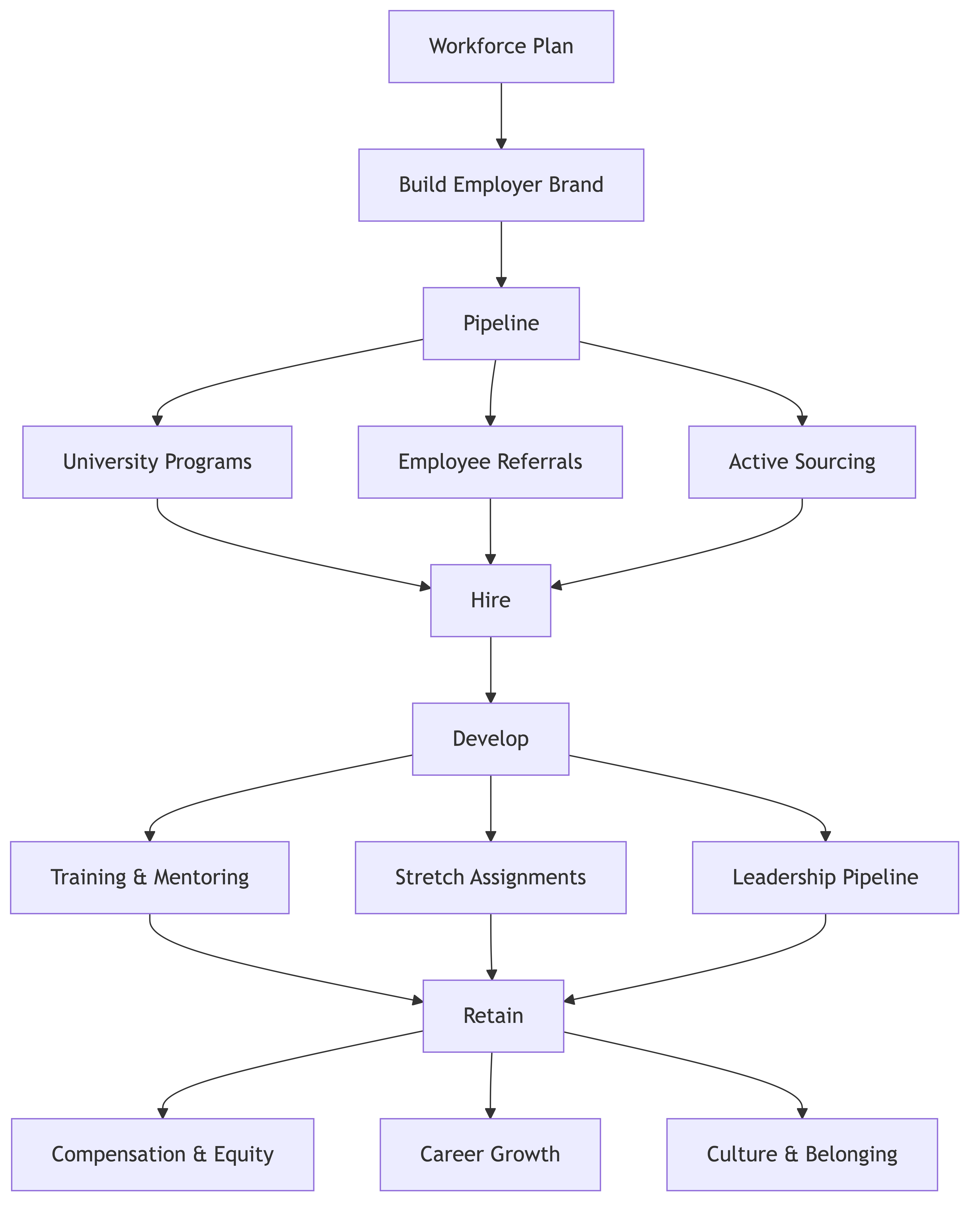
Talent strategy at the director and VP level is about building a machine that consistently attracts, develops, and retains great people. It's not about any single hire. It's about creating an organization where exceptional engineers want to work, where they can do the best work of their careers, and where they tell their friends to join them.
The companies that win at talent don't just pay the most (though they're competitive). They offer compelling work, great managers, genuine growth opportunities, and a culture where people feel valued and included. Building that doesn't happen by accident. It requires the same strategic thinking and sustained investment you'd apply to any critical business capability. Because that's exactly what it is.
Common Pitfalls
- Treating hiring as an HR function. Abdicating talent strategy to recruiters means nobody with engineering context is defining what "great" looks like, resulting in inconsistent quality and misaligned hires.
- Only hiring reactively. Posting jobs only when a team is drowning means you are always behind. Continuous pipeline development is essential for hiring speed when needs arise.
- Neglecting retention while focusing on recruiting. Pouring effort into hiring without addressing why people leave is pouring water into a leaky bucket -- expensive and unsustainable.
- Over-indexing on technical skills at senior levels. Hiring brilliant individual contributors who cannot collaborate or communicate effectively often results in net-negative impact despite their technical output.
- Ignoring the manager's role in attrition. Failing to address managers with high turnover sacrifices good engineers to protect struggling leaders and sends the wrong signal to the organization.
- Not knowing your talent metrics. Without tracking time-to-fill, offer acceptance rate, attrition by tenure, and source effectiveness, you are guessing about whether your strategy works.
Key Takeaways
- Talent strategy at this level is about building a machine that consistently attracts, develops, and retains great people -- not about any single hire.
- Start workforce planning from strategy, not headcount. Work backward from capabilities needed in 12-24 months.
- Plan for attrition explicitly. A 100-person org with 15% attrition needs 15 replacement hires before any net growth.
- Employer branding is built by your engineers, not by corporate marketing. Invest in engineering blogs, conference talks, and authentic storytelling.
- Diversity is a talent strategy imperative. Expand sourcing channels, structure interviews, and invest in inclusion alongside recruiting.
- Speed in the hiring process is a competitive advantage. The best candidates have a shelf life of about 10 days.
- Internal mobility solves retention, development, and cross-pollination challenges simultaneously. Make it a cultural norm.
- Manager quality is your secret weapon for both recruiting and retention. Great managers attract and keep great engineers.