
Prerequisites for Director/VP of Engineering
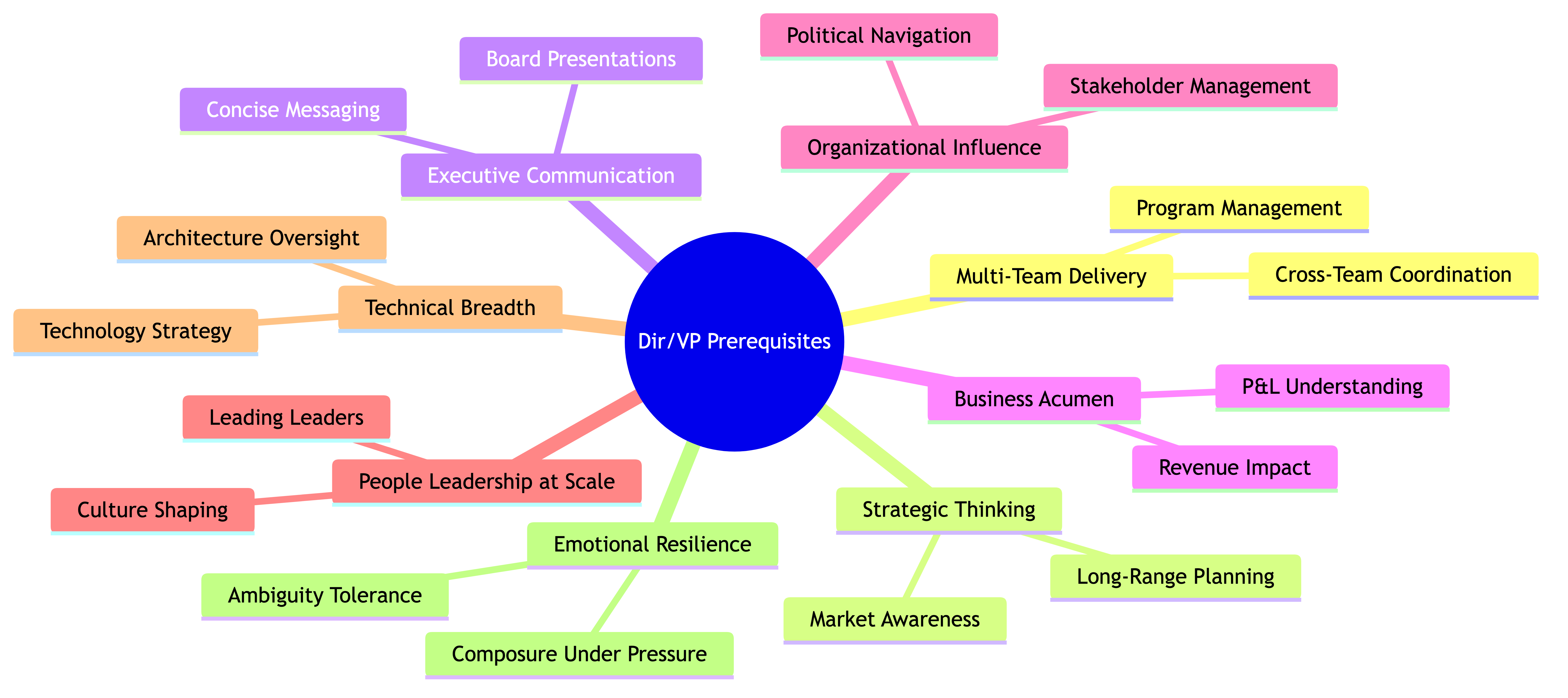
So you're thinking about the jump to Director or VP of Engineering. Good. But before we get into what the role looks like, let's talk honestly about what you need to have under your belt before you're ready for it. This isn't a checklist you can grind through in six months. These are capabilities you've built over years, tested under pressure, and proven with results.
Director vs VP: Scope & Expectations
These two roles share core competencies — strategy, org health, financial management — but differ significantly in scope and organizational influence. A Director typically manages managers and owns a functional area (e.g., "Director of Backend Engineering"), overseeing 20-50 engineers. A VP owns a large department or multiple functional areas, sits at the executive table, and is responsible for 50-200+ engineers. Some companies insert a Senior Director level as an intermediate step between the two.
| Dimension | Director | VP |
|---|---|---|
| Scope | Single functional area or product domain | Multiple areas or full engineering department |
| Direct reports | Engineering Managers, sometimes Senior Managers | Directors and/or Senior Managers |
| Org size | ~20-50 engineers | ~50-200+ engineers |
| Executive access | Presents to executives, attends selectively | Standing seat at the executive table |
| Budget authority | Manages allocated budget | Owns and defends departmental budget |
| Strategy role | Executes and shapes divisional strategy | Sets engineering strategy, co-authors company strategy |
| External presence | Internal focus, some recruiting visibility | Industry presence, board interactions, key customer meetings |
This content covers both levels since the core competencies are shared. Where VP-specific expectations diverge — broader executive influence, larger budget ownership, company-level strategy — those differences are called out explicitly.
1. Multi-Team Delivery Track Record
Nobody is going to hand you a department if you haven't already demonstrated that you can drive results across multiple teams. This means you've owned delivery for at least two or three teams simultaneously, or you've led a large team through complex, multi-quarter initiatives where the coordination challenge was real.
The key word here is proven. Not "I was involved." Not "I contributed to." You owned the outcome. When things went sideways — and they did — you course-corrected. You shipped. You can point to specific projects and say "I drove that, here's what we delivered, here's the business impact, here's what I learned."
If you've only ever managed one team at a time, you're not ready yet. The jump from one team to many isn't linear. The failure modes are completely different. You stop being the person who unblocks — you become the person who builds systems so that unblocking happens without you.
2. Strategic Thinking
At the Director/VP level, the planning horizon changes fundamentally. You're not thinking in sprints anymore. You're thinking in quarters and years. You're connecting engineering work to business strategy in a way that's concrete, not hand-wavy.
This means you can look at a company's annual plan and translate it into an engineering roadmap. You can identify where technical investment today creates leverage six months from now. You can make the case for infrastructure work not in terms of "technical debt" (nobody in the C-suite cares about your debt metaphor) but in terms of speed-to-market, reliability, and competitive advantage.
Strategic thinking also means knowing what to say no to. At this level, the demand for engineering work always outstrips capacity. Your job is to make sure your teams are working on the things that matter most — and that requires a clear-eyed understanding of where the business is going.
3. Executive Communication
You're going to be in rooms with the CEO, the CFO, the board, and cross-functional leaders who don't share your technical vocabulary. You need to communicate in their language, not yours.
BLUF — Bottom Line Up Front. Lead with the conclusion, then support it. Don't build up to the punchline. Executives are scanning for "what do I need to know" and "what do I need to decide." Give them that in the first thirty seconds.
Data-driven. Opinions are fine at the team level. At this level, you bring data. "We believe X because the data shows Y." If you don't have data, say so — then explain what you're doing to get it.
Business-framed. Stop talking about story points, velocity, and technical debt. Start talking about time-to-market, revenue impact, customer retention, and risk. Translate everything into business terms. Every single time.
If you can't present a crisp five-minute update to a group of non-technical executives and leave them feeling informed and confident, you need more practice before you're ready.
4. Business Acumen
Engineering is a business function. Not a cost center. Not a "necessary evil." A business function that creates value, drives revenue, and determines competitive position.
You need to understand:
- P&L basics. How does the company make money? What are the margins? Where does engineering sit in the cost structure?
- Revenue models. Is this SaaS? Marketplace? Transaction-based? How does the product you're building translate into revenue?
- Market dynamics. Who are the competitors? What's the competitive moat? Where is the market heading?
- Unit economics. What does it cost to acquire a customer? What's the lifetime value? How does engineering efficiency affect those numbers?
You don't need an MBA. But you need to be conversant in business fundamentals so you can sit at the leadership table and contribute to decisions that go beyond "should we use Kafka or RabbitMQ."
When you can walk into a budget discussion and make a compelling case for engineering investment framed entirely in business terms — not technical terms — you're getting close.
5. Organizational Influence
At this level, a huge portion of your effectiveness comes from your ability to influence people and decisions outside your direct reporting line. Product, Design, Sales, Finance, Legal — you need relationships and credibility across all of them.
You influence decisions in rooms you're not in. That's the real test. When your name comes up in a meeting you didn't attend, what do people say? Do they trust your judgment? Do they seek your input? Do they assume good intent?
This is built through:
- Consistently following through on commitments
- Being honest about trade-offs even when it's uncomfortable
- Helping other leaders succeed, not just your own teams
- Building genuine relationships, not transactional ones
- Having a reputation for fairness and sound judgment
If your influence stops at the boundary of your engineering org, you're not ready for Director/VP. The role requires you to operate as a company leader, not just an engineering leader.
6. People Leadership at Scale
You've managed managers. You understand what it means to lead through other leaders rather than leading individual contributors directly. This is a fundamentally different skill.
At this level, you need to understand:
- Org design. How do you structure teams for the work that needs to get done? When do you reorganize? How do you minimize disruption while maximizing alignment?
- Culture. You're no longer just participating in culture — you're actively shaping it. What you tolerate, what you celebrate, what you ignore — all of it sends signals at scale.
- Talent strategy. Hiring plans, succession planning, performance calibration across teams. You're thinking about the engineering organization as a portfolio of talent.
- Hard decisions. You've handled layoffs, reorgs, or major organizational changes. Not hypothetically. Actually. You've looked people in the eye during the worst moments and handled it with dignity and clarity.
If you've never managed managers, you're not ready. If you've never had to make a gut-wrenching people decision — letting someone go, restructuring a team, shutting down a project — you haven't been tested enough yet.
7. Technical Breadth
Here's the nuance: you don't need to code at this level. But you absolutely need to evaluate architecture decisions, understand system design trade-offs, and challenge technical plans when something doesn't add up.
You need enough technical breadth to:
- Smell when an estimate is way off and ask the right follow-up questions
- Understand the implications of choosing one architecture over another
- Evaluate build-vs-buy decisions with both technical and business lenses
- Know when your senior engineers are overengineering something and when they're cutting corners
- Have credibility with your technical leaders so they respect your input
This isn't about staying hands-on. It's about maintaining enough technical judgment that you can't be snowed. Your principal engineers and architects will make the detailed decisions. But you need to be able to engage with those decisions at the right altitude.
If you're the kind of leader who just says "I trust the team" on every technical decision without understanding the trade-offs, you'll eventually get burned — and you won't see it coming.
8. Emotional Resilience
Let's be real: the Director/VP role comes with higher stakes, more ambiguity, and more politics. The feedback loops are longer. The decisions are harder. The consequences are bigger.
You will deal with:
- Conflicting priorities from executives who each think their thing is the most important
- Organizational politics that have nothing to do with the quality of your work
- Being held accountable for outcomes that depend on teams and people you don't directly control
- Pressure to deliver more with less, quarter after quarter
- Ambiguity that never fully resolves — you just get better at operating within it
Emotional resilience doesn't mean being stoic or suppressing your feelings. It means you handle pressure without losing composure. You can absorb bad news, process it, and respond thoughtfully instead of reactively. You can sit with ambiguity without freezing. You can navigate political dynamics without becoming cynical or burned out.
If you find yourself regularly overwhelmed, reactive, or exhausted by the demands of managing one team, adding more scope isn't the answer. Get your foundation solid first. Build your support systems — coach, mentor, therapist, peer group, whatever works. The role will test you.
9. How to Know You're Ready
Signs you might be ready:
- You're already operating at the next level informally. People come to you for cross-team decisions. You're involved in strategy discussions. You're mentoring other managers.
- You've delivered results across multiple teams over multiple quarters. Not one good quarter — sustained performance.
- Senior leaders outside engineering seek your input and trust your judgment.
- You think about organizational problems naturally — team structure, talent gaps, culture, process — not just technical problems.
- You're energized by the ambiguity and complexity, not drained by it.
- You can articulate a vision for your engineering organization that connects to business outcomes.
Signs you're not ready yet:
- You still derive most of your satisfaction from solving technical problems yourself.
- You haven't managed managers, or you've managed managers but haven't really let go of the IC work.
- Your influence is mostly within your own team. Cross-functional leaders don't know you well.
- You struggle with executive communication — you go too deep, too technical, too long.
- You avoid conflict or hard conversations. At this level, you can't.
- You haven't been through a real organizational crisis — a layoff, a failed project, a major pivot — and come out the other side with lessons learned.
Being not-ready-yet is not a criticism. It's information. Use it to focus your development.
10. The Director/VP Role — What Changes from EM
Let's be clear about what you're signing up for, because the role is fundamentally different from engineering management.
Less hands-on, more strategic. You're not in the code. You're probably not in the design docs. You're setting direction, allocating resources, and making bets on where to invest. Your planning horizon is 6-18 months out.
More cross-functional. Half your time (or more) is spent working with Product, Design, Sales, Finance, and other functions. You're not just an engineering leader — you're a business leader who happens to own engineering.
More organizational. Org design, culture, talent strategy, succession planning — these become primary concerns. The health and capability of your organization is your product.
More political. This isn't a dirty word. Politics at this level means understanding competing priorities, building coalitions, navigating trade-offs between groups, and influencing outcomes. You can refuse to play politics, but the politics won't refuse to play you.
Less direct feedback, longer loops. When you're an EM, you see the impact of your decisions pretty quickly. At the Director/VP level, it might take quarters to see whether a decision was right. You need to be comfortable with that delay and build systems to get signal in the meantime.
Higher stakes, fewer do-overs. A bad hire at the IC level is recoverable in weeks. A bad org design, a wrong strategic bet, a mishandled reorg — those can take quarters to unwind and damage trust that takes even longer to rebuild.
Business Value
Everything at this level comes back to business value. If you can't articulate the business value of what your engineering organization does, you will lose every resource allocation fight, every prioritization debate, and eventually your seat at the table.
Here's how to think about it:
- Engineering velocity is a business metric. How fast you can ship directly affects time-to-market, competitive position, and revenue growth. Frame it that way.
- Reliability is a business metric. Downtime has a dollar cost. Latency affects conversion rates. Security incidents affect brand trust and regulatory standing.
- Technical investment is a business investment. Platform work, infrastructure improvements, developer tooling — these aren't "engineering vanity projects." They're investments in future speed. Make the ROI case explicitly.
- Talent is a business asset. The quality and retention of your engineering team directly affects execution capability. When you invest in people, you're investing in the company's ability to deliver on its strategy.
- Engineering culture is a business differentiator. Companies that build strong engineering cultures attract better talent, ship faster, and innovate more. That's a competitive advantage with real dollar value.
Your job as a Director/VP is to make the connection between engineering and business value so obvious and so consistent that nobody questions whether engineering is a strategic function. They just know it is, because you've proven it over and over.
Final Thought
The jump to Director/VP isn't just a promotion. It's a role change. The skills that made you a great engineering manager — technical depth, hands-on problem solving, close team relationships — those become secondary. The skills that matter now are strategic thinking, organizational leadership, business acumen, and cross-functional influence.
Make sure you actually want this. Not everyone does, and that's perfectly fine. Some of the most impactful engineering leaders I know chose to stay closer to the technical work, and they're better for it. But if this is the path you want, make sure you're building the prerequisites honestly, not just checking boxes.
The role will find you when you're ready. And if you're doing the work outlined here, you'll be ready when it does.
Common Pitfalls
- Rushing the transition before building prerequisites. Stepping into a Director/VP role without proven multi-team delivery experience leads to floundering in the first six months and erodes confidence from both your team and your peers.
- Clinging to technical hands-on work. Continuing to write code or review pull requests as a primary activity prevents you from developing the strategic and organizational muscles the role demands, and signals to your team that you do not trust them.
- Ignoring business acumen. Failing to learn how the company makes money means you cannot frame engineering investments in terms executives understand, which leads to budget cuts and loss of influence.
- Underestimating the political dimension. Treating organizational politics as beneath you results in decisions being made without your input and resources being allocated to leaders who do engage.
- Neglecting emotional resilience. Powering through stress without building support systems leads to burnout, reactive decision-making, and ultimately poor outcomes for the people who depend on you.
- Confusing being busy with being ready. Managing one team intensely is not the same as managing multiple teams. The failure modes are different at scale, and assuming linear extrapolation will leave you unprepared.
Key Takeaways
- The Director/VP role is a fundamentally different job from engineering management, not just a bigger version of the same job.
- Multi-team delivery track record, strategic thinking, and executive communication are non-negotiable prerequisites.
- Business acumen and the ability to frame engineering work in revenue and business terms separates effective leaders from technically strong ones who plateau.
- Organizational influence extends beyond your reporting line -- you must be effective with Product, Sales, Finance, and other functions.
- People leadership at scale means leading through other leaders, not leading individuals directly.
- Technical breadth is required for credibility, but technical depth is no longer your primary value.
- Emotional resilience is not optional -- build support systems before you need them.
- Honestly assessing whether you are ready is more valuable than chasing the title prematurely.