
Managing EMs
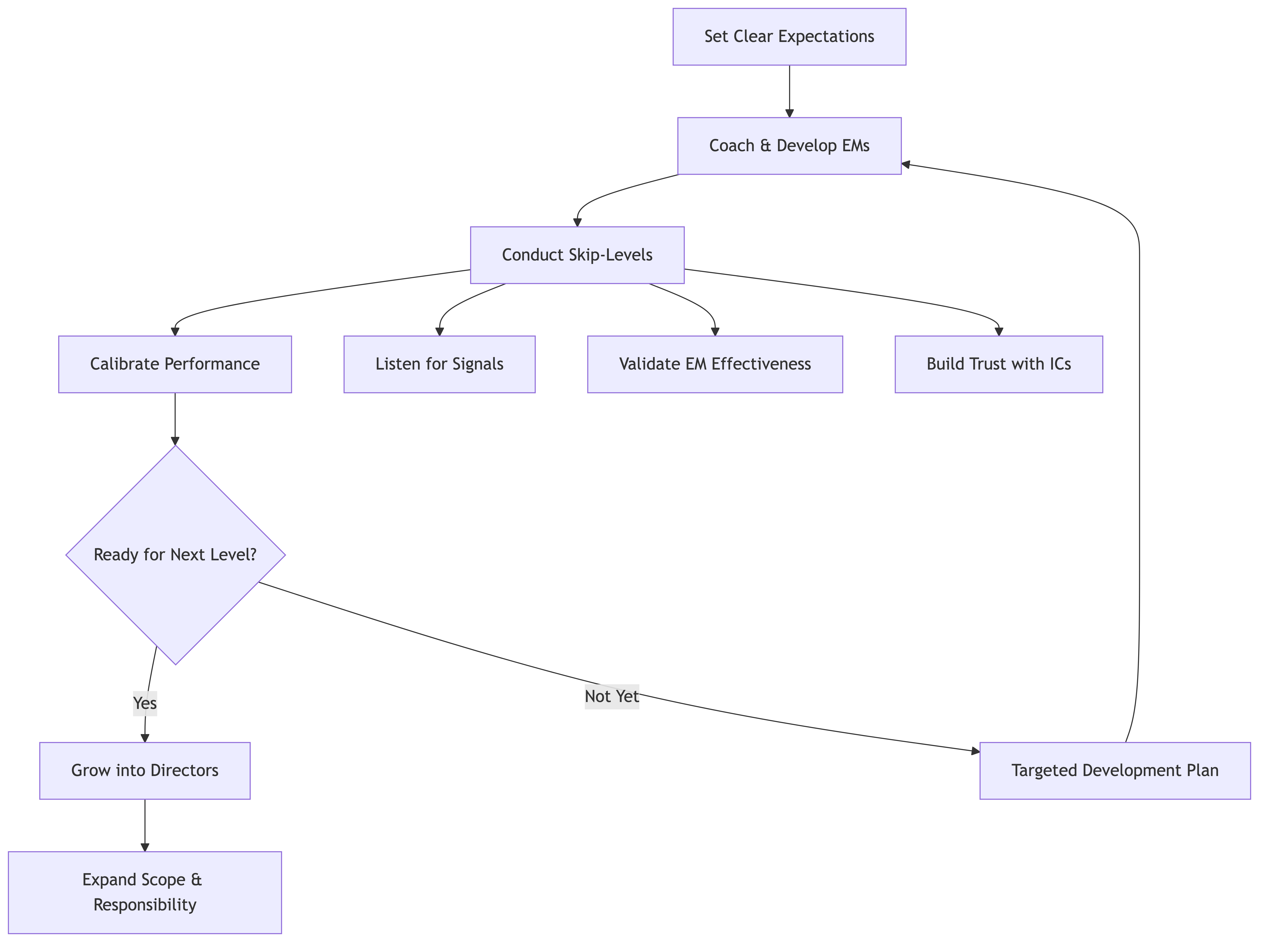
Why This Matters at the Director/VP Level
Here's the fundamental shift that happens when you move from managing engineers to managing engineering managers: you're no longer close to the work. You can't see every pull request. You don't know every sprint's velocity. You might not even know all the individual contributors by name, especially as the org grows past 50 or 60 people.
And that's exactly how it should be.
Your job isn't to be close to the work. Your job is to build a layer of leadership beneath you that's excellent — and then to make that layer even better over time. The quality of your EMs determines the quality of their teams, which determines the quality of what your organization delivers. You are, in a very real sense, only as good as the managers you develop.
This is hard for a lot of directors and VPs to internalize. Many of us got promoted because we were great individual managers. We knew how to run a team, ship software, grow engineers. Now we have to do something fundamentally different: develop the people who do that work, rather than doing it ourselves. It's a different skill set, and the leaders who struggle most at this level are the ones who never make that transition.
Business Value
Managing EMs well isn't a "soft skill" nice-to-have. It's one of the highest-leverage activities a director or VP can engage in, and the business impact is substantial.
Organizational scaling. A director who develops strong EMs can scale an organization from 30 to 150 engineers without everything falling apart. A director with weak EMs hits a ceiling at 40 or 50 because they're constantly stepping in to do their managers' jobs for them. I've seen orgs stall for years because the VP never invested in their EM layer — they just kept adding engineers while their managers stayed mediocre.
Retention and talent density. Research consistently shows that people leave managers, not companies. When your EMs are great, attrition drops, engagement goes up, and your best engineers stay. When your EMs are average or poor, you hemorrhage senior talent and spend all your time backfilling. The cost of replacing a senior engineer is easily $200-400K when you factor in recruiting, ramp-up, and lost productivity.
Delivery consistency. Strong EMs deliver reliably across quarters. They manage scope, communicate risks early, and keep their teams focused. Weak EMs produce teams that alternate between heroic sprints and periods of confusion. When you have six teams and four of them deliver consistently because their EMs are strong, your planning accuracy and business commitments become much more credible at the executive level.
Leadership pipeline. The EMs you develop today are your directors of tomorrow. And the directors you develop are your future VPs. If you're not intentionally growing your management bench, you'll always be hiring externally for senior roles — which is slower, more expensive, and riskier than promoting from within.
Cultural multiplication. Your EMs are the primary carriers of engineering culture. They set the tone for code review practices, incident response, psychological safety, and work-life balance across dozens of engineers. Investing in your EMs is how you shape the culture of an entire organization, not through all-hands talks, but through the daily behaviors of the leaders closest to the teams.
Managing Managers of Managers
Let's start with the structural reality. As a director or VP, you're often two levels removed from the actual engineering work. There might be a principal engineer writing code, reporting to a TL, who reports to an EM, who reports to you. That's three layers between you and the keyboard.
This scares a lot of new directors. They feel disconnected. They worry they're losing touch. And so they start doing the wrong things — dropping into standups, reviewing technical designs they don't have context on, giving feedback directly to ICs that contradicts what their EM said.
Here's the mental model I've found most helpful: your leverage is multiplicative, not additive. When you were an EM, you could directly improve the output of 6-10 engineers. Now, if you have 5 EMs each with 8 engineers, and you make each EM 20% better, you've improved the output of 40 engineers. That's far more impact than you could ever have by trying to manage those 40 people yourself.
So what does "making your EMs better" actually look like?
Investing in regular, high-quality 1:1s. Your 1:1s with EMs should be fundamentally different from the 1:1s they have with their reports. You're not talking about task status or sprint progress. You're talking about team dynamics, organizational challenges, strategic alignment, and their own growth as leaders. A good 1:1 cadence with each EM is weekly, for at least 45 minutes. This is not a meeting to cut when your calendar gets busy. It's the primary mechanism through which you lead.
Giving real, specific feedback. Not "you're doing great" or "the team seems behind." Specific, actionable feedback like: "In the planning meeting yesterday, you committed your team to a deadline without pushing back on scope. Let's talk about why that happened and how to handle it differently next time." The more concrete, the better.
Modeling the leadership behaviors you want to see. Your EMs will copy you. If you handle escalations calmly, they'll learn to handle escalations calmly. If you panic and micromanage when things go wrong, they'll do the same to their teams. You're teaching leadership by example whether you intend to or not.
Pushing decisions down. When an EM comes to you for a decision, your first instinct should be: "Can they make this decision themselves?" If yes, push it back. Coach them through how to think about it, but let them own it. If you make every decision for your EMs, you'll bottleneck the organization and your EMs will never develop judgment.
Coaching EMs vs. Coaching TLs
One of the most common mistakes I see directors make is coaching their EMs the same way they coached tech leads. It doesn't work. The problems are different, the skills are different, and the coaching needs to match.
When you coached a TL, you probably focused on things like:
- How to run an effective standup
- How to break down a project into tasks
- How to give code review feedback
- How to have a difficult 1:1 with a struggling IC
- How to manage up by communicating status clearly
These are important skills, but your EMs should already have them. If they don't, that's a hiring or promotion problem, not a coaching problem.
What EMs need coaching on is fundamentally different:
Strategic thinking. "Given our company's direction, how should your team's roadmap evolve over the next 2-3 quarters? What bets should you be making?" Most EMs default to executing whatever product gives them. Strong EMs have a point of view on what their team should build and why.
Organizational thinking. "You have 12 engineers and you're being asked to take on a new product area. Do you split into two teams now or wait? If you split, how do you draw the boundary? Who leads the second team?" These are the decisions that shape an organization, and many EMs have never had to think at this level.
Cross-functional influence. "Product wants to go in direction A, but you believe direction B is better for the business. How do you make your case? How do you influence without authority? How do you disagree and commit if you lose the argument?" EMs need to be effective partners, not just executors.
Business alignment. "The company's top priority this quarter is reducing churn. How does your team's work connect to that? Can you explain the business impact of your team's last three shipped features?" EMs who can't connect their work to business outcomes eventually find their teams deprioritized or reorganized.
People strategy. "You're going to lose two senior engineers to attrition this year. What's your plan? Who's on your bench? What skills gaps are forming? How are you developing your high-potentials?" This is different from handling individual performance issues — it's about thinking about the team as a portfolio of talent.
The coaching approach is different too. With TLs, you could often just tell them what to do: "Here's how to run a retrospective." With EMs, you need to ask questions that build their judgment: "What are you optimizing for with this team structure? What are the tradeoffs? What would you do if that assumption turns out to be wrong?" You're building their ability to reason about complex, ambiguous problems, not giving them playbooks.
Setting Expectations
One of the biggest failures I see in director-EM relationships is ambiguity about what "great" looks like. The EM thinks they're doing well because their team ships code. The director is frustrated because the EM isn't operating strategically. Neither has articulated what "great" actually means.
Don't leave this to chance. Be explicit. Here's a framework for what great looks like for an EM:
Team delivery. The team consistently delivers on commitments. Not by overworking, but through good planning, scope management, and execution. Estimates are generally accurate. Risks surface early. When things slip, the EM communicates proactively and adjusts. A great EM's team hits roughly 80% of its commitments without burning out.
People growth. Engineers on the team are growing. Junior engineers are becoming mid-level. Mid-level engineers are becoming senior. People are getting promoted, and those promotions are well-deserved. The EM can articulate a development plan for each person on their team and is actively working those plans.
Retention. Great EMs keep their best people. Attrition on a healthy team should be well below company average. When someone does leave, it's usually for an opportunity the EM couldn't match — not because they were unhappy or disengaged. If a great EM's team has regrettable attrition, the EM has already identified the root cause and is addressing it.
Business alignment. The EM understands why their team exists and how it contributes to company goals. They can articulate this clearly — to you, to their team, and to cross-functional partners. They proactively adjust priorities when business context changes rather than waiting to be told.
Operational excellence. The team's systems are healthy. On-call burden is reasonable. Incidents are followed up with meaningful action items that actually get done. Technical debt is managed intentionally, not ignored. Deployments are smooth. The team isn't drowning in toil.
Stakeholder management. Product managers, designers, and other cross-functional partners trust and respect the EM. Relationships are collaborative, not adversarial. When conflicts arise, the EM handles them directly rather than escalating everything to you.
Write these expectations down. Share them with your EMs. Calibrate on them quarterly. When you do performance reviews, evaluate against these dimensions explicitly. This clarity is a gift to your EMs — most managers spend their careers guessing about what their boss actually values.
Organizational Design Decisions
As a director or VP, one of your most important responsibilities is organizational design: how teams are structured, who reports to whom, and where scope boundaries lie.
This is your decision to own. Not in an autocratic way — you should absolutely partner with your EMs, gather input, and consider their perspectives. But the final call on org structure sits with you, because you're the one with the cross-organizational view. An individual EM sees their team's world. You see how all the teams fit together.
Key decisions you'll face:
Team topology. Should teams be organized around products, platforms, or capabilities? Should you have dedicated infrastructure teams or embed that work into product teams? There's no universal right answer. It depends on your company's stage, product architecture, and engineering maturity.
Team size. How big should individual teams be? I generally find 5-8 engineers per team to be the sweet spot. Smaller and you lack resilience — one person on vacation and the team is at half capacity. Larger and the coordination costs start eating into productivity. But your mileage will vary.
Reporting lines. When you have a senior engineer who's not quite a manager but leads technical direction for a team, do they report to the EM or to you? When you acquire a company and need to integrate their engineering team, how do you restructure reporting lines to minimize disruption while maintaining clear accountability?
Scope boundaries. This is the hardest one. Where does Team A's responsibility end and Team B's begin? Get this wrong and you get constant coordination overhead, dropped balls at team boundaries, and territorial conflicts. The best scope boundaries follow the architecture: teams own services or product surfaces with clear interfaces.
When to split teams. A team that's grown to 12 engineers almost certainly needs to split. But when exactly? And how? Splitting too early creates unnecessary management overhead. Splitting too late means the EM is overwhelmed and the team's cohesion has already degraded. Watch for signs: the EM can't have regular 1:1s with everyone, the team's standup is too long, or different workstreams have no natural connection.
When making these decisions, communicate the reasoning, not just the outcome. "We're reorganizing the teams" creates anxiety. "We're splitting the Platform team into Infrastructure and Developer Experience because we've identified that these workstreams have different cadences, different stakeholders, and different success metrics, and they'll move faster as independent teams" gives people something they can understand and get behind.
Calibration Across Teams
One of the less glamorous but critically important parts of managing multiple EMs is ensuring consistency across their teams. Without active calibration, you'll end up with wildly different standards depending on which team someone happens to be on.
Performance standards. EM A might rate all their engineers as "exceeding expectations" while EM B is a tougher grader. Without calibration, you end up with unfair situations where an engineer on Team B who outperforms someone on Team A gets a lower rating. Run calibration sessions before every review cycle. Have your EMs present their ratings and justifications, and challenge inconsistencies.
Promotion criteria. What does it take to go from senior to staff engineer? If each EM has their own interpretation, you'll promote people who aren't ready and hold back people who are. Establish clear, written criteria. Review every promotion case as a group with all your EMs, not just with the sponsoring EM. This forces consistency and gives EMs exposure to the full range of what "staff-level work" looks like.
Compensation. Are base salaries and equity grants roughly consistent for people at the same level doing similar work? Compensation inequity is one of the fastest ways to destroy trust and drive attrition. Review compensation data across your org at least annually and address outliers proactively.
Workload and on-call burden. Is one team drowning while another has slack? Is one team's on-call rotation brutal while another team barely gets paged? As the leader who sees across all teams, it's your job to rebalance when things get skewed. This sometimes means moving people between teams or redistributing scope — decisions that individual EMs can't make on their own.
Hiring bar. Are your EMs all hiring to the same standard? Sit in on interviews across teams regularly. Review interview feedback. If one team is consistently hiring weaker candidates, the effects will compound over years and you'll end up with a quality gap that's very hard to close.
The calibration work isn't exciting, but it's one of the things that separates a well-run engineering organization from a collection of loosely affiliated teams that happen to share a VP.
Skip-Level Programs
Skip-levels — meeting directly with people who report to your EMs — are one of the most valuable tools in your toolkit. They're also one of the most commonly misused.
Done well, skip-levels give you ground truth about organizational health, help you identify talent and problems early, and build relationships that strengthen the organization. Done poorly, they undermine your EMs and create confusion about who's actually in charge.
How to structure skip-levels:
Set a regular cadence. I recommend meeting each IC or TL who reports to your EMs at least once per quarter. For a large org, that's a lot of meetings, so you may need to batch them — doing a "skip-level week" once per quarter where you have 30-minute conversations with everyone.
Be transparent with your EMs about what you're doing and why. "I'm going to have quarterly skip-levels with everyone on your team. This is not because I don't trust you or because I'm checking up on you. It's because I need to understand our organization at a level I can't get from your reports alone, and because I want our ICs to feel connected to leadership beyond their direct manager."
What to ask in skip-levels:
- "What's going well on the team?" (Start positive, build comfort.)
- "What's frustrating you right now?" (Listen carefully — patterns across multiple skip-levels are gold.)
- "Do you feel like you're growing? What would help you grow faster?"
- "Is there anything you think leadership should know about?"
- "What would you change about how we work if you could change one thing?"
What NOT to do in skip-levels:
- Don't give direction that contradicts the EM. If someone asks you to make a decision their manager already made, redirect them: "That's a conversation to have with your manager. I trust their judgment on this."
- Don't use skip-levels to gather ammunition against an EM you're frustrated with. That's not what this is for.
- Don't make promises you can't keep. "I'll look into that" is fine. "I'll fix that for you" when it's the EM's domain is not.
How to use skip-level data:
After a round of skip-levels, share themes (not individual attributions) with your EMs. "I heard from several people across different teams that our deploy process is a pain point. Can we talk about that?" This gives your EMs actionable feedback without exposing individuals or creating a surveillance dynamic.
If you hear something concerning about an EM — say, that they're dismissive in 1:1s or that they play favorites — bring it to the EM directly as a coaching conversation, not as a "people are saying..." ambush. "I've picked up a signal that some folks on your team don't feel heard in 1:1s. I want to explore that with you. What's your read on how your 1:1s are going?"
When an EM Struggles
Every director will face this: an EM who's not performing. Maybe the team is consistently missing deliverables. Maybe attrition is spiking. Maybe you're getting escalations from cross-functional partners. Maybe the skip-level data is concerning.
Before you act, you need to diagnose. The most important question is: is it the EM, or is it the situation?
Signs of a situational problem (the EM might be fine, but the context is hard):
- The team inherited a codebase that's genuinely terrible, and no EM could make it productive without significant investment.
- The team is understaffed for the scope they've been given.
- The product direction keeps changing, making consistent delivery impossible.
- A toxic senior engineer is dragging the team down, and the EM hasn't been empowered to address it.
Signs of an EM performance problem:
- Multiple teams have struggled under this EM, not just the current one.
- The EM avoids difficult conversations — underperformers persist, conflicts fester.
- The EM can't articulate a clear picture of their team's health or priorities.
- Other EMs at the same level are handling similar challenges successfully.
- The EM is defensive when given feedback rather than curious and open.
If it's situational: Fix the situation. Give the team more resources. Stabilize the product direction. Empower the EM to make hard people decisions. Then see if performance improves. Don't blame the EM for a context that would make anyone struggle.
If it's the EM: You have a coaching obligation. Be direct about what you're seeing. "Your team's delivery has slipped for three consecutive quarters. Attrition is above average. Two of your engineers asked to transfer to other teams in the last month. I want to help you turn this around, but we need to be honest about where things are."
Set clear expectations with a timeline. "Over the next 90 days, I need to see these specific improvements: [list them]. I'm going to support you with [specific support]. Let's meet weekly to track progress."
If the EM doesn't improve after genuine coaching and support, you need to make a change. That might mean moving them to a smaller scope, transitioning them to an IC role, or managing them out of the organization. This is never easy, but allowing an underperforming EM to continue costs you the engagement and careers of everyone on their team. Your obligation to those engineers is just as real as your obligation to the EM.
Growing EMs into Directors
Part of your job is building the next generation of engineering leaders. The best directors and VPs I know are always thinking about which of their EMs could step into a director role — and actively developing those high-potential leaders.
How to identify high-potential EMs:
- They think beyond their team. They notice problems in adjacent teams and offer help. They care about the organization, not just their territory.
- They're strategic. They don't just execute what they're given — they have a point of view on what the org should be doing and why.
- Other EMs respect them. When you bring your EMs together, the high-potentials are the ones others naturally turn to for advice.
- They handle ambiguity well. When you give them a vague problem, they structure it themselves rather than asking for detailed instructions.
- They develop their own people. Their teams produce TLs and future EMs — they're not just managing, they're building leaders.
How to develop them:
Give them director-level exposure. Invite them to strategy meetings. Let them present to your peers or your boss. Have them attend executive reviews. Exposure to how directors think and operate is invaluable and can't be learned from a book.
Assign cross-functional leadership. "I need someone to lead our engineering response to the SOC 2 audit. It spans all our teams and requires working with Legal, Security, and Compliance." Projects like this give EMs practice at influencing across organizational boundaries without having direct authority.
Give them org-wide initiatives. "We need to revamp our interview process across all engineering teams." This forces them to think at an organizational level, build consensus among peers, and drive change at a scale bigger than their own team.
Let them make director-level decisions (with a safety net). "We need to restructure the backend teams. I want you to come up with a proposal. I'll give you feedback, but I want you to own the analysis and recommendation." This builds the muscle of org design and strategic thinking.
Have honest career conversations. Not every EM wants to be a director, and not every EM should be. Talk openly about what the director role entails — less hands-on, more politics, broader scope, harder tradeoffs. Some EMs will hear that and be excited. Others will realize they're happier at the EM level, and that's a perfectly valid choice.
Real-World Examples
Scenario 1: The EM Who Can't Let Go
You have an EM, Priya, who was an exceptional tech lead before becoming a manager. She still reviews every technical design, weighs in on architectural decisions, and sometimes rewrites her engineers' code. Her team's output is technically excellent, but her senior engineers are frustrated. Two of them have mentioned in skip-levels that they don't feel trusted. One is interviewing elsewhere.
The diagnosis: Priya is managing like a TL, not an EM. She's adding value through her technical contributions but subtracting it through disempowerment.
Your coaching approach: "Priya, your technical instincts are a real strength, and I don't want you to lose that. But I need your senior engineers to own technical decisions. Your job is to set the bar and coach them to meet it, not to do it yourself. Let's try an experiment: for the next month, you don't review any code or designs unless explicitly asked. Instead, let's focus your energy on the two people development conversations you've been putting off and on building a roadmap for next quarter. I think you'll find that when you step back technically, your seniors will step up — and your impact will actually increase."
Scenario 2: Inconsistent Standards Across Teams
You manage three EMs. After a promotion cycle, you notice that Team A promoted two engineers to senior, Team B promoted one, and Team C promoted none. You look at the justifications and realize Team A's bar is noticeably lower than Team C's. One of Team A's new seniors would likely have been rated "not yet ready" by Team C's EM.
Your action: First, don't undo the promotions that already went through — that would be devastating to those engineers and unfair since they met the bar as it was communicated to them. But fix the system going forward.
You call a calibration meeting with all three EMs. You share anonymized promotion packets from the last cycle and ask each EM to rate them independently. When the ratings diverge, you discuss why. You work together to write explicit, shared criteria for each level transition. You commit to running cross-team calibration before every future promotion cycle. And you check in with Team C's EM separately: "I think you might have engineers who are ready and haven't been sponsored. Let's review your team together."
Scenario 3: An EM in Over Their Head
Marcus was promoted to EM six months ago. He was a strong senior engineer and showed leadership potential. But managing a team of eight — including two underperformers and a complex migration project — has overwhelmed him. Sprint commitments are consistently missed. He's working 60-hour weeks. In your 1:1s, he seems exhausted and defensive.
Your diagnosis: This is partly situational (the scope is aggressive for a first-time EM) and partly a development gap (Marcus doesn't yet know how to manage performance issues or delegate effectively). This is not a case where you should give up on Marcus, but it is a case where you need to actively intervene.
Your action: Reduce the pressure first. Move the migration project to a more experienced EM's team, or bring in a senior TL to co-lead it. This isn't a punishment — frame it as "I set you up with too much too soon, and I want to correct that." Then invest in coaching. Work with Marcus specifically on having the performance conversations he's been avoiding. Role-play them if needed. Check in more frequently — go to twice-weekly 1:1s for a month. Set a 90-day checkpoint: "By then, I want to see you handling your team with confidence and having addressed the performance issues. I believe you can get there, and I'm going to support you."
Common Mistakes
Bypassing your EMs. This is the single most common and most damaging mistake. You hear about a problem on a team and go directly to the IC to fix it. You make a technical decision without involving the EM. You give career advice to someone that contradicts their manager's guidance. Every time you do this, you undermine your EM's authority and teach the team that the EM is optional. If you have a problem with how an EM is handling something, talk to the EM — don't route around them.
Inconsistent standards. If you praise one EM for something and criticize another EM for the same thing, your EMs will notice. If you hold one team to a higher delivery bar than another without a clear reason, that team will feel unfairly treated. Consistency doesn't mean treating everyone identically — context matters — but your principles and expectations should be stable and transparent.
Not investing in EM development. When things get busy, EM coaching is often the first thing to go. You cancel 1:1s, skip calibrations, and stop giving feedback. This feels like you're freeing up time for higher-priority work, but it's actually the opposite. Under-developed EMs create more problems, not fewer. The investment you skip today becomes the escalation you handle tomorrow.
Micromanaging. You ask for daily status updates from your EMs. You want to be cc'd on every important email. You sit in on their team meetings "just to observe." This tells your EMs you don't trust them, and it prevents them from developing their own judgment. Set clear expectations, establish lightweight reporting mechanisms, and then give your EMs room to operate. Check in on outcomes, not activities.
Avoiding hard conversations. An EM is struggling, and everyone knows it — their team, the other EMs, cross-functional partners. But you keep hoping it'll get better on its own. It won't. The longer you wait, the more damage accumulates. Your other EMs are watching how you handle this, and your credibility as a leader depends on your willingness to address problems directly.
Treating all EMs the same. A first-time EM managing five engineers needs very different support than a seasoned EM managing 15 engineers across two teams. Tailor your management approach. Some EMs need more structure and guidance. Others need more autonomy and strategic challenges. Part of your job is knowing which EM needs what.
Taking too long on org changes. When a reorg is needed — a team split, a manager change, a scope redistribution — delays rarely make things better. People sense that something is coming, anxiety builds, and productivity drops. Once you've decided a change is necessary, move with appropriate speed. Communicate clearly, execute cleanly, and support people through the transition.
Putting It All Together
Managing EMs is the core of what it means to be a director or VP of engineering. It's not the most visible part of your job — executives will notice your strategy presentations and your quarterly business reviews. But the quality of your EM relationships is what determines whether your organization actually executes on that strategy.
Invest in your EMs relentlessly. Coach them like the leaders they are, not like the individual contributors they used to be. Set clear expectations and calibrate consistently. Build skip-level relationships without undermining the management chain. Have the hard conversations when they're needed. And always, always be developing the next generation of engineering leaders.
The best compliment a director or VP can receive isn't "your org ships great software." It's "your managers are incredible." Because if your managers are incredible, the great software is inevitable.
Common Pitfalls
- Bypassing your EMs. Going directly to ICs to fix problems, make technical decisions, or give career advice undermines your managers' authority and teaches the team that the EM layer is optional.
- Coaching EMs like tech leads. Focusing coaching on tactical skills (standups, sprint planning, code review) instead of strategic and organizational thinking leaves EMs operating below the level the role requires.
- Not investing in EM development when busy. Canceling 1:1s, skipping calibrations, and stopping feedback during crunch periods creates more problems than it saves time, because under-developed EMs generate escalations.
- Tolerating inconsistent standards across teams. Allowing each EM to apply different performance, promotion, and hiring bars creates unfairness, erodes trust, and produces quality gaps that compound over years.
- Avoiding hard conversations about struggling EMs. Allowing an underperforming EM to continue costs the engagement and careers of everyone on their team. Your obligation to those engineers is as real as your obligation to the EM.
- Micromanaging through excessive status requests. Asking for daily updates, sitting in on team meetings, and requiring CC on emails tells your EMs you do not trust them and prevents them from developing judgment.
Key Takeaways
- Your leverage as a director/VP is multiplicative: making each EM 20% better improves the output of every engineer they lead.
- Invest in regular, high-quality 1:1s with EMs focused on team dynamics, strategic alignment, and leadership growth -- not task status.
- Set explicit expectations for what "great" looks like across delivery, people growth, retention, business alignment, operational excellence, and stakeholder management.
- Push decisions down to your EMs. Coach them through how to think about problems rather than making decisions for them.
- Run calibration sessions for performance reviews, promotions, compensation, and hiring bar to ensure consistency across teams.
- Use skip-levels to get ground truth about organizational health without undermining the management chain.
- Actively develop high-potential EMs into future directors through exposure, cross-functional leadership, and org-wide initiatives.
- The quality of your EM layer determines the quality of everything your organization delivers.