
AI/ML Strategy: Navigating the Biggest Technology Shift of Our Era
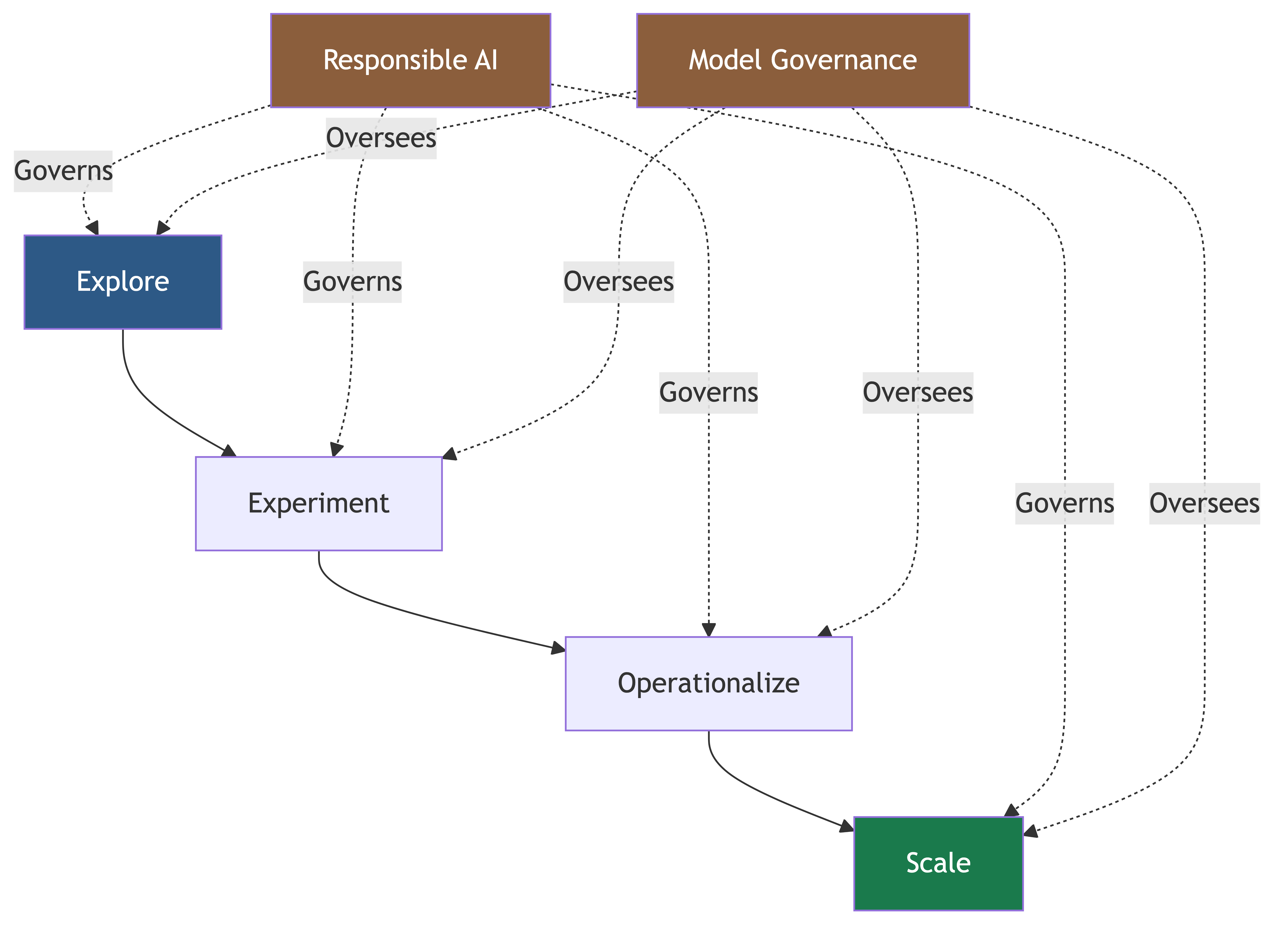
I'll be honest with you: AI is the most overhyped and simultaneously the most underestimated technology shift I've seen in my career. It's overhyped because not every problem needs AI, and most companies are implementing it poorly. It's underestimated because the companies that get it right are achieving efficiency gains that fundamentally alter their competitive position.
Your job as CTO isn't to chase every AI trend. It's to figure out where AI creates genuine, measurable value for your business and execute on that with discipline. This chapter is about doing exactly that — building an AI strategy that's grounded in business reality, not hype.
AI as the Current Biggest Efficiency Multiplier
Let's start with why AI matters right now. The efficiency gains are real and unprecedented:
- Code generation: Engineers using AI coding assistants report 25-50% increases in productivity for certain tasks. Not for all tasks — for boilerplate, tests, documentation, and routine implementations.
- Customer support: AI-powered support can resolve 40-60% of customer inquiries without human intervention, dramatically reducing cost per ticket.
- Content generation: Marketing, documentation, and communication that used to take hours can be drafted in minutes.
- Data analysis: AI can identify patterns in data that would take human analysts weeks to find.
- Operations: AI-driven monitoring can detect anomalies and predict failures before they impact customers.
But here's the nuance: these gains aren't automatic. They require thoughtful implementation, proper tooling, training, and measurement. A company that hands engineers an AI coding assistant without guidance on how to use it effectively might see a 5% improvement. A company that integrates it into their workflow with proper training and quality guardrails might see 40%.
The difference is strategy.
AI Adoption Roadmap
Don't try to boil the ocean. AI adoption works best as a phased approach, starting with high-value, low-risk applications and building toward more ambitious use cases.
Phase 1: Internal Efficiency (Months 1-3)
Start with AI tools that improve your team's productivity:
Engineering Productivity
- AI coding assistants (GitHub Copilot, Cursor, etc.) for your engineering team
- AI-powered code review assistants
- Automated test generation
- Documentation generation from code
Operations
- AI-enhanced monitoring and alerting
- Automated log analysis and anomaly detection
- AI-assisted incident triage
Business Operations
- AI-powered customer support (starting with suggestion mode, not autonomous)
- Meeting summarization and action item extraction
- Document drafting and editing assistance
The goal of Phase 1 is to build organizational familiarity with AI while capturing immediate efficiency gains. These are relatively low-risk applications because they augment humans rather than replacing human judgment.
Phase 2: Product Enhancement (Months 3-9)
Once your team is comfortable with AI tools, start integrating AI into your product:
- Search and discovery: AI-powered search that understands intent, not just keywords
- Personalization: Recommendations, content curation, user experience customization
- Natural language interfaces: Let users interact with your product using natural language
- Smart defaults: AI that predicts what users want and pre-fills or suggests accordingly
- Content generation: If your product involves content creation, AI assistance can dramatically improve the user experience
Phase 3: AI-Native Features (Months 9-18)
Build features that are only possible because of AI:
- Predictive capabilities: Forecasting, trend analysis, risk assessment
- Intelligent automation: Workflows that adapt based on context and learning
- Conversational interfaces: AI agents that can complete complex tasks through natural conversation
- Generative features: Content, design, or code generation as a core product capability
Phase 4: AI as Competitive Moat (18+ months)
If done well, your AI capabilities become a competitive advantage:
- Proprietary models: Fine-tuned models trained on your unique data
- Data flywheel: More users generate more data, which improves your models, which attracts more users
- AI-native workflows: Entirely new ways of working that competitors can't easily replicate
- Domain expertise embedded in AI: Your industry knowledge captured in models that new competitors can't quickly reproduce
Build vs. Buy for AI
This is one of the most consequential decisions you'll make. The AI landscape has both powerful off-the-shelf solutions and compelling reasons to build custom capabilities.
When to Buy (Use Third-Party AI)
- Commodity capabilities: Translation, transcription, image recognition, general-purpose text generation. These are solved problems. Don't rebuild them.
- Rapidly evolving technology: Foundation models are improving so fast that anything you build today may be obsolete in six months. Buying keeps you on the cutting edge without the maintenance burden.
- Non-core functionality: If AI enhances your product but isn't your core differentiator, buy. Focus your engineering effort on what makes you unique.
- Speed to market: Buying gets you to market faster. When competitive pressure demands speed, buy first and consider building later.
When to Build (Custom AI)
- Core differentiator: If AI is central to your value proposition, you need to own it. Building gives you control over quality, capability, and direction.
- Proprietary data advantage: If your unique data makes custom models significantly better than general-purpose ones, building captures that advantage.
- Cost at scale: API-based AI services charge per call. At high volume, the cost can be substantial. Self-hosted models have high upfront cost but lower marginal cost.
- Privacy and compliance: If your data can't leave your infrastructure (healthcare, finance, government), you may need to run models locally.
- Latency requirements: API calls add latency. If you need real-time AI inference, self-hosted models may be necessary.
The Hybrid Approach
Most companies should take a hybrid approach:
- Use third-party APIs for general-purpose AI capabilities
- Fine-tune open-source models for domain-specific tasks
- Build custom models only for true differentiators
- Re-evaluate regularly as the landscape evolves
The key is being intentional. Don't build custom AI for the sake of it. Don't buy when building would create a meaningful competitive advantage. And don't make this decision once — revisit it quarterly as the technology and your needs evolve.
LLM Integration Strategy
Large Language Models deserve their own section because they're uniquely powerful and uniquely tricky.
Architecture Patterns for LLM Integration
Direct API Integration The simplest pattern: your application calls an LLM API directly. Good for prototyping and low-volume use cases. Challenges: latency, cost at scale, vendor dependency.
RAG (Retrieval-Augmented Generation) Combine LLMs with your own data. Retrieve relevant context from your data stores, inject it into the LLM prompt, and get responses grounded in your specific information. This is the most common pattern for enterprise AI applications.
RAG architecture:
- Index your documents/data into a vector database
- When a user asks a question, retrieve relevant chunks
- Include retrieved chunks in the LLM prompt as context
- The LLM generates a response grounded in your data
Agent Architectures LLMs that can use tools — calling APIs, querying databases, executing code. More powerful but harder to control. Use with caution and strong guardrails.
Fine-Tuning Training an existing model on your specific data and tasks. Expensive but can significantly improve quality for domain-specific applications. Consider fine-tuning when RAG isn't sufficient and you have enough domain-specific training data.
LLM Guardrails
LLMs are powerful but unreliable in specific ways. Build guardrails:
- Input validation: Filter and sanitize user inputs to prevent prompt injection attacks.
- Output validation: Check LLM outputs before presenting them to users. Validate factual claims against your data. Filter inappropriate content.
- Hallucination detection: LLMs confidently generate false information. For high-stakes applications, implement fact-checking against known data sources.
- Rate limiting and cost controls: LLM API calls are expensive. Implement rate limiting per user and global cost caps to prevent bill shock.
- Fallback paths: What happens when the LLM is slow, unavailable, or returns garbage? Always have a graceful degradation path.
- Human oversight: For critical decisions, keep a human in the loop. AI should augment human judgment, not replace it, especially for high-stakes decisions.
Prompt Engineering as a Discipline
Prompt engineering is a real skill, not a gimmick. Invest in it:
- Develop prompt templates for common use cases
- Version control your prompts like you version control your code
- Test prompts systematically with diverse inputs
- Measure prompt quality with automated evaluation metrics
- Iterate based on user feedback and failure analysis
Model Governance
As AI becomes more central to your product and operations, governance becomes critical.
Model Lifecycle Management
- Development: Track experiments, hyperparameters, training data, and results. Tools like MLflow, Weights & Biases, or similar platforms help.
- Testing: Test models rigorously before deployment. Include edge cases, adversarial inputs, and fairness evaluations.
- Deployment: Use staged rollouts for model updates. Canary deployments let you catch problems before they affect all users.
- Monitoring: Track model performance in production. Models degrade over time as data distributions shift (model drift). Detect and address it.
- Retirement: Define criteria for when a model should be retired or retrained. Don't leave stale models in production.
Model Registry
Maintain a registry of all models in production:
- What does each model do?
- What data was it trained on?
- When was it last updated?
- What's its current performance?
- Who owns it?
- What are its known limitations?
This isn't bureaucracy — it's operational hygiene. When something goes wrong with an AI feature, you need to be able to quickly identify which model is responsible and who can fix it.
Data Governance for AI
AI is only as good as its data. Govern your AI data carefully:
- Training data provenance: Know where your training data came from. Can you legally use it? Is it representative? Is it biased?
- Data quality: Garbage in, garbage out is more true for AI than for any other technology. Invest in data quality.
- PII handling: Training data often contains personal information. Implement proper anonymization and access controls.
- Data versioning: Track which version of training data produced which model. You need to be able to reproduce results.
Responsible AI Guidelines
This isn't just ethics — it's business risk management. AI that behaves irresponsibly creates legal liability, reputational damage, and customer distrust.
Principles for Responsible AI
-
Transparency: Users should know when they're interacting with AI. Don't pretend AI-generated content is human-generated. Don't hide AI decision-making behind a black box when the decision matters to the user.
-
Fairness: AI models can perpetuate and amplify biases present in training data. Test for bias across demographic groups. Monitor for disparate impact. Address it proactively.
-
Privacy: AI that processes personal data must comply with all applicable privacy regulations. Don't use customer data for model training without explicit consent. Don't let AI expose private information.
-
Safety: AI outputs should be safe. Content filters, output validation, and human oversight are not optional for customer-facing AI.
-
Accountability: Someone must be responsible for AI behavior. Designate owners for every AI system. When AI makes a mistake, there should be a clear path to investigation and correction.
-
Reliability: AI should work consistently and predictably. Test thoroughly. Monitor continuously. Fail gracefully when the AI doesn't know the answer.
Implementing Responsible AI
- Bias testing framework: Regularly test models for bias across protected characteristics. Build this into your model deployment pipeline.
- AI ethics review: For high-impact AI applications, conduct an ethics review before deployment. Consider second-order effects and potential misuse.
- User feedback mechanisms: Make it easy for users to report AI problems. A thumbs-up/thumbs-down or "report an issue" button provides valuable signal.
- Regular audits: Periodically audit AI systems for compliance with your responsible AI principles. Include external perspectives when possible.
- Documentation: Document the intended use, limitations, and known issues for every AI system. This documentation should be available to anyone who needs it, including customers.
AI Talent Strategy
AI talent is scarce and expensive. Your talent strategy matters.
Building vs. Upskilling
You have two options:
Hiring AI specialists: ML engineers, data scientists, AI researchers. They bring deep expertise but are expensive and hard to find. You need them for core AI development.
Upskilling existing engineers: Many AI applications don't require PhD-level ML expertise. Training your existing engineers to use AI tools, implement RAG systems, and integrate LLM APIs expands your AI capability dramatically at lower cost.
The best strategy combines both: hire a small team of AI specialists to lead strategy and build core capabilities, and upskill the broader engineering team to implement AI features using the tools and patterns the specialists create.
Organizing AI Teams
Three common models:
Centralized AI team: A dedicated team that builds all AI capabilities and provides them to product teams. Pros: consistency, efficiency, deep expertise. Cons: bottleneck, disconnect from product context.
Embedded AI engineers: AI engineers embedded in product teams. Pros: close to the product, faster iteration. Cons: inconsistent approaches, duplicated effort, isolation from AI peers.
Hub-and-spoke: A central AI team sets standards, builds shared tools, and provides expertise, while embedded AI engineers in product teams implement specific features. This is the model that works best for most organizations.
Retaining AI Talent
AI engineers have options. Keep them by:
- Giving them interesting problems to work on
- Providing compute resources for experimentation
- Allowing time for research and learning
- Publishing papers and contributing to open source
- Offering competitive compensation (benchmarked against AI-specific market rates, not general engineering rates)
- Connecting their work to business impact — good AI engineers want to build things that matter
Measuring AI ROI
This is where many AI initiatives die: they can't prove their value. Measure AI ROI from the start.
Efficiency Metrics
For AI tools that improve internal efficiency:
- Time saved: How much faster are tasks with AI vs. without? Measure with A/B tests or before/after studies.
- Quality impact: Does AI improve output quality? Measure error rates, rework frequency, customer satisfaction.
- Cost reduction: What's the fully loaded cost reduction? Include AI tool costs, training costs, and ongoing maintenance.
Product Metrics
For AI features in your product:
- Adoption: What percentage of users use the AI feature?
- Engagement: Do users who use AI features engage more with the product?
- Conversion: Do AI features improve conversion rates?
- Retention: Do AI features improve retention?
- Revenue: Can you attribute revenue to AI features?
Model-Specific Metrics
- Accuracy: How often is the model correct? Track over time.
- Latency: How fast are inference responses? Track percentiles, not just averages.
- Cost per inference: What does each model call cost? Track and optimize.
- User satisfaction: How do users rate AI outputs? Track with feedback mechanisms.
Building the Business Case
When presenting AI ROI to leadership:
- Start with the problem, not the technology
- Quantify the current cost of the problem (time, money, opportunity cost)
- Show the AI solution and its measured impact
- Include all costs (development, infrastructure, ongoing maintenance, AI service fees)
- Calculate net ROI over a meaningful time period
- Address risks and mitigation strategies
Avoiding AI Hype
This section might be the most important in the chapter. The hype cycle around AI is intense, and CTOs who get swept up in it waste enormous resources.
Red Flags That You're Chasing Hype
- "We need an AI strategy" without a specific business problem: AI is a tool. Tools solve problems. If you don't start with the problem, you'll build solutions nobody needs.
- "Our competitors are using AI, so we should too": Maybe. But what are they using it for? Is it working? Does your business have the same needs?
- "Let's build a foundation model": Unless you're a well-funded AI research lab, no. Use existing foundation models. Fine-tune if needed.
- "AI will replace [entire function]": AI augments humans. It rarely replaces them entirely, especially for complex, judgment-heavy work.
- Press-release-driven development: Building AI features because they'll make for good press releases, not because they solve customer problems.
Staying Grounded
- Start with the problem: What business problem are you trying to solve? Is AI the best solution, or would simpler technology work?
- Run experiments before committing: Prototype AI solutions quickly and cheaply. Measure results. Only invest heavily in what works.
- Set clear success criteria upfront: Define what "success" looks like before building. "We'll consider this successful if it reduces support ticket resolution time by 30%."
- Accept that some AI projects will fail: Not every AI initiative will deliver value. Build a portfolio of bets, not a single massive bet.
- Listen to your engineers: If your ML engineers say the data isn't sufficient or the problem isn't well-suited for AI, listen. They're usually right.
The "Just Because You Can" Trap
AI can do many things. That doesn't mean it should. For every potential AI application, ask:
- Does this solve a real customer problem?
- Is the accuracy sufficient for this use case? (90% accuracy is great for recommendations. It's terrible for medical diagnosis.)
- What happens when the AI is wrong? Is the failure mode acceptable?
- Is the cost justified by the value?
- Would a simpler solution work nearly as well?
If you can solve the problem with a well-designed rule-based system, a good search algorithm, or a straightforward database query — do that. AI adds complexity, cost, and unpredictability. Use it when the payoff justifies those costs.
Real-World Examples
The AI Efficiency Win
A B2B SaaS company deployed AI coding assistants to their 50-person engineering team. But they didn't just hand out licenses. They invested two weeks in training: workshops on effective prompt engineering, guidelines on when AI assistance is most valuable (boilerplate, tests, documentation) vs. when it's not (complex business logic, security-critical code), and quality review processes for AI-generated code. After three months, they measured a 35% reduction in time spent on routine coding tasks. Engineers reported higher job satisfaction because they spent less time on tedious work and more time on interesting problems. The ROI on the AI tool investment was over 10x.
The AI Feature That Missed the Mark
A startup built an AI-powered "smart assistant" for their project management tool. It could auto-generate project plans, suggest task assignments, and predict deadlines. They spent six months building it. When they launched, adoption was dismal — under 5% of users tried it, and fewer than 1% used it regularly. The problem: project managers didn't trust AI-generated plans for complex projects, and the AI wasn't accurate enough for simple ones where the answer was obvious. A post-mortem revealed they'd never validated the use case with customers before building. Six months of engineering effort was largely wasted.
The Responsible AI Save
A fintech company built an AI model for credit scoring. Before deployment, their responsible AI review process flagged significant bias: the model was systematically scoring applicants from certain zip codes lower, correlating with racial demographics. The bias wasn't intentional — it was present in the historical training data, which reflected decades of discriminatory lending practices. The team retrained the model with bias mitigation techniques and added ongoing monitoring for disparate impact. If they'd deployed the original model, they would have faced regulatory action and reputational damage. The responsible AI process saved them.
The Build vs. Buy Decision
A healthcare company needed AI-powered medical image analysis. Initially, they considered building custom models. After analysis, they realized: (1) medical AI requires FDA clearance, which would take years; (2) several established companies had already achieved clearance; (3) their differentiation was in the clinical workflow, not the image analysis itself. They partnered with an established medical AI vendor for image analysis and focused their engineering on the workflow integration that made it useful for clinicians. They went to market 18 months faster than if they'd built the AI from scratch.
Common Mistakes
1. Starting Without Clear Business Objectives
"We need to use AI" is not a strategy. "We need to reduce customer support costs by 30% while maintaining satisfaction scores" is. Start with the business objective, then evaluate whether AI is the right tool.
2. Underestimating Data Requirements
AI needs data. Good AI needs good data. If your data is messy, incomplete, or biased, your AI will be too. Invest in data quality before investing in models.
3. Ignoring Total Cost of Ownership
AI isn't just model development. It's data pipelines, compute infrastructure, monitoring, retraining, and ongoing maintenance. The model is 20% of the cost. The supporting infrastructure is 80%.
4. Over-Automating Too Fast
Jumping from "no AI" to "fully autonomous AI" is a recipe for disaster. Start with AI as an assistant (suggesting, drafting, flagging). Move to AI as a co-pilot (doing work with human approval). Only move to autonomous AI for well-understood, low-stakes tasks with excellent fallback mechanisms.
5. Ignoring AI Ethics and Safety
"Move fast and break things" is dangerous with AI. AI that generates harmful content, makes biased decisions, or leaks private information creates real damage. Build safety in from the start.
6. Not Measuring Results
If you can't measure the impact of your AI initiatives, you can't justify the investment, you can't improve the models, and you can't identify failures. Measurement is not optional.
7. Treating AI as a Silver Bullet
AI is a powerful tool. It's not magic. It won't fix bad products, bad processes, or bad data. It amplifies what's already there — for better or worse.
8. Building What You Should Buy
Foundation models, speech-to-text, image recognition, general-purpose NLP — these are commodity capabilities. Don't build them. Use them. Focus your engineering on what makes your application unique.
9. Hiring Without a Plan
Hiring ML engineers without clear projects for them is expensive and frustrating for everyone. Hire for specific needs, not for prestige.
10. Neglecting Change Management
AI changes how people work. Engineers, support teams, content creators — they all need training, guidance, and time to adapt. Technology adoption without change management produces expensive shelfware.
Business Value
AI strategy, when executed well, delivers transformative business value:
- Efficiency multiplication: AI is the biggest efficiency lever available right now. A 30% productivity improvement across a 100-person engineering team is equivalent to hiring 30 engineers without the cost, management overhead, or ramp-up time.
- Product differentiation: AI-powered features create experiences that non-AI competitors can't match. Personalization, intelligent search, and natural language interfaces aren't just nice to have — they're becoming table stakes.
- Cost structure transformation: AI-powered customer support, content generation, and operations can fundamentally change your cost structure, improving margins and enabling scale without proportional cost increases.
- New revenue streams: AI capabilities can be monetized directly (premium AI features, AI-as-a-service) or indirectly (attracting enterprise customers who require AI capabilities).
- Data moat: Companies that use AI effectively build data flywheels: more users generate more data, which improves models, which attracts more users. This creates a compounding competitive advantage.
- Speed to market: AI accelerates everything from development (code generation) to research (data analysis) to content creation. Companies that harness AI move faster than those that don't.
- Talent attraction: Top engineers want to work with AI. A well-articulated AI strategy helps attract and retain the best talent.
The CTO who gets AI strategy right doesn't just improve a few metrics — they position the company for a fundamentally different competitive trajectory. But the key word is "strategy." Without clear objectives, measurement, and governance, AI investment is just expense. With them, it's leverage.
Summary
AI strategy is about disciplined investment in the most powerful technology tool available, while avoiding the traps of hype, waste, and irresponsibility.
Start with business problems, not technology fascination. Build a phased adoption roadmap that starts with proven, low-risk applications and builds toward more ambitious use cases. Make thoughtful build-vs-buy decisions. Govern your models and data carefully. Measure everything. Stay grounded.
The companies that win with AI won't be the ones that adopted it fastest. They'll be the ones that adopted it most thoughtfully — solving real problems, measuring real results, and building real competitive advantages.
Your job as CTO is to be the adult in the room: excited about the potential, realistic about the challenges, and disciplined about the execution. That's how you turn AI from a buzzword into a business advantage.
Common Pitfalls
-
Starting with "we need an AI strategy" instead of a specific business problem. AI is a tool that solves problems. Without a clear problem to solve, you build solutions nobody needs and waste engineering resources chasing hype.
-
Underestimating the total cost of ownership. The model is roughly 20% of the cost. The other 80% is data pipelines, compute infrastructure, monitoring, retraining, and ongoing maintenance. Budget for the full stack.
-
Jumping from no AI to fully autonomous AI too quickly. Start with AI as an assistant (suggesting, drafting, flagging), progress to co-pilot (doing work with human approval), and only move to autonomous for well-understood, low-stakes tasks with excellent fallback mechanisms.
-
Ignoring AI ethics and safety. AI that generates harmful content, makes biased decisions, or leaks private information creates real legal liability, reputational damage, and customer distrust. Safety must be built in from the start.
-
Deploying models without measuring results. If you cannot measure impact, you cannot justify investment, improve performance, or identify failures. Measurement is not optional for AI initiatives.
-
Building commodity AI capabilities instead of buying them. Foundation models, speech-to-text, image recognition, and general-purpose NLP are solved problems with mature vendors. Focus engineering effort on what makes your application unique.
Key Takeaways
-
AI is simultaneously the most overhyped and underestimated technology shift. The companies that get it right achieve efficiency gains that fundamentally alter competitive position.
-
Adopt AI in phases: internal efficiency first (coding assistants, monitoring, support), then product enhancement (search, personalization, NLP interfaces), then AI-native features (prediction, intelligent automation), then AI as competitive moat (proprietary models, data flywheels).
-
Most companies should take a hybrid build-vs-buy approach: use third-party APIs for commodity capabilities, fine-tune open-source models for domain-specific tasks, and build custom models only for true differentiators.
-
RAG (Retrieval-Augmented Generation) is the most common architecture pattern for enterprise LLM applications. Build guardrails for input validation, output validation, hallucination detection, rate limiting, and fallback paths.
-
Model governance requires lifecycle management (development, testing, staged deployment, monitoring, retirement), a model registry, and careful data governance including provenance, quality, PII handling, and versioning.
-
Responsible AI principles (transparency, fairness, privacy, safety, accountability, reliability) are not just ethics. They are business risk management that prevents legal liability and reputational damage.
-
Measure AI ROI from the start with efficiency metrics (time saved, quality impact, cost reduction), product metrics (adoption, engagement, conversion, retention), and model-specific metrics (accuracy, latency, cost per inference, user satisfaction).
-
The best AI talent strategy combines a small team of specialists to lead strategy and build core capabilities with broad upskilling of existing engineers to implement AI features using the tools and patterns the specialists create.