
Data Strategy
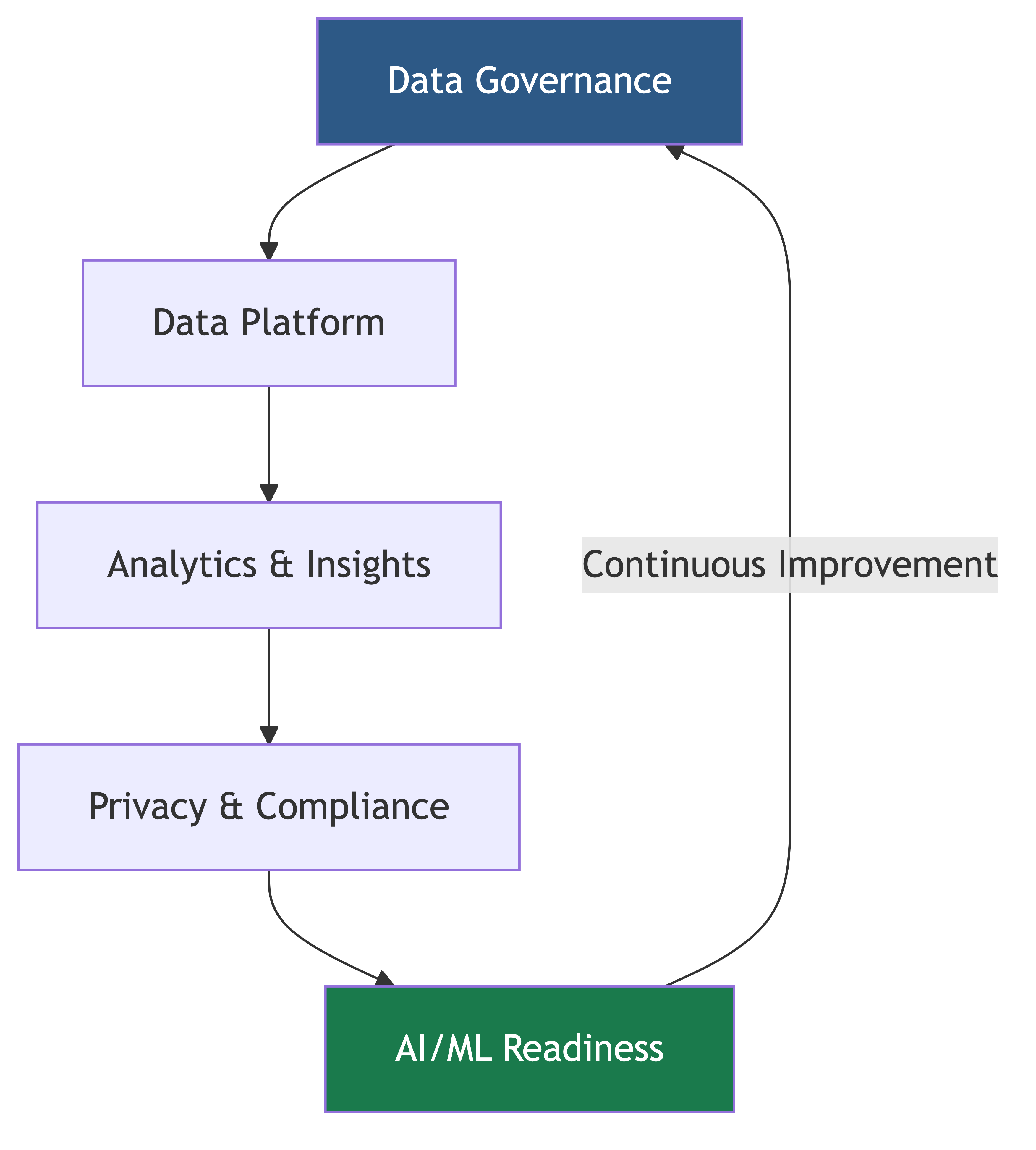
Why This Matters at the CTO Level
Data is one of those words that everybody uses and almost nobody treats with the seriousness it deserves. As CTO, your relationship with data is fundamentally different from anyone else in the organization. You're not building dashboards or writing SQL queries. You're deciding whether data is a strategic asset or just exhaust from your systems. You're setting the policies that determine whether your organization can actually use the data it collects. You're building the infrastructure that turns raw information into competitive advantage.
Here's the uncomfortable truth: most companies are data-rich and insight-poor. They collect terabytes of data and can't answer basic questions about their customers, their products, or their operations. They have data lakes that are really data swamps. They have analytics teams that spend 80% of their time cleaning data and 20% actually analyzing it.
As CTO, you own this problem. Not the specifics of every data pipeline, but the strategy, the governance framework, the platform investment, and the organizational structure that determines whether data actually delivers business value.
Data Governance: The Foundation Nobody Wants to Build
Data governance is the broccoli of data strategy. Everyone knows it's important, and almost nobody wants to do it. But without governance, everything else falls apart. Your analytics are unreliable, your privacy compliance is a ticking time bomb, and your data teams spend their lives arguing about which number is the "real" number.
What Data Governance Actually Means
At its core, data governance answers three questions:
- Who owns each piece of data? Not "who created the table" — who is accountable for its accuracy, completeness, and accessibility?
- What are the rules for using it? Who can access it, how can it be used, how long do we keep it, what happens when we need to delete it?
- How do we ensure quality? What are the standards, how do we measure compliance, what happens when quality degrades?
Data Ownership Model
The biggest governance failure I see is treating data as an IT concern. Data ownership should sit with the business domain that generates and primarily uses the data. Your customer data is owned by the customer-facing teams. Your financial data is owned by finance. Your product usage data is owned by product.
Engineering and data teams are stewards, not owners. They build and maintain the infrastructure, enforce the policies, and provide the tools. But the business domain makes the decisions about what data to collect, how to define it, and what quality standards to enforce.
A practical ownership model looks like this:
- Data Owners (business leaders): Define what data to collect, set quality standards, approve access policies
- Data Stewards (senior ICs or managers): Implement quality checks, manage metadata, handle day-to-day governance
- Data Engineers: Build and maintain pipelines, infrastructure, and tooling
- Data Platform Team: Provides the shared infrastructure, tools, and standards that everyone uses
Data Catalogs and Metadata Management
You need a data catalog. Not a nice-to-have — a need. When an analyst joins your company and wants to understand what "active user" means, they should be able to look it up in one place and get a definitive answer. When a product manager wants to know if we track a specific event, they shouldn't need to Slack five different people.
A good data catalog includes:
- Business definitions: What does each data element mean in business terms?
- Technical metadata: Where does it live, what's the schema, how often is it updated?
- Lineage: Where does this data come from, and what downstream systems use it?
- Quality metrics: How complete is it, how fresh is it, how accurate is it?
- Access policies: Who can see it, what classifications apply?
Data Quality as a First-Class Concern
Here's a pattern I've seen destroy trust in data: a dashboard shows a number. Someone in a meeting questions it. The data team investigates and finds a pipeline bug that's been silently corrupting data for three weeks. Now nobody trusts any dashboard, and every data-driven decision gets second-guessed.
Data quality needs automated monitoring, just like application uptime. Set up checks for:
- Freshness: Is the data arriving on schedule?
- Volume: Did we get roughly the expected number of records?
- Schema: Did the schema change unexpectedly?
- Distribution: Are the values within expected ranges?
- Uniqueness: Are there unexpected duplicates?
- Referential integrity: Do foreign keys still resolve?
When quality checks fail, treat it like a production incident. Page someone. Fix it. Write a postmortem. Data quality degradation should get the same urgency as application downtime.
Data Platform Roadmap
Your data platform is the foundation that every data initiative builds on. Get it wrong, and every team struggles independently. Get it right, and you create leverage across the entire organization.
The Maturity Curve
Most organizations evolve through predictable stages:
Stage 1: Ad Hoc. Teams query production databases directly. Analysts write SQL against replicas. Reports are built in spreadsheets. There's no single source of truth. This works until it doesn't, which is usually around 20-30 employees.
Stage 2: Centralized Data Warehouse. You build an ETL pipeline that pulls data from operational systems into a warehouse (Snowflake, BigQuery, Redshift). A small data team manages the warehouse and builds core reports. This covers you from roughly 30 to 200 employees.
Stage 3: Self-Service Analytics. You invest in a transformation layer (dbt or similar), a BI tool with governed self-service capabilities, and data documentation. Business users can explore data without filing tickets. This is appropriate from roughly 200 to 1000 employees.
Stage 4: Data Platform. You build a full data platform with streaming capabilities, feature stores, ML infrastructure, data mesh principles for domain ownership, and sophisticated governance. This is where large organizations need to operate.
Key Platform Decisions
Batch vs. Streaming. Most organizations start with batch processing (daily or hourly ETL) and add streaming as specific use cases demand it. Don't over-invest in streaming infrastructure before you have use cases that genuinely require sub-minute latency. Real-time dashboards that update every 15 minutes are perfectly fine for most business metrics.
Monolith vs. Mesh. The "data mesh" concept — distributing data ownership to domain teams with a centralized platform — is compelling in theory but challenging in practice. It requires each domain team to have data engineering capability, which is expensive. Most organizations do better with a centralized data platform team that serves all domains, with domain teams contributing to data modeling and quality definitions.
Build vs. Buy. For the data platform itself, buy. Modern cloud data warehouses, transformation tools, orchestration platforms, and BI tools are mature and well-integrated. The place to build is in the connectors, transformations, and models that are specific to your business.
The Modern Data Stack
A practical modern data stack looks like this:
- Ingestion: Fivetran, Airbyte, or custom connectors for data sources
- Storage: Cloud data warehouse (Snowflake, BigQuery, Databricks)
- Transformation: dbt for SQL-based transformations
- Orchestration: Airflow, Dagster, or Prefect
- BI/Visualization: Looker, Tableau, Metabase, or similar
- Data Quality: Great Expectations, Monte Carlo, or similar
- Catalog: DataHub, Atlan, or similar
- Reverse ETL: Census, Hightouch for pushing data back to operational systems
Don't try to build all of this at once. Start with ingestion, storage, and transformation. Add the rest as you grow.
Data Privacy Frameworks
Privacy isn't optional, and it's not just a legal concern. As CTO, you need to build privacy into your data architecture from the ground up.
The Regulatory Landscape
GDPR, CCPA/CPRA, LGPD, PIPEDA — the alphabet soup of privacy regulations keeps growing. Rather than treating each regulation as a separate compliance exercise, build a privacy framework that satisfies the strictest requirements and apply it globally.
The common requirements across all major privacy regulations:
- Consent management: Track what users consented to and when
- Data minimization: Only collect what you actually need
- Purpose limitation: Only use data for the purpose it was collected for
- Right to access: Users can request a copy of their data
- Right to deletion: Users can request their data be deleted
- Data portability: Users can request their data in a machine-readable format
- Breach notification: Notify users and authorities within specified timeframes
Privacy by Design
Privacy by design means building privacy considerations into your architecture from the start, not bolting them on later. This is both a regulatory requirement (GDPR explicitly requires it) and a practical necessity.
Key architectural patterns for privacy:
Data classification. Classify all data into sensitivity tiers. At minimum: public, internal, confidential, restricted. Each tier has different access controls, encryption requirements, and retention policies.
Purpose binding. When you collect data, tag it with the purpose for which it was collected. If you collected an email for account creation, you can't automatically use it for marketing without separate consent.
Pseudonymization and anonymization. Separate identifying information from behavioral data wherever possible. Your analytics pipeline probably doesn't need to know who the user is — it just needs a consistent identifier.
Data retention policies. Don't keep data forever. Set retention periods based on business need and legal requirements. Implement automated deletion. If you don't need it, don't keep it. Every byte of data you store is a byte that could be breached.
Access logging. Log every access to sensitive data. Not just who accessed it, but what query they ran, what data they saw, and when. This is essential for compliance audits and breach investigations.
Cross-Border Data Transfers
If you operate internationally, data residency is a real constraint. Some countries require certain data to stay within their borders. Others restrict transfers to countries without "adequate" privacy protections.
Build your data architecture to support geographic partitioning from the start. It's much harder to retrofit data residency onto a system that was designed to store everything in a single region.
Analytics Strategy
Analytics is where data strategy meets business value. Your analytics strategy should answer one question: how does this organization make better decisions?
The Analytics Hierarchy
Think of analytics as a hierarchy of increasing sophistication:
- Reporting: What happened? (Dashboards, standard reports)
- Analysis: Why did it happen? (Ad hoc investigation, root cause analysis)
- Prediction: What will happen? (Forecasting, propensity models)
- Prescription: What should we do? (Optimization, recommendation systems)
Most organizations need to be excellent at levels 1 and 2 before investing heavily in 3 and 4. I've seen companies hire data scientists to build ML models when they couldn't even answer basic questions about their user funnel. That's building a penthouse on quicksand.
Metrics That Matter
As CTO, you should care about having a clear, agreed-upon metrics hierarchy:
North Star Metric: The single metric that best captures the value your product delivers to customers. For Spotify, it might be time spent listening. For Slack, it might be messages sent. Everything else should ultimately connect to this.
Input Metrics: The levers you can pull that drive the North Star. These are actionable and team-assignable.
Health Metrics: Things that should stay within a range — like error rates, support ticket volume, or churn. You don't optimize these, you monitor them.
The biggest mistake I see is metrics proliferation. Teams track 50 metrics and optimize none of them. Pick a few that matter and track them obsessively. You can always look at the others when you need to diagnose something.
Self-Service vs. Embedded Analytics
Two models for getting analytics into the hands of decision-makers:
Self-service: Give business users tools and training to answer their own questions. This scales well but requires investment in data literacy, documentation, and governed datasets.
Embedded analytics: Build data products into the workflows people already use. Instead of making a sales rep log into a BI tool, surface the relevant data right in their CRM. This is more expensive to build but gets much higher adoption.
Most organizations need both. Self-service for exploratory analysis and strategic questions. Embedded analytics for operational decisions that happen frequently.
Data as a Business Asset
This is the conversation you need to have with your CEO and board. Data isn't just an operational necessity — it's a business asset that can create competitive advantage, open new revenue streams, and fundamentally change your company's trajectory.
Competitive Moats from Data
Data creates competitive advantage in several ways:
Network effects. More users generate more data, which makes the product better, which attracts more users. Google's search quality improves with every search. Amazon's recommendations improve with every purchase. This is the strongest form of data-driven competitive advantage.
Proprietary datasets. If you have data that nobody else has — because you're the only one in a position to collect it — that's a moat. A logistics company that has decades of shipping data can optimize routes in ways that a new entrant simply can't replicate.
Model training. In the AI era, proprietary training data is becoming the scarcest and most valuable resource. If your product generates unique, high-quality training data, that's an asset that compounds over time.
Data Products and Monetization
Some companies can turn their data into direct revenue:
- Data-as-a-service: Selling aggregated, anonymized data to third parties
- Insights-as-a-service: Selling analysis and benchmarks derived from your data
- API access: Providing programmatic access to your data
- Enhanced products: Using data to create premium features (recommendations, predictions, insights)
But be careful. Data monetization can conflict with privacy commitments. If users gave you their data to use your product, selling it to third parties is a trust violation even if it's technically legal. Always err on the side of protecting user trust.
Data-Driven Decision Making at the Organizational Level
Being "data-driven" is easy to say and incredibly hard to actually do. It requires cultural change, not just technical infrastructure.
What Data-Driven Actually Means
Data-driven doesn't mean "we look at dashboards." It means:
- Decisions start with data. Before debating opinions, we look at the evidence.
- Hypotheses are testable. We frame proposals as experiments with measurable outcomes.
- Results are shared transparently. Even when they're inconvenient or contradict what leadership expected.
- Intuition is informed, not replaced. Data tells you what's happening. Human judgment tells you what to do about it.
Building the Culture
As CTO, you set the tone. If you make decisions based on gut feel and then cherry-pick data to justify them, everyone will learn that data doesn't actually matter. If you genuinely change your mind when the data contradicts your hypothesis, everyone will learn that data is taken seriously.
Practical steps to build a data-driven culture:
- Start every strategy review with data. What do the metrics say? What changed? What surprised us?
- Require experiment results, not just opinions. When someone proposes a change, ask: "How would we measure whether this worked?"
- Celebrate learning from failed experiments. If every experiment succeeds, you're not experimenting ambitiously enough.
- Make data accessible. If people can't easily find and understand data, they won't use it.
- Invest in data literacy. Teach people how to interpret data, understand statistical significance, and avoid common analytical pitfalls.
Data Team Structure
How you structure your data organization has a huge impact on its effectiveness.
Common Models
Centralized. A single data team serves the entire company. Pros: consistent standards, efficient resource utilization, clear career paths for data people. Cons: can become a bottleneck, may be disconnected from business context.
Embedded. Data people are embedded in each product or business team. Pros: close to the business, faster turnaround, deep domain expertise. Cons: inconsistent standards, duplicated effort, lonely data people without a peer community.
Hub and Spoke. A central data platform team provides infrastructure and standards, while embedded data analysts/scientists work within business teams. This is the model that works best at scale. The hub ensures consistency and provides career development. The spokes ensure business relevance and fast turnaround.
Roles You Need
- Data Engineers: Build and maintain the data platform, pipelines, and infrastructure
- Analytics Engineers: Build the transformation layer (dbt models, governed datasets)
- Data Analysts: Answer business questions, build dashboards, do ad hoc analysis
- Data Scientists: Build predictive models, run experiments, do advanced analytics
- ML Engineers: Productionize ML models, build training pipelines, manage model serving
Don't hire data scientists before you have data engineers and analysts. Scientists can't build models without reliable data, and their work is wasted if nobody can operationalize it.
Hiring Sequence
For a startup or a company just starting to invest in data, hire in this order:
- A senior analytics engineer who can set up the data warehouse and transformation layer
- A data analyst who can build dashboards and answer business questions
- A data engineer to build and maintain production pipelines
- A data scientist (only when you have specific ML use cases with clear business value)
ML/AI Data Requirements
Machine learning and AI are hungry for data, but not just any data. As CTO, you need to understand what ML/AI initiatives require from your data infrastructure.
Data Quality for ML
ML models are the ultimate garbage-in, garbage-out system. A model trained on bad data will make bad predictions, confidently. The data requirements for ML are stricter than for analytics:
- Volume: Most ML models need substantial training data. The exact amount depends on the problem, but "not enough data" is the most common reason ML projects fail.
- Labeling: Supervised learning requires labeled data, and labeling is expensive and error-prone. Budget for labeling infrastructure and quality control.
- Freshness: Models trained on stale data make stale predictions. You need to think about model retraining cadence and data drift detection.
- Representativeness: If your training data is biased, your model will be biased. Ensure your data represents the full distribution of cases you'll encounter in production.
- Feature stores: As you scale ML, you'll want a feature store — a centralized repository of computed features that can be shared across models and served consistently in training and production.
AI and LLM Considerations
The rise of large language models adds new data considerations:
- Fine-tuning data: If you're fine-tuning models on proprietary data, that data needs curation, quality control, and versioning.
- RAG (Retrieval-Augmented Generation): Many AI applications retrieve relevant context from your data to augment LLM responses. This requires a robust search/retrieval infrastructure.
- Data privacy in AI: Be careful about what data flows through third-party AI services. PII in prompts, customer data in fine-tuning datasets — all of these create privacy risks.
- Training data provenance: Know where your training data came from. This matters for IP, compliance, and debugging model behavior.
Real-World Examples
Example 1: The Analytics Team That Couldn't Answer Questions
A B2B SaaS company had five data analysts and a Snowflake warehouse. They were drowning in dashboard requests and couldn't keep up. Every team wanted their own dashboard, and every dashboard showed slightly different numbers for the same metrics.
The fix wasn't hiring more analysts. It was investing in a semantic layer (using dbt and Looker's modeling layer) that defined metrics once and exposed them consistently across all reporting. They also implemented a data catalog so teams could find existing answers before requesting new dashboards.
Result: dashboard request volume dropped 60%, analyst productivity doubled, and cross-team arguments about "whose number is right" essentially disappeared.
Example 2: The Privacy Retrofit
A consumer app had been collecting and storing every piece of user data they could get their hands on for five years. When GDPR enforcement got serious, they discovered they had no way to fulfill a "right to deletion" request. User data was scattered across 40 different systems with no consistent identifier mapping and no deletion propagation mechanism.
The retrofit took 18 months and cost more than it would have cost to build privacy-by-design from the start. They had to build a user data registry, implement cross-system deletion pipelines, and retroactively classify five years of data.
Lesson: privacy architecture is dramatically cheaper to build in from the start than to retrofit.
Example 3: The Premature ML Investment
A fintech company hired a team of five data scientists before they had a data warehouse. The scientists spent their first year building their own data pipelines (poorly — they were scientists, not engineers) and couldn't produce any production models.
After a year, the CTO restructured: hired data engineers first, built a proper data platform, then redirected the scientists to actually build models. Within six months of having proper infrastructure, they shipped three models to production.
Lesson: infrastructure first, science second. The most brilliant data scientist is useless without reliable data.
Common Mistakes
Mistake 1: Treating Data as an IT Problem
Data strategy is a business strategy. If you delegate it entirely to engineering, you'll build technically impressive infrastructure that doesn't serve business needs. Data governance, data ownership, and data strategy need business leadership involvement.
Mistake 2: Boiling the Ocean
Trying to build a perfect data platform before delivering any value. Start with the highest-value use case, build the minimum infrastructure needed to support it, and iterate. You'll learn more from delivering one useful dashboard than from six months of "building the platform."
Mistake 3: Ignoring Data Quality
Assuming that if the pipeline runs without errors, the data is correct. Pipeline success and data correctness are completely different things. A pipeline can successfully load garbage data. Invest in data quality monitoring from day one.
Mistake 4: No Clear Ownership
When nobody owns the data, nobody is responsible for its quality. Assign ownership explicitly, and hold owners accountable for data quality metrics just as you'd hold a service owner accountable for uptime.
Mistake 5: Over-Investing in Real-Time
Not everything needs to be real-time. Most business decisions work fine with data that's a few hours old. Streaming infrastructure is expensive and complex. Use it where sub-minute latency genuinely matters (fraud detection, real-time recommendations), not for weekly business reports.
Mistake 6: Collecting Everything "Just in Case"
The instinct to collect every possible piece of data "because we might need it someday" creates storage costs, privacy risk, and governance nightmares. Collect what you need, define retention policies, and delete what you don't need. You can always start collecting new data later.
Business Value
Data strategy at the CTO level is ultimately about business outcomes. Here's how to connect your data investments to value the board cares about:
Revenue enablement. Better data leads to better products, better personalization, and better customer understanding. Quantify the revenue impact of data-driven features like recommendations, dynamic pricing, or churn prediction.
Cost reduction. Good analytics identify inefficiencies. Good ML automates manual processes. Good data quality reduces the time wasted on data wrangling. Track the cost savings from data investments.
Risk reduction. Data governance and privacy compliance reduce regulatory risk. Data quality monitoring reduces the risk of bad decisions based on bad data. Quantify the cost of the risks you're mitigating.
Speed of decision-making. When decision-makers can get answers in minutes instead of days, the organization moves faster. This is harder to quantify but very real. Track the cycle time from question to answer.
Competitive advantage. Proprietary data and the models built on it create moats that competitors can't easily replicate. This is the long-term strategic value that justifies sustained investment.
When you present data strategy to the board, don't talk about data warehouses and ETL pipelines. Talk about how data-driven decision making reduced customer churn by 15%, how predictive analytics saved $2M in infrastructure costs, how privacy compliance eliminated the risk of a GDPR fine that could be 4% of global revenue.
The CTO who treats data as plumbing will always be fighting for budget. The CTO who treats data as a strategic asset will be asked to invest more.
Common Pitfalls
-
Treating data as an IT problem instead of a business strategy. Delegating data strategy entirely to engineering without business leadership involvement produces technically impressive infrastructure that does not serve business needs.
-
Collecting everything "just in case." The instinct to store every possible piece of data creates storage costs, privacy risk, and governance nightmares. Collect what you need, define retention policies, and delete what you do not need.
-
Hiring data scientists before you have data infrastructure. Scientists cannot build models without reliable data pipelines. Invest in data engineers and analytics engineers first, then hire scientists when you have specific ML use cases with clear business value.
-
Ignoring data quality until trust is broken. A single corrupted dashboard number discovered in a leadership meeting destroys confidence in all data. Automated data quality monitoring should get the same urgency as application uptime monitoring.
-
Over-investing in real-time infrastructure prematurely. Most business decisions work fine with data that is a few hours old. Streaming infrastructure is expensive and complex. Reserve it for use cases where sub-minute latency genuinely matters.
-
Having no clear data ownership. When nobody owns the data, nobody is responsible for its quality. Assign ownership explicitly to business domains, not just engineering.
Key Takeaways
-
Data strategy at the CTO level answers whether data is treated as a strategic asset or just exhaust from systems. The difference determines competitive positioning and business intelligence capability.
-
Data governance answers three questions: who owns each piece of data, what are the rules for using it, and how do we ensure quality. Without governance, analytics are unreliable and privacy compliance is a ticking time bomb.
-
A data catalog is a necessity, not a nice-to-have. Analysts and product managers should be able to look up definitive business definitions, technical metadata, lineage, and quality metrics in one place.
-
The modern data stack (ingestion, warehouse, transformation, orchestration, BI, quality monitoring, catalog) should be built incrementally, starting with the highest-value use case.
-
Privacy must be built into data architecture from the start through data classification, purpose binding, pseudonymization, retention automation, and access logging. Retrofitting privacy is dramatically more expensive.
-
Most organizations need to be excellent at reporting and analysis before investing in prediction and prescription. Building ML on unreliable analytics is building a penthouse on quicksand.
-
Data creates competitive moats through network effects, proprietary datasets, and model training data. Present data strategy to the board in terms of revenue enablement, cost reduction, and risk mitigation, not warehouses and pipelines.