
Security Strategy
Why This Matters at the CTO Level
Security is one of those topics where the stakes are existential. A data breach doesn't just cost money — it destroys customer trust, invites regulatory scrutiny, and can end careers. As CTO, security is your problem whether you like it or not. You may have a CISO who leads the security organization, but the technology decisions that determine your security posture ultimately trace back to you.
Here's what makes security strategy different from most other CTO responsibilities: the consequences of getting it wrong are catastrophic and often irreversible. You can recover from a bad product launch. You can fix a bad hire. You can pay down technical debt. But you can't un-breach customer data. Once those records are in the wild, they're there forever.
The challenge is that security is also one of the easiest things to under-invest in, because the return on investment is invisible when things are going well. You never get credit for the breaches that didn't happen. The board will never say "great job not getting hacked this quarter." But they will absolutely say a lot if you do get hacked.
Your job as CTO is to build a security program that's proportionate to your risk, sustainable as you scale, and integrated into how your organization builds and operates software — not bolted on as an afterthought.
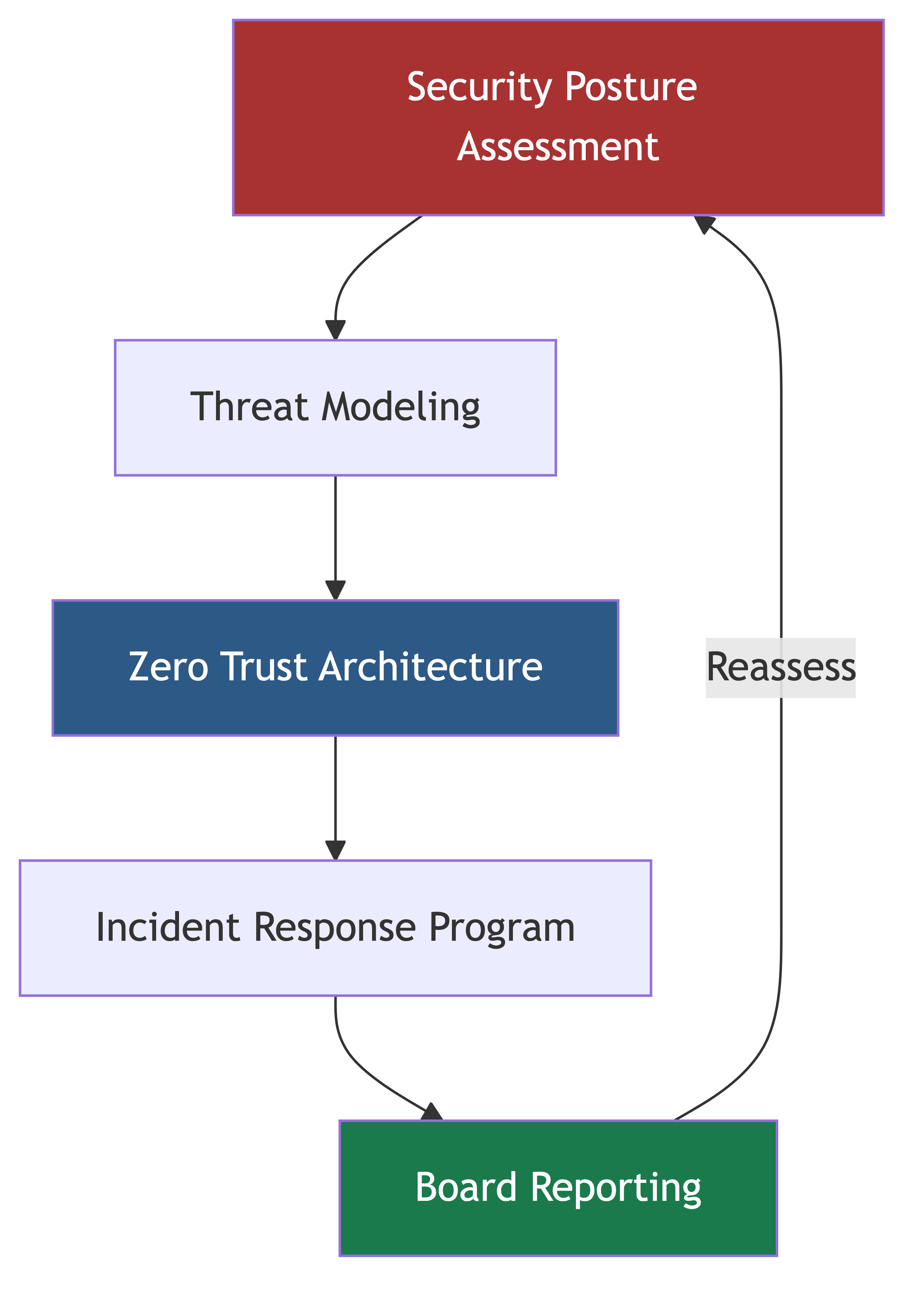
Security Posture Roadmap
A security posture roadmap is a multi-year plan for systematically improving your organization's security capabilities. It should be grounded in a realistic assessment of where you are today and where you need to be.
Assessing Current State
Before you can plan improvements, you need an honest assessment of your current security posture. This means:
External assessment. Hire a reputable security firm to do a penetration test and security audit. Internal teams have blind spots. Outside eyes find things you've gotten used to or didn't know to look for.
Asset inventory. You can't secure what you don't know about. Inventory all systems, services, data stores, APIs, and third-party integrations. This is almost always more extensive than anyone thinks. Shadow IT, forgotten test environments, and legacy systems are everywhere.
Vulnerability assessment. Scan your infrastructure and applications for known vulnerabilities. Categorize by severity and exploitability. Don't just count vulnerabilities — prioritize the ones that actually matter based on exposure and impact.
Access audit. Who has access to what? Are there former employees with active accounts? Are there service accounts with excessive permissions? Are there shared credentials? Almost every access audit reveals alarming findings.
Compliance gap analysis. If you're subject to regulatory requirements (SOC 2, HIPAA, PCI-DSS, GDPR), assess your current compliance status. Identify gaps and prioritize remediation.
Building the Roadmap
Organize your security roadmap around maturity levels:
Level 1: Foundations (Months 1-6). Get the basics right. This is where most security value comes from:
- Multi-factor authentication for all employees
- Encrypted data at rest and in transit
- Regular patching and vulnerability management
- Basic access controls and least-privilege principles
- Security awareness training for all employees
- Incident response plan (even a basic one)
Level 2: Structured (Months 6-18). Build systematic security practices:
- Centralized logging and monitoring (SIEM)
- Application security testing in CI/CD pipelines
- Formal access review processes
- Vendor security assessment program
- Bug bounty or responsible disclosure program
- Regular penetration testing
Level 3: Advanced (Months 18-36). Implement sophisticated security capabilities:
- Zero-trust architecture
- Threat modeling as part of the design process
- Security champions program in engineering teams
- Advanced threat detection and response
- Red team / blue team exercises
- Data loss prevention (DLP)
Level 4: Optimized (Ongoing). Continuous improvement and adaptation:
- Proactive threat intelligence
- Automated security orchestration and response (SOAR)
- Supply chain security
- Advanced identity governance
- Security metrics and KPIs tied to business outcomes
Staffing the Security Program
Security talent is scarce and expensive. Here's how to think about building your security team:
First hire: a senior security leader. Whether it's a CISO, a Head of Security, or a senior security engineer depends on your size and risk profile. What matters is getting someone with the judgment to prioritize correctly and the communication skills to work across the organization.
Don't try to centralize all security. You can't hire enough security engineers to review every line of code and every infrastructure change. Instead, build security capability into your engineering teams through training, tooling, and security champions.
Augment with external services. Managed security service providers (MSSPs), penetration testing firms, and security consultants can fill gaps while you build internal capability. This is especially valuable early on when you don't have the volume to justify full-time specialists.
Threat Modeling Frameworks
Threat modeling is the practice of systematically thinking about what could go wrong and how to prevent it. Done well, it catches security issues during design — when they're cheap to fix — rather than in production, when they're expensive and dangerous.
When to Threat Model
Not everything needs a formal threat model. Focus on:
- New systems or services
- Major architectural changes
- Features that handle sensitive data (authentication, payment, PII)
- Integrations with external systems
- Changes to access control or authorization models
STRIDE Framework
STRIDE is the most widely used threat modeling framework. It categorizes threats into six types:
- Spoofing: Can an attacker pretend to be someone they're not?
- Tampering: Can an attacker modify data they shouldn't?
- Repudiation: Can an attacker deny actions they performed?
- Information Disclosure: Can an attacker access data they shouldn't?
- Denial of Service: Can an attacker prevent legitimate users from accessing the system?
- Elevation of Privilege: Can an attacker gain permissions they shouldn't have?
For each component and data flow in your system, walk through each STRIDE category and identify potential threats.
Practical Threat Modeling Process
Here's a practical process that works without requiring a PhD in security:
-
Diagram the system. Draw the components, data flows, trust boundaries, and external dependencies. You don't need fancy tools — a whiteboard works fine.
-
Identify assets. What data or capabilities would an attacker want? Customer PII, financial data, admin access, API keys?
-
Identify entry points. How could an attacker interact with the system? APIs, user interfaces, file uploads, third-party integrations?
-
Walk through STRIDE. For each entry point and each asset, consider each STRIDE category. What could go wrong?
-
Prioritize. Not all threats are equal. Prioritize by likelihood and impact. A theoretical attack that requires physical access to your data center is less urgent than an SQL injection in a public-facing API.
-
Mitigate. For each high-priority threat, define a mitigation. This might be a code change, a configuration change, an architectural change, or a monitoring/detection control.
-
Document and track. Record the threat model, the identified threats, and the mitigations. Track mitigation implementation as you would any other engineering work.
The key is making this lightweight enough that teams actually do it. A two-hour session during the design phase of a new feature is far more valuable than a comprehensive but never-completed threat model document.
Zero-Trust Architecture
Zero trust is both overused as a buzzword and genuinely important as an architectural principle. The core idea is simple: don't trust anything by default, even if it's inside your network perimeter.
Why Traditional Perimeter Security Fails
The traditional model — hard outer shell, soft inner core — assumes that anything inside the network perimeter is trusted. This model fails because:
- The perimeter is porous. VPNs, remote work, cloud services, SaaS integrations — there is no clear perimeter anymore.
- Lateral movement. Once an attacker gets past the perimeter (via phishing, a compromised vendor, or a vulnerable service), they can move freely within the network.
- Insider threats. Not all threats come from outside. Disgruntled employees, compromised accounts, and accidental misconfigurations are all "inside the perimeter."
Zero Trust Principles
Verify explicitly. Authenticate and authorize every request based on all available data points: user identity, device health, location, resource being accessed, and anomaly detection.
Use least-privilege access. Grant the minimum permissions needed for the task at hand. Use just-in-time access for elevated permissions. Nobody should have standing admin access to production systems.
Assume breach. Design your systems as if the attacker is already inside. Segment your network, encrypt data in transit even internally, monitor for anomalous behavior, and limit the blast radius of any compromise.
Implementing Zero Trust Practically
Zero trust is a journey, not a destination. Here's a practical implementation path:
Phase 1: Identity and access. Start with strong identity management. Multi-factor authentication everywhere. Single sign-on for all applications. Role-based access control. Regular access reviews.
Phase 2: Device trust. Verify that devices accessing your systems meet security requirements. Managed device? Up-to-date patches? Encrypted disk? Endpoint detection software installed?
Phase 3: Network segmentation. Move from flat networks to microsegmented architectures. Services should only be able to communicate with the specific services they need, not everything on the network.
Phase 4: Application-level controls. Implement service-to-service authentication (mutual TLS, service mesh). Every service verifies the identity of the calling service, not just the network origin.
Phase 5: Data-level controls. Classify data by sensitivity, encrypt everywhere, implement data loss prevention, and monitor data access patterns.
Don't try to do all of this at once. Each phase delivers independent value. And don't let perfect be the enemy of good — partial zero trust is much better than no zero trust.
Incident Response Program
Security incidents will happen. The question isn't if, it's when. What determines the outcome isn't whether you can prevent every incident — you can't — but how quickly and effectively you respond when one occurs.
Building an Incident Response Plan
Your incident response plan should cover:
Detection. How will you know when an incident occurs? This requires:
- Centralized logging from all systems
- Security monitoring and alerting (SIEM)
- Anomaly detection (unusual login patterns, unexpected data access, abnormal network traffic)
- External reporting channels (bug bounties, customer reports, threat intelligence feeds)
Classification. Not all incidents are equal. Define severity levels:
- Critical (SEV1): Active breach with data exfiltration, ransomware, or system compromise
- High (SEV2): Confirmed breach contained but not yet remediated, or active exploitation attempt
- Medium (SEV3): Vulnerability discovered that could be exploited, suspicious activity under investigation
- Low (SEV4): Policy violations, minor misconfigurations, informational alerts
Response procedures for each severity level:
- Who gets notified (engineering, security, legal, PR, executive team)?
- Who leads the response?
- What are the communication protocols?
- What are the escalation criteria?
- What are the containment strategies?
Communication. During a security incident, communication is as important as the technical response:
- Internal stakeholders need to know what's happening and what to do
- Legal needs to assess notification obligations
- PR needs to prepare external communications
- Customer-facing teams need talking points
- Depending on the severity, the board may need to be informed
Recovery. Getting back to normal operations:
- Eradicate the threat (patch vulnerabilities, revoke compromised credentials, remove malware)
- Restore affected systems from known-good backups
- Verify that the threat is completely eliminated
- Monitor for re-compromise
Post-incident review. After every significant incident:
- Timeline of events: what happened, when, and in what order
- Root cause analysis: how did the attacker get in, what did they do, what did we miss?
- Response assessment: what went well, what went poorly, what should we change?
- Remediation tracking: what systemic changes will prevent similar incidents?
Tabletop Exercises
Run tabletop exercises at least quarterly. Present a realistic scenario ("A customer reports seeing another customer's data") and walk through the response process without actually touching any systems. These exercises reveal gaps in your plan, train your team, and build muscle memory.
Involve everyone who would be involved in a real incident: engineering, security, legal, PR, and executive leadership. The worst time to figure out the chain of communication is during an actual breach.
Security as a Board-Level Concern
Security has moved from an IT back-office concern to a board-level topic. Regulatory requirements, high-profile breaches, and the financial impact of security incidents have made boards pay attention. As CTO, you need to be able to communicate security posture to the board in terms they understand.
What the Board Needs to Know
Risk posture. What are the top security risks facing the organization? Not a list of 500 vulnerabilities — a prioritized view of the 3-5 risks that could materially impact the business. For each risk: what's the potential impact, what's the likelihood, and what are we doing about it?
Program maturity. Where is the security program on the maturity curve? What improvements have been made? What's planned? Use a recognized framework (NIST CSF, CIS Controls) to provide a structured assessment that allows year-over-year comparison.
Compliance status. What regulatory requirements apply to us? Are we compliant? If not, what's the remediation plan and timeline?
Incident history. What incidents have occurred? How were they handled? What was the impact? What changes resulted?
Investment. What are we spending on security? How does that compare to industry benchmarks? What additional investment is needed and why?
Framing Security in Business Terms
Don't present security in technical terms. The board doesn't need to know about your WAF rules or your SIEM configuration. They need to understand:
- Risk in dollar terms: "A breach of our customer database would affect 2M customers, trigger notification costs of 10M, and estimated revenue loss from churn of $15M."
- Investment as insurance: "Our security program costs 8M."
- Comparison to peers: "Our security spend as a percentage of IT budget is 12%, compared to an industry average of 10%. This reflects our handling of sensitive financial data."
CISO Partnership
If you have a CISO (Chief Information Security Officer), your relationship with them is one of the most important partnerships in the organization.
Reporting Structure
The CISO reporting structure debate never dies. Should the CISO report to the CTO, the CEO, the CFO, or the board directly? There are arguments for each, but here's my perspective:
CISO reporting to CTO works well when there's mutual trust and the CTO is committed to giving security appropriate priority even when it conflicts with engineering velocity. The advantage is tight alignment between security and technology decisions.
CISO reporting to CEO works well when security is a board-level concern and the CISO needs organizational authority independent from the technology organization. The advantage is that security priorities can't be overridden by engineering priorities.
What matters more than the reporting structure is the relationship. The CTO and CISO need to be partners, not adversaries. They'll disagree — security wants to slow down, engineering wants to move fast — and those disagreements need to be resolved through dialog, not power dynamics.
Making the Partnership Work
Regular syncs. Meet weekly, not just when there's a problem.
Shared goals. Set OKRs that require both security and engineering to succeed. "Reduce time to remediate critical vulnerabilities from 30 days to 7 days" is a goal that needs both teams.
Joint planning. Include security in architectural reviews, platform planning, and technology strategy. Not as a reviewer or approver, but as a partner who contributes to the design.
Unified messaging. Present security as a shared priority, not as something the security team imposes on the engineering team. If engineers see security as "those people who block our deploys," you have a cultural problem.
Empathy in both directions. The CTO should understand the security team's constraints and concerns. The CISO should understand engineering's need for velocity and the business pressure to ship.
Security Budget Justification
Justifying security spend is uniquely challenging because you're essentially paying for something not to happen. Here's how to make the case.
The Risk-Based Approach
Frame security investment in terms of risk reduction:
-
Identify the risks. What could happen? Data breach, ransomware, insider theft, DDoS, supply chain compromise.
-
Quantify the impact. What would each scenario cost? Include direct costs (remediation, notification, fines) and indirect costs (revenue loss, brand damage, customer churn).
-
Estimate likelihood. Based on industry data, your threat profile, and your current controls, what's the probability of each scenario?
-
Calculate expected loss. Impact x probability = expected annual loss.
-
Show risk reduction. Your security investments reduce either the likelihood or the impact of each scenario. The difference in expected loss before and after the investment is the value of the investment.
Benchmarking
Security spending benchmarks provide useful context:
- Most technology companies spend 8-15% of their IT budget on security
- Companies handling financial or health data typically spend at the higher end
- Regulated industries (financial services, healthcare) spend more
- Startups typically under-invest early and over-correct later
Use benchmarks as a reference point, not a target. Your security investment should be proportionate to your risk, not to an industry average.
The Breach Cost Argument
The Ponemon/IBM annual Cost of a Data Breach report provides concrete numbers:
- Average cost of a data breach: $4.45M (2023 data)
- Average cost per breached record: $165
- Average time to identify a breach: 204 days
- Average time to contain a breach: 73 days
Organizations with mature security programs have significantly lower breach costs:
- Security AI and automation reduced costs by $1.76M on average
- Incident response planning and testing reduced costs by $1.49M on average
- Employee training reduced costs by $232K on average
These numbers make a compelling case for investment. A $2M annual security program that reduces your breach probability by even 30% is a strong ROI when the expected breach cost is in the millions.
Real-World Examples
Example 1: The Breach That Could Have Been Prevented
A mid-size SaaS company experienced a data breach when an attacker exploited a known vulnerability in an unpatched server. The patch had been available for three months, but the company had no systematic patching process. The breach exposed 500,000 customer records.
Total cost: 200K.
The CTO was replaced. Not because of the breach itself — breaches happen — but because the vulnerability was known and unpatched for three months. That indicated a systemic failure in security governance that the CTO owned.
Example 2: The Zero Trust Migration
A financial services company migrated from a traditional perimeter-based security model to zero trust over 18 months. Key results:
- Eliminated VPN as a single point of failure (and a major user complaint)
- Reduced attack surface by 60% through microsegmentation
- Detected and blocked a compromised employee account within hours instead of the days or weeks it would have taken in their old model
- Improved developer experience by replacing VPN with identity-aware proxies
The migration cost approximately $2M in tooling and engineering time. The CTO estimated it prevented at least one significant breach in the first year, based on the compromised account that was caught.
Example 3: The Board Presentation That Got Security Funded
A CTO struggling to get security budget presented the following to the board:
"We have three critical risks:
- A customer data breach would cost us approximately $12M and 18 months of customer trust recovery, with an estimated annual probability of 15% given our current controls.
- A ransomware attack would halt operations for an estimated 5-10 days, costing $3-5M in lost revenue and recovery costs, with an estimated annual probability of 20%.
- A compliance failure with SOC 2 would prevent us from closing enterprise deals worth approximately $8M in our pipeline.
The proposed 4.5M in risk reduction."
The board approved the budget in the same meeting.
Common Mistakes
Mistake 1: Security as a Gate, Not a Partner
Making the security team a blocking approval step in the development process. This creates adversarial relationships, slows delivery, and encourages teams to find ways around security review. Instead, embed security into the development process through automation, training, and consultation.
Mistake 2: Compliance-Driven Security
Building your security program around compliance checklists rather than actual risk. SOC 2 compliance doesn't mean you're secure. PCI-DSS compliance doesn't mean payment data is safe. Compliance is a floor, not a ceiling. Build security that addresses your actual threats, and compliance will follow.
Mistake 3: All Prevention, No Detection
Spending all your security budget on preventing breaches and nothing on detecting and responding to them. Prevention will fail eventually. You need the ability to detect breaches quickly and respond effectively. The difference between a minor incident and a catastrophic breach is often detection speed.
Mistake 4: Ignoring the Supply Chain
Your security is only as strong as your weakest vendor. A third-party library with a vulnerability, a SaaS provider with poor security, or a contractor with excessive access can all be attack vectors. Implement vendor security assessments and monitor your supply chain.
Mistake 5: Security Theater
Implementing visible but ineffective security measures (complex password policies that lead to sticky notes, security training that people click through without reading, elaborate access request processes that people circumvent). Focus on controls that actually reduce risk, even if they're less visible.
Mistake 6: No Incident Response Practice
Having an incident response plan that's never been tested. When a real incident happens, people panic, communication breaks down, and critical steps get missed. Practice regularly through tabletop exercises and simulated incidents.
Mistake 7: Underestimating Insider Threats
Focusing all security efforts on external attackers while ignoring the risk from insiders — whether malicious or negligent. Implement least-privilege access, monitor for unusual access patterns, and have clear offboarding processes that revoke access immediately.
Business Value
Security investment is risk management. Here's how to frame its business value:
Revenue protection. A major security incident can cause significant customer churn. For subscription businesses, the lifetime value of churned customers can dwarf the direct costs of the breach. Security investment protects recurring revenue.
Sales enablement. Enterprise customers increasingly require evidence of security maturity before purchasing. SOC 2, ISO 27001, and comprehensive security questionnaire responses are table stakes for B2B sales. Every enterprise deal you can't close because of inadequate security is a direct revenue cost of under-investment.
Regulatory risk reduction. GDPR fines can be up to 4% of global annual revenue. HIPAA penalties can reach millions per violation. PCI-DSS non-compliance can result in the inability to process payments. Security investment that ensures compliance eliminates existential regulatory risk.
Brand value preservation. Trust is a business asset that takes years to build and can be destroyed by a single breach. The reputational cost of a security incident often exceeds the direct financial cost. Companies that have experienced breaches consistently report that the hardest thing to recover is customer trust.
Insurance cost reduction. Cyber insurance premiums are directly tied to your security posture. A mature security program can significantly reduce your insurance costs, providing a concrete, measurable return.
Competitive differentiation. In markets where security is a concern (healthcare, finance, enterprise software), a demonstrably strong security program is a competitive advantage. "We've never had a breach" is a powerful selling point.
The CTO who treats security as a tax on innovation will eventually face a catastrophic incident. The CTO who treats security as a business enabler will build an organization that can move fast and break exactly zero customer trust.
Common Pitfalls
-
Positioning security as a gate that blocks engineering. Making the security team an approval bottleneck creates adversarial relationships and encourages teams to route around security review entirely. Embed security into the development process through automation and training instead.
-
Building the security program around compliance checklists instead of actual risk. SOC 2 compliance does not mean you are secure. Compliance is a floor, not a ceiling. Address your actual threat profile first and compliance will follow.
-
Spending all security budget on prevention with nothing on detection. Prevention will fail eventually. The difference between a minor incident and a catastrophic breach is often how quickly you detect and respond.
-
Ignoring supply chain security. A third-party library with a vulnerability, a SaaS vendor with poor security practices, or a contractor with excessive access can all be attack vectors that bypass your internal defenses.
-
Having an incident response plan that has never been tested. Untested plans fail when real incidents occur because people panic, communication breaks down, and critical steps get missed. Quarterly tabletop exercises build the muscle memory needed for real events.
-
Implementing security theater instead of effective controls. Complex password policies that lead to sticky notes, training that people click through without reading, and elaborate processes that people circumvent create a false sense of security while leaving real risks unaddressed.
Key Takeaways
-
Security consequences are catastrophic and often irreversible. You can recover from a bad product launch, but you cannot un-breach customer data.
-
Build the security program around a maturity roadmap: foundations first (MFA, encryption, patching), then structured practices (SIEM, security testing in CI/CD), then advanced capabilities (zero trust, threat modeling, red teaming).
-
Threat modeling using STRIDE should happen during design, when issues are cheap to fix, not in production, when they are expensive and dangerous.
-
Zero trust architecture replaces the failed perimeter model. Implement it in phases: identity and access, device trust, network segmentation, application-level controls, and data-level controls.
-
The CTO-CISO partnership is critical regardless of reporting structure. Set shared goals, conduct joint planning, and present security as a shared priority rather than something imposed by the security team.
-
Frame security investment for the board in dollar terms: expected breach costs, risk reduction from the security program, and comparison to industry benchmarks.
-
Enterprise customers increasingly require evidence of security maturity before purchasing. SOC 2, ISO 27001, and comprehensive security questionnaire responses are table stakes for B2B sales.