
Technology Vision and Strategy
Why This Matters
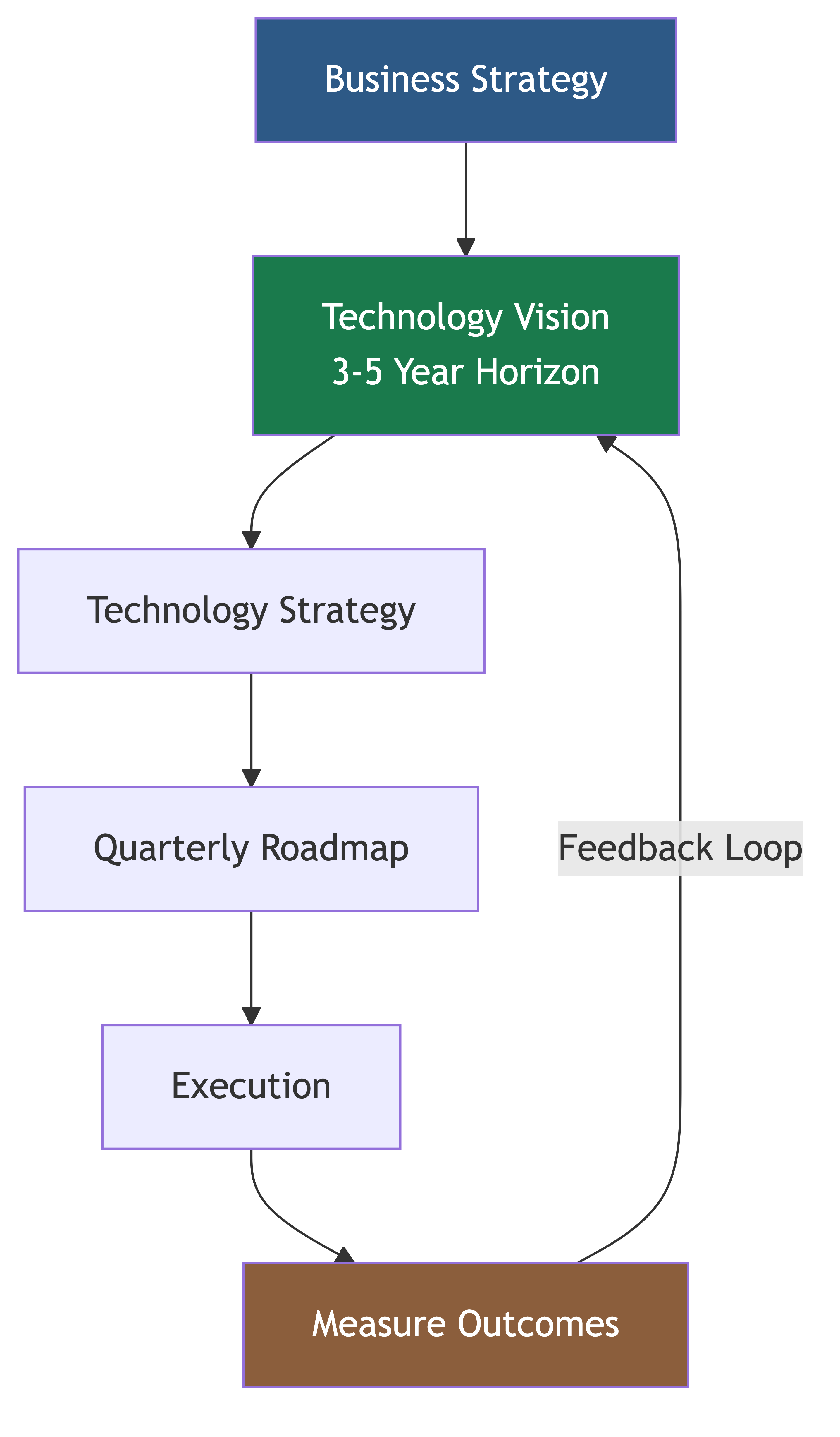
If you only do one thing well as CTO, make it this: set a clear technology vision and connect it to business strategy. Everything else flows from here.
I've seen companies with mediocre technology but a brilliant technology strategy outperform companies with superior technology but no strategy. Why? Because strategy creates alignment. When a thousand engineers understand where they're going and why, they make better decisions every single day -- without you being in the room.
A CTO without a technology vision is just an expensive engineering manager.
The 3-5 Year Technology Vision
Your technology vision is a clear, compelling picture of where your technology landscape will be in three to five years. Not a roadmap -- a vision. The difference matters.
A roadmap says "In Q3, we'll migrate to Kubernetes." A vision says "In three years, our infrastructure will be fully self-healing, allowing us to deploy to any region in the world within hours, giving us a speed advantage that competitors can't match."
See the difference? The vision is about capability and competitive advantage. The roadmap is about implementation. You need both, but the vision comes first.
How to write a technology vision:
Start with the business. Where does the company want to be in three to five years? What markets? What customers? What scale? Your technology vision needs to enable that business vision, not exist independently of it.
Identify the technology capabilities needed. Given the business vision, what does technology need to be able to do? Think in terms of capabilities, not specific technologies.
Articulate the gap. Where are we today versus where we need to be? Be honest about this. Sugarcoating the current state helps nobody.
Define the principles that will guide the journey. Not the specific steps, but the principles. "We will prioritize developer experience" or "We will build for global scale from day one."
Paint the picture. What does it look like when we get there? How does it feel to work here? What can we do that we can't do today? What can we do that competitors can't?
A template that works:
Our Technology Vision (2026-2029)

Today, we [honest assessment of current state].

In three years, we will [vivid description of future state].

This matters because [connection to business outcomes].

We will get there by [high-level approach].

We will know we've succeeded when [measurable outcomes].
Keep it to two pages maximum. If your vision document is twenty pages, it's a strategy document, not a vision. The vision needs to be short enough that everyone can remember it.
Technology as Competitive Moat
This is where great CTOs separate themselves from good ones. They don't just think about technology as a tool -- they think about it as a competitive moat.
A competitive moat is something that makes it hard for competitors to catch you. Technology can be a moat in several ways:
Data moat
Your technology processes and learns from data that competitors can't easily replicate. Think about how Google's search algorithm improves with every search. The more people use it, the better it gets, and the harder it is for competitors to catch up.
Network effects moat
Your technology creates network effects that compound over time. Each new user or participant makes the platform more valuable for everyone else.
Speed moat
Your technology lets you move faster than competitors. You can ship features faster, enter new markets faster, respond to customer needs faster. This compounds -- the faster you move, the more you learn, and the more you learn, the faster you can move.
Integration moat
Your technology is deeply integrated into your customers' workflows, making it painful to switch. This isn't about lock-in through manipulation -- it's about being so useful that leaving creates real cost.
Scale moat
Your technology operates at a scale that's expensive and difficult to replicate. The infrastructure, the operational knowledge, the tooling -- all of it creates a barrier that new entrants can't easily cross.
Your job as CTO is to identify which of these moats your technology can create, and invest accordingly. Not all of them will apply to your business. Pick the ones that matter most and go deep.
Innovation Thesis
Every CTO should have an innovation thesis -- a clear point of view on where technology is heading and how your company should respond.
Your innovation thesis answers three questions:
-
What technology trends will reshape our industry in the next five years? Not every trend -- the ones that specifically matter to your business.
-
How should we position ourselves relative to those trends? Are we going to be early adopters, fast followers, or wait-and-see?
-
What bets are we making? Every technology strategy involves bets. Name them explicitly. "We're betting that AI-assisted development will double developer productivity within three years" is a bet. Own it.
Having an explicit innovation thesis does two things. First, it gives your organization a framework for evaluating new technologies. When someone says "Should we adopt this new tool?", the answer comes from the thesis, not from hype cycles or individual enthusiasm. Second, it signals to the industry and to potential hires that you have a point of view. The best engineers want to work for CTOs who think deeply about where technology is going.
Technology Principles
Technology principles are the guardrails that guide every technical decision in your organization. They should be:
-
Few. Five to seven principles, not twenty. If you have too many, nobody remembers them.
-
Opinionated. "We value quality" is not a principle because nobody disagrees with it. "We will sacrifice time-to-market for reliability" is a principle because it makes a real trade-off.
-
Actionable. Each principle should help someone make a decision they couldn't make without it.
-
Stable. Principles shouldn't change every quarter. They evolve over years, not months.
Example principles:
-
Own our core, rent the rest. We build the technology that differentiates us and buy everything else. If it's not a competitive advantage, we don't build it.
-
Global by default. Every system is designed for multi-region deployment from day one. We don't retrofit global scale later.
-
Data is a product. We treat internal data with the same rigor as customer-facing products. Schema, documentation, SLAs, and ownership.
-
Composable over monolithic. We favor composable systems that can be recombined over monolithic systems that do everything.
-
Automate the toil. If a human does something more than twice, we automate it. Human judgment is too valuable for repetitive tasks.
-
Secure by design, not by audit. Security is built into our development process, not bolted on through periodic reviews.
Notice how each of these helps someone make a decision. "Should we build our own billing system?" Principle 1 says no -- billing isn't our competitive advantage. "Should we design this service for a single region first?" Principle 2 says no -- global by default.
Build-Partner-Buy Framework
One of the most important frameworks a CTO uses is the build-partner-buy decision framework. You'll make this decision dozens of times a year, and getting it wrong is expensive.
Build when:
- The capability is core to your competitive advantage
- No existing solution meets your specific requirements
- You have the team and expertise to build and maintain it
- The long-term cost of building is lower than buying
- Speed of iteration on this capability matters more than speed of initial deployment
Partner when:
- You need a capability but it's not core to your business
- A partner has deep expertise you can't easily replicate
- The integration is well-defined and manageable
- You want to share risk and investment
- The partner relationship itself creates value (co-marketing, shared customers, etc.)
Buy when:
- The capability is commoditized
- Multiple vendors offer mature solutions
- Your requirements are standard
- Building it would distract from your core focus
- Time-to-value matters more than customization
The mistake most CTOs make:
They default to building. Engineers love building things. It's in their DNA. But building something that already exists as a mature product is one of the most expensive mistakes a technology organization can make. Not just the initial build cost, but the ongoing maintenance, the opportunity cost of those engineers not working on differentiating features, and the risk of building something inferior to what you could buy.
I've seen companies spend millions building internal tools that were worse than off-the-shelf products costing a fraction of that. Every time, the justification was "our requirements are unique." They almost never were.
Rule of thumb: If in doubt, buy. You can always switch to building later if the bought solution truly doesn't meet your needs. But you can rarely recover the years spent building something you should have bought.
Platform Bets
Platform bets are the big, foundational technology decisions that shape everything built on top of them. Cloud provider. Programming languages. Database technologies. API architecture. These decisions have long half-lives and high switching costs.
How to evaluate platform bets:
Longevity. Will this platform still be relevant in five to ten years? Look at the company behind it, the community, the investment, and the trajectory.
Ecosystem. Is there a rich ecosystem of tools, libraries, and talent? A platform without an ecosystem is an island.
Talent availability. Can you hire people who know this platform? If the talent pool is tiny, you're creating a bottleneck.
Migration path. If you need to move off this platform in five years, how hard will it be? Avoid platforms that lock you in without an escape hatch.
Total cost. Not just licensing, but operational cost, training cost, integration cost, and the cost of the talent needed to run it.
Current platform bets worth considering:
I won't tell you which specific platforms to choose -- that depends entirely on your context. But I will tell you the categories where you need explicit platform decisions:
- Cloud infrastructure (and whether to go multi-cloud)
- Primary programming languages (limit to two or three)
- Data infrastructure (storage, processing, analytics)
- AI/ML infrastructure (if relevant to your business)
- Developer experience platform (CI/CD, observability, testing)
- API architecture (REST, GraphQL, gRPC, or a combination)
Make these decisions explicitly and document them. Don't let them happen by accident through individual team choices.
Communicating Vision to the Board
This is where many CTOs struggle. You've developed a brilliant technology vision, but you need to communicate it to board members who may not understand the technology.
Principles for board communication:
Lead with business impact. "This technology investment will reduce our customer acquisition cost by 30%" is more compelling than "We're migrating to a microservices architecture."
Use analogies. Board members understand business concepts. Translate technology concepts into business analogies. "Our current architecture is like a factory with one assembly line -- if it breaks, everything stops. We're moving to multiple independent assembly lines so a problem in one area doesn't shut down the whole factory."
Quantify everything you can. Board members think in numbers. "This will take 18 months, cost $X million, and the expected return is Y% improvement in Z metric."
Show, don't just tell. A demo is worth a thousand slides. If you can show a board member what your technology does, it's ten times more effective than describing it.
Be honest about risks. Board members respect CTOs who are candid about what could go wrong. "The biggest risk is that migration takes longer than planned. Here's our mitigation plan."
A board presentation structure that works:
- Context (2 minutes): What's happening in the market and competitive landscape that makes this relevant?
- Vision (3 minutes): Where are we going and why?
- Progress (3 minutes): What have we accomplished since last time?
- Plan (3 minutes): What are we doing next?
- Investment ask (2 minutes): What do we need?
- Risks (2 minutes): What could go wrong and how are we mitigating?
Fifteen minutes total. Resist the urge to go longer.
Connecting Technology Strategy to Business Strategy
This is the heart of the CTO role. If your technology strategy exists independently of your business strategy, you've failed.
How to connect them:
Map every major technology initiative to a business objective. If you can't draw a clear line from a technology investment to a business outcome, question whether you should be making that investment.
Participate in business strategy discussions. Don't wait to be invited. Make it clear that technology is a strategic input, not just an execution function.
Translate business goals into technology requirements. When the CEO says "We need to enter the European market," you translate that into "We need GDPR compliance, multi-region infrastructure, and localization capabilities."
Create a shared vocabulary. Business leaders and technology leaders often talk past each other because they use different words for the same concepts. Create a shared vocabulary that both sides understand.
Example: connecting strategies
Business strategy: "Double revenue in 24 months by expanding to mid-market customers."
Technology strategy implications:
- Multi-tenant architecture to serve many mid-market customers efficiently
- Self-service onboarding to reduce customer acquisition cost
- Flexible configuration system to handle diverse mid-market needs without custom development
- Analytics platform to understand mid-market usage patterns
- API platform to enable mid-market integrations
See how every technology decision flows from the business strategy? That's what good CTO work looks like.
Real-World Examples
Example 1: The vision that saved the company
A CTO at a fintech company saw that their monolithic payment processing system would hit its scaling limits within 18 months, right as the company was planning aggressive growth. Instead of just proposing a migration project, she framed it as a technology vision: "In three years, we'll process payments in any currency, in any country, with sub-second latency. This gives us a speed advantage that legacy financial institutions can't match."
The board funded a $15 million investment because they understood the business case. Three years later, the company's payment processing speed was a key selling point in their IPO prospectus.
Example 2: The build trap
A CTO at an e-commerce company decided to build a custom recommendation engine because "our requirements are unique." Two years and 200K/year third-party solution. The CTO had fallen into the build trap -- overestimating uniqueness and underestimating the maturity of existing solutions.
Example 3: Platform bet that paid off
A CTO made an early bet on Kubernetes when it was still relatively new. Many on the team pushed for a simpler, more mature orchestration platform. The CTO held firm, betting that Kubernetes' ecosystem would mature quickly. Two years later, the company had a significant advantage in deployment speed and could hire from a much larger talent pool than companies stuck on proprietary orchestration platforms.
Common Mistakes
Mistake 1: Vision without execution plan
A vision that doesn't connect to a practical execution plan is just a dream. Every vision needs a rough roadmap showing how you'll get there in phases.
Mistake 2: Technology-driven instead of business-driven
Starting with "what cool technology should we adopt?" instead of "what does the business need and how can technology enable it?" This is backwards and leads to expensive solutions looking for problems.
Mistake 3: Too much detail too early
A three-year vision doesn't need a detailed implementation plan for year three. The first six months should be detailed. Year one should be directional. Years two and three should be aspirational. You'll refine as you go.
Mistake 4: Not revisiting the vision
Your vision isn't set-it-and-forget-it. Review it quarterly. The market changes, the business evolves, and technology moves fast. Adjust accordingly without whipsawing.
Mistake 5: Vision that nobody knows about
If your technology vision lives in a document that nobody reads, it doesn't exist. Communicate it constantly. Reference it in decisions. Make it part of how your organization thinks.
Mistake 6: Ignoring the current reality
A vision that doesn't acknowledge where you are today isn't credible. If you have massive technical debt, your vision needs to include a realistic plan for addressing it, not pretend it doesn't exist.
Business Value
The business value of strong technology vision and strategy is enormous:
-
Alignment reduces waste. When everyone understands the direction, teams make consistent decisions. Without alignment, you get duplicated effort, conflicting architectures, and expensive rework.
-
Strategic technology investment improves ROI. Every dollar spent on technology is more effective when it's guided by a clear strategy connected to business outcomes.
-
Technology moats create durable competitive advantage. Companies with technology moats command higher valuations and are harder to displace.
-
Clear vision attracts top talent. The best engineers want to work somewhere with a compelling technology vision. This reduces recruiting cost and improves quality.
-
Board confidence enables investment. When the board trusts your technology vision, they're more willing to fund strategic initiatives. This is a real competitive advantage -- companies that can invest boldly in technology outperform those that invest timidly.
-
Platform bets reduce long-term cost. Making deliberate platform choices prevents the fragmentation that comes from ad-hoc decisions. Fewer platforms means lower operational cost, easier hiring, and faster onboarding.
A CTO with a clear, business-connected technology vision is one of the most valuable leaders in any organization. Invest the time to get this right.
Common Pitfalls
-
Writing a vision that lives in a document nobody reads. A technology vision that is not actively communicated and referenced in decisions has zero organizational impact, no matter how thoughtful it is.
-
Starting with technology instead of business needs. Leading with "what cool technology should we adopt" rather than "what does the business need" produces expensive solutions looking for problems.
-
Defaulting to build when you should buy. Engineers love building things, but building what already exists as a mature product wastes millions in engineering time and opportunity cost while delivering an inferior result.
-
Creating a vision with too much detail too early. Specifying implementation plans for year three of a three-year vision creates false precision and rigidity. The first six months should be detailed; the rest should be directional.
-
Failing to revisit the vision as conditions change. A set-it-and-forget-it vision becomes stale and loses credibility. Quarterly reviews keep the vision relevant without causing whiplash.
-
Ignoring current technical reality in the vision. A vision that pretends massive technical debt does not exist is not credible. Acknowledging the starting point honestly is essential to building trust and a realistic path forward.
Key Takeaways
-
A clear technology vision connected to business strategy is the single most important thing a CTO produces. Everything else flows from it.
-
The vision should describe capabilities and competitive advantage, not implementation details. Keep it to two pages so everyone can remember it.
-
Technology can serve as a competitive moat through data, network effects, speed, integration depth, or scale. Identify which moats apply to your business and invest accordingly.
-
Every CTO needs an innovation thesis that names specific technology bets and positions the company relative to industry trends.
-
Technology principles should be few, opinionated, and actionable. If a principle does not help someone make a real decision, it is not useful.
-
The build-partner-buy framework should be applied rigorously. When in doubt, buy first and switch to building later if the purchased solution truly falls short.
-
Platform bets in cloud, languages, data, and developer experience should be made explicitly and documented. Letting them happen by accident through individual team choices creates costly fragmentation.
-
Board communication must lead with business impact, use analogies, quantify results, and stay within fifteen minutes.