
Innovation and R&D
The Innovation Paradox
Here's the paradox every CTO faces: the business depends on you to deliver reliably today AND to invest in the technology that will matter tomorrow. These two goals compete for the same resources -- the same engineers, the same budget, the same attention.
Most CTOs fail at one side or the other. They either over-invest in innovation and delivery suffers, or they over-invest in delivery and wake up three years later with technology that's falling behind competitors.
The goal of this chapter is to help you find the balance. Not a perfect balance -- that doesn't exist. A dynamic, intentional balance that you adjust over time based on your company's needs.
R&D Investment Framework
The first question every CTO faces around innovation is: how much should we spend? There's no universal answer, but there are frameworks that help.
Industry benchmarks:
- SaaS companies: 15-25% of revenue on R&D (includes both new development and maintenance)
- Enterprise software: 12-20% of revenue
- Fintech: 15-25% of revenue
- Hardware + software: 8-15% of revenue
- E-commerce/marketplace: 8-15% of revenue
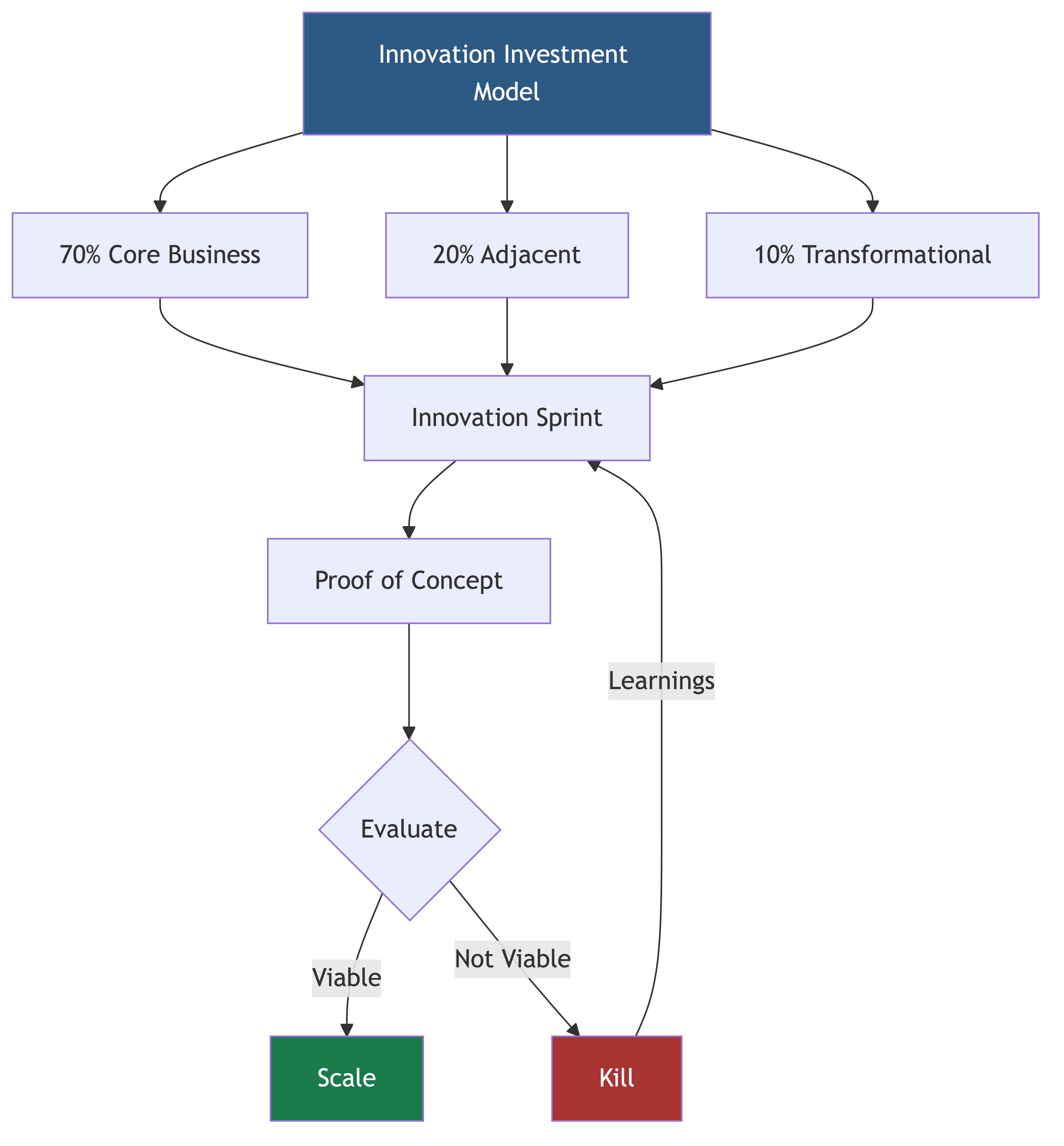
These are total R&D numbers. Within that, how much goes to true innovation versus maintaining existing products? A useful split:
-
70% on core business: Features, improvements, and maintenance for existing products. This is the work that keeps revenue flowing.
-
20% on adjacent innovation: New capabilities closely related to your core business. New product features, new integrations, new markets for existing technology.
-
10% on transformative innovation: True R&D into new technologies, new business models, or fundamental platform changes. This is the work that might not pay off for two to three years.
This 70/20/10 split comes from Google's early days, and while the exact percentages will vary for your company, the principle is sound: most of your investment should be on the core, with intentional allocation to adjacent and transformative work.
How to sell this to the CFO:
The CFO will push back on innovation spending because it doesn't have immediate ROI. Here's how to frame it:
"If we spend 100% of our engineering budget on today's products, we'll maximize this year's results. But our technology will fall behind, our best engineers will get bored and leave, and in three years we'll be scrambling to catch up. The 20% we invest in adjacent innovation protects next year's revenue. The 10% we invest in transformative innovation protects the business three years from now."
Back this up with examples. Show what happened to companies in your industry that stopped innovating. Show the cost of playing catch-up versus staying ahead. Make the ROI case for innovation spending even though the returns are delayed and uncertain.
Tracking R&D investment:
You need to track where your engineering resources actually go. Not at a granular level -- that creates bureaucracy. But at a category level:
- How much time goes to new features? (core)
- How much time goes to adjacent innovation? (adjacent)
- How much time goes to true R&D? (transformative)
- How much time goes to maintenance and operational work? (keep the lights on)
If your "keep the lights on" work is consuming more than 30% of your engineering capacity, you have a technical debt problem that's crowding out innovation. Fix that before trying to increase innovation spending.
Innovation Sprints
Innovation sprints -- sometimes called hack weeks, innovation time, or 20% time -- are dedicated periods where engineers work on ideas outside their normal product work.
Why they work:
-
They surface ideas you'd never see otherwise. The best innovations often come from engineers closest to the technology and customers, not from leadership.
-
They keep engineers engaged. Working on the same product features month after month is draining. Innovation time provides creative variety.
-
They're low cost, high optionality. A week of innovation time costs relatively little but can produce prototypes that lead to major product features or internal tools.
How to structure them:
Frequency: Quarterly works well for most organizations. Some companies do biannual innovation weeks with more fanfare. Avoid monthly -- it's too frequent and disrupts delivery rhythm.
Duration: Three to five days. Less than three days isn't enough time to build something meaningful. More than five days and you start impacting delivery commitments.
Scope: Let people work on anything that relates to the business, even loosely. The best ideas often come from unexpected connections. Don't restrict themes too much.
Teams: Let people form their own teams across organizational boundaries. This is one of the biggest benefits -- it creates connections between people who don't normally work together.
Presentations: End with demos. Everyone presents what they built. Make it a celebration, not a competition. Some companies do awards, which can help, but be careful not to make it so competitive that people game the system instead of taking genuine creative risks.
Follow-through: This is where most innovation programs fail. People build exciting prototypes, demo them to applause, and then... nothing happens. You need a process for evaluating innovation sprint outputs and deciding which ones deserve continued investment. More on this in the next section.
Common pitfalls with innovation sprints:
-
Canceling them under delivery pressure. This sends the message that innovation isn't really valued. Protect innovation time fiercely.
-
Management picking the topics. If leadership dictates what people work on during innovation time, it's just more regular work with a different name. Let people choose.
-
No connection to product strategy. While topics should be self-selected, help people understand the company's strategic direction so their innovation naturally aligns with business needs.
-
Excluding non-engineers. Some of the best innovation sprint outcomes come from cross-functional teams. Invite designers, product managers, and customer support team members.
POC Pipeline
Innovation sprints generate ideas. A POC (Proof of Concept) pipeline turns the best ideas into real products or capabilities. Without a pipeline, you generate excitement but no value.
The pipeline stages:
Stage 1: Idea An engineer or team has an idea. It might come from an innovation sprint, a customer interaction, a technology trend, or just a shower thought. Capture it somewhere accessible -- an ideas board, a Slack channel, a simple database.
Stage 2: Evaluation Periodically (monthly works well), a small committee evaluates submitted ideas against criteria:
- Does this align with our technology strategy?
- Is there a plausible business case?
- Do we have or can we build the capability to execute it?
- What's the estimated effort to build a POC?
- What would we need to see from a POC to justify further investment?
Stage 3: POC Selected ideas get dedicated time and resources for a proof of concept. This is typically two to four weeks with one to three engineers. The POC should answer a specific question: "Is this technically feasible?" or "Would customers actually use this?"
Define success criteria before starting the POC. "Build something cool" is not a success criterion. "Demonstrate that we can process 10,000 transactions per second using this new approach" is.
Stage 4: Validation The POC is evaluated against the success criteria. If it succeeds, it moves to the next stage. If it fails, document the learnings and move on. Failure is not just acceptable -- it's expected. If every POC succeeds, you're not being ambitious enough.
Stage 5: Investment decision POCs that pass validation go to a product and engineering leadership review. This is where you decide: do we invest real resources in building this into a product? This decision should involve product management, engineering leadership, and business stakeholders.
Stage 6: Integration Approved projects get moved into the regular product development process with proper product management, design, and engineering resources.
Pipeline metrics:
Track these to understand how healthy your innovation pipeline is:
- Ideas submitted per quarter: Is the organization generating ideas?
- Ideas advanced to POC: Are you selecting and investing appropriately?
- POC success rate: Are your POCs answering the right questions? (Target 30-50% success rate -- lower means you're being too ambitious, higher means not ambitious enough.)
- POC to production rate: Are successful POCs actually becoming products?
- Time from idea to production: How long does the pipeline take? (Target 3-9 months for most innovations.)
- Revenue/impact from innovations: What business value have pipeline graduates generated?
Balancing Exploration vs. Exploitation
This is the fundamental tension of innovation management. In academic terms, it's the explore-exploit trade-off.
Exploitation is doing more of what works. Optimizing existing products, serving existing customers better, squeezing more value from existing technology. It's low-risk, predictable, and pays off in the short term.
Exploration is trying new things. New technologies, new markets, new approaches. It's high-risk, unpredictable, and pays off in the long term (if at all).
How to balance them:
Separate the work organizationally. Have dedicated teams or time for exploration versus exploitation. If you ask the same team to do both, they'll default to exploitation because it feels more productive and less risky.
Use different metrics. Measure exploitation work on efficiency and output metrics (velocity, throughput, quality). Measure exploration work on learning metrics (hypotheses tested, experiments run, insights gained).
Protect exploration from exploitation pressure. When delivery deadlines loom, the natural instinct is to pull exploration resources into delivery. Resist this unless it's truly critical. If you constantly raid exploration for exploitation, you'll never innovate.
Rotate people. Let engineers spend time in both exploration and exploitation roles. This keeps exploitation teams energized and grounds exploration teams in customer reality.
Set expectations clearly. Exploration work has a high failure rate by design. Make sure leadership and the board understand this. If you're expected to bat 1.000 on innovation bets, you'll only make safe bets -- which defeats the purpose.
The Christensen problem:
Clayton Christensen's "Innovator's Dilemma" describes how successful companies fail because they focus too much on current customers and products (exploitation) and miss disruptive innovations (exploration). This is real and it happens frequently.
As CTO, you're the person most likely to see disruptive technology coming. It's your job to push the organization to invest in exploration even when exploitation seems like the safer bet. This requires courage, because you're advocating for uncertain future value over certain present value.
Emerging Technology Evaluation
Part of your job as CTO is to keep a pulse on emerging technologies and evaluate which ones matter for your business. The challenge is separating signal from noise. The technology industry produces more hype than any other industry on earth.
An evaluation framework:
For each emerging technology, answer these questions:
-
What problem does this solve? Not "what can it do" but "what problem that we have does it solve?" If it doesn't solve a real problem you have, it's interesting but not relevant right now.
-
How mature is it? Where is it on the adoption curve? Bleeding edge (risky, unproven)? Early mainstream (viable but still evolving)? Mature (proven, well-supported)?
-
What's the adoption cost? Not just money -- engineering time, training, integration effort, operational complexity. Some technologies are free to adopt but expensive to operate.
-
What's the competitive impact? If we adopt this, does it create a meaningful advantage? If we don't adopt it, do we fall behind?
-
What's the reversibility? If we adopt this and it doesn't work out, how hard is it to switch to something else? Low-reversibility decisions deserve more scrutiny.
A practical process:
Technology radar. Maintain a technology radar -- a living document that categorizes emerging technologies into four rings:
- Adopt: We're actively using this and recommend it broadly.
- Trial: We're testing this in limited contexts and it's promising.
- Assess: We're watching this and evaluating whether it's relevant.
- Hold: We've looked at this and decided not to pursue it right now.
Review the radar quarterly. Move technologies between rings as your understanding evolves. Make the radar accessible to the entire engineering organization so everyone has the same picture.
Scouting missions. Assign individuals or small teams to deeply evaluate specific technologies. Give them two to four weeks to build something real with the technology and report back. This is much more valuable than reading blog posts or attending vendor demos.
Vendor-neutral evaluation. Be skeptical of vendor presentations. They're designed to sell, not to inform. Supplement vendor input with independent research, community experience, and your own hands-on evaluation.
Creating Space for Innovation Without Losing Delivery Focus
This is the practical challenge. You believe in innovation. You've secured the budget. Now how do you actually create space for it without delivery falling apart?
Structural approaches:
Dedicated innovation team. A small team (3-8 people) whose full-time job is exploration and POC development. They don't carry delivery commitments. This is the cleanest separation but requires enough scale to afford dedicated people.
Innovation rotation. Engineers rotate through innovation assignments. Each engineer spends one quarter per year on innovation work. This spreads the innovation mindset across the organization but creates planning complexity.
20% time. Engineers spend one day per week on self-directed innovation. This is the hardest model to sustain because it requires discipline to actually protect that time.
Innovation sprints (hack weeks). Dedicated bursts of innovation time (one week per quarter). Less disruptive to delivery than ongoing models but provides less sustained innovation effort.
Cultural approaches:
Celebrate failure. If people are punished for failed experiments, they won't experiment. Create forums where people share what they tried, why it didn't work, and what they learned. Make failure a learning event, not a career risk.
Reward innovation outcomes. Include innovation contributions in performance reviews and promotion criteria. If innovation is valued in words but not in the systems that determine people's careers, it won't happen.
Leadership modeling. When the CTO personally explores new technologies, builds prototypes, and shares learnings, it signals that innovation is genuinely valued. You don't have to do this constantly, but doing it visibly once or twice a year has an outsized impact.
Cross-pollination. Create opportunities for engineers from different teams to share ideas. Internal tech talks, architecture review sessions, cross-team projects -- anything that exposes people to problems and approaches outside their daily work.
Real-World Examples
Example 1: The 70/20/10 in practice
A CTO at a B2B SaaS company with 200 engineers implemented a 70/20/10 model. 140 engineers on core product, 40 on adjacent innovation (new product features and integrations), and 20 on a dedicated R&D team exploring AI applications.
The R&D team spent nine months exploring various AI approaches. Seven of their experiments failed to produce viable results. The eighth -- an AI-powered anomaly detection feature -- became the company's most-requested feature and contributed to a 15% increase in annual contract value.
The CFO initially questioned the R&D investment. After the anomaly detection feature launched, she became the R&D team's biggest advocate.
Example 2: Innovation sprints that actually shipped
A CTO implemented quarterly hack weeks with a critical addition: a "graduation committee" that met two weeks after each hack week to evaluate which projects deserved continued investment. Over two years, the hack weeks produced 180 prototypes. 30 went through the POC pipeline. 12 became real features. Three became standalone products.
One of those products now generates 600,000 in lost feature development time. That's a remarkable return on investment.
Example 3: Emerging tech evaluation that prevented a mistake
A CTO was under pressure to adopt a trendy new database technology. Three teams had already started building on it. The CTO implemented a structured evaluation process: a two-person team spent three weeks testing the technology under realistic conditions.
They found that the database performed well under low write volumes but degraded catastrophically under the write-heavy workloads that the company's core use case required. If the company had committed to the migration, it would have cost an estimated $3 million and six months to discover this and reverse course.
The structured evaluation cost two engineers three weeks. That's roughly 3 million mistake.
Example 4: The innovation team that lost connection
A CTO created a dedicated innovation lab with ten senior engineers. They worked in a separate office, had no delivery responsibilities, and were told to "think big." After 18 months, they had built some impressive technology demos but nothing that connected to customer needs or business strategy. The lab was quietly disbanded.
The mistake: innovation without connection to the business is just expensive tinkering. The CTO's successor created a new innovation function, but embedded the innovators within product teams and required that every exploration project start with a customer problem, not a technology solution.
Common Mistakes
Mistake 1: Innovation as a budget line with no process
Allocating budget to innovation but having no process for how ideas are generated, evaluated, and advanced. Money without process produces expensive experiments that go nowhere.
Mistake 2: Only safe bets
Every innovation project has clear ROI projections and low risk. This isn't innovation -- it's incremental improvement. Real innovation requires accepting that most bets won't pay off.
Mistake 3: No follow-through
Running hack weeks and generating excitement, then having no mechanism to turn successful prototypes into products. This is worse than not running hack weeks at all because it breeds cynicism.
Mistake 4: Innovation as a seniority perk
Only allowing senior engineers to do innovation work. Some of the best ideas come from junior engineers who aren't constrained by "how things have always been done."
Mistake 5: Copying someone else's model
Implementing Google's 20% time or Spotify's squad model without adapting it to your context. These models worked for those companies at specific points in their evolution. Your company is different. Take the principles and adapt the implementation.
Mistake 6: Measuring innovation like you measure delivery
Using velocity, story points, and sprint completion rates to evaluate innovation work. Innovation needs different metrics: experiments run, hypotheses validated, learnings documented, and prototypes demonstrated.
Mistake 7: Starving innovation during downturns
Cutting innovation spending to zero during tough economic times. This is understandable but shortsighted. Companies that maintain innovation investment through downturns emerge stronger. Reduce if you must, but don't eliminate.
Business Value
Innovation and R&D investment create business value in several ways:
-
Future revenue. Today's innovation projects become tomorrow's products and revenue streams. Without R&D, your product portfolio stagnates and competitors pass you by.
-
Competitive differentiation. Companies that innovate faster maintain technology advantages that competitors can't easily replicate. This supports premium pricing and customer retention.
-
Talent retention. Top engineers want to work at companies that invest in innovation. Innovation programs reduce turnover among your most valuable (and hardest to replace) people. If retaining one senior engineer saves 1.5 million in direct savings.
-
Risk mitigation. Emerging technology evaluation prevents costly mistakes (wrong technology bets) and ensures you're not caught off-guard by disruptive changes in your industry.
-
Company valuation. Investors value companies with strong R&D programs because they demonstrate the capacity for future growth. This is especially true for technology companies where innovation is core to the value proposition.
-
Operational efficiency. Many innovations improve internal processes rather than creating new products. An internal tool that saves ten engineers one hour per day is worth over $500K per year in recovered productivity.
Innovation isn't a luxury. It's a strategic necessity. Your job as CTO is to make it happen systematically, not leave it to chance.
Common Pitfalls
-
Canceling innovation sprints under delivery pressure. This sends a clear signal that innovation is not genuinely valued. Protecting innovation time fiercely is essential to maintaining a healthy exploration pipeline.
-
Allocating budget to innovation without a process. Money without a structured pipeline for generating, evaluating, and advancing ideas produces expensive experiments that go nowhere and breed cynicism.
-
Measuring innovation with delivery metrics. Using velocity, story points, and sprint completion to evaluate exploration work kills the creative risk-taking that innovation requires. Innovation needs its own metrics: experiments run, hypotheses validated, and learnings documented.
-
Disconnecting innovation from business context. Innovation labs that operate in isolation from customer needs and business strategy produce impressive demos that never become products. Every exploration project should start with a customer problem.
-
Starving innovation during economic downturns. Cutting R&D to zero in tough times is understandable but shortsighted. Companies that maintain innovation investment through downturns emerge stronger when conditions improve.
-
Only allowing senior engineers to do innovation work. Some of the best ideas come from junior engineers who are not constrained by assumptions about how things have always been done. Innovation should be accessible at all levels.
Key Takeaways
-
The 70/20/10 framework provides a useful starting point: 70% on core business, 20% on adjacent innovation, and 10% on transformative R&D. Adjust the ratios for your context.
-
Innovation sprints work best when they are quarterly, three to five days long, self-directed by participants, and followed by a structured evaluation process for graduating successful prototypes.
-
A POC pipeline with clear stages from idea through evaluation, proof of concept, validation, investment decision, and integration turns innovation excitement into actual business value.
-
Balancing exploration and exploitation requires organizational separation, different metrics for each, and explicit protection of exploration resources from delivery pressure.
-
A technology radar that categorizes emerging technologies into adopt, trial, assess, and hold rings provides a shared framework for evaluating new technologies across the organization.
-
If your maintenance and operational work consumes more than 30% of engineering capacity, you have a technical debt problem that is crowding out innovation and must be addressed first.
-
Frame R&D investment for the CFO in terms of protecting future revenue: the 20% on adjacent innovation protects next year, and the 10% on transformative work protects the business three years out.