
Engineering Brand and Open Source
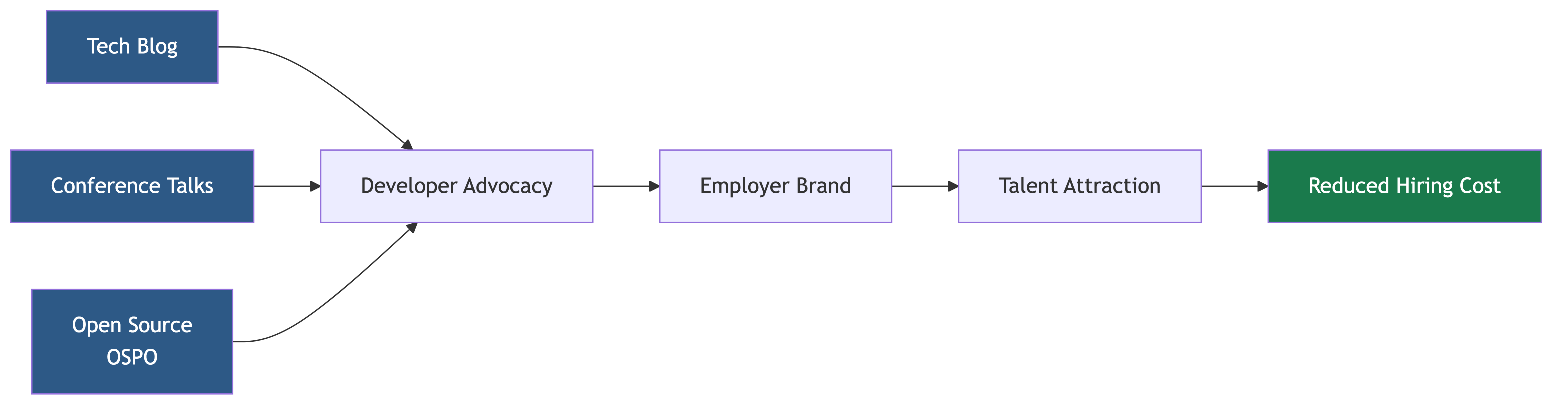
Why Engineering Brand Matters
Let me start with a number that will get your attention: the average cost to hire a senior software engineer in the US is between 50,000 when you factor in recruiter fees, interview time, and onboarding. If you hire 50 engineers a year, that's 2.5 million in recruiting costs alone.
Now here's the thing. Companies with strong engineering brands cut those costs dramatically. When engineers actively want to work at your company, you spend less on sourcing, your offer acceptance rate goes up, and your time-to-fill goes down. I've seen companies with strong engineering brands reduce their recruiting costs by 40-60%.
But engineering brand isn't just about recruiting. It's about credibility with partners, confidence from investors, and pride within your existing team. It's a strategic asset that compounds over time, and as CTO, you're the person responsible for building it.
Tech Blog Strategy
A technology blog is the foundation of your engineering brand. It's the most scalable way to show the world how your engineering team thinks and works.
What to write about:
Technical challenges you've solved. "How we scaled our payment processing to handle 100K transactions per second." This demonstrates competence and attracts engineers who want to work on similar problems.
Architectural decisions. "Why we chose event-driven architecture for our order management system." This shows thoughtfulness and invites interesting discussions.
Open source contributions. "Introducing our new open source library for distributed rate limiting." This demonstrates generosity and technical depth.
Engineering culture. "How we do code reviews at [Company]." This helps potential candidates understand what it's like to work with you.
Lessons from failures. "What we learned from our biggest outage in 2025." This demonstrates maturity and humility. Some of the most-read engineering blog posts of all time are post-incident write-ups.
Technology evaluations. "Why we switched from X to Y and what we learned." This positions your team as thoughtful evaluators of technology.
What NOT to write about:
- Vendor press releases disguised as blog posts
- Generic tutorials that add nothing new to the conversation
- Posts so sanitized by legal that they say nothing interesting
- Posts that reveal proprietary competitive advantages or customer data
Building a sustainable blog program:
Publication cadence. Aim for two to four posts per month. Less than one per month and you lose momentum. More than one per week and quality typically suffers.
Writer pipeline. Don't rely on the same three people to write everything. Build a pipeline:
- Identify engineers who have interesting stories to tell
- Pair them with a technical editor who can help shape the post
- Provide a writing guide with examples and templates
- Remove friction (don't make people go through 12 approvals)
Editorial support. Most engineers are better writers than they think, but they need support. Hire or designate a technical editor who can help with structure, clarity, and voice. This doesn't mean rewriting their posts -- it means helping them communicate more effectively.
Distribution. Writing a great post isn't enough. You need to distribute it. Share on Hacker News, Reddit, Twitter/X, LinkedIn, and relevant community forums. Encourage your engineers to share on their personal channels too.
Measurement. Track views, engagement, and most importantly, whether the blog drives recruiting outcomes. Ask candidates in interviews whether they've read your blog. Track which posts generate the most inbound recruiting interest.
Conference Talk Pipeline
Conference talks are the highest-impact engineering brand activity per individual event. A single great conference talk can reach thousands of people and establish your company as a leader in a particular area.
Building a talk pipeline:
Identify topics. Survey your engineering teams quarterly: "What are you working on that the broader engineering community would find interesting?" You'll be surprised by how much interesting work is happening that nobody outside the company knows about.
Identify speakers. Not everyone wants to speak at conferences. Don't force it. Instead, find people who are interested and invest in developing them. Look for:
- Engineers who give great internal presentations
- Engineers who are active in online communities
- Engineers who've expressed interest in public speaking
- Engineers from underrepresented groups (many conferences actively seek diverse speakers, and you should be developing these opportunities)
Speaker development program. Most engineers have never given a conference talk and find the prospect terrifying. Help them:
- Start with internal tech talks (low stakes, friendly audience)
- Provide presentation skills training
- Pair new speakers with experienced ones as mentors
- Do dry runs with feedback before the real talk
- Cover conference travel and give time for preparation
CFP (Call for Papers) tracking. Maintain a list of relevant conferences and their submission deadlines. Assign someone to track these and nudge potential speakers to submit.
Talk quality bar. Your company's reputation is on the line. Help speakers create great talks, not just adequate ones. Invest in slide design, storytelling structure, and rehearsal time.
Maximizing conference ROI:
Record everything. Even if the conference records talks, make your own recording. Post it on your engineering blog and YouTube channel.
Write companion blog posts. Turn every talk into a blog post for people who prefer reading to watching.
Network intentionally. Conference talks aren't just about the audience in the room. They're about the conversations in the hallway after. Encourage speakers to stay for the conference and connect with peers.
Track outcomes. Which conferences generate the most recruiting interest? Which talks get the most views? Use this data to focus your conference investment.
OSPO: Open Source Program Office
An Open Source Program Office (OSPO) manages your company's relationship with the open source ecosystem. If your company uses open source (and it does -- every company does), you need a strategy for how you engage with it.
Why you need an OSPO (or at least an open source strategy):
Legal risk management. Open source licenses have obligations. If you're not tracking what open source you use and what the license obligations are, you're exposed to legal risk.
Security. Open source dependencies have vulnerabilities. You need a process for tracking and responding to them.
Contribution strategy. When and how your engineers contribute back to open source projects. This needs guidelines to protect proprietary information while enabling participation.
Open sourcing your own projects. Deciding what to open source, how to maintain it, and how to build community around it.
OSPO structure:
For most companies, a full-time OSPO isn't necessary until you're at significant scale (500+ engineers). Before that, assign OSPO responsibilities to a senior engineer or engineering manager. The key functions are:
Policy: Create clear policies for:
- Using open source in your products (license compatibility, security scanning, approval process for new dependencies)
- Contributing to external open source projects (when it's OK, what approval is needed, how to avoid disclosing proprietary information)
- Open sourcing your own projects (criteria for what to open source, how to maintain it, community guidelines)
Compliance: Ensure you're meeting the obligations of the open source licenses you use. This is especially important if your software is distributed to customers (as opposed to SaaS).
Community: Build relationships with the open source communities that matter to your business. Sponsor projects, contribute engineering time, and participate in governance.
Internal advocacy: Help internal teams understand the value of open source participation. Many engineers want to contribute but worry about corporate pushback. Clear policies and visible support from leadership remove this friction.
What to open source:
Open source the things that:
- Are not your competitive advantage (tooling, infrastructure, utilities)
- Would benefit from external contributions
- Help establish your engineering brand
- Would help the broader community solve common problems
Don't open source the things that:
- Are your competitive moat
- Contain proprietary algorithms or business logic
- Would be a maintenance burden without community adoption
- Reveal security-sensitive implementation details
Making open source projects successful:
Most corporate open source projects fail. They're launched with fanfare and then neglected. To avoid this:
-
Commit maintenance resources. Open sourcing a project is the beginning, not the end. Budget engineering time for maintenance, issue triage, and PR review.
-
Write excellent documentation. The number one reason people don't adopt open source projects is poor documentation. Invest here.
-
Be responsive. If someone opens an issue or PR, respond within 48 hours, even if it's just to acknowledge receipt. Unresponsive maintainers kill community engagement.
-
Build community. Create a Slack or Discord channel. Be welcoming to new contributors. Recognize contributions publicly.
Developer Advocacy
Developer advocacy (sometimes called developer relations or DevRel) is the practice of building relationships with the developer community on behalf of your company.
What developer advocates do:
- Create technical content (blog posts, tutorials, videos, sample code)
- Speak at conferences and meetups
- Engage with developers on social media and community forums
- Gather feedback from the developer community and bring it back to product and engineering teams
- Build and maintain SDK and API documentation
- Create and support developer programs (beta programs, early access, ambassadors)
When you need developer advocacy:
Not every company needs a dedicated DevRel team. You need one when:
- Your product has an API or SDK that external developers use
- Developer adoption is a key growth channel
- You're competing for developer mindshare
- Your engineering brand is a significant factor in recruiting
If none of these apply, your engineering blog and conference talks may be sufficient for brand building.
DevRel as an engineering function:
There's an ongoing debate about whether DevRel should sit in Engineering or Marketing. My strong recommendation: put it in Engineering, with dotted-line reporting to Marketing.
Why? Developer advocates need to be credible developers themselves. They need to write real code, understand your technology deeply, and be respected by the engineering community. If they're viewed as "marketing people who happen to know code," they lose credibility fast.
However, DevRel benefits from Marketing's expertise in content strategy, distribution, events management, and measurement. The dotted line to Marketing gives them access to these resources without losing their engineering identity.
Employer Brand Through Engineering
Your engineering brand is one of the most powerful employer brand assets you have. In a competitive talent market, it can be the difference between getting the candidate you want and losing them to a competitor.
What top engineers look for:
When senior engineers evaluate a company, they look for:
-
Interesting problems. "Will I be challenged?" Your blog posts and conference talks answer this question.
-
Strong peers. "Will I work with people I can learn from?" Your engineering team's public presence signals the quality of your team.
-
Good practices. "Will I be able to do my best work?" Your open source projects, your blog posts about engineering culture, and your Glassdoor reviews answer this.
-
Growth opportunities. "Will I grow here?" Your career ladder, mentoring programs, and conference speaking support signal investment in growth.
-
Impact. "Will my work matter?" Your product's market position and your technology's role in the business answer this.
How to build employer brand through engineering:
Make your engineers visible. Encourage personal blogs, conference talks, open source contributions, and social media presence. The more visible your engineers are, the more attractive your company is to other engineers.
Show your work. Don't just show the polished results -- show the process. How you make decisions, how you handle failures, how you grow people. This authenticity resonates far more than marketing copy.
Create signature moments. Annual hack weeks, engineering summits, unique rituals that become part of your identity. These become stories that your engineers tell their networks.
Leverage your engineers as recruiters. The most effective recruiters in your organization aren't your recruiting team -- they're your engineers. When your engineers actively refer people and speak positively about working at your company, it's more credible than any employer brand campaign.
Attracting Talent Through Brand
Let's get specific about how engineering brand translates to recruiting outcomes.
The inbound recruiting flywheel:
- Engineer writes blog post or gives conference talk
- Other engineers read/watch and are impressed
- Some of those engineers check your careers page
- Some apply for roles
- They tell their friends about your company
- Their friends check your blog and careers page
- Repeat
This flywheel takes time to build but compounds powerfully. Companies like Stripe, Netflix, and Shopify have built such strong engineering brands that a significant percentage of their engineering hires come from inbound interest rather than outbound recruiting.
Specific tactics:
Engineering careers page. Don't use generic corporate career page templates. Create an engineering-specific page that shows your tech stack, your team, your challenges, and your culture. Include engineer testimonials and links to your blog.
Open source as recruiting. Your open source projects attract contributors. Some of those contributors become candidates. This is one of the highest-quality recruiting channels because you've already seen their work.
Conference recruiting. When your engineers speak at conferences, have a recruiting presence. Not a aggressive booth pitch, but a genuine invitation: "If you found this talk interesting, we're hiring people who want to work on these problems."
Community engagement. Sponsor meetups, host events at your office, participate in online communities. Be helpful without being salesy. Build genuine relationships.
Reducing Hiring Cost
Let's quantify the impact of engineering brand on hiring costs.
Direct cost reduction:
-
Lower recruiter dependency. Strong brands generate more inbound applications, reducing reliance on expensive external recruiters (who typically charge 20-25% of first-year salary).
-
Higher offer acceptance rate. Candidates who already know and respect your engineering brand are more likely to accept offers. Every declined offer represents wasted interview time and delayed project timelines.
-
Shorter time-to-fill. Strong brands fill roles faster. Every week a role is open costs you in delayed projects and overworked existing team members.
Indirect cost reduction:
-
Better candidate quality. Inbound candidates from brand awareness are typically higher quality than outbound sourced candidates. Better candidates mean fewer bad hires, and the cost of a bad hire is enormous (estimated at 1.5-3x annual salary).
-
Retention improvement. Engineers who joined because of your engineering brand tend to stay longer. They came for the mission and culture, not just the paycheck.
-
Referral increase. Engineers who are proud of their company's engineering brand refer more candidates. Referral hires are faster, cheaper, and have higher retention rates.
Quantifying the impact:
Here's a simple model. Company with 500 engineers, 15% annual turnover, average loaded cost of $250K per engineer:
Without engineering brand:
- 75 hires per year
- Average cost per hire: $40K
- Average time to fill: 60 days
- Offer acceptance rate: 65%
- Total recruiting cost: $3M/year
With strong engineering brand:
- 75 hires per year
- Average cost per hire: $20K (more inbound, fewer recruiter fees)
- Average time to fill: 35 days
- Offer acceptance rate: 80%
- Total recruiting cost: $1.5M/year
That's $1.5 million per year in savings. And this model is conservative -- it doesn't account for the quality improvement in hires or the retention benefits.
Measuring Brand Impact
You can't manage what you can't measure. Here's how to measure your engineering brand's impact.
Awareness metrics:
- Blog traffic and engagement. Monthly unique visitors, average time on page, social shares.
- Conference talk reach. Attendance, video views, social media mentions.
- Open source metrics. Stars, forks, contributors, community growth.
- Social media following. Engineering team's collective following on Twitter/X, LinkedIn, etc.
- Media mentions. How often your engineering team or practices are referenced in industry publications.
Recruiting metrics:
- Inbound application rate. What percentage of applications come from people who found you rather than people you found?
- Source attribution. When candidates apply, where did they first hear about you? Track blog, conference, open source, referral, etc.
- Offer acceptance rate. Are candidates who engaged with your brand before applying more likely to accept?
- Quality of hire. Do candidates sourced through brand channels perform better?
- Referral rate. Are your engineers referring more people over time?
Sentiment metrics:
- Glassdoor engineering ratings. Specifically engineering-related reviews.
- Community sentiment. What do people say about your engineering team on Hacker News, Reddit, Twitter/X?
- NPS from engineering candidates. Even candidates you reject should have a positive impression of your engineering organization.
A quarterly brand report:
Create a simple quarterly report that tracks these metrics over time. Present it to the executive team to demonstrate the ROI of your brand investment. This report should connect brand metrics to business outcomes (recruiting cost savings, time-to-fill improvements, retention rates).
Real-World Examples
Example 1: The blog that built a recruiting engine
A mid-stage startup with 150 engineers started an engineering blog with a simple goal: publish two posts per month. They assigned a part-time technical editor (an existing engineer who enjoyed writing) and created a simple submission process.
After 18 months, the blog was generating 100K monthly page views. More importantly, 35% of engineering candidates mentioned the blog as the reason they applied. The company reduced its external recruiter spend by $800K per year.
The total investment: roughly 20 hours per month of engineering time for writing and editing, plus $5K per year for the blog platform. The ROI was extraordinary.
Example 2: The open source project that became an industry standard
A CTO decided to open source the company's internal feature flagging system. The initial reaction from the business was skepticism: "Why would we give away something we built?" The CTO's argument: "Feature flagging isn't our competitive advantage. Our product is. By open sourcing the tooling, we attract contributors who improve it for free, we build brand credibility, and we establish ourselves as thought leaders in engineering practices."
Three years later, the project had 5,000 GitHub stars, 200 external contributors, and was used by dozens of companies. It became a key recruiting asset -- candidates consistently cited it in interviews as evidence of the company's engineering quality. Several hires came directly from the contributor community.
Example 3: The conference strategy that targeted the right audience
A B2B infrastructure company was struggling to hire distributed systems engineers -- a small, competitive talent pool. Instead of trying to be everywhere, their CTO focused conference investments on three events where distributed systems engineers gathered.
They sponsored these events, sent speakers with talks about their specific distributed systems challenges, and hosted after-conference meetups. Within two years, they were known in the distributed systems community as one of the most interesting places to work on these problems. Their time-to-fill for distributed systems roles dropped from 90 days to 40 days.
Example 4: The brand that hurt recruiting
A large company had a strong consumer brand but a weak engineering brand. Their technology was perceived as legacy, their practices as bureaucratic. Despite offering competitive salaries, they couldn't attract top talent. Candidates would take lower-paying offers from companies with stronger engineering brands.
The CTO launched a comprehensive brand overhaul: new engineering blog, conference speaking program, open source contributions, and (most importantly) genuine improvements in engineering practices. It took two years, but they turned the perception around. The lesson: engineering brand must be authentic. You can't market your way to a great engineering brand -- you have to actually be great and then tell the story.
Common Mistakes
Mistake 1: Marketing-driven content
Letting marketing control the engineering blog. The posts become polished but sterile -- they read like press releases instead of technical content. Engineers can smell marketing from a mile away. Keep the content authentic and technically substantive.
Mistake 2: No consistency
Publishing five posts in one month, then nothing for three months. Brand building requires consistency. A steady cadence of two posts per month is far more effective than bursts of activity followed by silence.
Mistake 3: Only showcasing senior leaders
If every blog post and conference talk comes from a VP or Director, your brand feels top-heavy. Showcase engineers at all levels. This is more authentic and also develops your pipeline of future technical leaders.
Mistake 4: Ignoring negative sentiment
If your Glassdoor reviews are bad or there's negative sentiment in online communities, address the underlying issues before investing in brand marketing. Brand built on top of real problems is fragile and can backfire.
Mistake 5: No measurement
Investing in brand activities without measuring their impact. This makes it impossible to know what's working and makes the investment vulnerable to budget cuts because you can't demonstrate ROI.
Mistake 6: Treating open source as marketing
Open sourcing a project for brand purposes but not committing the resources to maintain it. Abandoned open source projects hurt your brand more than having no open source presence at all.
Mistake 7: Not protecting engineers' time
Asking engineers to write blog posts, give talks, and maintain open source projects on top of their normal delivery commitments. This leads to burnout and resentment. Budget time for brand activities. If an engineer is writing a blog post, that's work -- account for it in their capacity.
Business Value
Engineering brand and open source create substantial, measurable business value:
-
Recruiting cost reduction. As quantified above, a strong engineering brand can cut recruiting costs by 40-60%. For a company hiring 75 engineers per year, this is $1-2 million in annual savings.
-
Talent quality improvement. Better brand attracts better candidates. Better candidates build better products. Better products drive more revenue. The causal chain is long but real.
-
Retention improvement. Engineers who are proud of their company's engineering brand stay longer. Even a 2-3% improvement in retention saves hundreds of thousands in replacement costs.
-
Partner and customer credibility. Technical partners and sophisticated customers evaluate your engineering brand when deciding whether to work with you. A strong brand creates trust.
-
Investor confidence. For technology companies, investors evaluate the engineering team as a key asset. A strong engineering brand signals a strong engineering team, which supports higher valuations.
-
Community contributions. Open source projects attract external contributors who improve your tools for free. This is engineering leverage that doesn't show up on your headcount.
-
Market intelligence. Active participation in the engineering community gives you early visibility into trends, competitive moves, and emerging technologies. This is strategic intelligence that's hard to get any other way.
Engineering brand isn't a vanity project. It's a strategic investment with quantifiable returns. As CTO, building and maintaining this brand is one of your highest-leverage activities. The compounding effects take time to materialize, but once they do, they create a durable competitive advantage that's very hard for competitors to replicate.
Common Pitfalls
-
Letting marketing control the engineering blog. Posts that read like press releases instead of authentic technical content destroy credibility with engineers. Keep content technically substantive and let the engineering voice come through.
-
Open sourcing projects without committing maintenance resources. Abandoned open source projects hurt your brand more than having no open source presence at all. Budget ongoing engineering time for issue triage, PR review, and community engagement.
-
Publishing inconsistently. Five posts in one month followed by three months of silence signals a program that is not taken seriously. A steady cadence of two posts per month is far more effective than bursts of activity.
-
Only showcasing senior leaders. When every blog post and conference talk comes from VPs and Directors, the brand feels top-heavy and inauthentic. Showcase engineers at all levels to demonstrate depth and develop future technical leaders.
-
Investing in brand without addressing underlying problems. If Glassdoor reviews are negative or there is genuine discontent about engineering practices, marketing your way to a better brand will backfire. Fix the real issues first.
-
Not budgeting time for brand activities. Expecting engineers to write posts, give talks, and maintain open source on top of full delivery commitments leads to burnout and resentment. Brand work is real work and must be accounted for in capacity planning.
Key Takeaways
-
A strong engineering brand can reduce recruiting costs by 40-60%, which translates to over a million dollars annually for companies hiring at scale.
-
The tech blog is the foundation of engineering brand. Aim for two to four posts per month covering technical challenges, architectural decisions, lessons from failures, and engineering culture.
-
Conference talks are the highest-impact brand activity per event. Build a speaker pipeline with training, mentorship, dry runs, and travel support.
-
An Open Source Program Office (or at least a clear open source strategy) manages legal risk, security exposure, contribution guidelines, and decisions about what to open source.
-
Open source the things that are not your competitive advantage and would benefit from external contributions. Do not open source competitive moats or proprietary business logic.
-
Engineering brand creates an inbound recruiting flywheel: content attracts engineers, some apply, they tell friends, and the cycle compounds over time.
-
Measure brand impact through awareness metrics (blog traffic, conference reach, open source stars), recruiting metrics (inbound application rate, offer acceptance rate), and sentiment metrics (Glassdoor ratings, community perception).