
Delegation
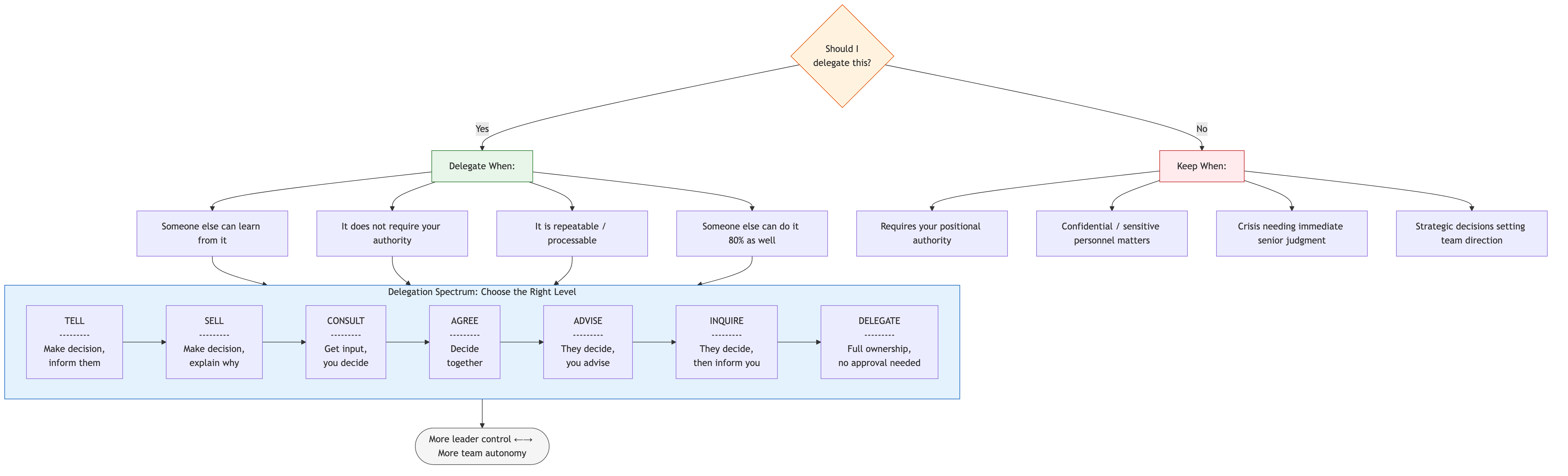
Delegation is the single most important skill you need to develop as a new team leader. It is also the one that will feel the most unnatural. This guide will help you understand why it matters, how to do it well, and how to recover when it goes wrong.
Why Delegation is Hard for Engineers
Here is the uncomfortable truth: you got promoted because you were excellent at doing things. Writing code, solving problems, shipping features. Your entire career up to this point has rewarded you for personal output. Every promotion, every raise, every bit of recognition came because you delivered.
Now you need to be good at not doing things.
This is a genuine psychological barrier, not a minor adjustment. There are several forces working against you:
Identity. You think of yourself as a great engineer. If you stop writing code and start handing work to others, who are you? This is an identity crisis disguised as a process question.
Speed. You know you can do it faster. And you are right. You absolutely can do it faster — this time. But "this time" thinking is a trap that keeps you permanently busy while your team permanently waits.
Quality anxiety. You have standards. You have seen what "good" looks like because you have built it yourself. Handing something to someone who might not hit that bar feels physically uncomfortable.
Control. When you do the work, you know exactly where it stands. Delegating means trusting someone else's status update, someone else's judgment, someone else's timeline. That loss of control is stressful.
Guilt. Some new leaders feel guilty about "making other people do their work." This is a fundamental misunderstanding of the role. Your job is no longer to do the work. Your job is to make sure the work gets done — and that the people doing it are growing.
Recognizing these feelings is the first step. They are normal. Every effective leader has wrestled with them. The ones who succeeded pushed through anyway.
The Math of Delegation
Forget the emotional side for a moment. Look at the math.
If you do everything yourself, your output is 1x. You are one person. You have the same number of hours as everyone else.
If you teach five people to do what you do, your output is 5x. Even if each of them is only 70% as effective as you (which is generous — they might be 90%), that is still 3.5x your solo output.
Let's put real numbers on it:
| Approach | Your time | Team output | Total |
|---|---|---|---|
| You do everything | 40 hrs/week coding | 1 unit of work | 1x |
| You delegate + coach | 10 hrs/week coaching | 3.5 units of work | 3.5x |
| You delegate well over time | 5 hrs/week oversight | 5 units of work | 5x |
Now factor in the second-order effects:
- Those five people teach others. Your investment compounds.
- You free up time for higher-leverage work: architecture decisions, cross-team coordination, removing blockers.
- Your team can work in parallel. You are no longer the serialization point.
The math is not even close. Delegation is not about being lazy. It is a force multiplier.
There is a short-term cost. Teaching someone takes longer than doing it yourself. That investment pays off the second time, the third time, the tenth time. If you never pay that cost, you stay at 1x forever.
What to Delegate
Not everything should be delegated, but far more than you think. Here is a framework for deciding.
Delegate when:
- The task will grow someone. If a team member has never designed an API, giving them an API design task (with guidance) is how they learn. This is delegation as development.
- The task does not require your unique knowledge. If anyone on the team could do it with reasonable ramp-up time, it should not be sitting on your plate.
- "Good enough" is acceptable. Not every task needs to be done the way you would do it. If the outcome meets the requirements, the approach is secondary.
- The task is repeatable. Anything you will need done more than once is a prime candidate. Invest in teaching it now.
- Someone on your team has expressed interest in this area. Delegation aligned with career goals is the best kind.
A simple test: Ask yourself, "Am I the only person who can do this, or am I just the person who has been doing this?" If it is the latter, delegate it.
The 70% rule: If someone on your team can do the task at least 70% as well as you can, delegate it. The remaining 30% is the price you pay for multiplicative output and team growth. Over time, that gap closes.
What NOT to Delegate
Some things should stay with you, at least for now.
Sensitive people issues. Performance conversations, conflict resolution between team members, compensation discussions, and situations involving personal difficulties. These require your direct involvement because they involve trust, confidentiality, and organizational authority.
Critical architecture decisions in your domain. If you are the team leader for a payments system and there is a decision about how to handle transaction integrity, you need to be deeply involved. You can and should include others, but the final call and the accountability sit with you.
Things only you have context for — yet. Sometimes you are the only person who understands why a system was built a certain way, or who knows about a constraint from another team. The key word is "yet." Your job is to transfer that context so these items become delegatable. Every piece of knowledge that only exists in your head is a risk.
High-stakes, no-recovery situations. A production migration with no rollback plan. A contract negotiation with a critical vendor. A public-facing incident response. These are not training exercises. Handle them yourself and debrief afterward so others learn from the experience.
Delegation itself. You cannot delegate the responsibility for ensuring work gets done well. You can delegate tasks, but you own the outcomes. If something you delegated fails, it is your problem, not the person's who did the work.
How to Delegate Effectively
Delegation is not binary. It is a spectrum. The level you choose should match the person's experience and the task's risk.
The Delegation Spectrum
Tell — "Do exactly this." Use for brand-new team members or high-risk tasks where the process must be followed precisely. This is the lowest level of delegation and should be temporary.
Sell — "Here is what I need done, and here is why we are doing it this way." The person follows your approach, but they understand the reasoning. This builds judgment for next time.
Consult — "Here is the problem. I am leaning toward approach X. What do you think?" You make the final call, but you genuinely consider their input. This respects their growing expertise.
Agree — "Here is the problem. Let's decide together how to solve it." True collaboration. You and the team member are peers in the decision, even if you have the tiebreaker.
Advise — "Here is the problem. I have some thoughts if you want them, but it is your call." You offer perspective but the person decides. This is appropriate for experienced team members on moderate-risk tasks.
Inquire — "I saw you handled X. How did it go? What did you decide?" You check in after the fact. The person has full autonomy and you are there to learn about the outcome and offer feedback.
Delegate — "This is your area. Keep me informed of anything I should know." Full ownership. You trust the person completely in this domain. This is the goal for your senior team members.
Matching the Level
The right level depends on two factors: the person's competence on this specific task (not their general skill level) and the risk if things go wrong.
- New person + high risk = Tell or Sell
- New person + low risk = Consult or Agree (let them learn)
- Experienced person + high risk = Advise (trust but verify)
- Experienced person + low risk = Inquire or Delegate
Move people up the spectrum over time. If someone has been at "Consult" for six months and performing well, push them to "Advise." If they stumble, step back one level temporarily, not all the way back to "Tell."
The Delegation Conversation
How you hand off work matters enormously. A poor handoff creates more work than doing it yourself. A good handoff sets someone up for success.
Here is what to cover in every delegation conversation:
Context
Tell them why this work matters. Not just what it is, but where it fits in the bigger picture. "We need to optimize the search query because our P95 latency is over 2 seconds and the product team has identified search speed as the top driver of user retention this quarter."
Context is what turns a task into a learning experience. Without it, the person can only follow instructions. With it, they can make good decisions when they encounter something unexpected.
Expected Outcome
Be clear about what "done" looks like. Not how to get there — what the end state is. "The P95 latency should be under 500ms for queries with fewer than 10 filters. We should not regress the relevance score by more than 5%."
If you cannot articulate the expected outcome clearly, you are not ready to delegate the task yet. Spend more time thinking about it first.
Constraints
What are the boundaries? "Do not change the public API contract. Stay within the existing infrastructure — no new services. Budget is two weeks of effort."
Constraints prevent the person from going down a path that wastes time or creates problems. They are not micromanagement. They are guardrails.
Timeline
When does it need to be done? Is the deadline hard or soft? What are the intermediate milestones?
Be honest about deadlines. If you say "no rush" but actually need it by Friday, you are setting the person up to fail.
Checkpoints
Agree on when you will check in. "Let's sync after you have done the investigation and before you start coding. Then again after the first PR is up."
Checkpoints are not surveillance. They are opportunities for course correction. They protect the person from going too far down a wrong path. Make them explicit so neither of you feels awkward about them.
What NOT to include
Do not give step-by-step instructions. If you tell someone exactly how to do the work, you are not delegating — you are dictating. They will not learn, they will not develop judgment, and they will come back to you for instructions every time.
The exception is when safety or compliance requires a specific process. In those cases, provide the steps and explain why each one matters.
Letting Go of Perfection
This is the section you need to read twice.
When you delegate a task and get the result back, your first instinct will be to notice everything you would have done differently. The variable names. The code structure. The approach to error handling. The way the documentation is written.
Stop.
Ask yourself one question: Does the outcome meet the requirements?
If yes, approve it. Ship it. Move on.
Their approach will be different from yours. This is not a problem. It is a feature. Diversity of approaches makes your codebase more resilient and your team more capable. If every line of code looks like you wrote it, you have not delegated — you have cloned yourself, poorly.
The 80% rule in practice: If the result is 80% of what you would have produced, and the remaining 20% is style and preference rather than correctness, accept it. Give feedback on the 20% for next time, but do not block the work.
Resist the "just fix it" urge. When you see something you want to change, your fingers will itch. You will think "it would take me five minutes to clean this up." Maybe it would. But those five minutes send a message: "Your work is not good enough, and I do not trust you to fix it." Instead, leave a review comment. Explain what you would change and why. Let them make the fix. They will learn more from fixing it themselves than from seeing your correction.
The ego check: Sometimes "I would have done it differently" is ego talking. Ask whether your way is genuinely better or just more familiar to you.
Building Trust Through Delegation
Delegation is one of the most powerful trust-building tools you have. When you hand someone meaningful work, you are saying: "I believe you can do this." That message matters more than any verbal praise.
Start Small
Do not hand a junior engineer the database migration on their first week. Start with something that has clear boundaries and limited blast radius. A well-scoped feature. A test suite improvement. A documentation overhaul.
Increase Scope
As they succeed, give them bigger challenges. Let them own a small service. Let them lead a technical design. Let them run a sprint planning session. Each step up builds confidence — theirs and yours.
Give Credit
This is non-negotiable. When work that you delegated succeeds, the credit goes to the person who did it. In standups, in sprint reviews, in conversations with your manager. "Sarah designed and implemented the new caching layer" — not "We improved caching" and definitely not "I had the team improve caching."
When work that you delegated fails, the responsibility is yours. You chose to delegate it. You set the checkpoints (or did not). You own the outcome. Publicly blaming someone for a delegated task that went wrong will destroy trust instantly and permanently.
The Trust Flywheel
Delegation builds trust. Trust enables more delegation. More delegation builds more capability. More capability enables more ambitious delegation. This is a flywheel, and it takes time to spin up, but once it is moving, your team becomes dramatically more capable.
When Delegation Fails
It will happen. You delegate something and it comes back broken. The design is wrong, the code does not work, or the timeline was missed entirely. How you handle this moment defines your leadership.
Do Not Take Over
Your instinct will be to grab the keyboard and fix it yourself. Resist. Taking over teaches the person nothing except that you do not trust them. It guarantees they will not try next time.
Diagnose Before Acting
Figure out what went wrong. There are usually three root causes:
- Insufficient context. You did not provide enough information about the problem, the constraints, or the expected outcome. This is your fault, not theirs.
- Skill gap. The person did not have the knowledge or experience to complete the task. This means you misjudged the delegation level. Move them down the spectrum and provide more support.
- Effort or attention. The person did not invest the necessary time or care. This is a different conversation and may indicate a motivation or engagement problem.
Coach Through It
Once you understand the root cause, help the person fix it themselves. Ask questions rather than give answers:
- "Walk me through your approach. Where did you get stuck?"
- "What would you do differently if you started over?"
- "What assumptions did you make? Were any of them wrong?"
This takes longer than fixing it yourself. That is the point. You are investing in their ability to handle it next time.
Adjust, Do Not Abandon
If a delegation fails, do not stop delegating to that person. Adjust the level. Provide more checkpoints. Give smaller tasks. Reduce the risk. Then try again. People learn from failure, but only if they get another chance.
The only exception is if the failure was due to negligence or dishonesty. Those are performance issues and require a different conversation entirely.
Real-World Examples
Scenario 1: The Multiplier
Priya leads a team of six engineers. When she became team lead, she identified three areas where she was the only person with deep knowledge: the deployment pipeline, the API gateway configuration, and the monitoring setup.
Over three months, she paired with different team members on each area. She wrote lightweight runbooks, not for herself, but so others could operate independently. She delegated increasingly complex tasks in each domain, starting at "Sell" and working up to "Advise."
Six months in, three of her six engineers could handle deployment issues independently. Two could make API gateway changes without her involvement. One had become the go-to person for monitoring, surpassing Priya's own knowledge in that area.
Priya's team shipped 40% more features that quarter. She spent her time on cross-team architecture work and mentoring. When she took two weeks of vacation, nothing broke. Her manager noticed and put her on the fast track for senior engineering manager.
Scenario 2: The Bottleneck
Marcus leads a team of five engineers. He is technically brilliant — the best engineer on the team by a wide margin. He knows it, and so does everyone else.
When complex tasks come in, Marcus takes them. "It will be faster if I do it." He reviews every PR in detail, often rewriting significant portions. His team has learned to write code the way Marcus would, which means they are not developing their own judgment.
Marcus works 60-hour weeks. His team works 35-hour weeks because they are constantly waiting on his reviews, his designs, his decisions. Two of his best engineers have started interviewing elsewhere because they do not feel like they are growing.
The team ships about the same amount as when Marcus was an individual contributor. He is working twice as hard for the same output. His manager is concerned about the team's bus factor and Marcus's burnout risk.
Scenario 3: The Recovery
Jun delegates a critical data migration to Alex, a mid-level engineer who has been performing well. Jun provides context and the expected outcome, sets up two checkpoints, and steps back.
At the first checkpoint, Jun realizes Alex has misunderstood a key constraint about data ordering. The migration as designed would corrupt historical reports. Jun feels the urge to take over — the deadline is tight and this is a significant setback.
Instead, Jun explains the constraint Alex missed and asks: "Given what you now know, how would you redesign the migration?" Alex comes back the next day with a revised approach that is actually cleaner than what Jun would have done. They adjust the timeline by three days, communicate the delay to stakeholders, and Alex completes the migration successfully.
Alex learns more from this one experience — the failure, the recovery, the revised design — than from ten tasks that went smoothly. Six months later, Alex leads the next major data migration with no issues. Jun does not even attend the checkpoint meetings.
Common Mistakes
Delegating Only Grunt Work
If you only delegate boring, repetitive tasks while keeping the interesting work for yourself, your team will notice. They will feel like they are doing your chores, not growing as engineers. Delegate challenging work — that is where the growth happens.
Micromanaging After Delegating
"I trust you to handle this" followed by daily check-ins and detailed questions about your approach is not delegation. It is surveillance with extra steps. Set your checkpoints upfront, then step back between them. If you cannot resist checking in, the problem is your anxiety, not their competence.
Not Providing Enough Context
"Can you fix the search bug?" is not delegation. It is a vague instruction that will generate a dozen clarifying questions or, worse, a solution to the wrong problem. Invest the time upfront to provide context, constraints, and expected outcomes. It saves time on the back end.
Taking Credit
Nothing kills a team's motivation faster than a leader who presents delegated work as their own. If your team does not trust that you will give credit, they will stop investing discretionary effort in delegated tasks. Be generous and specific with attribution.
Delegating Without Authority
Giving someone responsibility for a task but not the authority to make decisions about it creates frustration. If you delegate the design of a new service, the person needs to be able to make technical choices without getting your approval on every detail. Delegate the authority along with the task.
Never Delegating Upward or Sideways
Delegation is not only about handing things to your direct reports. Sometimes the right move is to push a decision up to your manager or sideways to a peer team lead. If a task requires organizational authority you do not have, or context from another team, delegate it to the person who can actually handle it effectively.
Waiting Too Long to Delegate
Many new leaders wait until they are drowning before they start delegating. By that point, they have no time to do the handoff well, and the delegation is rushed and sloppy. Start delegating before you need to. Build the muscle early.
Business Value
Delegation is not just a soft skill or a nice management philosophy. It has direct, measurable business impact.
Revenue Impact
A team that operates at 3.5x output ships more features, ships them faster, and responds to market opportunities more quickly. If your team can deliver three features in the time it used to take to deliver one, the business can experiment more, learn faster, and capture revenue sooner.
Delegation also improves quality over time. When multiple people can work on complex tasks, you get diverse perspectives during design and review. This catches problems earlier and produces more robust solutions.
Efficiency Gains
When you are the bottleneck, everything flows through you. PRs wait for your review. Designs wait for your input. Decisions wait for your opinion. Your team sits idle while you context-switch between fifteen things.
Effective delegation removes you as the serialization point. Your team works in parallel. Five people working simultaneously on five tasks will always outperform five people waiting in a queue for one person's attention.
Cost of Not Delegating
The costs are severe and compound over time:
- You burn out. Working 60-hour weeks because you cannot let go is not sustainable. Your decision quality degrades, your patience shortens, and your health suffers.
- Your team does not grow. Engineers who are not given challenging work stagnate. They stop learning, lose motivation, and eventually leave. Replacing an engineer costs six to nine months of salary in recruiting, onboarding, and lost productivity.
- Bus factor of one. If you are the only person who can handle critical tasks, you are a single point of failure. You cannot take vacation, you cannot get sick, and you certainly cannot get promoted — because there is nobody to replace you.
- Organizational ceiling. You will never be promoted to manage a larger team or organization if you cannot demonstrate that your current team operates independently. Leaders who cannot delegate cannot scale.
Measurable Outcomes
Track these metrics to measure your delegation effectiveness:
- Team velocity over time. Is the team delivering more, even as you personally write less code? This is the clearest signal that delegation is working.
- Number of people who can handle complex tasks. At the start, maybe only you can do deployments. After six months of deliberate delegation, how many people can? This is your bench depth.
- Your time allocation. Track how you spend your time for a week. What percentage is individual contributor work versus leadership work (mentoring, planning, unblocking, cross-team coordination)? If you are still spending more than 30% of your time on IC work after six months as a team lead, you are not delegating enough.
- Team retention and satisfaction. People stay on teams where they are growing. If your delegation is effective, your team members will report feeling challenged and trusted. If you see attrition among strong performers, insufficient delegation might be a contributing factor.
- Time to recover from your absence. Take a week off. What happens? If the team continues to ship and make decisions, your delegation is working. If everything stops, you have more work to do.
Common Pitfalls
- Waiting until you are overwhelmed to start delegating. By that point, you have no time to do handoffs well, and the delegation is rushed and sloppy. Building the delegation muscle early, before you need it, leads to far better outcomes.
- Only delegating grunt work while keeping interesting tasks for yourself. Your team will notice and feel like they are doing your chores, not growing as engineers. Delegating challenging, meaningful work is where real development happens.
- Providing step-by-step instructions instead of context and outcomes. Dictating exactly how to do the work prevents learning, kills judgment development, and ensures the person will come back to you for instructions every time.
- Taking over when delegated work comes back imperfect. Grabbing the keyboard and fixing it yourself teaches the person nothing except that you do not trust them. It guarantees they will not try next time.
- Taking credit for delegated work that succeeds. Nothing kills a team's motivation faster than a leader who presents delegated work as their own. If your team does not trust that you will give credit, they will stop investing effort in delegated tasks.
- Confusing "different" with "wrong" and blocking work over stylistic preferences. When the result meets requirements but you would have done it differently, accepting it and moving on is essential. Your taste is not a standard.
Key Takeaways
- Delegation is not about being lazy. It is about multiplying your impact through others.
- The discomfort you feel about delegating is normal. Push through it.
- Match the delegation level to the person and the task. Not everything is full autonomy, and not everything needs step-by-step instructions.
- Invest in the handoff. Clear context, outcomes, constraints, and checkpoints prevent most delegation failures.
- Accept "different" as long as it meets "correct." Perfection is the enemy of delegation.
- When delegation fails, coach through the problem instead of taking over.
- Give credit publicly and take responsibility privately.
- Start delegating before you need to. The best time to build this muscle is before you are overwhelmed.