
Sprint Ceremonies & Agile Practices
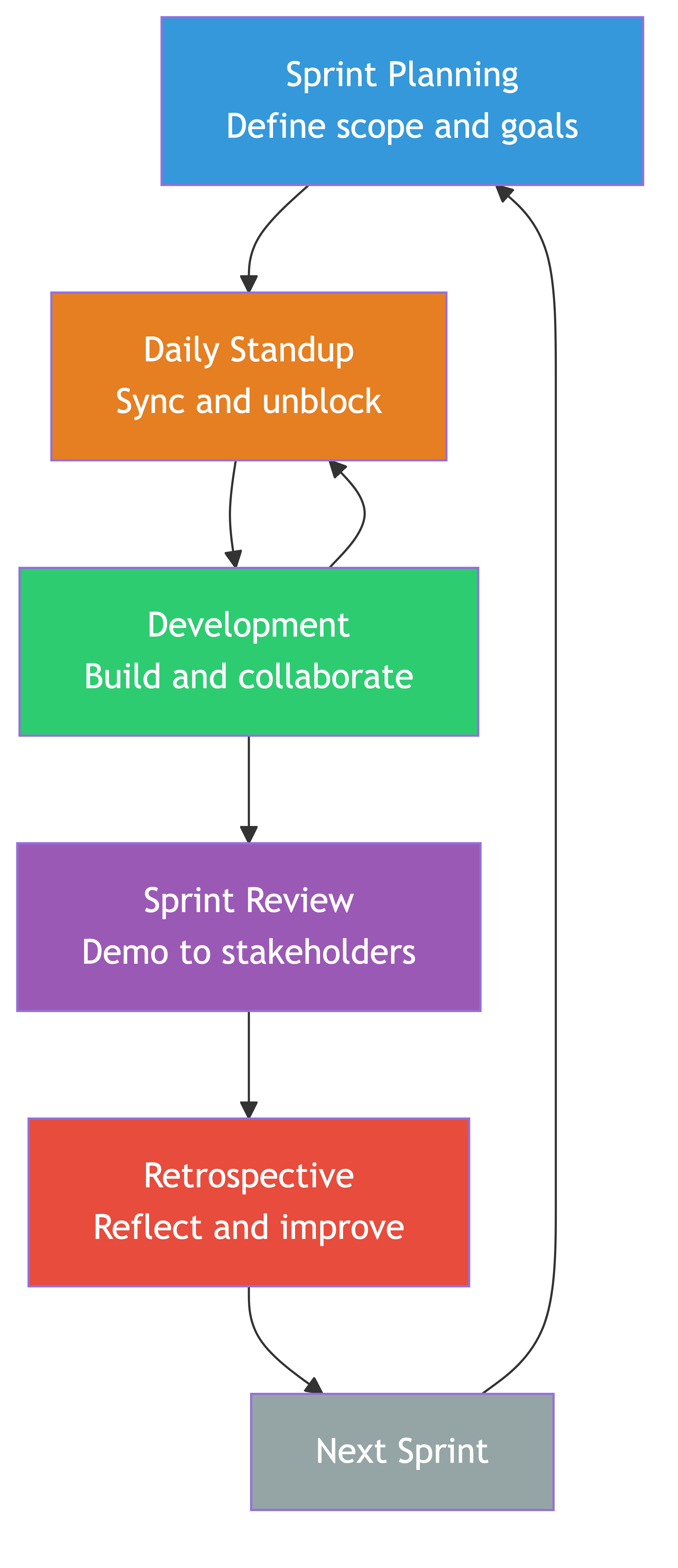
Let's get something out of the way immediately: most teams that say they "do agile" don't actually do agile. They do meetings. They have sprints on the calendar, standups every morning, a Jira board with columns, and a retro every two weeks. They have all the rituals and none of the results.
Agile is not a set of ceremonies. It's a way of working that optimizes for learning fast and delivering value continuously. The ceremonies are just tools that help you get there — when used well. When used poorly, they're overhead that makes everyone hate their job.
As a new team leader, your job is not to enforce the Scrum Guide. Your job is to help your team ship valuable software consistently, learn from what they build, and get better every sprint. The ceremonies are in service of that goal, not the other way around.
1. Agile in Practice
Forget everything you read in a certification textbook. Here's what agile actually looks like in real teams that do it well:
They ship frequently. Not "we finished the sprint" — they actually put working software in front of users. Every sprint, or more often. If you're doing two-week sprints but only deploying once a quarter, you're not agile. You're waterfall with standups.
They learn and adapt. The team notices something isn't working, talks about it, and changes it. Not in six months during a "process review" — next sprint. The feedback loop is tight.
They break work into small pieces. Not because some book told them to, but because small pieces are easier to estimate, easier to review, easier to deploy, and easier to throw away if they turn out to be wrong.
They prioritize ruthlessly. There's always a clear answer to "what is the most important thing right now?" Not ten things. One thing. Maybe two. If a developer has to guess what to work on, your process is broken.
They talk to each other. Not just in standups. Throughout the day. When someone is stuck, they ask for help. When someone finishes early, they pick up the next thing without being told. The team operates as a unit, not a collection of individuals with assigned tickets.
That's it. That's agile. Everything else is implementation detail.
The ceremonies exist to create structure around these behaviors. Sprint planning creates alignment. Standups create visibility. Retros create improvement. Demos create accountability. But the behaviors matter more than the meetings. If your team naturally does all of the above, you could cut half your ceremonies and be fine. If your team does none of the above, no amount of ceremonies will save you.
2. Scrum vs. Kanban
You'll need to pick a framework — or more likely, you'll inherit one. Here's the practical difference.
Scrum
Scrum works in fixed-length iterations (sprints, usually two weeks). You plan what you'll do, do it, review it, reflect on it, and repeat.
Use Scrum when:
- Your team builds features with clear start and end points.
- Stakeholders need predictability — "when will this be done?"
- You want a regular cadence for planning, feedback, and improvement.
- Your team is relatively new to working together and benefits from structure.
Scrum gives you: Predictability, regular reflection points, clear commitments, and a natural rhythm.
Scrum's weakness: It can feel rigid. Interruptions break the model. And teams sometimes optimize for "completing the sprint" instead of "delivering value."
Kanban
Kanban is continuous flow. There are no sprints. Work moves through columns (To Do, In Progress, Review, Done) with limits on how much can be in each column at once (WIP limits).
Use Kanban when:
- Your team handles a lot of unplanned work — bugs, support, ops, incidents.
- Work items vary wildly in size and priority.
- You need to respond to incoming requests quickly.
- Sprints feel forced and artificial for the type of work you do.
Kanban gives you: Flexibility, fast response to change, and visibility into flow and bottlenecks.
Kanban's weakness: Without sprints, there's no natural checkpoint for reflection. You have to deliberately create those moments or improvement stalls. It also makes it harder to give stakeholders timelines.
The Hybrid Reality
Here's a secret: most good teams end up doing a hybrid. They might run two-week sprints for feature work but handle bugs and urgent requests on a Kanban-style pull basis. They might do sprint planning and retros on a regular cadence but not commit to a fixed scope.
That's fine. In fact, that's great. It means the team is adapting the process to fit their reality instead of forcing reality to fit the process. Just make sure the hybrid is intentional, not accidental. "We do Scrum but we skip retros and never finish sprints" isn't a hybrid — it's broken Scrum.
3. Sprint Planning
Sprint planning is where the sprint is won or lost. A bad planning session leads to two weeks of confusion, context-switching, and missed commitments. A good one creates clarity and momentum.
How to Run It Well
Keep it under 1 hour. For a two-week sprint, 45–60 minutes is plenty. If your planning takes two hours, your backlog isn't refined enough. Fix that upstream.
Before planning starts:
- The backlog should be refined. Top items should have clear acceptance criteria, reasonable estimates, and no open questions. If you're debating what a ticket means during planning, you've failed at refinement.
- You should know your capacity. Who's on vacation? Who has on-call duty? Any holidays? Any big meetings that eat into dev time?
The flow:
-
Set the sprint goal. Not a list of tickets — a goal. "By the end of this sprint, users can reset their own passwords" is a goal. "Complete JIRA-1234, JIRA-1235, JIRA-1236" is not. The goal gives the team a north star for making tradeoffs during the sprint.
-
Review capacity. "We have 4 developers, one is on vacation for 3 days, one has on-call. Realistic capacity is about X story points / Y days of work." Don't pretend you have 100% capacity. You never do.
-
Select work. Pull items from the top of the backlog until you hit capacity. The team — not you — decides what they can commit to. Your job is to make sure the selection aligns with the sprint goal and the broader priorities.
-
Sanity check. "Does this feel achievable? Are there dependencies we're missing? Any risks?" Give the team a moment to raise concerns. If someone looks uneasy, ask them directly.
-
Commit. The team agrees: "This is what we're going to deliver." This is a commitment, not a wish. It should feel challenging but realistic.
Common Pitfalls
- Planning without the team. You and the PM pick the tickets and hand them to the team. This kills ownership and usually produces bad estimates.
- Overcommitting. Every sprint. "This time we'll definitely finish everything." You won't. Plan to 70–80% capacity. Leave room for the unexpected.
- No sprint goal. Just a bag of tickets. Nobody knows what "success" looks like at the end of the sprint, so nobody prioritizes.
- Unrefined tickets. Half the planning session is spent arguing about what "implement the new flow" means. Waste of everyone's time.
- Ignoring historical velocity. The team has averaged 30 points per sprint for six months, but you plan 50 because "this sprint is different." It's not.
4. Daily Standup
The standup is the most frequently misused ceremony in all of agile. Done well, it's 15 minutes that keeps everyone aligned and unblocked. Done poorly, it's a daily status report that everyone hates.
The Rules
15 minutes. Maximum. If your standup takes 30 minutes, it's not a standup — it's a meeting. Set a timer if you have to.
Three questions per person:
- What did I finish since yesterday?
- What am I working on today?
- What's blocking me?
That's it. No deep dives. No problem-solving. No "let me tell you about the interesting bug I found." If something needs discussion, say "let's take this offline" and schedule a follow-up after the standup.
It's for the team, not for you. This is critical. The standup is developers talking to each other about coordination and blockers. It is not a status report to the team leader. If you're the only one listening while each person talks at you, you've broken it. Developers should be reacting to each other: "Oh, you're working on the API? I need to sync with you on the schema change."
How to Keep It Useful
Stand up. Literally. If people are sitting comfortably in chairs, the meeting will expand to fill the time. Standing creates natural urgency to finish.
Go in order. Whether it's a rotation, left-to-right, or random — have a system. Don't let the loudest person dominate.
Focus on blockers. The most valuable part of the standup is surfacing blockers. Your job as TL is to hear a blocker and immediately think "how do I remove this today?" If blockers are mentioned and nothing happens, people stop mentioning them.
Watch for patterns. If someone says "working on the same thing" for three days, they might be stuck and not saying it. Check in privately.
Async standups are valid. If your team is distributed across time zones, a Slack thread where everyone posts their update by a certain time works fine. The format stays the same. Just make sure you still have a mechanism for surfacing blockers and getting them resolved quickly.
When to Change the Format
If your standup has become a zombie ceremony — people go through the motions, nobody listens, no value is created — try shaking it up:
- Walk the board. Instead of going person-by-person, go ticket-by-ticket on the sprint board. Start from the right (closest to done) and move left. This focuses the conversation on flow, not individuals.
- Skip the "what I did" part. Just focus on blockers and what's needed today. If the board is up to date, everyone can see what was done.
- Do it three times a week instead of five. Sometimes daily is too much. Try Mon/Wed/Fri and see if the team stays aligned.
5. Sprint Review / Demo
The sprint review — commonly called the demo — is where you show stakeholders what the team actually built. It's one of the most underrated ceremonies.
Why Demos Matter
Feedback. You built something. Now the people who asked for it can see it, touch it, and tell you if it's what they actually needed. This feedback is gold. Without it, you might build the wrong thing for months.
Visibility. Stakeholders often have no idea what the engineering team does all day. Demos make the work visible. This builds trust, understanding, and (frankly) political capital. When budget discussions come up, the leaders who've been watching your demos every sprint will fight to protect your team.
Celebration. Your team worked hard for two weeks. The demo is a moment to show off what they built and feel proud of it. Don't underestimate how much this matters for morale. Engineering work is often invisible. The demo makes it real.
Accountability. If you know you have to demo something in two weeks, you build differently. You build working software, not half-finished features hidden behind feature flags. The demo creates healthy pressure to finish things.
How to Run One
Keep it to 30 minutes. Longer than that and you'll lose your audience.
Show working software. Not slides. Not mockups. Not "we refactored the database layer and here's the architecture diagram." Stakeholders want to see the product. Click through it. Show the user's journey. If the work was infrastructure or backend, show the impact — faster load times, fewer errors, a dashboard of the results.
Let the developers demo their own work. Not you. Not the PM. The person who built it should present it. This gives them visibility, builds their communication skills, and feels way more authentic.
Prepare (a little). A completely impromptu demo often goes sideways — test data is missing, the staging environment is down, nobody knows who's going first. Spend 10 minutes before the meeting making sure things work and there's a rough order.
Invite feedback. After each demo, ask: "Does this match what you expected? Anything we should change?" Take notes. Feed those back into the backlog.
Show what you didn't finish too. If you committed to five things and shipped four, say so. Explain why. This builds trust and gives stakeholders realistic expectations. Hiding misses makes them worse, not better.
6. Retrospectives
The retrospective is the most important ceremony in agile. Not sprint planning. Not the standup. The retro.
Why? Because the retro is how the team gets better. Every other ceremony is about executing the current sprint. The retro is about making the next sprint better than this one. If you only keep one ceremony, keep this one.
And yet — retros are the first ceremony teams skip when things get busy. "We don't have time for a retro this sprint." That's like saying "we don't have time to sharpen the saw because we're too busy sawing." You're guaranteeing that next sprint will have the same problems.
How to Run Retros That Actually Lead to Change
The core problem with most retros: people vent, ideas go on a list, nothing changes, and everyone stops caring. To avoid this, you need two things: psychological safety and follow-through.
Psychological safety means people say what they actually think, not what's safe to say. If the retro is just "things went well" and nobody mentions the disaster mid-sprint, you don't have safety. Build it by going first with something vulnerable: "I think I dropped the ball on X." React to criticism with curiosity, not defensiveness. Never punish honesty.
Follow-through means every retro produces 1–2 concrete action items, those items get assigned to specific people, and you check on them next retro. Not 10 action items. Not vague intentions like "communicate better." Specific, achievable changes. "Move code review to a 4-hour SLA" or "Add a 10-minute backlog triage to Wednesday standups."
Formats That Work
Start/Stop/Continue. Simple and effective. What should we start doing? What should we stop doing? What should we continue doing? Good for teams new to retros.
Mad/Sad/Glad. What made you angry? What disappointed you? What made you happy? Good for surfacing emotions, which often point to real issues.
4Ls: Liked, Learned, Lacked, Longed For. A bit more structured. Especially good for teams that tend to focus only on negatives.
Sailboat. Draw a sailboat. Wind (what's pushing us forward), anchor (what's holding us back), rocks (risks ahead), island (our goal). Good for visual thinkers and a nice change of pace.
Timeline. Walk through the sprint week by week or event by event. Plot high points and low points. Good after a particularly eventful sprint.
The format matters less than the facilitation. Any format works if you create safety, drive to action items, and follow through. No format works if you don't.
Retro Anti-Patterns
- The blame retro. "The sprint failed because Dave's code had bugs." This kills safety instantly. Focus on systems and processes, not individuals.
- The venting session. People complain for 45 minutes and leave feeling worse. Always end with action items.
- The "everything is fine" retro. Nobody raises anything. Either the team genuinely has nothing to improve (unlikely) or they don't feel safe. Assume the latter.
- Action items that never happen. The fastest way to kill retros. If the team sees that nothing changes, they stop investing.
7. Backlog Management
A healthy backlog is the engine of a well-run sprint. A messy backlog is the source of most planning failures, priority confusion, and wasted effort.
Grooming / Refinement
Backlog refinement (some call it grooming) is the session where you prepare upcoming work so it's ready for sprint planning. This should happen mid-sprint, not the day before planning.
What happens in refinement:
- Review upcoming tickets. Are the requirements clear? Are acceptance criteria defined?
- Estimate effort (story points, t-shirt sizes, hours — pick one and be consistent).
- Break down stories that are too large. If a story can't be finished in a sprint, it's too big.
- Identify dependencies and risks. "This needs the design team to finalize the mockups first."
- Ask questions. If anything is ambiguous, flag it and get answers before planning.
Who attends: The whole dev team, plus the PM or product owner. Keep it to 30–45 minutes weekly.
Prioritization
Here's the uncomfortable truth: if everything in your backlog is "high priority," nothing is. Prioritization means making hard choices — and that's the PM's job, with your input.
A good prioritization framework:
- Must have: The sprint fails without this. Usually tied to the sprint goal.
- Should have: Important but not critical. Do it if capacity allows.
- Nice to have: Would be great, but can wait.
- Won't do (this sprint): Explicitly out of scope. This is just as important as defining what's in scope.
Your role as TL: You don't own priorities — the PM does. But you own the conversation about trade-offs. "If we do X, we won't have time for Y. Which matters more?" You also own technical prioritization: "This tech debt item isn't a feature, but if we don't address it now, it will slow us down for the next three sprints."
Keeping the Backlog Healthy
- Regular pruning. If a ticket has been sitting in the backlog for 6 months and nobody has touched it, close it. If it was important, it'll come back.
- No duplicate tickets. Merge them when you find them.
- Clear ownership. Every ticket should have an owner or at minimum a clear team assignment.
- Size limits. A backlog with 500 items is not a backlog — it's a graveyard. Keep it to 2–3 sprints worth of refined work, plus a longer-term "ideas" bucket that gets reviewed monthly.
8. Handling Scope Changes Mid-Sprint
It will happen. Every sprint. The PM walks over and says, "Hey, can we just squeeze this one thing in? It's really small." Or worse: leadership drops a "critical priority" on Thursday afternoon.
The Principles
Protect the sprint, but don't be a wall. Your job is not to blindly say "no" to everything that wasn't in the plan. Your job is to make the cost of the change visible so everyone can make an informed decision.
The magic phrase: "We can do that. What should we drop?" This is the most important sentence in your sprint management toolkit. It reframes the conversation from "can you just add this" to "what are we willing to trade?" Suddenly the request has a cost, and the requester has to own that cost.
Evaluate honestly:
- Is this truly urgent? "The CEO saw it and wants it fixed" might be urgent. "A customer mentioned it would be nice" is not.
- How big is it really? "It's just a small change" is almost always a lie. Get a developer to estimate it before agreeing.
- What's the impact on the sprint goal? If you can add it without jeopardizing the goal, maybe it's fine. If it means the goal is at risk, that's a different conversation.
The Process
- Acknowledge the request. Don't dismiss it. "I hear you, let me look at the impact."
- Size it. Get a quick estimate from the team. Actually quick — 5 minutes, not a meeting.
- Show the trade-off. "This is about 3 points. We're currently at capacity. To fit this in, we'd need to drop the reporting feature."
- Let the PM/stakeholder decide. They own priorities. Present the facts, let them choose.
- If it goes in, update the plan. Don't just quietly absorb it. Remove something, update the board, communicate the change.
When to Break the Sprint
Sometimes you should just break the sprint. A P0 production incident. A critical security vulnerability. A major customer about to churn. In these cases, don't argue about process — fix the problem. But afterwards, in the retro, talk about why it happened and how to reduce the frequency of mid-sprint emergencies.
If you're breaking the sprint every sprint, you don't have an interruption problem — you have a planning problem. Or a prioritization problem. Or a product management problem. Fix the root cause.
9. Sprint Metrics
Metrics can help you understand how your team is performing and where to improve. They can also be weaponized, misunderstood, and gamed. Use them wisely.
Velocity
What it is: The number of story points (or tickets, or whatever you estimate in) completed per sprint.
What it tells you: Over time, velocity shows your team's throughput and helps with forecasting. If you consistently deliver 30 points per sprint, you can make reasonable predictions about when a 90-point epic will be done.
What it doesn't tell you: Anything about quality, value, or team health. A team can have high velocity and ship garbage. A team can have low velocity and be doing the most important work in the company.
The cardinal rule: never compare velocity between teams. Team A does 50 points, Team B does 25. Is Team A better? No. They estimate differently. Points are relative to each team. Cross-team comparison is meaningless and toxic.
Burn-Down Chart
What it is: A chart showing remaining work in the sprint over time. Ideally it goes from top-left to bottom-right in a roughly diagonal line.
What it tells you: Whether the team is on track to complete the sprint. A flat line mid-sprint means work isn't getting finished. A cliff at the end means everything was merged on the last day (review your process).
What it doesn't tell you: Why the line looks the way it does. You need context for that.
Cycle Time
What it is: The time from when work starts on a ticket to when it's deployed.
What it tells you: How fast your team moves from "started" to "shipped." Long cycle times often point to bottlenecks — slow code reviews, long QA queues, deployment friction.
This is arguably the most actionable metric. If your cycle time is 8 days and you get it to 3 days, your team will feel faster, stakeholders will see faster delivery, and your flow will improve dramatically.
Don't Weaponize Metrics
This is worth repeating in bold: do not use metrics to pressure, punish, or compare individuals.
"Why is your velocity down this sprint?" asked in an accusatory tone will teach your team one thing: game the metrics. Inflate estimates. Close tickets faster by cutting corners. Avoid hard work that takes longer.
Use metrics to understand and improve, not to judge. Share them with the team, discuss them in retros, and focus on trends, not individual data points.
10. When Agile Feels Like Overhead
There will come a moment — maybe during your third hour of meetings on a Monday — when someone on your team says, "Why are we doing all this? Can we just write code?" Listen to them. They might be right.
Signs Your Process Is Too Heavy
- More time in meetings than coding. If your team spends 20% of their time in ceremonies, something is wrong.
- Ceremonies feel performative. People go through the motions but aren't engaged.
- The standup is a chore. People recite what they're doing in a monotone, nobody listens, nothing changes.
- Retro action items pile up. You generate them but never do them.
- Sprint planning takes half a day. This means your refinement is broken.
- People can't tell you the sprint goal. If the team doesn't know the goal, the goal isn't working.
How to Trim Without Losing Value
Start by asking: what is each ceremony doing for us? If the answer is "nothing" or "I don't know," it's a candidate for cutting or restructuring.
Things you can usually trim:
- Daily standup to 3x/week (Mon, Wed, Fri), or go async.
- Sprint review combined with planning (demo first 30 min, plan second 30 min).
- Separate refinement sessions replaced by inline refinement during planning (if the backlog is already in good shape).
Things you should almost never cut:
- Retrospectives. This is your improvement engine. Cutting it saves 1 hour per sprint and costs you compounding improvement over months.
- Some form of planning. Even if it's lightweight, the team needs to align on what they're doing.
The test: After trimming, does the team still ship consistently, stay aligned, surface problems early, and improve over time? If yes, you trimmed well. If not, add back what you need.
11. Real-World Examples
Team Alpha: Agile Done Well
Team Alpha is a 5-person feature team. They run two-week sprints. Here's what a sprint looks like:
Monday (Sprint Start): 45-minute planning. The PM presents the sprint goal. The team pulls tickets from a pre-refined backlog. Quick discussion of dependencies. Everyone knows what they're doing.
Daily (15 min): Quick standups, walking the board. Blockers surface and get resolved the same day. Twice a week, someone says "I'm ahead, I'll pick up the next item" without being asked.
Wednesday of week 1 (30 min): Backlog refinement for next sprint. The PM brings upcoming items, the team asks questions and estimates. By the end, the next sprint's backlog is basically ready.
Friday of week 2 (60 min): Demo first (30 min). Three developers show what they built to stakeholders. Real feedback comes in — "this is great, but can we also filter by date?" becomes a ticket for next sprint. Then retro (30 min). The team identifies one thing to improve. Last sprint they said code reviews were too slow, so they agreed to a 4-hour SLA. This sprint, cycle time improved by a full day.
The result: Predictable delivery. Happy stakeholders. A team that feels ownership over their work and their process. Continuous improvement that compounds over time.
Team Beta: Agile Theater
Team Beta is a 6-person team. They also "do agile." Here's their reality:
Sprint planning (2 hours): The TL and PM pick the tickets beforehand. Planning is really just "announcing what you'll be working on." Half the tickets are vague. Developers ask questions and get "we'll figure it out." Estimates are made up to hit the target velocity. Everyone knows they won't finish, but nobody says it.
Daily standup (25 min): One by one, each person gives a status report to the TL. Nobody listens to anyone else. The TL asks follow-up questions that turn into mini-meetings. Two people check Slack during the standup. It ends with "anything else? no? ok."
No refinement. They "don't have time." So every planning session starts with unrefined tickets and devolves into requirements discussions.
Sprint review (skipped most sprints). "We didn't finish enough to demo." When they do demo, it's the TL showing slides about what the team did. No stakeholder feedback loop.
Retro (every other sprint, maybe). When it happens, it's a venting session. Five action items get written on a whiteboard. Nobody is assigned to any of them. None get done. Next retro, the same complaints come up.
The result: Missed deadlines. Frustrated stakeholders. A team that feels like agile is bureaucratic overhead. Zero improvement sprint over sprint. Engineers who update their LinkedIn profiles.
The difference between these two teams isn't talent or resources. It's how they treat their process. Team Alpha uses ceremonies as tools and adapts them to their needs. Team Beta goes through the motions without understanding the purpose.
12. Common Mistakes
These are the mistakes I see most often from new team leaders running agile teams. Every single one is avoidable.
Treating agile as religion. "The Scrum Guide says we must do X." Nobody cares what the Scrum Guide says if X isn't working for your team. Agile is about adapting. Ironically, the most un-agile thing you can do is refuse to change your process.
Skipping retros. "We're too busy to retro." Translation: "We're too busy to improve." You will pay for this in compounding inefficiency.
Planning without the team. You and the PM pick the work, then tell the team what to do. This kills ownership, produces bad estimates, and guarantees that engineers feel like ticket machines instead of problem solvers.
Sprint goals nobody remembers. If you ask your team on Wednesday "what's our sprint goal?" and they can't tell you, the goal is useless. Write it somewhere visible. Reference it in standups. Use it to make priority decisions.
Filling sprints to 100% capacity. Leave slack. Every sprint has unexpected work — a production bug, a teammate out sick, a dependency that takes longer than expected. Plan to 70–80% and you'll consistently deliver. Plan to 100% and you'll consistently miss.
Running standups as status reports. This is for the team, not for you. If developers are talking at you instead of to each other, change the dynamic.
Estimating for stakeholders instead of the team. Estimates exist to help the team plan their work. The moment estimates become promises to stakeholders, developers start gaming them.
Never changing the process. You set up your ceremonies in month one and never touch them again. The team's needs change. The process should change with them. That's literally what retros are for.
Ignoring the data. You have metrics — velocity, cycle time, sprint completion rate — but you never look at them. Or you look at them but don't act on what they're telling you.
Confusing busy with productive. The team is in meetings all day, the Jira board is active, Slack is buzzing. But how much valuable software shipped this sprint? Activity is not progress.
Business Value
Here's something they don't teach you in agile training: every ceremony you run, every process you follow, every practice you adopt has to connect to business value. If it doesn't, it's waste.
Sprint planning isn't about filling a board. It's about making sure the team spends the next two weeks working on the things that matter most to the business. A well-planned sprint means engineering effort is aligned with business priorities. A poorly planned sprint means your most expensive resource — engineers — is working on things that don't move the needle.
Standups aren't about tracking people. They're about removing blockers fast so that value flows to customers without delay. Every day a blocker goes unresolved is a day of business value stuck in a queue.
Demos aren't about showing off. They're about tightening the feedback loop between what the business needs and what engineering builds. Every demo that produces feedback saves you from building the wrong thing — which is the most expensive mistake in software.
Retros aren't about team feelings. They're about continuously reducing the cost of delivery. A team that improves 5% every sprint compounds that improvement over a year. That's not a warm and fuzzy team benefit — it's a concrete business advantage. Faster delivery, fewer bugs, less rework, better retention of expensive engineering talent.
Backlog management isn't about ticket hygiene. It's about making sure the highest-value work is always at the top and ready to go. Poor backlog management means the team works on low-value items while high-value work rots in an unrefined state.
Handling scope changes well isn't about process purity. It's about making trade-offs explicit. When a PM says "add this one thing," the business needs to understand what they're giving up. Your job is to make those trade-offs visible so the business can make informed decisions.
When you frame it this way, ceremonies stop feeling like overhead and start feeling like business tools. And when you talk to leadership about why you run the process the way you do, you're not speaking "agile speak" — you're speaking business. That's how you earn trust and autonomy from the people above you.
The teams that do agile well aren't the ones that follow the framework most faithfully. They're the ones that deliver value most consistently. The framework is just how they get there.
Final Thought
The best agile teams I've seen share one trait: they hold their process lightly. They take the work seriously, but they don't take the framework seriously. They'll change anything about how they work if it means delivering better results.
Your job as a team leader is not to be the agile police. It's to create the conditions for your team to deliver great work consistently, learn from their mistakes, and get better over time. If sprints and standups and retros help with that, use them. If something isn't helping, change it. If you're not sure, try something for a few sprints and measure the result.
That's agile. Not the ceremonies. Not the board. Not the points. Just a team that ships, learns, and improves — over and over again.
Common Pitfalls
- Treating agile as a religion rather than a tool. Refusing to adapt your process because "the Scrum Guide says X" is ironically the most un-agile thing you can do. The ceremonies serve the team, not the other way around.
- Skipping retrospectives when things are busy. This is like saying you are too busy sawing to sharpen the saw. Without retros, the team has no mechanism to improve, and the same problems recur sprint after sprint.
- Planning without the team. When you and the PM pick the work and hand it to the team, you kill ownership, produce bad estimates, and guarantee engineers feel like ticket machines rather than problem solvers.
- Filling sprints to 100% capacity. Every sprint has unexpected work. Planning to 100% means you will consistently miss commitments. Plan to 70-80% and you will consistently deliver, which builds trust with stakeholders.
- Running standups as status reports to the team leader. The standup is developers talking to each other about coordination and blockers. If each person is speaking only to you while others tune out, the meeting has lost its purpose.
- Never changing the process after setting it up. Your team's needs evolve. A process that worked in month one may be dead weight by month six. That is exactly what retros are for.
Key Takeaways
- Agile is not a set of ceremonies. It is a way of working that optimizes for learning fast and delivering value continuously. The ceremonies are tools in service of that goal.
- The best agile teams hold their process lightly. They take the work seriously but adapt the framework freely whenever it means delivering better results.
- Sprint planning should take under an hour, with a clear sprint goal, realistic capacity assessment, and team-driven commitment.
- Standups should be 15 minutes maximum, focused on blockers and coordination, not status reporting. Walk the board instead of going person by person if your standups feel stale.
- The retrospective is the most important ceremony in agile because it is how the team gets better. If you keep only one ceremony, keep this one.
- Backlog management is about ensuring the highest-value work is always at the top and ready to go. Regular refinement and ruthless pruning keep the backlog healthy.
- When handling scope changes mid-sprint, always make the cost visible: "We can do that. What should we drop?" This reframes the conversation from a request to a trade-off.