
Managing Up — Keeping Your EM Informed and Building Trust with Leadership
You just stepped into a team lead role, and most of your energy is going downward — toward your team, their work, their problems. That makes sense. But there is an entire dimension of your job that nobody really teaches you: managing the relationship with your own manager.
This guide is about that. Not politics. Not sucking up. Just the practical skill of making the people above you confident that your corner of the world is handled.
1. What Is Managing Up
Let's kill the misconception right away. Managing up is not flattery, it is not performing enthusiasm in meetings, and it is not telling your boss what they want to hear.
Managing up means making your manager's job easier. That's it.
Your engineering manager has their own boss, their own goals, their own fires to put out. When they have to spend mental energy worrying about what is happening on your team — that is a failure of managing up. When they feel confident that you have things under control, that you will surface problems early, and that you will follow through on commitments — that is managing up working.
The reward is real: autonomy. Managers give more freedom to the people they trust. If you want less oversight, fewer check-ins, and more decision-making authority, the path runs straight through managing up well. You earn trust by being trustworthy, and being trustworthy means being predictable, transparent, and reliable.
Think of it this way. Your manager is balancing five or six teams worth of context. You are the expert on your team. Your job is to give them the right information, at the right altitude, at the right time — so they can do their job without having to dig into yours.
2. The No-Surprise Rule
This is the single most important rule in managing up, and it is non-negotiable:
Your manager should never hear bad news about your team for the first time from someone else.
Not from a VP in a hallway conversation. Not from a stakeholder in a status meeting. Not from a Slack message they stumble across. From you. Always from you, and always before it reaches anyone else.
Why does this matter so much? Because when your manager gets blindsided, two things happen. First, they look bad — they are supposed to know what is going on in their org, and they clearly did not. Second, and more importantly, they lose trust in you. They start wondering what else they do not know. And once that wondering starts, it leads to more check-ins, more scrutiny, more micromanagement. The exact opposite of what you want.
The practical implication is simple. The moment you realize something is going sideways — a deadline is at risk, a key person might leave, a technical decision is blowing up — you tell your manager. Not after you have fixed it. Not after you have a perfect plan. Now. Even if the update is "I see a problem forming, I don't have a solution yet, but I wanted you to know."
That last sentence is magic. It buys you time, preserves trust, and signals maturity all at once.
Bad news does not get better with age. Surface it early, surface it yourself, and surface it with context.
3. What Your Manager Actually Needs from You
Every manager is different, but almost all of them need the same four things from their team leads. If you deliver these consistently, you are doing 80% of managing up right.
Predictability. Your manager needs to be able to predict what you are going to do and how your team is going to perform. This does not mean you never miss a deadline — it means when you are going to miss one, they know about it well in advance. Surprises destroy predictability. Consistent communication builds it.
Early risk signals. Not "the project is late." That is not a signal, that is a postmortem. A risk signal sounds like: "The integration with the payments team is taking longer than expected because their API docs are outdated. If we don't get clarity by Wednesday, we'll slip the milestone by a week." That gives your manager something they can act on. A late notification gives them nothing but a mess to clean up.
Solutions, not just problems. We will dig into this more in the framing section, but the principle is straightforward. Anyone can identify a problem. Your job as a lead is to also bring a perspective on what to do about it. Even a rough one. Even one you are not sure about. "Here is what I think we should do" is always better than "What should we do?"
Team health visibility. Your manager cannot sit in every standup or every one-on-one. They rely on you to be their eyes and ears for team morale, burnout risk, interpersonal friction, and engagement levels. If someone on your team is struggling, your manager needs to know — not so they can swoop in, but so they can support you in handling it, and so they are not blindsided if the situation escalates.
4. Communication Cadence
One of the most common mistakes new leads make is winging their upward communication. They share updates when they feel like it, in whatever format occurs to them, at whatever level of detail seems right in the moment. This is a recipe for miscommunication.
Instead, establish a deliberate cadence. Here is a framework that works for most manager-lead relationships:
Weekly written update. Send this every week on the same day, in the same format. Keep it short — five to ten bullet points maximum. Cover three categories: what shipped or progressed this week, what is at risk or blocked, and what is coming next week. Your manager should be able to scan this in under two minutes. Many leads send this on Friday afternoon or Monday morning. Pick a time and stick with it.
Weekly or biweekly one-on-one. This is your protected time with your manager. Do not let it become a status update — that is what the written update is for. Use this time for the things that do not fit in bullets: career conversations, strategic questions, team dynamics you are navigating, decisions you want to think through together. Come with an agenda. Even a loose one. "Nothing to talk about this week" is almost never true — it usually means you have not thought about it.
Real-time escalations. Some things cannot wait for the weekly cadence. Production incidents affecting customers, people quitting, major scope changes coming from stakeholders, interpersonal conflicts that are escalating. For these, message your manager immediately. A short Slack message or a quick call. Do not wait for the one-on-one.
The altitude rule. Match the level of detail to your audience. Your manager does not need to know that you refactored the authentication middleware. They need to know that the login reliability improvement is on track. Save the technical details for your team. Give your manager business context, timelines, and risks.
A useful test: if your manager forwarded your update to their boss, would it make sense? If it is full of implementation details and Jira ticket numbers, probably not. If it talks about outcomes, risks, and progress toward goals, yes.
5. Framing Problems for Leadership
This is where many new leads stumble. They walk into a one-on-one or fire off a Slack message that amounts to: "Everything is broken and I don't know what to do." That is venting, not communicating.
When you bring a problem to your manager, use this structure:
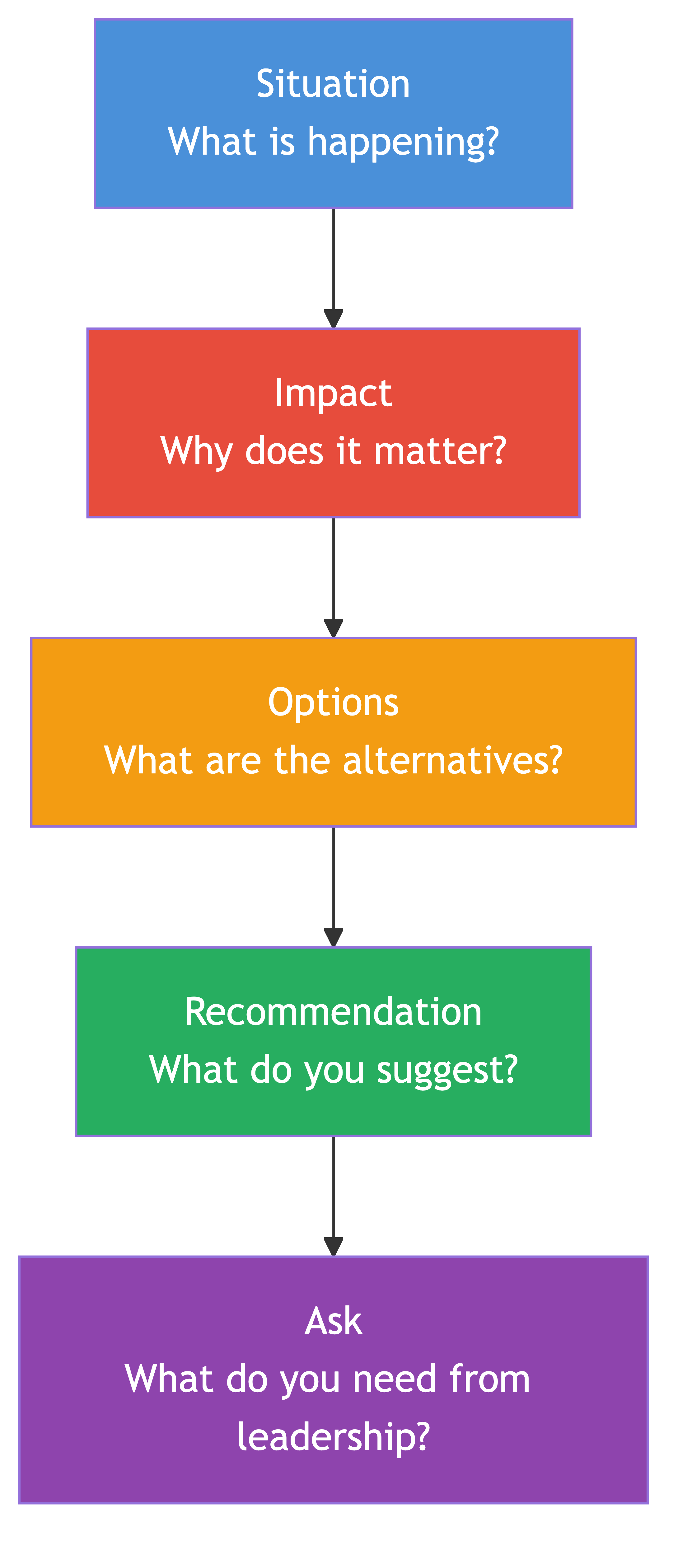
The problem. State it clearly and concisely. What is happening, since when, and who is affected.
The impact. Why does this matter? What happens if we do nothing? Quantify it if you can — delayed launch, revenue at risk, team morale declining, customer complaints increasing.
Two or three options. What are the realistic paths forward? Not every possible option — just the ones that are actually viable. Include the tradeoffs for each.
Your recommendation. Which option do you think is best, and why? This is critical. Even if you are not sure. Even if your manager overrides you. The act of making a recommendation shows that you have thought it through and are not just dumping a problem on someone else's desk.
Here is what this looks like in practice:
Bad: "Hey, the search feature is way behind and the team is burned out and I'm not sure we can hit the deadline."
Good: "The search feature is tracking about two weeks behind our original estimate. The main driver is that the ranking algorithm turned out to be more complex than we scoped. Impact-wise, if we slip two weeks, we miss the Q2 launch window and marketing will need to adjust the campaign timeline. I see three options. One, we cut the personalization component and ship a simpler version on time. Two, we keep full scope and push the launch to mid-April. Three, we bring in Sarah from the platform team for two weeks to parallelize the work. I'd recommend option one — it gets us to market on time, and we can add personalization in a fast follow. Want to discuss?"
Notice the difference. The second version respects your manager's time, gives them what they need to make a decision, and positions you as someone who thinks ahead. It also makes the conversation faster — your manager can either agree with your recommendation or push back on specific points, rather than starting from scratch.
6. Asking for Help Without Looking Weak
Here is something that took me a long time to learn: asking for help is not a weakness. It is actually one of the clearest signals of good judgment. The leaders who never ask for help are the ones who end up in the deepest holes, because they waited too long to admit they were stuck.
But how you ask matters. There is a difference between "I have no idea what to do" and "I have tried X and Y, I am stuck on Z, and I think I need your help with this specific thing."
When you need help from your manager, frame it like this:
What you have already tried. This shows you are not being lazy. You have put in the work and you have a reason for escalating.
Where specifically you are stuck. Not a vague "things are hard." A specific blocker. "I cannot get the infrastructure team to prioritize our request" or "I am not sure how to handle the performance conversation with this person" or "I need a decision from product leadership and I don't have the relationship to push for it."
What you need from them. Be explicit. Do you need them to make an introduction? To escalate on your behalf? To give you advice? To make a decision you do not have the authority to make? The more specific you are, the faster they can help.
Managers actually worry more about leads who never ask for help than those who do. If you are running a team and you never need anything from your boss, one of two things is true: either you are superhuman, or you are hiding problems. Most managers assume the latter.
7. Building Trust Over Time
Trust is not built in a single moment. It accumulates through hundreds of small interactions over weeks and months. Here are the behaviors that build it:
Deliver what you promise. If you say the feature will be done by Thursday, it needs to be done by Thursday. If you realize on Tuesday that Thursday is not going to happen, say so on Tuesday. The pattern of promise-deliver or promise-update-renegotiate builds trust. The pattern of promise-miss-explain erodes it. Be conservative in your commitments and aggressive in your delivery.
Own your mistakes. When something goes wrong on your team, you own it. Not "well, the junior developer missed the edge case" — that is throwing your team under the bus. Instead: "We missed an edge case in testing. I should have caught it in code review, and I've added it to our checklist so it doesn't happen again." Your manager knows you did not personally write every line of code. Taking ownership anyway shows leadership.
Give credit to your team. When things go well, it was the team. When things go poorly, it was you. This is the oldest leadership principle in the book and it still works because so few people actually do it consistently. When your manager praises a launch, respond with "The team really crushed it — especially Alex on the backend work." Your manager will think more of you, not less.
Be transparent about what you do not know. "I'm not sure, let me find out" is always better than guessing or bluffing. Your manager will trust your confident statements more when they know you are honest about your uncertain ones.
Follow through on small things. If you said you would send that document, send it. If you said you would follow up with someone, follow up. Small broken promises add up faster than you think. The lead who always does what they said they would do is the lead who gets trusted with the big things.
8. Managing Different Manager Styles
Not all managers operate the same way, and part of managing up is adapting your approach to the person you are working with. Here are the most common styles and how to work with each:
The hands-off manager. They give you a lot of rope. This feels great until you realize that "hands-off" can also mean "I have no idea what's happening on your team." With this type, you need to over-communicate. Send those weekly updates religiously. Flag risks proactively. Do not mistake their silence for satisfaction — check in explicitly. "Are you getting what you need from me? Is there anything you wish you had more visibility into?" A hands-off manager who trusts you is a gift. A hands-off manager who is just disengaged is a risk. Make sure you know which one you have.
The micromanager. They want to know everything. Every decision, every detail, every change. Your instinct will be to push back, but resist that urge initially. Micromanagement usually comes from anxiety, and anxiety comes from a lack of trust. The fastest way to earn a longer leash is to flood them with information before they ask for it. Over-communicate. Share your reasoning for decisions proactively. Give them so much visibility that they start to feel comfortable stepping back. This takes time — usually a few months. But it works far more reliably than complaining about being micromanaged.
The data-driven manager. They want metrics, dashboards, and numbers. Learn to speak their language. When you present options, include data. "Option A costs us two sprint points but reduces page load time by 300ms, which based on our conversion data should recover about $40K per month." If you do not have data, say so, and propose how to get it. These managers respect rigor and distrust gut feelings, so anchor your communication in measurable outcomes.
The relationship-driven manager. They care about how people feel, how the team is doing, whether there is conflict. These managers want to hear about team dynamics, morale, and individual growth. Lead your updates with the people stuff. "The team is in a good place — morale is high after the launch. I'm keeping an eye on burnout for two people who put in extra hours. I have a plan to give them lighter work next sprint." This manager will trust you more if they feel you genuinely care about your team as humans, not just as output machines.
The key insight: do not try to change your manager's style. Adapt to it. Meet them where they are. You can influence their approach over time through consistent trust-building, but the starting point is always adaptation, not resistance.
9. Real-World Scenarios
Scenario 1: A Project Is Slipping
Bad managing up: You know the project is behind, but you keep telling your manager "we're working on it" in standups. You hope to catch up through overtime. Two days before the deadline, you finally admit it is going to be late. Your manager is blindsided, has to scramble to reset expectations with stakeholders, and loses trust in your estimates going forward.
Good managing up: At the two-week mark, you notice velocity is lower than planned. You message your manager: "Heads up — we're tracking about 20% behind on the search project. Main issue is API complexity we didn't fully scope. I'm looking at options to either reduce scope or extend the timeline. I'll have a recommendation by Thursday's one-on-one." Thursday comes, you present two options with tradeoffs, recommend one, and your manager agrees. Stakeholders are informed with three weeks of buffer. Nobody panics.
Why it matters: In the first version, you lost trust and created a fire drill. In the second, you demonstrated judgment, gave your manager time to act, and reinforced the idea that you have things under control — even when things are not perfect.
Scenario 2: A Team Member Is Underperforming
Bad managing up: You are struggling with a developer who is not meeting expectations. You do not mention it to your manager because you want to handle it yourself. Three months later, the situation has not improved, the rest of the team is frustrated, and your manager finds out from a skip-level. Now they are wondering what else you have been sitting on.
Good managing up: After two weeks of observing the performance issue and having an initial conversation with the developer, you bring it up with your manager. "I want to give you visibility into something. Pat has been missing commitments for about two weeks. I've had a direct conversation, and I think it might be related to the project complexity. My plan is to pair them with a senior engineer for the next sprint and reassess. If it doesn't improve, I'll want your help thinking through a more formal performance conversation. Just wanted you aware in case it comes up." Your manager now trusts your judgment, is not surprised, and can offer support if needed.
Why it matters: People problems are the ones most likely to escalate beyond your control. Your manager needs early visibility, not because they want to take over, but because they need to be prepared if the situation reaches HR, affects team output, or surfaces in a skip-level.
Scenario 3: You Disagree with a Decision from Above
Bad managing up: Your manager tells you the team needs to switch frameworks mid-project because of a VP-level initiative. You think it is a terrible idea. You nod in the meeting, then complain to your team about "leadership making bad decisions." The team's morale drops, and when the migration hits problems, nobody is motivated to solve them. Your manager eventually hears that you were undermining the decision.
Good managing up: Same situation. You think the framework switch is wrong. In the meeting, you say: "I want to make sure we think this through. Switching mid-project will cost us about three weeks and introduce risk around these two integration points. Can I put together a brief analysis of the tradeoffs so we can make this call with full visibility?" If the decision still goes forward after your analysis, you commit fully. You tell your team: "We looked at this carefully. There are good reasons for the switch, and I want us to execute it well. Here is the plan." Disagree and commit. Never disagree and sabotage.
Why it matters: Your manager needs to know you will push back thoughtfully when you disagree, and then execute wholeheartedly once a decision is made. Leaders who only do the first are difficult. Leaders who only do the second are not adding strategic value. The combination is what makes someone trusted.
10. Common Mistakes
Hiding problems until they explode. This is the number one managing-up failure mode. It comes from a good place — you want to fix things before bothering your boss. But the risk is enormous. Surface early, surface often.
Only sharing good news. If your updates are always positive, your manager stops trusting them. Every team has challenges. If you are not sharing any, you are either not seeing them or not being honest. Both are bad.
Not asking for feedback. "How am I doing? Is there anything you wish I were doing differently?" Ask this explicitly, at least once a quarter. Most managers will not volunteer this feedback unprompted. And when they do give it, receive it without defensiveness. Thank them, reflect on it, and follow up on what you changed.
Going around your manager. If you disagree with your manager and you take it to their boss without telling them, you have just broken the relationship. There are very rare exceptions — ethical violations, harassment, things that genuinely require escalation. But for normal professional disagreements, resolve it directly or accept the decision. Going around someone is a trust-destroying move that is almost never worth it.
Being invisible. Some leads think the best thing they can do is handle everything quietly and not bother anyone. They see managing up as unnecessary overhead. Then they are confused when someone with more visibility gets the promotion or the high-profile project. Your work does not speak for itself. You have to give it a voice, appropriately and consistently.
Treating one-on-ones as status meetings. If you spend your entire one-on-one reading through Jira tickets, you are wasting the most valuable time you have with your manager. Use written updates for status. Use face time for the things that require nuance, trust, and back-and-forth.
Not understanding your manager's priorities. If you do not know what your manager is being evaluated on, what their biggest worries are, and what they are trying to accomplish this quarter, you are flying blind. Ask. "What are your biggest priorities right now? How can my team best support those?" The answers will reshape how you communicate and what you emphasize.
Business Value
Managing up is not a soft skill that is nice to have. It has direct, measurable impact on the business. Here is how:
Revenue impact through faster decision-making. When you frame problems well and bring recommendations, decisions happen faster. A team that surfaces a scope risk three weeks early can adjust and hit a launch window. A team that surfaces it three days early misses the window entirely. For a product with $500K in projected first-quarter revenue, that three-week difference is not a communication nicety — it is a six-figure business outcome.
Efficiency gains from reduced management overhead. A manager who trusts their leads spends less time monitoring and more time on strategic work — removing cross-team blockers, securing resources, shaping roadmaps. Research from Google's Project Oxygen found that the highest-performing teams had managers who could delegate effectively, which is only possible when leads manage up well. Every hour your manager does not spend checking on your team is an hour they can spend unblocking the whole organization.
Cost of poor managing up. When trust breaks down between a lead and their manager, the consequences are expensive. Increased meeting overhead as the manager inserts themselves into more decisions. Delayed escalations that turn small problems into big ones. Duplicated work when the manager starts doing the lead's job because they do not trust the lead to do it. In severe cases, it leads to the lead being moved off the team or leaving the company — and replacing a team lead costs roughly six to nine months of salary in recruiting, onboarding, and lost productivity.
Measurable outcomes to track. You can actually measure whether managing up is working. Track how often your manager is surprised by something on your team — the number should trend toward zero. Track how often decisions that require your manager's input are resolved within one business day versus dragging across multiple meetings. Track whether your manager is attending fewer of your team's tactical meetings over time, which indicates growing trust. Track your own autonomy — are you making more decisions independently quarter over quarter?
Retention and team stability. Leads who manage up well create a buffer that protects their teams from organizational chaos. When priorities shift at the leadership level, a well-connected lead hears about it early and can prepare their team. When layoffs or reorgs happen, a lead who has built trust with leadership is better positioned to advocate for their team. This stability directly reduces attrition, and attrition is one of the most expensive problems in engineering — each departure costs the organization months of productivity and tens of thousands in direct costs.
The bottom line: managing up is not about your career. It is about creating the conditions where your team can do their best work, your manager can do their best work, and the organization moves faster because information flows well and trust is high. Everything else — the autonomy, the recognition, the career growth — follows from that.
Quick Reference
| Situation | Action | Timing |
|---|---|---|
| Project risk identified | Message manager with problem, impact, and options | Same day |
| Weekly progress | Written update in consistent format | Same day each week |
| Team member struggling | Flag to manager with your plan | Within one week of identifying |
| Disagreement with a decision | Voice concerns with data, then commit | In the meeting or immediately after |
| Need help or resources | Frame what you tried, where you are stuck, what you need | As soon as you realize you are stuck |
| Good news or team win | Share it and credit the team | Next update or one-on-one |
| Mistake or failure | Own it, explain what happened, share what you will change | Immediately |
Managing up is not a separate job from leading your team. It is the same job, pointed in a different direction. Get good at it, and you will find that almost everything else about leadership gets easier.
Common Pitfalls
- Hiding problems until they explode. This is the number one managing-up failure. The instinct to fix things before telling your boss comes from a good place, but the risk of being blindsided is enormous. Surface problems early, even without a perfect plan.
- Only sharing good news. If your updates are always positive, your manager stops trusting them. Every team has challenges, and omitting them signals either a lack of awareness or a lack of honesty.
- Going around your manager to their boss without telling them. Except in cases of ethical violations or harassment, skipping your manager destroys the relationship and erodes trust that is extremely difficult to rebuild.
- Treating 1:1s with your manager as status meetings. Spending your entire 1:1 reading through Jira tickets wastes the most valuable time you have with your manager. Use written updates for status and face time for nuance, strategy, and support.
- Not understanding your manager's priorities. If you do not know what your manager is being evaluated on or what their biggest worries are, you are communicating in the dark. Ask directly so you can align your updates and emphasis with what matters to them.
- Being invisible and hoping your work speaks for itself. Some leads handle everything quietly and never surface their contributions. Then they are confused when someone with more visibility gets the promotion or the high-profile project. Appropriate, consistent communication about your team's work is part of the job.
Key Takeaways
- Managing up means making your manager's job easier by being predictable, transparent, and reliable. The reward is autonomy: managers give more freedom to the people they trust.
- The no-surprise rule is non-negotiable. Your manager should never hear bad news about your team for the first time from someone else.
- Establish a deliberate communication cadence: weekly written updates, regular 1:1s for strategic discussion, and real-time escalations for urgent issues.
- When bringing problems to your manager, always include the situation, the impact, two or three options, and your recommendation. This positions you as someone who thinks ahead.
- Asking for help is a sign of good judgment, not weakness. Frame requests by showing what you have tried, where specifically you are stuck, and what you need from them.
- Trust accumulates through hundreds of small interactions: delivering what you promise, owning mistakes, giving credit to your team, and following through on commitments.
- Adapt your communication approach to your manager's style rather than trying to change them. Whether they are hands-off, data-driven, or relationship-focused, meet them where they are.