
Retrospectives & Continuous Improvement
If someone forced you to drop every agile ceremony except one, keep the retro. You can survive without standups — people will find ways to communicate. You can survive without sprint planning — work will get organized somehow. But without retrospectives, your team has no structured mechanism to get better. And a team that isn't getting better is, by definition, falling behind.
Here's the math that makes retros so powerful: if your team improves just 1% every two weeks, that compounds to over 25% improvement in a year. That's not some theoretical ideal — that's what actually happens when a team consistently identifies friction, removes it, and builds on what's working. Compounding improvement is your secret weapon as a leader. It's quiet, it's unglamorous, and it absolutely transforms teams over time.
The catch? Retros only work if they're done well. A bad retro isn't just a waste of time — it actively erodes trust. It teaches people that speaking up doesn't lead to change. That's worse than not having retros at all.
What a Good Retro Looks Like
A good retro has four qualities: safety, honesty, concrete actions, and follow-through.
Safety means people believe they can say what they actually think without getting punished for it. Not just "we won't fire you for speaking up" safe — truly safe. Safe enough to say "I think our sprint planning is broken and we're kidding ourselves about our capacity." Safe enough to say "I'm struggling and I need help." If people are only sharing surface-level observations, your retro isn't safe enough yet.
Honesty flows from safety. When people feel safe, they tell you the real problems. Not the sanitized, politically correct version — the actual thing that's causing friction. "Our deploys take too long" is honest. "Things could be a bit smoother" is diplomatic noise.
Concrete actions mean you leave the retro with specific, assignable things to do. Not "we should communicate better" — that's a wish, not an action. "We'll add a 5-minute sync at 10am each day for the next two weeks to see if it helps coordination on the payments project" — that's an action. It's specific, time-bound, and you can tell whether it happened.
Follow-through is where most teams fail. They generate great action items and then nobody does them. The actions sit in a Confluence page nobody looks at until the next retro, where someone sheepishly says "oh yeah, we didn't get to that." If your retro actions don't get done, people stop proposing them. Then they stop attending the retro with any real engagement. Then the retro dies, even if it's still on the calendar.
A bad retro looks like this: people show up, vent about the same problems they vented about last time, somebody writes it on a sticky note, nothing changes, repeat. That's not a retrospective. That's a complaint session with snacks.
Running the Retro
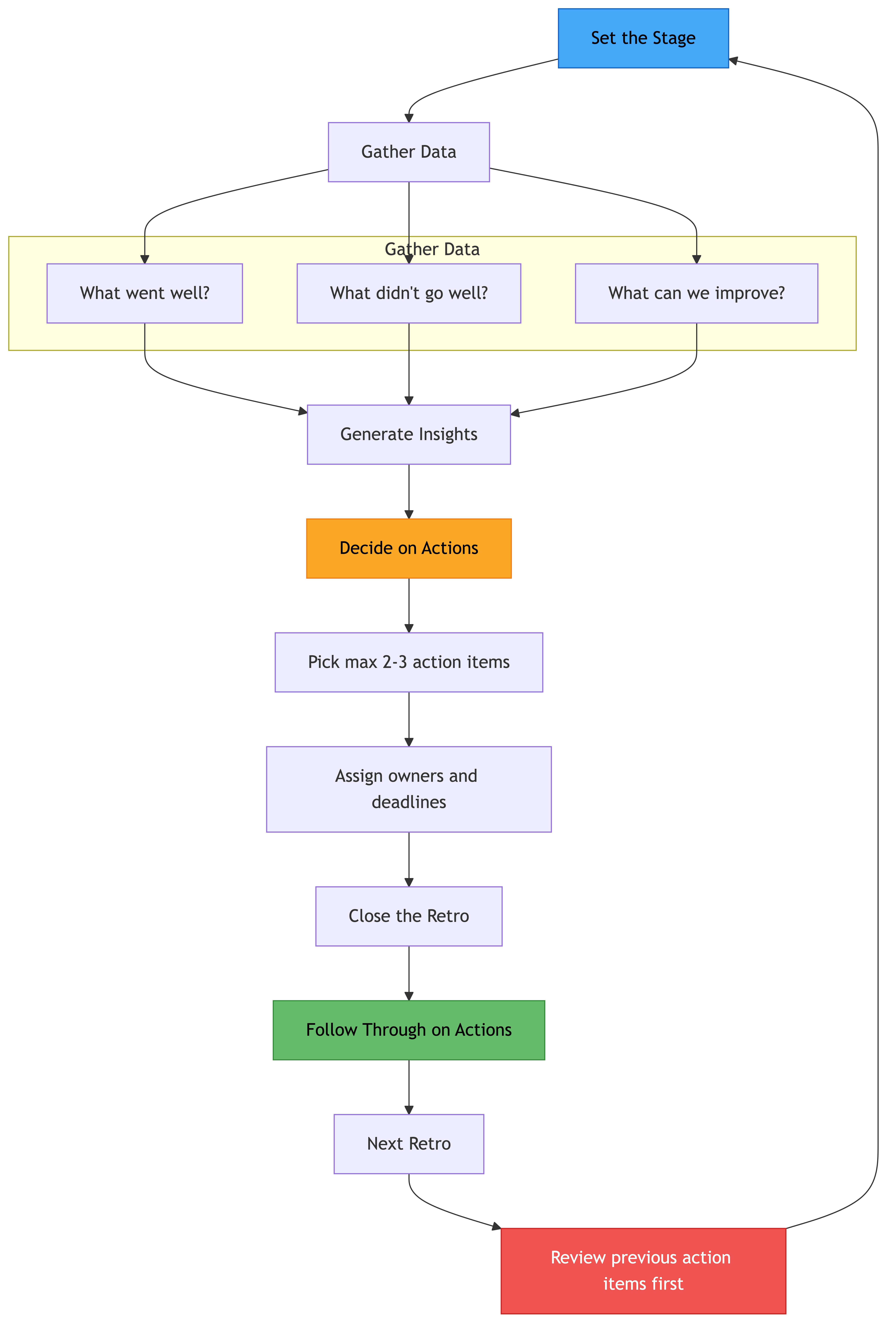
There's a classic structure that works well. You don't have to follow it rigidly, but it's a solid starting point, especially if you're new to facilitation.
Set the stage (5-10 minutes). Start with a safety check. This can be as simple as asking people to rate on a scale of 1-5 how comfortable they feel speaking openly today. If you see a bunch of 2s and 3s, acknowledge it. You might say "I notice some folks aren't feeling fully comfortable today — let's be extra mindful of that." Don't force people to explain their rating. The point is awareness, not interrogation.
You can also use a quick warm-up. "Share one word that describes last sprint" or "What's one thing you're proud of from the last two weeks." This gets people talking and shifts their brain from "I'm in another meeting" to "I'm reflecting on how we work."
Gather data (10-15 minutes). What actually happened? This is about creating a shared picture of reality. People have wildly different experiences of the same sprint. The developer who was heads-down on a feature might have had a great sprint while the person handling support escalations was drowning.
Give people time to write things down individually before sharing. Silent brainstorming prevents the loudest voices from anchoring the conversation. Sticky notes (physical or virtual) work great. Each person writes their observations, then you put them all up and group similar themes.
Generate insights (15-20 minutes). This is the critical step most teams skip. You've gathered what happened — now ask why. "We missed our sprint commitment" is data. "We missed our sprint commitment because we consistently underestimate the complexity of integration work" is an insight. The second one is actionable. The first is just a fact.
Ask "why" a few times. Not in an annoying way, but genuinely. "We had a lot of bugs." Why? "Because we rushed the feature." Why did we rush? "Because the deadline was set before we understood the scope." Now you're getting somewhere useful.
Decide actions (10-15 minutes). Based on your insights, what are you going to do differently? This is where you get specific. Vote on the most impactful items if you have too many. Aim for 2-3 actions maximum — more on why that number matters later. Each action needs an owner and a due date. Write them down where everyone can see them.
Close (5 minutes). End on a positive note. Ask each person to appreciate someone else on the team, or share one thing they're looking forward to. This matters more than you think. Retros can get heavy. Ending with appreciation sends people back to work feeling connected, not drained.
Total time: 60-90 minutes. Yes, that feels like a lot. But consider what you're getting: a structured opportunity for your team to collectively get smarter about how they work. There's no other meeting on your calendar with that kind of ROI. If you're running retros in 20 minutes, you're probably skipping the insight phase, which means you're treating symptoms instead of causes.
Retro Formats That Work
Using the same format every time is a fast track to stale retros. Rotate formats every few sprints to keep the conversation fresh and to surface different kinds of feedback.
Start / Stop / Continue
Three columns. What should we start doing? What should we stop doing? What's working that we should keep doing? This is the simplest format and it's great for teams new to retros. The "continue" column is important — it forces people to acknowledge what's going well, not just what's broken.
Best for: New teams, teams that need a straightforward structure, quick retros.
What Went Well / What Didn't Go Well / What Can We Improve
Similar to Start/Stop/Continue but slightly different framing. "What didn't go well" is more reflective than "what should we stop" — it invites analysis rather than just complaints. The improvement column is forward-looking.
Best for: General-purpose retros, teams that are comfortable with honest reflection.
4Ls — Liked, Learned, Lacked, Longed For
This one's underrated. "Liked" captures positives. "Learned" highlights growth and new knowledge, which is motivating. "Lacked" identifies gaps without blame — you're not saying someone messed up, you're saying something was missing. "Longed for" lets people express what they wish they had, which often surfaces deeper structural issues.
Best for: Teams that tend toward blame, teams going through change, after particularly challenging sprints.
Mad / Sad / Glad
Explicitly emotional framing. What made you mad? What made you sad? What made you glad? This works surprisingly well because it gives people permission to bring emotions into the conversation. Engineering culture often pretends emotions don't exist at work, but they drive everything. A developer who's mad about constant context-switching will eventually burn out or leave, whether you talk about the emotion or not.
Best for: Teams where people are checked out or holding back, after a particularly tough period, when you sense unspoken frustration.
Sailboat / Speedboat
Visual metaphor. The boat is your team. Wind in the sails is what's pushing you forward. Anchors are what's holding you back. Rocks ahead are risks you see coming. The island is your goal. People engage differently with visual metaphors than with text prompts — it can unlock perspectives that other formats miss.
Best for: Teams that are bored of traditional formats, creative teams, planning-heavy retros where you want to look forward as well as back.
Timeline
Plot the sprint on a timeline. Mark key events, decisions, and turning points. Then discuss: where did things go well? Where did they go sideways? When did we make a decision that seemed right at the time but turned out to be wrong? This format is excellent for sprints where a lot happened and the team needs to build a shared understanding of the sequence of events.
Best for: After complex sprints, when there's disagreement about what happened, post-incident reflection.
The key insight with formats is that different frames surface different feedback. When you ask "what should we stop doing," you get operational answers. When you ask "what made you sad," you get emotional answers. Both are valuable. Rotating formats ensures you're not only hearing one dimension of your team's experience.
Getting Honest Feedback
Let's be direct: if people aren't being honest in your retros, it's almost certainly a safety problem, not a personality problem.
Psychological safety is the prerequisite for everything else. If someone shared a concern six months ago and nothing changed — or worse, they got a reputation as a "complainer" — they learned their lesson. They won't share again. And everyone who watched it happen learned the same lesson.
How to build safety:
You go first. Share your own mistakes before asking others to share theirs. "I think I dropped the ball on the requirements for the search feature — I should have pushed back on the ambiguity before we started building." When the leader is vulnerable, it signals that vulnerability is okay. This isn't a technique. You actually have to mean it. People can smell performative vulnerability instantly.
Offer anonymous input. Tools like Retrium, EasyRetro, or even a simple Google Form let people submit items anonymously. Some people will never feel safe enough to say certain things out loud, no matter how good your team culture is. That's fine. The goal is to surface the feedback, not to force public confession. Over time, as trust builds, people will say more things directly. But anonymous input is a permanent option, not training wheels.
Watch for silence. If someone is consistently quiet during retros, don't assume they have nothing to say. They might not feel safe. They might be processing differently and need more time. They might be new and not want to rock the boat. Don't put them on the spot — "Sarah, you've been quiet, what do you think?" is a trap, not an invitation. Instead, make sure your process includes individual writing time before group discussion, and check in with quiet folks privately afterwards. "Hey, I noticed you didn't say much in the retro — I just want to make sure you know your perspective matters and I'm here if you want to share anything one-on-one."
React well to hard feedback. The first time someone says something genuinely uncomfortable — "I think our architecture decisions are being made by one person and the rest of us just go along with it" — your reaction sets the tone for every retro after that. If you get defensive, game over. If you say "that's a really important observation, let's dig into that," you've just made it safe to bring the hard stuff.
Don't let anyone get punished for retro feedback. This includes subtle punishment. If someone raises a concern about a process and then gets assigned to "fix it" as a punishment disguised as ownership, people notice. If someone criticizes a decision and then gets left out of the next decision, people notice. You have to actively protect people who speak up.
Action Items That Actually Happen
This is where most retros fail. Not in the discussion — in the follow-through.
Keep it to 2-3 action items per retro. This feels counterintuitive when you've identified ten problems. But here's the reality: your team has a limited capacity for change on top of their regular work. Three actions that actually get done beat ten actions that sit in a backlog. If you consistently complete your retro actions, you'll address 6-8 improvements per month. That's 70-90 per year. That's transformational.
Every action needs an owner. "The team will improve our testing process" is not owned by anyone, which means it's owned by no one. "Marcus will draft a proposal for our testing approach and share it by Thursday" is owned. The owner doesn't have to do all the work — they just need to make sure it moves forward.
Every action needs a due date. "Soon" is not a date. "Next sprint" is barely a date. "By March 28th" is a date. Due dates create accountability without requiring you to nag.
Review last retro's actions at the start of every retro. This is non-negotiable. Spend the first 5-10 minutes going through each action item from last time. Done? Great, celebrate it. Not done? Why not? Was it deprioritized, was it harder than expected, did the owner get pulled into something else? No judgment — just honest accounting. This review does two things: it creates accountability (people know their items will be checked), and it surfaces patterns (if actions consistently don't get done, that itself is a retro topic).
Track your completion rate. Over time, you want to see 70%+ of retro actions completed. Below that, and you have a credibility problem — the team will stop believing that retros lead to change. If your completion rate is low, reduce the number of actions until you can reliably complete them, then gradually increase.
Put actions where work lives. If your team tracks work in Jira, retro actions go in Jira. If they use Linear, they go in Linear. Don't create a separate system for retro actions — they'll get lost. Treat improvement work like real work, because it is.
When Retros Go Stale
You'll know it when you see it. The energy drops. People show up but they're going through the motions. Someone says "I don't really have anything" and three other people nod. The same complaints from three months ago show up on the board again. The retro ends in 25 minutes and everyone seems relieved it's over.
Stale retros are a symptom, not a root cause. Something underneath is broken. Here's what to look for and what to do about it.
Same complaints every time. If "too many meetings" has been on the retro board for four sprints in a row, your team has learned that raising this issue doesn't lead to change. Either fix the underlying problem (reduce meetings) or have an honest conversation about why it can't be fixed right now. The worst thing you can do is keep writing it down and keep not addressing it.
Low energy. This might mean people are burned out from a tough stretch, or it might mean the retro format has gone stale. Try something different. Run a retro focused entirely on wins and positives. Do a futurespective — "imagine it's six months from now and we're the best team in the company, what changed?" Bring in an activity or game element. Sometimes the team just needs novelty.
"Nothing to discuss." This almost never means everything is perfect. It usually means one of three things: people don't feel safe, they're too tired to engage, or the retro has become so routine that they've stopped actually reflecting before showing up. Try sending a pre-retro prompt 24 hours in advance: "Take 10 minutes to think about what went well and what was frustrating this sprint."
How to refresh:
-
New format. If you've been doing Start/Stop/Continue for six months straight, of course it's stale. Switch to 4Ls or the Sailboat. The new frame will surface new thoughts.
-
External facilitator. Have someone from another team or a scrum master run the retro. When you facilitate your own retro, you're simultaneously a participant and an authority figure. Some feedback won't surface with you in control. An external facilitator changes the dynamic.
-
Themed retros. Instead of a general "how did the sprint go," focus on a specific topic. "Today we're going to retro specifically on our code review process." Narrow focus drives deeper conversation.
-
Change the environment. If you always do retros in the same conference room or the same Zoom call, change it. Go to a coffee shop. Use a different tool. Small environmental changes break habitual thinking.
-
Skip-level participation. Occasionally invite your manager to the retro — not to observe and judge, but to hear directly from the team and to answer questions about organizational context. This only works if your manager understands their role is to listen and support, not to direct. Brief them beforehand.
Continuous Improvement Beyond Retros
Retros are the most visible part of continuous improvement, but they shouldn't be the only part. If improvement only happens every two weeks for 90 minutes, you're leaving a lot of potential on the table.
The Kaizen mindset. Kaizen is the Japanese philosophy of continuous, incremental improvement. The core idea is simple: everyone on the team, every day, is looking for small ways to make things better. Not grand transformations — small, practical tweaks. Renamed a confusing variable. Added a comment to a tricky piece of code. Updated the onboarding doc with something that confused you. Automated a manual step in the deploy process.
None of these things are impressive on their own. But multiply them by the number of people on your team, by the number of working days in a year, and the cumulative effect is massive.
Encourage experiments. Frame improvements as experiments, not permanent changes. "Let's try pair programming on complex features for the next two sprints and see if it reduces bugs." Experiments are psychologically safer than permanent process changes because there's a built-in exit. If it doesn't work, you stop. If it does, you keep it.
Track your experiments. A simple table works: What we tried, why, what we expected, what actually happened, decision (keep/stop/modify). Over time, this becomes a record of your team's learning. It's also incredibly useful when someone new joins the team and asks "why do we do it this way?"
Create space for improvement work. If every minute of every sprint is allocated to feature work, improvement will never happen. Some teams reserve 10-20% of each sprint for tech debt and process improvement. Others have a dedicated "improvement day" once a month. The specific mechanism matters less than the principle: improvement work needs time allocated to it or it will always lose to the next feature request.
Make improvement visible. Keep a running list of improvements the team has made. Review it quarterly. You'll be amazed at how much has changed. This visibility also helps with morale — when you're in the day-to-day grind, it's hard to see progress. A list of 30 improvements over three months makes the progress concrete.
Celebrating Wins
Teams that only talk about what's broken eventually break themselves.
If your retros are exclusively about problems, complaints, and things that need fixing, you're training your team to see their work through a lens of inadequacy. That's demoralizing. People need to hear that what they're doing is working, that their effort matters, that progress is happening.
Start with wins. Begin every retro by asking "what went well?" and spend real time on it. Not a perfunctory two minutes before diving into problems — genuine recognition of good work. When someone mentions a win, dig into it. "Our deploy went really smoothly." Great — why? What did we do differently? Can we replicate that? Wins contain just as much learning as failures.
Be specific. "Great job everyone" is nice but forgettable. "The way Priya handled that production issue on Wednesday — she stayed calm, communicated clearly in the channel, and had the fix deployed in under 20 minutes — that was excellent incident response" is specific and memorable. Specificity shows you're actually paying attention.
Celebrate improvement, not just outcomes. If your team's deploy process used to take four hours and now takes 45 minutes, that's worth celebrating even if the business metrics haven't moved yet. Process improvement is leading indicator work. The outcomes will follow.
Recognition is free and powerful. You don't need a budget for this. A genuine "thank you" in the retro, a shout-out in the team channel, a mention in your status update to leadership — these things cost nothing and they matter enormously. People remember being recognized. They remember who noticed their work.
Watch out for toxic positivity. Celebrating wins doesn't mean ignoring problems or forcing artificial enthusiasm. If the sprint was genuinely rough, acknowledge that. "This was a hard two weeks. Let's talk about what made it hard and also recognize the things that went right despite the difficulty." Authenticity always beats forced cheerfulness.
Real-World Examples
The team that improved velocity 30% over six months
A backend team of six engineers was consistently missing sprint commitments. They were completing about 60-70% of what they planned each sprint. Morale was low. Stakeholders were frustrated. The team felt like they were always behind.
In their first meaningful retro, they identified a pattern: they were underestimating integration work. Features that looked simple in isolation turned complex when they had to work with other services. The team's action item was concrete — add a "integration complexity" factor to their estimates and start tracking how actual integration time compared to estimated.
Two sprints later, the retro surfaced a new insight: code reviews were a bottleneck. PRs were sitting for 1-2 days waiting for review, which meant work was "in progress" much longer than necessary. Action: the team agreed to a "review before new work" policy — each morning, the first thing you do is review any open PRs before starting new feature work.
A month later, the retro identified that their CI pipeline was slow — 25 minutes per run. Developers were context-switching while waiting for builds. Action: one developer spent a sprint optimizing the pipeline, getting it down to 8 minutes.
None of these changes were revolutionary. Each one was a small, specific improvement. But stacked together over six months, the team went from completing 60-70% of sprint commitments to consistently hitting 90%+. That's roughly a 30% improvement in effective velocity. More importantly, morale transformed. The team felt competent and in control of their process.
The team where retros were theater
A frontend team had retros on the calendar every two weeks, without fail. They used sticky notes. They had a Confluence page where actions were recorded. On paper, they were doing everything right.
In practice, nothing ever changed. The retro would generate 6-8 action items. Nobody was assigned as owner. No due dates were set. The Confluence page was updated but never reviewed. The next retro would start without any mention of the previous one's actions.
Over time, the same issues appeared sprint after sprint. "Unclear requirements" showed up eleven times in six months. "Too much work in progress" appeared eight times. Team members stopped engaging genuinely — they'd put up a sticky note or two, nod during the discussion, and leave. New team members quickly picked up on the unspoken message: this is a ritual we perform, not a process that leads to change.
The team leader eventually noticed the pattern but misdiagnosed it as "the team doesn't care about process." The real problem was that the team had learned, through repeated experience, that retro feedback went nowhere. They cared plenty — they'd just stopped believing the retro was a vehicle for change.
The fix started with brutal honesty. The team leader opened a retro by saying "I looked back at our last six months of retro notes, and I owe you an apology. We've raised the same issues over and over and I haven't made sure they got addressed. That changes today." They picked the single most common complaint — unclear requirements — and spent the entire retro working out a concrete solution with a clear owner and deadline. The next retro started by reviewing whether that action was done (it was). Trust rebuilt slowly, but it rebuilt.
The retro that uncovered a systemic process problem
A platform team kept experiencing a frustrating pattern: features would be "done" according to the development team, but QA would find significant issues, sending work back for rework. This created tension between developers and QA. Developers felt QA was too picky. QA felt developers weren't testing their own work.
During a retro using the Timeline format, the team mapped out the lifecycle of a recent feature that had gone through three rounds of rework. Plotting it on a timeline made something visible that nobody had seen before: the requirements had changed twice after development started, but the acceptance criteria in the ticket were never updated. Developers were building against the original spec. QA was testing against the updated verbal understanding. Both sides were right — they were just working from different sources of truth.
The insight wasn't about developers being careless or QA being pedantic. It was a process gap: there was no mechanism to ensure that requirement changes during development were reflected in the written acceptance criteria. The action item was to implement a simple rule: any requirement change after sprint start gets documented in the ticket as an updated acceptance criteria before development continues. Both the developer and QA on the story have to acknowledge the update.
This single process change, surfaced through a retro, reduced their rework rate by over 50% in the following quarter. It also dramatically improved the relationship between development and QA, because they stopped blaming each other and started seeing the system.
Common Mistakes
No action items. A retro without actions is a discussion group. Interesting, maybe cathartic, but not improvement. Always leave with at least one concrete thing you're going to do differently.
Too many action items. The opposite problem. You identified twelve things to improve and you're going to do all of them. No, you're not. You're going to do zero of them because twelve is overwhelming and nothing will get prioritized. Pick 2-3. Do them well. Pick 2-3 more next time.
No follow-through. This is the number one retro killer. If actions don't get done and nobody notices, the team learns that retros are performative. Always review last retro's actions. Always.
Same format every time. Start/Stop/Continue is great. Start/Stop/Continue for 18 months straight is not great. Rotate formats. Different frames surface different insights.
Manager dominating the conversation. If you're talking more than 20% of the time during a retro, you're talking too much. Your job is to facilitate, not to share your own opinions on everything. Ask questions, summarize what you hear, draw out quieter voices. Save your own observations for the end, or share them sparingly.
Retro as blame session. "Who broke the build?" is not a retro question. "What about our process made it possible for a breaking change to reach production?" is a retro question. The first one finds a person to punish. The second one finds a system to improve. If your retros are drifting toward finger-pointing, intervene immediately. Reframe toward the process, the system, the environment — not individuals.
Skipping retros when things are busy. "We don't have time for a retro this sprint, we're too busy." This is exactly backwards. If you're so busy you can't take 90 minutes to figure out how to work more effectively, you're going to stay that busy forever. The busier you are, the more you need the retro.
Not adapting to the team's needs. A team that just went through a major incident needs a different retro than a team that had a smooth sprint. A team with new members needs a different retro than a team that's been together for a year. Read the room. Adjust the format, the tone, and the focus to what your team needs right now.
Business Value
If someone asks you why you're "spending time on process instead of shipping features," here's your answer.
Compounding efficiency gains. Every retro action that removes friction, automates a manual step, or improves a handoff makes your team permanently faster. A team that spends 90 minutes every two weeks on improvement and removes even one 30-minute-per-week friction point has paid for the retro in two sprints and generates positive returns forever after. Over a year, these small gains compound into dramatic differences in throughput.
Team morale. Engineers who feel heard, who see their feedback lead to real changes, and who feel ownership over their process are more engaged and more productive. Engagement isn't a fuzzy concept — Gallup data consistently shows that engaged teams are 17-21% more productive. A well-run retro is one of the highest-leverage tools you have for engagement.
Delivery predictability. Teams that continuously improve their estimation, their process, and their self-awareness become more predictable over time. They learn their own capacity. They identify risks earlier. They communicate blockers faster. Predictability is enormously valuable to the business — it means product managers can make reliable commitments, sales can set accurate expectations, and leadership can plan with confidence.
Retention. Good engineers want to work on teams that get better. They want to feel like their concerns are heard and addressed. They want to see problems get fixed, not just discussed. A team with strong retrospective practices and genuine continuous improvement is a team people want to stay on. Given the cost of replacing an engineer — typically 6-9 months of salary when you factor in recruiting, onboarding, and ramp-up time — retention alone can justify every minute you spend on retros.
Organizational learning. When one team discovers a better way to do code reviews, or a better way to handle requirement changes, that knowledge can spread. Retro insights shared across teams raise the performance of the entire engineering organization. One team's improvement becomes everyone's improvement. That kind of learning doesn't happen without a structured reflection practice.
The teams that consistently ship well, that stakeholders love working with, that engineers want to join — they all have one thing in common. They reflect honestly on how they work, they make small improvements constantly, and they follow through. That's what retros give you. Not a ceremony. A compounding advantage.
Common Pitfalls
- Generating action items without follow-through. This is the number one retro killer. If actions do not get done and nobody notices, the team learns that retros are performative. Always review last retro's actions at the start of the next one.
- Creating too many action items per retro. Identifying twelve things to improve and committing to all of them guarantees none will get done. Limit to 2-3 well-defined actions and execute them reliably. Consistency beats ambition.
- Using the same format for every retro until it goes stale. Running Start/Stop/Continue for eighteen months straight produces diminishing engagement. Rotate formats to surface different kinds of feedback and keep reflection fresh.
- Allowing the manager to dominate the conversation. If you are talking more than 20% of the time during a retro, you are talking too much. Your job is to facilitate, ask questions, and draw out quieter voices, not share your opinions on everything.
- Letting retros become blame sessions. "Who broke the build?" is not a retro question. "What about our process made it possible for a breaking change to reach production?" is. If retros drift toward finger-pointing, intervene immediately and reframe toward systems.
- Skipping retros when things are busy. This is exactly backwards. If you are so busy you cannot take 90 minutes to figure out how to work more effectively, you are guaranteed to stay that busy forever.
Key Takeaways
- If you could keep only one agile ceremony, keep the retrospective. It is how the team gets better, and a team that improves just 1% every two weeks compounds to over 25% improvement in a year.
- A good retro has four qualities: safety (people say what they really think), honesty (real problems surface), concrete actions (specific, owned, time-bound), and follow-through (actions actually get completed).
- Use the structured flow: set the stage with a safety check, gather data through silent brainstorming, generate insights by asking "why," decide on 2-3 actions with owners and deadlines, and close with appreciation.
- Rotate formats regularly. Start/Stop/Continue, 4Ls, Mad/Sad/Glad, Sailboat, and Timeline each surface different dimensions of the team's experience.
- Psychological safety is the prerequisite for honest retros. Build it by going first with your own vulnerabilities, offering anonymous input options, reacting well to hard feedback, and never punishing people for speaking up.
- Track your action item completion rate. Below 70% means the team is losing faith in the process. Reduce the number of actions until you can complete them reliably, then gradually increase.
- Continuous improvement extends beyond retros. Adopt a Kaizen mindset where everyone looks for small daily improvements, frame changes as time-boxed experiments, allocate explicit sprint time for improvement work, and make progress visible through a running list of changes made.