
Stakeholder Management
Here is a truth that nobody tells new team leaders: your ability to write good code got you this role, but your ability to manage the people around your team is what will determine whether you succeed in it.
Stakeholder management sounds like something from an MBA textbook. It sounds like it involves PowerPoint decks and executive steering committees. At your level, it does not. At your level, stakeholder management is about making sure the people who depend on your team's work — and the people your team depends on — are aligned, informed, and not surprised. That is it. If you can do those three things consistently, you are already better at this than most team leaders.
1. Who Are Your Stakeholders
Let's start by scoping this correctly, because new team leaders often get this wrong in one of two ways. Either they think stakeholders only means "my manager" or they think they need to manage relationships with the VP of Engineering. Neither is right.
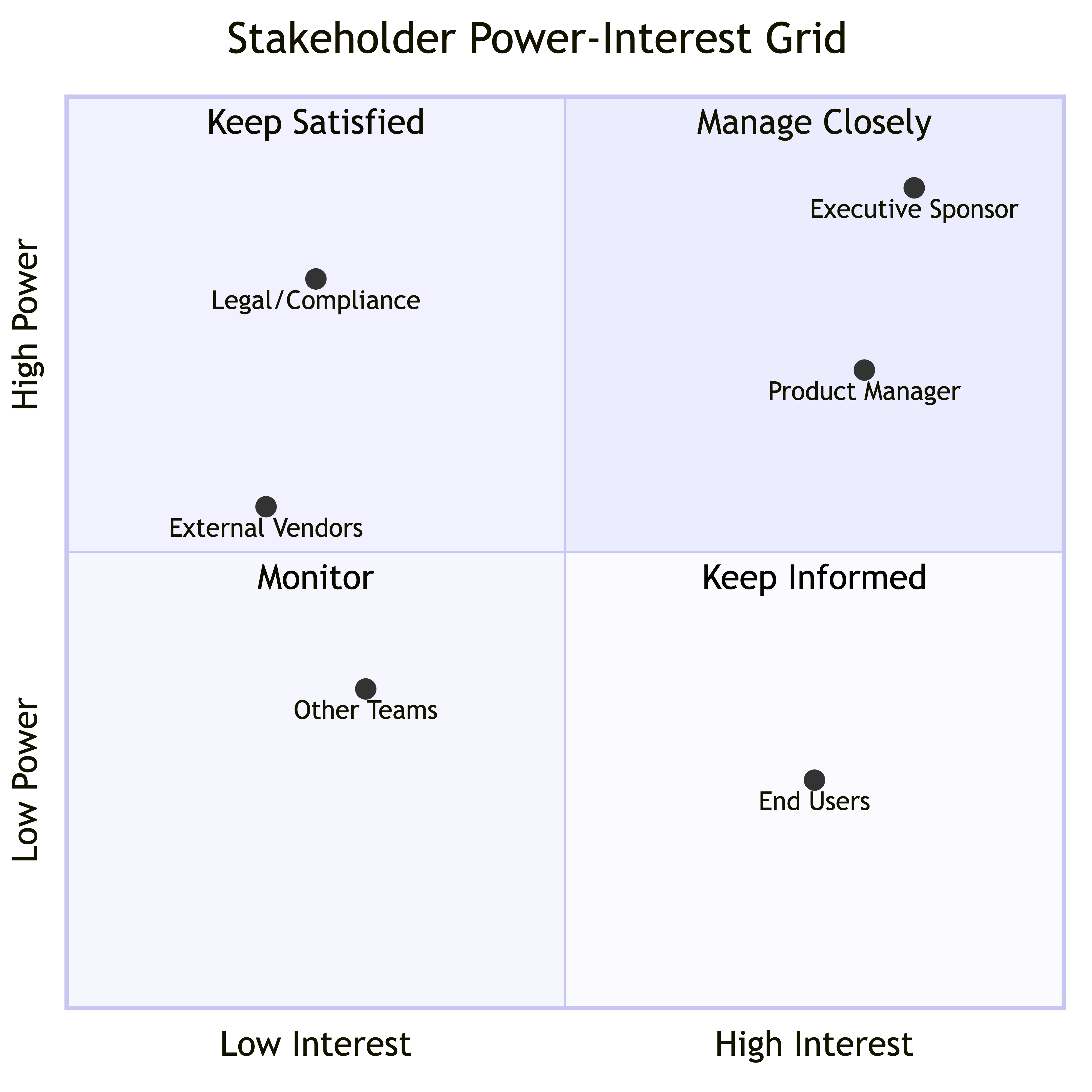
At the team leader level, your stakeholders are the people who directly influence or are directly influenced by your team's work. Here is the realistic list:
Your Product Manager. This is your most important stakeholder. They define what the team builds and when. You will work with this person more closely than anyone else outside your team.
Your Engineering Manager. They care about your team's health, your growth as a leader, and whether delivery is on track. They are also the person who removes organizational blockers for you.
Adjacent team leads. The team lead whose team consumes your API. The team lead whose service your feature depends on. These peer relationships are critical and often neglected.
QA or test engineers. Whether they are embedded in your team or a separate function, they need to understand what you are building, how it should behave, and when it is ready for testing.
Designers. They have opinions about how things should look and work, and those opinions are informed by research you probably have not seen. Ignore them at your peril.
Sometimes customers or customer-facing teams. If your team builds something that support engineers interact with daily, or if you occasionally join customer calls, those people are stakeholders too.
Not the CEO. Not the CTO. Not the VP of Engineering. You do not need to manage those relationships right now. Your EM handles that layer. If you find yourself constantly in rooms with senior executives, something has gone wrong with the organizational structure, or you are being pulled into things that are not your responsibility yet.
Keep your stakeholder map small and focused. You are not running a political campaign. You are trying to make sure the five to eight people who matter most are on the same page as you.
2. Why It Matters
Let me paint two pictures for you.
Picture one: misaligned stakeholders. Your PM thinks the team is building feature A with full admin controls. Your designer thinks the admin controls were cut from scope two weeks ago. QA has not been looped in at all and finds out about the feature three days before release. The adjacent team that needs your API changes has been waiting for a spec you forgot to share. Your EM gets blindsided in a leadership meeting when someone asks about a timeline your team cannot hit.
The result: rework, scope creep, blocked work, a frustrated team, and you looking like you do not have things under control. Because you do not.
Picture two: aligned stakeholders. Your PM and you agreed on scope last Tuesday. The designer reviewed the technical constraints and adjusted the mocks accordingly. QA has been writing test plans alongside development. The adjacent team has a draft API spec and knows when to expect the final version. Your EM knows exactly where things stand and can speak to it confidently.
The result: smooth delivery. Fewer surprises. A team that can focus on building instead of firefighting. And you looking like someone who has their act together.
The difference between these two pictures is not talent or luck. It is communication. It is whether you took the time to make sure everyone who needs to know something actually knows it.
3. Understanding What Each Stakeholder Cares About
Here is the most important insight in this entire guide: different stakeholders care about different things, and if you communicate with all of them in the same way, you will fail with most of them.
This is not manipulation. It is empathy. You are learning to speak each person's language so they can actually hear what you are saying.
What Your PM Cares About
Features and deadlines. Market timing. User impact. Whether the thing you are building will actually solve the problem it is supposed to solve. They live in a world of roadmaps, customer requests, and business metrics.
When you talk to your PM, talk about scope, timelines, trade-offs, and user outcomes. Do not lead with technical details unless they directly affect the plan. "The database migration will take an extra week" is useful. "We are refactoring the repository pattern to use a mediator instead of direct injection" is not — unless it changes the timeline.
What Your EM Cares About
Team health, delivery predictability, your growth as a leader, and whether there are any risks they need to know about. They are accountable for your team's output and your team's people, often to leaders above them.
When you talk to your EM, talk about how the team is doing, where the risks are, what you need help with, and where you are growing or struggling. They want to hear "the team is stretched thin and I am worried about burnout" just as much as they want to hear "we are on track for the release."
What Your Designer Cares About
User experience consistency, design system adherence, whether the implementation matches the intent of the design, and whether their research and thinking were respected in the final product.
When you talk to designers, ask about the "why" behind their decisions. Show them working implementations early so they can flag issues before it is expensive to fix them. Nothing frustrates a designer more than seeing their carefully considered design butchered in implementation and only finding out at the end.
What QA Cares About
Testability. Clear acceptance criteria. Enough time to actually test properly instead of being crammed into the last two days of a sprint. Knowing what changed and what the edge cases are.
When you talk to QA, give them context early. Share technical decisions that affect testing. If you took a shortcut that creates an edge case, tell them. They will find it anyway — it is better if they find it because you told them where to look rather than discovering it in production.
What Adjacent Team Leads Care About
Whether your team's work will break their team's plans. API contracts. Shared timelines. Dependencies that could block their delivery.
When you talk to peer team leads, be specific and proactive. "We are changing the user endpoint response format in sprint 14, here is the new schema" is infinitely better than them discovering the breaking change when their integration tests start failing.
4. Setting Expectations
There is one rule that will save you more grief than any other in stakeholder management:
Never guess. Never speculate. Never commit to something you have not thought through.
When someone asks "can you have this done by Friday?" and you do not know the answer, the correct response is "I need to check with my team and I will get back to you by end of day." That is it. That is the whole trick.
New team leaders feel enormous pressure to have answers immediately. They think that saying "I don't know" makes them look incompetent. The opposite is true. Saying "yes, definitely" and then missing the deadline makes you look incompetent. Saying "let me find out" makes you look thoughtful.
Under-Promise and Over-Deliver
This is old advice and it is old because it works. If you think something will take two weeks, say two and a half. Not because you are padding — because you are accounting for the reality that things go wrong. When you deliver in two weeks, people are pleasantly surprised. When you deliver in two and a half weeks, you met the expectation. You cannot lose.
The inverse — over-promising and under-delivering — destroys trust faster than almost anything else. One missed deadline that you committed to confidently will undo months of reliable delivery.
Be Honest About Bad News
When things are going wrong, say so early. "We are at risk of missing the deadline because the integration turned out to be more complex than expected" is a useful statement that gives your stakeholders time to react. They can adjust scope, shift resources, update their own stakeholders, or help you find a solution.
"We missed the deadline, sorry" gives them nothing. It makes them look bad to their stakeholders, and it makes them lose trust in you. Bad news does not age well. Deliver it early, deliver it clearly, and deliver it with options.
5. Handling Competing Priorities
This is where stakeholder management gets hard. Because your stakeholders do not coordinate with each other, and their requests will inevitably conflict.
Your PM wants feature A shipped by end of quarter. Your EM wants you to address the tech debt that is causing production incidents. An adjacent team needs your API updated to unblock their own feature work. A designer wants you to fix the three UX inconsistencies they flagged last month. And your team is already at capacity.
Here is what you do not do: say yes to everyone. That is the fastest path to burning out your team and delivering nothing well.
Here is what you actually do:
Make the Conflicts Visible
Most stakeholders do not know their requests conflict with someone else's. When you surface the conflict, you are not complaining — you are giving people the information they need to make good decisions.
"Right now we have three high-priority requests: the PM needs feature A by March, the platform team needs our API changes by mid-February, and we have a growing tech debt problem that caused two incidents last month. I do not think we can do all three well. Can we talk about which one matters most?"
Bring Trade-Offs, Not Problems
Never walk into a conversation with "we can't do this." Walk in with "here are three options and the trade-off for each."
- Option A: We do the feature first, but the API changes slip two weeks and the tech debt stays.
- Option B: We split the team, do the feature and the API in parallel, but both take longer and quality might suffer.
- Option C: We spend one sprint on tech debt first, which actually speeds up the feature work because we stop fighting the broken build pipeline.
Let the stakeholders with the most context make the call. Your job is to give them clear options and honest assessments, not to be the single decision-maker for the entire organization's priorities.
Escalate When Needed
If two stakeholders both insist their thing is the top priority and you cannot resolve it at your level, that is what your EM is for. This is not a failure. This is the system working as designed. Your EM has the organizational context to make cross-team priority calls. Let them do their job.
6. Building Relationships
Everything I have described so far — setting expectations, handling conflicts, communicating changes — is ten times harder if you do not have relationships with your stakeholders. And relationships are built before you need them, not during a crisis.
Invest Before You Need to Withdraw
Think of stakeholder relationships like a bank account. Every positive interaction — being reliable, being honest, helping them out, showing interest in their work — is a deposit. Every time you need something from them — a deadline extension, a priority change, their patience when something goes wrong — is a withdrawal.
If your account balance is zero when you need to make a withdrawal, you are in trouble. You have no goodwill to draw on. Every request becomes a negotiation instead of a conversation.
Have Informal Conversations
You do not need to schedule formal meetings to build relationships. Grab a coffee with your PM and ask how their quarter is going. Sit with the designer and ask about the research behind their latest project. Ping the adjacent team lead and ask how their migration is going.
These conversations do two things. First, they build rapport. People are more willing to work with you when they know you as a person, not just as a name on a Slack message. Second, they give you information. You will learn about upcoming changes, organizational pressures, and potential risks that you would never hear about in a formal meeting.
Be Reliable
This is the simplest and most important relationship-building tool you have. Do what you say you will do. If you say you will send the spec by Thursday, send it by Thursday. If you say you will look into the bug, look into it. If you cannot follow through, say so early and explain why.
Reliability compounds. After six months of consistently doing what you said you would do, people trust you implicitly. That trust is worth more than any amount of charisma or political skill.
Understand Their Pressures
Your PM is not annoying you with deadline questions because they enjoy it. They have their own stakeholders — a head of product, a CEO, customers who were promised a delivery date. When you understand that your PM is also under pressure, you stop seeing their requests as adversarial and start seeing them as part of a shared problem.
Ask your stakeholders what they are dealing with. "What is keeping you up at night?" is a powerful question. Their answers will help you understand their behavior and anticipate their needs.
7. The PM-TL Partnership
This deserves its own section because it is the single most important stakeholder relationship you have, and getting it right is the difference between a functional team and a dysfunctional one.
What the Partnership Should Look Like
The PM-TL partnership is a genuine partnership. Not PM tells you what to build and you build it. Not you tell PM what is technically possible and they deal with it. It is two people with complementary expertise working toward a shared goal.
The PM brings market context, customer research, business strategy, and prioritization judgment. You bring technical expertise, team knowledge, implementation reality, and engineering trade-offs. Neither of you has the full picture alone. Together, you do.
How to Make It Work
Have regular syncs. At minimum, a weekly one-on-one with your PM. Not a status update — a conversation. Talk about what is coming next, what is worrying you, what trade-offs you see, what feedback the team has on the current direction.
Share context both ways. Tell your PM about technical constraints early, before they become surprises. Ask your PM about the business context behind priorities. The more you each understand the other's world, the better decisions you make together.
Disagree openly and respectfully. You will not always agree with your PM's priorities. That is fine and even healthy. What matters is how you handle disagreement. "I think we should invest in reliability this sprint instead of the new feature, and here is why" is a productive conversation. Silently resenting the priority and doing a bad job on the feature is not.
Present a united front. Once you and your PM have made a decision, support it publicly. If the team hears you saying one thing and the PM saying another, they lose confidence in both of you. Hash out disagreements in private. Present aligned decisions to the team.
Respect each other's domain. You do not tell the PM how to prioritize the roadmap. The PM does not tell you how to architect the system. You each share input and context, but you respect that the other person is the expert in their domain.
Warning Signs the Partnership Is Broken
- The PM is making technical decisions without consulting you.
- You are making product decisions without consulting the PM.
- You learn about priority changes from someone other than your PM.
- Your PM learns about technical risks from someone other than you.
- You dread your syncs with each other.
- The team does not know who to go to for product questions vs. technical questions.
If you see these signs, address them directly. Have an honest conversation with your PM about how you can work together better. If that does not work, involve your EM. A broken PM-TL relationship will sink the team faster than almost any technical problem.
8. Saying No Constructively
You cannot say yes to everything. But how you say no determines whether people see you as a partner or an obstacle.
The trick is simple: never say no without offering an alternative. Frame every "no" as a trade-off.
The Trade-Off Framework
Instead of: "No, we can't do that."
Say: "We can do that, but it means the dashboard feature slips by two weeks. Is that trade-off worth it?"
Instead of: "That's not possible in the timeline."
Say: "We could deliver a reduced version — the core flow without the edge cases — by the deadline, and follow up with the full version the next sprint. Would that work?"
Instead of: "We don't have capacity."
Say: "If we pick this up, something else has to come off the plate. Which of these current priorities should we deprioritize?"
Why This Works
When you say "no," you are closing a door. When you present trade-offs, you are opening a conversation. You are giving the other person agency to decide what matters most, while being honest about the constraints. Most stakeholders are reasonable people. When they understand the real cost of their request, they often adjust it themselves.
When to Hold the Line
Sometimes the answer really is no. If someone is asking your team to ship something that will create serious security vulnerabilities, or to work weekends for the third sprint in a row, or to skip testing to hit an arbitrary deadline — you need to hold the line. But even then, explain why. "I am not comfortable shipping without tests because the last time we did that, we had a production incident that took three days to resolve. Here is what I propose instead."
9. Real-World Examples
Theory is nice. Let's look at what this actually looks like in practice.
Scenario 1: The Shifting Deadline
Poor stakeholder management: The PM tells you the feature deadline moved up by two weeks. You panic, tell the team to work harder, and try to meet the deadline. You do not tell QA about the compressed timeline. You do not tell the adjacent team that the API changes they were expecting will be rushed. The feature ships on time but with bugs. QA is furious because they had one day to test. The adjacent team's integration breaks because you changed the API contract without warning. Your EM finds out about all of this from a production incident report.
Good stakeholder management: The PM tells you the deadline moved up. You take a beat. You check with your team on what is realistically possible in the compressed timeline. Then you go back to the PM: "We can hit the new deadline if we cut the export feature and defer it to next sprint. I will let QA know about the compressed timeline so they can adjust their test plan. I also need to give the payments team a heads-up because the API contract is going to be simpler than what we originally discussed." You send three messages and have one short conversation. It takes thirty minutes. It saves two weeks of chaos.
Scenario 2: The Tech Debt Standoff
Poor stakeholder management: Your team has been complaining about the legacy auth service for months. It is slow, buggy, and painful to work with. You keep telling the PM "we need to fix this" but never explain why it matters in terms they care about. The PM keeps saying "not this quarter." You get increasingly frustrated. Your team gets demoralized. Eventually someone quits, citing frustration with code quality.
Good stakeholder management: You sit down with your PM and put numbers on it. "The auth service caused four incidents last quarter, each one took two to four hours to resolve. That is roughly forty engineering hours lost. Every new feature that touches auth takes thirty percent longer than it should because of the workarounds we need. If we spend three weeks refactoring, we recover that velocity for the rest of the year." You quantify the cost of inaction in terms the PM cares about — delivery speed and incident frequency. You get the three weeks approved.
Scenario 3: The Cross-Team Dependency
Poor stakeholder management: Your feature depends on a new endpoint from the platform team. You mentioned this need in a standup three weeks ago and assumed it was being handled. It was not. The platform team lead never saw your standup notes. Now you are two days from your feature freeze and the endpoint does not exist. You escalate in a panic. Everyone is frustrated. The platform team scrambles, ships a half-baked endpoint, and you build on a shaky foundation.
Good stakeholder management: Your feature depends on a new endpoint from the platform team. You message the platform team lead directly, explain what you need, and ask what their timeline looks like. You discover they are swamped and cannot get to it for three weeks. So you work with your PM to adjust the plan: you build everything else first, mock the endpoint for local development, and schedule the integration for when the platform team is ready. No panic. No scrambling. No shaky foundations.
10. Common Mistakes
After watching new team leaders navigate stakeholder management for the first time, these are the patterns that trip people up the most.
Avoiding Stakeholders
Some team leaders, especially those who were introverted ICs, treat stakeholder communication as an interruption to "real work." They hide behind their code editor and hope problems resolve themselves. They do not. Avoidance is the single most damaging behavior in stakeholder management. A five-minute conversation today prevents a five-day crisis next week.
Over-Promising
Saying yes to make someone happy in the moment is a trap. Every over-promise is a future under-delivery. And under-delivery is how you lose trust. It is far better to disappoint someone now with a realistic timeline than to disappoint them later with a missed one.
Not Communicating Changes
Plans change. That is normal. What is not normal — and what will get you in trouble — is changing plans without telling the people who are affected. If scope changed, if timelines shifted, if a technical decision altered the API contract, the people who need to know should hear it from you, not discover it on their own.
Treating Stakeholders as Adversaries
Your PM is not the enemy. QA is not trying to slow you down. The designer is not being difficult for fun. The adjacent team lead is not trying to sabotage your timeline. These are all people trying to do their jobs well, just like you. If you approach every stakeholder interaction as a battle to be won, you will poison every relationship you have.
Most stakeholder conflicts are not personal. They are structural. Two reasonable people can have conflicting priorities because the organization has conflicting priorities. When you see it that way, you stop fighting the person and start solving the problem.
Only Communicating When Things Go Wrong
If the only time stakeholders hear from you is when there is a problem, they learn to dread your messages. Balance your communication. Share good news too. "We shipped the feature a day early" or "the team figured out an elegant solution to the caching problem" keeps the relationship healthy and makes the hard conversations easier when they come.
Filtering Information Through Your Own Bias
You think the tech debt is more important than the feature. So when the PM asks for a status update, you subtly emphasize the risks and downplay the progress. This is not stakeholder management. This is manipulation. Give people honest, complete information and let them make informed decisions. Even if you disagree with the outcome.
Business Value
Stakeholder management is not a soft skill that is nice to have alongside the "real" engineering work. It has direct, measurable impact on the bottom line.
Reduced Rework
Industry data consistently shows that rework accounts for 20 to 40 percent of total project effort in poorly managed teams. The primary cause is misalignment: building the wrong thing, building to the wrong spec, or building without considering downstream effects. Good stakeholder management attacks rework at its source. When everyone is aligned on what you are building and why, you build the right thing the first time.
Faster Delivery
Teams with strong stakeholder alignment deliver faster — not because they work more hours, but because they waste fewer. Less time in surprised-face meetings. Less time re-doing work that was based on outdated assumptions. Less time blocked waiting for dependencies that should have been coordinated weeks ago. When your team can focus on building instead of untangling miscommunication, velocity goes up naturally.
Lower Attrition
Engineers leave teams where they feel their work is wasted. Nothing is more demoralizing than spending two weeks on a feature only to have it killed because a stakeholder who should have been consulted was not. Good stakeholder management means your team builds things that actually ship and actually matter. That is a retention advantage you cannot buy with perks and ping-pong tables.
Better Decision-Making
When you have strong relationships with your stakeholders, information flows freely. Your PM tells you about upcoming strategy changes before they are finalized. Your EM gives you a heads-up about a reorg. The adjacent team lead mentions a deprecation that will affect your service. This information advantage lets you make better decisions for your team, earlier.
Organizational Trust
A team leader who consistently communicates well, manages expectations honestly, and delivers on commitments builds trust not just for themselves but for their entire team. That trust translates into more autonomy, better project assignments, more influence in technical decisions, and a stronger position when you need to advocate for your team's needs. Trust compounds, and it starts with how you manage the people around you.
Stakeholder management is not glamorous. Nobody gets promoted because they are amazing at sending status updates and having coffee chats. But people absolutely get derailed because they are bad at it. Master the basics — know your stakeholders, speak their language, set honest expectations, communicate changes early, and build relationships before you need them. Everything else builds on top of that foundation.
Common Pitfalls
- Avoiding stakeholders entirely. Some team leaders, especially introverted ones, treat stakeholder communication as an interruption to real work. Avoidance is the single most damaging behavior in stakeholder management. A five-minute conversation today prevents a five-day crisis next week.
- Over-promising to make someone happy in the moment. Every over-promise is a future under-delivery, and under-delivery is how you lose trust. It is far better to disappoint someone now with a realistic timeline than to disappoint them later with a missed one.
- Communicating the same way with every stakeholder. Your PM, your EM, your designer, and your adjacent team leads all care about different things. Sending the same update to everyone means nobody gets what they actually need.
- Treating stakeholders as adversaries. Your PM is not the enemy. QA is not trying to slow you down. Most stakeholder conflicts are structural, not personal. When you approach interactions as battles to win, you poison every relationship.
- Only communicating when things go wrong. If stakeholders only hear from you during problems, they learn to dread your messages. Balance communication with good news so the hard conversations are easier when they come.
- Not investing in the PM-TL partnership. This is your single most important stakeholder relationship. When it is broken, with misaligned priorities, lack of trust, or poor communication, the entire team suffers.
Key Takeaways
- Stakeholder management at the team leader level is about keeping the five to eight people who matter most aligned, informed, and not surprised.
- Different stakeholders care about different things. Learn to speak each person's language: PMs care about features and timelines, EMs care about team health and risks, designers care about UX intent, QA cares about testability and timing.
- Never commit to something you have not thought through. "Let me check with my team" is always better than a confident promise you cannot keep.
- When priorities conflict, make the conflicts visible, bring trade-offs instead of problems, and escalate to your EM when you cannot resolve it at your level.
- Build relationships before you need them. Reliability, informal conversations, and understanding their pressures create the goodwill you will draw on during difficult moments.
- The PM-TL partnership is a genuine collaboration between complementary expertise. Regular syncs, shared context, open disagreement, and a united front are what make it work.
- Frame every "no" as a trade-off. Never say no without offering an alternative, and let the stakeholder decide what matters most given the real constraints.