
Transition from Individual Contributor to Team Leader
You got the promotion. Congratulations. Now here's the uncomfortable truth: almost everything that made you successful as an individual contributor will actively work against you as a leader.
This guide is about navigating that transition honestly — what changes, what hurts, what to watch out for, and how to come out the other side as someone your team actually wants to follow.
1. The Mindset Shift
Your job is no longer to write the best code. Your job is to make your team produce the best output.
Read that again. Let it sit. This is the single hardest part of the transition, and most new leaders intellectually understand it but emotionally resist it for months.
As an IC, you were rewarded for the quality of your personal output. You wrote elegant solutions, you debugged the gnarly issues, you shipped features that mattered. That feedback loop — write code, see results, feel good — was tight and satisfying.
As a leader, the feedback loop is completely different. Your output is now measured by what your team ships, how reliably they ship it, and whether they're getting better over time. You might go an entire week without writing a line of production code, and that week could be the most productive week your team has ever had — because you unblocked three people, clarified a confusing requirement, and had a difficult conversation that resolved a two-week standoff between two engineers.
Real-world example: A newly promoted tech lead at a mid-stage startup spent her first month rewriting a junior engineer's PR. It was faster, cleaner, and more elegant than the original. She felt productive. Meanwhile, the junior engineer felt demoralized and stopped raising his hand for complex tasks. Two other engineers had blockers that went unaddressed for days. The team's total output dropped 30% that month — even though her personal output was stellar.
The mindset shift isn't about writing less code. It's about redefining what "productive" means. Productive now means: Did the team ship? Did people grow? Are we moving faster this month than last month?
2. Letting Go
This section is going to be painful if you're good at what you do. That's the point.
Stop Fixing Code Yourself
When you see a bug in a PR, your instinct is to fix it. You know exactly what the problem is. You could resolve it in ten minutes. Instead, you need to write a comment that helps the author find and fix it themselves. That takes longer. It feels slower. It is slower — today. But next month, that engineer won't make the same mistake, and you won't need to review that class of bug ever again.
Resist the Urge to Rewrite PRs
You will see code that works but isn't how you would have written it. You need to ask yourself a hard question: Is this actually wrong, or is it just different?
If it's different, approve it. Seriously. If it's functionally correct, readable, tested, and maintainable, the fact that you would have used a different design pattern is not a reason to request changes. Your taste is not a standard. Your team needs room to develop their own engineering judgment, and that only happens when they make real decisions and see the outcomes.
If it's genuinely wrong — it has a bug, it'll cause a performance problem in production, it violates an actual team standard — then give feedback. But be honest about which category you're in.
Trust Others to Do Work Differently
This is the hardest flavor of letting go. You need to delegate meaningful work — not the scraps, not the boring parts, but the interesting, challenging, resume-building work — to people who will do it differently than you. Maybe worse. Maybe, eventually, better.
A rule of thumb: if someone on your team can do a task at least 70% as well as you, delegate it. The 30% gap closes faster than you think, and you need the time for the work only you can do.
Real-world example: A senior engineer turned lead kept taking on all the system design work because "nobody else thinks about edge cases the way I do." Six months later, he was a bottleneck on every project, his team couldn't design anything independently, and he was working 60-hour weeks. When he finally started delegating design work, the first few designs had gaps. By the third round, his team was producing designs he wouldn't have thought of.
3. New Definition of Success
Your personal code output will drop. That's expected and correct.
Let's be specific about what this looks like:
| Metric | As IC | As Leader |
|---|---|---|
| Lines of code | High | Low (maybe zero some weeks) |
| PRs merged | Many | Few |
| Bugs fixed personally | Lots | Hardly any |
| Team velocity | Not your problem | Your primary metric |
| People who grew this quarter | N/A | Your primary metric |
| Delivery predictability | Your own work | The whole team's work |
If you're measuring yourself by IC metrics, you will feel like a failure every single day. You need to build new metrics for yourself.
Your new scorecard:
- Is the team shipping what they committed to?
- Are engineers growing in their skills and scope?
- Are blockers getting resolved quickly?
- Is the team's velocity stable or improving?
- Do people want to stay on this team?
- Are other teams happy working with yours?
Some of these are hard to measure weekly. That's fine. Leadership results compound over months, not days. Get comfortable with that longer feedback loop.
Real-world example: A newly promoted lead felt deeply unproductive for her first two months. She wasn't writing much code, and her calendar was full of one-on-ones and planning meetings. Then she looked at the numbers: her team's sprint completion rate had gone from 60% to 85%. Two junior engineers had shipped features that would have been assigned to seniors before. A cross-team dependency that had been stuck for weeks got resolved because she'd built a relationship with the other team's lead. She was wildly productive — she just couldn't feel it through the old lens.
4. Identity Change
Let's talk about something people rarely discuss openly: grief.
Many engineers tie their identity to coding. "I'm a great engineer" isn't just a job description — it's who they are. It's how they introduce themselves at parties. It's where their confidence comes from. It's what makes them feel valuable.
When you step into leadership, that identity takes a hit. You're coding less. When you do code, you're probably not writing the hardest stuff anymore. Juniors on your team might be writing more code than you. At your old skill level, sure, but still — they're doing the thing you used to be known for.
This loss is real. Don't dismiss it. Don't power through it. Acknowledge it.
How to Navigate It
Name what's happening. Tell yourself (or a trusted peer): "I'm grieving the loss of my identity as an IC, and that's normal." It sounds dramatic, but it's accurate.
Find identity in the new role. You're not "an engineer who also manages." You're a leader who builds high-performing teams. That's a skill, a craft, and an identity worth being proud of. The best engineering leaders in the industry are respected not for the code they wrote but for the teams they built.
Keep some technical edge. You don't have to stop coding entirely. Many good leads stay technical by doing code reviews, contributing to architecture decisions, writing prototypes, or taking on one small task per sprint. Just make sure it's intentional and doesn't come at the cost of your leadership work.
Find peers who understand. Other new leaders are going through the same thing. Your IC friends might not get it ("why are you complaining about a promotion?"). Find people who are navigating the same transition — inside your company or outside.
Give it time. Most leaders report that the identity shift takes six to twelve months. At some point, you'll realize you get the same satisfaction from watching someone on your team nail a design review that you used to get from nailing it yourself. That moment is when the transition is complete.
5. Common Traps in the First 90 Days
These are the mistakes almost every new leader makes. Knowing about them won't fully prevent them — but it might help you catch yourself faster.
Trap 1: Doing All the Work Yourself
What it looks like: You're the first to pick up bugs, you volunteer for the hardest tasks, you stay late to finish things that "aren't getting done fast enough."
Why it happens: It's comfortable. You know how to do IC work. You're good at it. And in the short term, it actually works — things get done.
Why it's a trap: You're creating a team that depends on you for execution. Nobody grows. You burn out. And you're not doing the actual leadership work that needs doing.
The fix: Every time you're about to pick up a task, ask: "Is there someone on my team who could do this, even if it takes them longer?" If yes, delegate it.
Trap 2: Micromanaging
What it looks like: Checking in on work multiple times a day. Prescribing exactly how to implement things. Requesting changes on PRs that are stylistic, not substantive.
Why it happens: Anxiety. You're responsible for the team's output now, but you're not the one producing it. That gap is terrifying. Micromanaging is an attempt to close it.
Why it's a trap: It destroys trust, kills motivation, and trains your team to wait for your input instead of thinking independently.
The fix: Set clear expectations up front (what the outcome should be, any constraints, when it's due), then step back. Check in at agreed-upon milestones, not constantly. If the outcome isn't what you wanted, that's a signal to improve your expectation-setting, not to manage more tightly.
Trap 3: Avoiding Hard Conversations
What it looks like: Someone on your team is underperforming, and you keep hoping it'll get better. Two people have a conflict, and you pretend not to notice. You disagree with your manager's decision but don't say anything.
Why it happens: You want people to like you. Hard conversations risk that.
Why it's a trap: Problems that aren't addressed get worse. Always. The underperformer doesn't magically improve. The conflict festers and affects the whole team. Your silence gets interpreted as agreement.
The fix: Have the conversation within 48 hours of noticing the problem. Use a simple framework: "Here's what I'm observing. Here's the impact. Here's what I need. How can I help?" It's not comfortable, but it gets easier with practice.
Trap 4: Trying to Be Everyone's Friend
What it looks like: Always saying yes. Avoiding giving critical feedback. Shielding people from consequences. Joining every social hang.
Why it happens: Especially if you were peers before the promotion, you want to maintain those relationships.
Why it's a trap: A friend won't tell you your work isn't good enough. A friend won't hold you accountable for a missed deadline. Your team doesn't need another friend — they need a leader who respects them enough to be honest.
The fix: Be friendly, not friends. Be warm, empathetic, approachable — and be willing to have the conversations that a friend would avoid. The people on your team will respect you more for it, even if it doesn't feel that way in the moment.
Trap 5: Not Setting Boundaries
What it looks like: Answering Slack messages at 11 PM. Taking on work from other teams because you can't say no. Letting meetings consume your entire calendar.
Why it happens: You feel like you need to prove yourself in the new role.
Why it's a trap: You burn out. And worse, you model bad behavior for your team. If the lead is always online, the team feels pressure to always be online.
The fix: Set explicit boundaries and communicate them. Block focus time on your calendar. Have an end-of-day ritual where you close your laptop. Your team will follow your example — make sure it's an example worth following.
6. What Your Team Expects from You
Here's what your team actually needs from you, roughly in priority order. Notice that "write great code" isn't on this list.
Clarity
Your team needs to know what they're building, why they're building it, and what "done" looks like. If they're confused, that's your failure, not theirs. Before any project kicks off, make sure every person can answer: What are we doing? Why does it matter? What does success look like? When does it need to be done?
Protection
Your team needs you to shield them from organizational noise. The leadership debate about Q3 strategy, the political drama between VPs, the ambiguous directive that keeps changing — absorb that. Process it. Translate it into clear direction. Don't pass the chaos downstream.
Feedback
Your team needs honest, specific, timely feedback — both positive and constructive. Not annual reviews. Not vague "you're doing great." Specific: "The way you handled the database migration was excellent — you identified the rollback risk early and built the migration in phases. That's exactly the kind of thinking we need more of."
Growth Opportunities
Your team needs you to help them grow. That means giving them stretch assignments, connecting them with people who can teach them, advocating for their promotions, and having honest conversations about where they need to develop.
Removal of Blockers
When someone on your team is stuck — on a technical problem, on a cross-team dependency, on a process issue — they need you to clear the path. Sometimes that means escalating. Sometimes it means having a conversation with another team. Sometimes it means making a decision so they can move forward.
Real-world example: An engineer spent three days waiting for access to a staging environment. His new lead noticed during a standup, made two Slack messages and one phone call, and the access was granted by lunch. That's three days of productivity recovered in twenty minutes of leadership work. That's the job.
7. What Your Manager Expects from You
Your manager's expectations are different from your team's, and understanding both is critical.
Predictable Delivery
Your manager needs to be able to trust that when you say "we'll ship X by date Y," it happens. They're making commitments to their stakeholders based on your commitments. If something is at risk, they need to know early — not the day before the deadline.
No Surprises
Bad news is fine. Surprises are not. If a project is going sideways, tell your manager immediately. If someone on your team is struggling, flag it. If you're worried about a technical risk, raise it. Your manager can help you solve problems they know about. They can't help with problems you hide.
Team Health
Your manager needs to know that the team is functioning well. That means low attrition, high engagement, people growing, conflicts getting resolved. They don't need to know the details — they need to trust that you're on top of it.
Growing People
Part of your job is developing the next generation of senior engineers and leads. Your manager expects you to invest in this. When promotion conversations come up, you should be able to articulate exactly where each person on your team is in their growth and what they need to get to the next level.
Flagging Risks Early
Technical risks. People risks. Process risks. Timeline risks. Your manager expects you to be a sensor for problems before they become crises. The phrase "I'm noticing something that might become a problem" is one of the most valuable things a leader can say.
Real-world example: A lead noticed that two key engineers were both interviewing at other companies (they'd started being vague about afternoon appointments and updating LinkedIn). Instead of panicking, she talked to each of them privately, understood their concerns (both were frustrated about lack of technical challenge), restructured their project assignments, and flagged the retention risk to her manager with a mitigation plan. Both stayed. Her manager never had to deal with a surprise resignation.
8. The First 30/60/90 Days
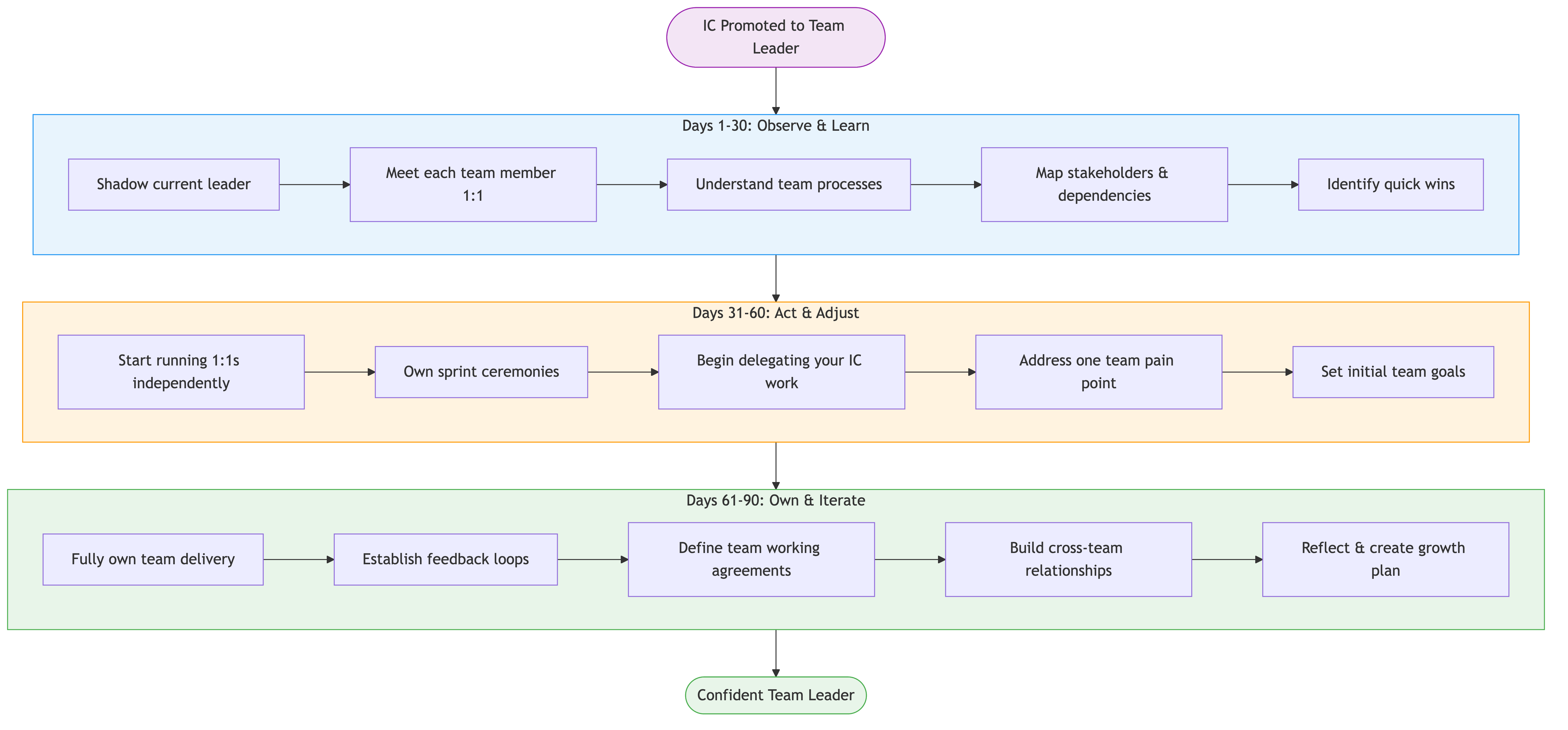
Here's a practical plan for the transition. Adapt it to your situation, but the structure is sound.
Days 1-30: Listen and Learn
Primary goal: Understand the current state of everything.
- Week 1: Set up one-on-ones with every person on your team. Ask: What's going well? What's frustrating? What would you change if you could? What do you need from me? Listen more than you talk. Take notes.
- Week 2: Map the landscape. What are the active projects? What are the dependencies? Where are the risks? What processes exist (standups, retros, planning)? What's the team's relationship with other teams?
- Week 3: Identify the top three problems. There will be many. Pick three. Resist the urge to fix everything at once.
- Week 4: Start addressing one small, visible problem. Pick something that demonstrates you listened — maybe a process fix, maybe unblocking a long-standing issue. Quick wins build credibility.
What to avoid in the first 30 days: Making sweeping changes, reorganizing processes, delivering big pronouncements about how things are going to be different now. You don't have enough context yet. You'll get things wrong.
Days 31-60: Start Shaping
Primary goal: Begin making intentional changes based on what you learned.
- Establish your operating rhythm: regular one-on-ones, team meetings, planning cadence. If these already exist, refine them. If they don't, start them.
- Have your first round of feedback conversations. Not performance reviews — informal check-ins where you share observations and ask for their perspective.
- Start delegating work you've been holding onto. Identify one task you're doing that someone on your team should be doing, and hand it off with clear context.
- Build relationships with your peer leaders. You'll need them for cross-team coordination, and they're also your support network.
- Begin documenting your team's goals and priorities. If your team can't articulate what they're working toward this quarter, fix that.
Days 61-90: Establish Your Leadership
Primary goal: Settle into the role with confidence.
- Address the harder problems you identified in month one. By now you have context and credibility. You can tackle the thornier issues — the underperformer, the broken process, the misaligned project.
- Run your first retrospective focused on team health, not just project delivery. How is the team feeling? What's working about how you work together? What isn't?
- Have a candid conversation with your manager about how the transition is going. Ask for feedback. Share what's hard. This isn't weakness — it's self-awareness.
- Set goals for the next quarter that are team goals, not personal goals. Where should the team be in three months? What does success look like?
- Look back at your first 90 days and be honest: What went well? What would you do differently? Write it down. You'll thank yourself later.
9. Imposter Syndrome
Let's address this directly: you are going to feel like a fraud.
You'll sit in a meeting with other leads who seem to know exactly what they're doing and think, "I have no idea what I'm doing." You'll make a decision and immediately doubt it. You'll have a bad one-on-one and think, "I'm not cut out for this." A senior engineer on your team will ask you a question you can't answer, and you'll wonder why anyone put you in charge.
This is normal. It happens to virtually every new leader. It doesn't mean you're in the wrong role.
Why It's Happening
You moved from a domain where you had years of expertise (writing code) to a domain where you're a beginner (leading people). Of course you feel less competent — you are less competent, at this specific skill, right now. That's how learning works.
How to Deal With It
Remember why you were promoted. You weren't promoted because you were the best coder (though you might have been). You were promoted because someone saw leadership qualities in you — how you communicated, how you helped others, how you thought about problems, how you handled ambiguity. Those qualities didn't disappear.
Separate feelings from facts. "I feel like I don't know what I'm doing" is a feeling. "The team shipped everything they committed to, and two people told me the one-on-ones are helpful" is a fact. Track the facts.
Talk to other leaders. You will discover that the leader who seems most confident in meetings also goes home and wonders if they're doing a good job. Imposter syndrome doesn't fully go away — it just gets quieter. Knowing that others experience it too takes the edge off.
Give yourself a learning timeline. You wouldn't expect to master a new programming language in 90 days. Don't expect to master leadership in 90 days either. Give yourself six months to feel somewhat comfortable, a year to feel competent, and two years to feel confident. Those are realistic timelines.
Keep a "wins" list. At the end of each week, write down three things that went well because of something you did as a leader. It can be small: "Noticed Alex was stuck and paired with him for 30 minutes, which unblocked him." Over time, this list becomes evidence against the imposter narrative.
Real-world example: A new lead confided to his skip-level manager that he felt like a fraud. The skip-level laughed — not dismissively, but knowingly — and said, "I've been doing this for fifteen years and I still feel that way on Mondays. By Wednesday I usually remember I'm okay at this. The fact that you're worried about doing a good job is exactly why you'll do a good job." He was right.
Business Value
The transition from IC to leader isn't just a personal journey — it has direct, measurable business impact.
Revenue Impact
A smooth transition means the team doesn't lose velocity. When a new leader stumbles, the team's output drops — features ship late, quality degrades, and revenue-generating work gets delayed. A well-executed transition preserves the team's throughput during a period that typically causes disruption.
For a team of six engineers with a fully-loaded cost of 60K in lost output — not counting the opportunity cost of delayed features or the revenue those features would have generated.
Efficiency Gains
The average leadership transition causes a three-to-six month productivity dip. Good transitions — where the new leader is prepared, supported, and given a clear framework — can reduce this to four to six weeks.
That's not just about the leader's adjustment. It's about the team's adjustment. When a new leader is flailing, the team spends energy managing up, working around gaps, and dealing with confusion. When a new leader is effective from the start, the team can focus on what they're paid to do.
Cost of a Bad Transition
The real cost isn't the transition period — it's what happens when a transition goes badly and stays bad.
- Team attrition: Engineers leave managers, not companies. If a new leader micromanages, fails to provide growth, or creates a chaotic environment, your best people leave first. Replacing a senior engineer costs 100K in recruiting, onboarding, and lost productivity — assuming you can find a replacement at all.
- Missed deadlines: A team with unclear direction or poor leadership misses deadlines consistently. That erodes trust with product, sales, and customers.
- Lost trust: Once a team loses confidence in their leader, it takes months to rebuild — if it can be rebuilt at all. Sometimes the only fix is a leadership change, which means another transition, another dip.
Measurable Outcomes
Track these to know whether the transition is working:
| Metric | What to measure | Healthy target |
|---|---|---|
| Team velocity | Sprint points completed vs. committed | 80-90% completion rate within 90 days |
| Retention | Voluntary attrition on the team | Zero regrettable departures in year one |
| Delivery predictability | Variance between estimated and actual delivery dates | Estimates within 20% accuracy |
| Team satisfaction | Anonymous survey or skip-level feedback | Stable or improving from pre-transition baseline |
| Growth | Promotions, skill development, scope expansion | At least one team member levels up within a year |
| Blocker resolution time | Time from blocker identified to blocker resolved | Decreasing trend over first 90 days |
Final Thoughts
The transition from IC to leader is one of the hardest career changes you'll make. Harder than switching languages, harder than changing companies, harder than moving from frontend to backend. You're not just learning new skills — you're changing how you define your value.
It gets better. The first three months are the hardest. By six months, you'll start to find your rhythm. By a year, you'll look back and wonder how you ever thought about going back.
The best leaders in our industry weren't born leaders. They were engineers who made this same uncomfortable transition, learned from their mistakes, and kept showing up for their teams.
You'll make mistakes. You'll have bad weeks. You'll occasionally wish you could just close Slack and write code for eight hours.
That's all fine. Keep going.
Common Pitfalls
- Continuing to measure yourself by IC metrics. If you track your personal lines of code or PRs merged, you will feel like a failure every day. Your new metrics are team velocity, people growth, and delivery predictability. Holding onto the old scorecard prevents you from embracing the new role.
- Rewriting your team members' code instead of coaching them. Fixing their work yourself is faster today but ensures they never learn, keeps you as a bottleneck, and demoralizes the people you are supposed to be developing.
- Trying to maintain your pre-promotion friendships unchanged. If you were peers before the promotion and you refuse to adjust the dynamic, you will struggle to give honest feedback, hold people accountable, and make tough decisions. Friendly is good; trying to remain best friends undermines your authority.
- Making sweeping changes in your first 30 days. You do not have enough context yet. Rushing to implement your vision before understanding the current state will alienate the team and likely produce changes that miss the real problems.
- Hiding your struggles and refusing to ask for help. Imposter syndrome is nearly universal for new leaders. Pretending you have everything figured out isolates you and prevents your manager and peers from supporting you through the most difficult phase of the transition.
- Not setting boundaries on your time and availability. Answering Slack at 11 PM and working weekends to prove yourself sets an unsustainable precedent and models destructive behavior for your team.
Key Takeaways
- The core mindset shift is redefining productivity from personal output to team output. Your job is no longer to write the best code but to make your team produce the best results.
- Letting go of doing the work yourself is one of the hardest parts of the transition. Delegate meaningful work even when others will do it differently or slower, because that is how teams grow.
- Your new success metrics are team shipping rate, people development, blocker resolution speed, and whether people want to stay on the team.
- Identity grief is real and normal. Acknowledge the loss of your IC identity and give yourself six to twelve months to build a new one grounded in enabling others.
- The first 90 days should follow a structured approach: listen and learn in month one, start shaping in month two, and establish your leadership in month three.
- Imposter syndrome is nearly universal and does not mean you are in the wrong role. Track facts over feelings and give yourself realistic timelines to build competence.
- The transition is the hardest career change most engineers will make, but it gets better. The first three months are the worst, and by a year in, most leaders find deep satisfaction in the new role.