
One-on-Ones: The Most Important Meeting on Your Calendar
You just became a team leader. You have a list of new responsibilities — sprint planning, code reviews, stakeholder meetings, roadmap input. But if you had to pick one thing to get right above everything else, it would be your one-on-ones.
This is not an exaggeration. The quality of your 1:1s will determine the quality of your team. Full stop.
1. What Is a 1:1?
Let's start by clearing up the most common misconception: a 1:1 is their meeting, not yours.
It is not a status update. It is not a standup. It is not a chance for you to check on their progress or ask where that pull request is. You have Slack, Jira, standups, and sprint reviews for all of that.
A 1:1 is a dedicated, protected space for your direct report to talk about whatever they need to talk about. Their concerns. Their frustrations. Their ideas. Their career. Their life, if they want to go there.
Your job in a 1:1 is to listen, coach, unblock, and support. Sometimes that means giving direct feedback. Sometimes it means just shutting up and letting them vent. Sometimes it means asking the one question that helps them see a problem differently.
Think of it this way: every other meeting on your calendar serves the company. The 1:1 serves the person. And by serving the person, you serve the company better than any other meeting ever could.
2. Why 1:1s Matter
If you're wondering whether you really need to block 30 minutes every week for every direct report, the answer is yes. Here's why.
Trust is built in small, repeated interactions. You don't build trust in a team offsite or an annual review. You build it by showing up consistently, week after week, and demonstrating that you care about this person as a human being, not just as a resource that writes code.
Problems surface early. An engineer who is frustrated with a teammate, confused about priorities, or thinking about leaving will almost never bring it up in a group setting. They will bring it up in a 1:1 — if you've built enough trust and if you ask the right questions. Every surprise resignation you hear about is a 1:1 that didn't happen or didn't go deep enough.
Coaching happens here. You can't coach someone in a code review comment or a Slack message. Real coaching — the kind that changes how someone thinks and grows their judgment — happens in conversation. The 1:1 is where you develop your people.
Feedback lands better. Feedback given in a 1:1 is private, timely, and two-way. The person can react honestly, ask questions, and push back. Feedback given in any other setting is almost always worse.
Career growth becomes real. Without regular 1:1s, career conversations get pushed to annual reviews, which means they happen once a year, which means they're basically useless. In 1:1s, you can check in on growth goals monthly and actually help someone make progress.
The 1:1 is where the real work of leadership happens. Everything else is logistics.
3. Cadence and Logistics
Frequency:
- Weekly for anyone new to your team, new to their role, or working through a challenge.
- Bi-weekly for experienced, autonomous reports who are in a stable groove.
- When in doubt, go weekly. You can always scale back. Starting at bi-weekly and trying to increase later sends the wrong signal.
Duration:
- 30 minutes minimum. Some will end at 20 minutes and that's fine. But schedule 30 so there's never a reason to rush.
- For career conversations or difficult topics, have the flexibility to go to 45 or 60 minutes.
Scheduling:
- Same time every week. Consistency matters. It signals reliability.
- Avoid Monday morning (people are still ramping up) and Friday afternoon (people are mentally checked out). Mid-week, mid-morning tends to work well.
- Put it on the calendar as a recurring event. Treat it as sacred.
The golden rule: never cancel a 1:1. If you have a conflict, reschedule it to another time that same week. Canceling tells your report that they are less important than whatever else came up. Do it twice and they'll stop bringing up real issues. Do it three times and they'll start interviewing.
If your report cancels, that's fine — it's their meeting. But if they cancel repeatedly, that's a signal worth paying attention to.
Location:
- In-person is ideal. A walk is even better for sensitive topics — side-by-side conversation feels less confrontational than face-to-face.
- Remote is perfectly fine. Cameras on, ideally. But don't force it.
- Not in a fishbowl conference room where the whole team can see you. Privacy matters.
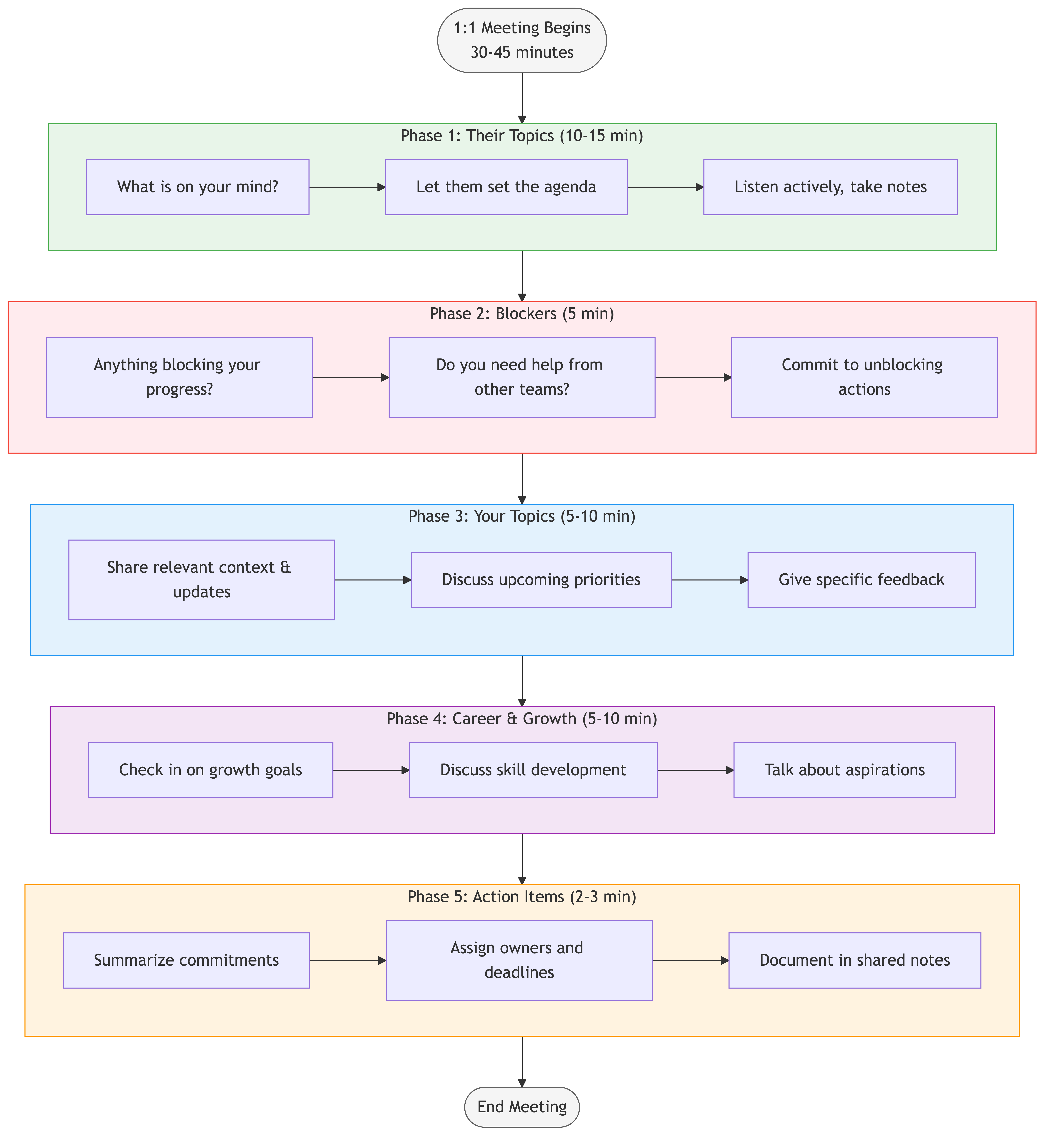
4. Structure
A 1:1 should have a loose structure, not a rigid agenda. Think of it as a framework you can deviate from, not a script you follow.
A good default flow:
-
"How are you doing?" — Start here. Not "what's your status?" but genuinely, how are you? This is an invitation to talk about whatever is top of mind. Sometimes it's work. Sometimes it's life. Both are valid.
-
Their topics first. — Ask what they want to talk about. If they have a shared doc, let them drive. Their priorities come before yours. Always.
-
"What's blocking you?" — This is where you earn your keep as a leader. Identify obstacles and either remove them directly or help your report figure out how to remove them.
-
"What do you need from me?" — A simple question that most managers never ask. The answers will surprise you. Sometimes it's "nothing." Sometimes it's "I need you to stop doing X." Both are gold.
-
Your topics. — Now you can bring up what's on your mind. Feedback, context from leadership, upcoming changes, whatever. But this comes second, not first.
-
Growth and career. — You don't need to cover this every week, but touch on it at least once a month. "How are you feeling about your growth?" is a good lightweight check-in.
Shared documents:
- Many managers and reports keep a shared doc (Google Doc, Notion page, whatever) where both can add topics before the meeting. This works well. It means the report can jot things down during the week instead of trying to remember everything on the spot.
- Keep it simple. A running list of topics and a section for action items is enough.
What if they say "I don't have anything"? This will happen, especially early on. Don't just end the meeting. Try:
- "What's been on your mind this week?"
- "What's the most frustrating thing about your work right now?"
- "If you could change one thing about how the team works, what would it be?"
- "How are you feeling about the project?"
- "Is there anything you've been hesitant to bring up?"
If someone consistently has nothing to talk about, that's either a sign that things are genuinely good (rare) or that they don't trust the space enough yet (common). Keep showing up. Keep asking.
5. Building Trust
Trust is the foundation that makes everything else in a 1:1 work. Without it, you'll get surface-level answers, hidden frustrations, and surprise departures.
Here's the hard truth: trust takes months to build and seconds to break.
How to build it:
-
Be consistent. Show up every week. On time. Prepared to listen. Consistency is the single biggest trust builder.
-
Be vulnerable. Share your own struggles. "I'm finding it hard to balance X and Y." "I made a mistake on Z and here's what I learned." This gives them permission to be honest with you.
-
Follow through on everything. If you say "I'll talk to the product manager about that," do it. And report back next week. Nothing — absolutely nothing — kills trust faster than broken promises. Even small ones.
-
Keep things confidential. What's said in a 1:1 stays in the 1:1 unless you both agree otherwise, or unless there's a legal or safety obligation. If someone tells you they're struggling with a teammate and you go tell that teammate, you've lost that person's trust permanently.
-
Don't use information against them. If someone admits they made a mistake, don't bring it up in a performance review as evidence of a pattern. They'll never be honest with you again.
-
Remember the details. Their partner's name. Their kid's soccer game. The side project they're excited about. You don't need to be their best friend, but remembering what matters to them shows you're paying attention.
-
Admit when you don't know. "I don't know, but I'll find out" is one of the most powerful things a leader can say.
How to break it (so you know what to avoid):
- Cancel 1:1s repeatedly.
- Share something they told you in confidence.
- Say you'll do something and don't.
- Make the meeting about your agenda.
- Get defensive when they give you feedback.
- Dismiss their concerns.
- Be visibly distracted (checking phone, typing, looking at another screen).
6. Coaching vs. Directing
This is one of the hardest transitions for new team leaders. You got promoted because you're good at solving problems. Your instinct is to hear a problem and immediately offer a solution. Resist that instinct.
The goal of coaching is to grow their judgment, not to demonstrate yours.
When someone brings you a problem, try this sequence:
-
Listen fully. Don't interrupt. Don't jump to solutions. Let them finish.
-
Ask what they think. "What's your take on this?" or "What do you think we should do?" Before you share your perspective, get theirs.
-
Ask clarifying questions. "What options have you considered?" "What would happen if we did X?" "What's the worst case?" These questions do the coaching. They help the person think through the problem more thoroughly.
-
Share your perspective last. If their approach is reasonable, endorse it and let them run. If you see something they're missing, offer it as an addition, not a correction. "That makes sense. One thing I'd also consider is..."
-
Let them make the decision. Unless the stakes are very high, let them choose the path, even if it's not exactly what you'd do. They'll learn more from executing their plan (even imperfectly) than from executing yours.
When to direct instead of coach:
- The building is on fire (production is down, a deadline is hours away).
- They've tried coaching-style exploration and they're genuinely stuck.
- There's critical context they don't have and you can't share the reasoning (rare, but it happens).
- They're new and need explicit guidance before they have enough context to be coached.
The ratio to aim for: In a typical 1:1, you should be talking less than half the time. If you're doing most of the talking, you're directing, not coaching. Pause. Ask a question. Listen.
Over time, you'll notice your reports start solving bigger problems on their own. They'll come to you not for answers, but to pressure-test their thinking. That's when you know coaching is working.
7. Having Hard Conversations
The 1:1 is where hard conversations belong. Not in a group setting. Not in Slack. Not in a formal HR meeting (unless it's gotten to that point). The 1:1 is private, recurring, and built on trust — exactly the right environment for difficult topics.
And yet, most managers avoid hard conversations like the plague.
They avoid them because hard conversations are uncomfortable. They worry about the person's reaction, about damaging the relationship, about being wrong. So they wait, hoping the problem will fix itself. It almost never does.
Types of hard conversations you'll need to have:
- Performance isn't meeting expectations.
- Their behavior is affecting the team.
- They're not growing in the ways they need to.
- There are organizational changes that affect them negatively.
- You need to give critical feedback on something they care about.
How to approach them:
Be direct and specific. Don't hint. Don't sandwich criticism between compliments so thick they miss the point. Say what you need to say clearly.
Bad: "You're doing great overall, but maybe sometimes the code reviews could be a little more detailed, you know? But really, great work."
Good: "I want to talk about your code reviews. In the last sprint, three PRs you approved had issues that were caught in production. Specifically, [examples]. I need the review quality to improve. Let's talk about what's getting in the way."
Focus on behavior and impact, not character. "Your code reviews have been missing issues" is actionable. "You're careless" is a character judgment and will trigger defensiveness.
Have the conversation early. A small course correction in week 2 is a quick conversation. The same issue addressed in month 6 is a serious performance discussion. Don't let things fester.
Leave space for their perspective. After you've shared the issue, ask: "What's your take on this?" They might have context you're missing. Maybe the quality dropped because they were pulled into three other things and didn't have time to review properly. That changes the conversation entirely.
End with clear next steps. What specifically needs to change? By when? How will you both know it's improved? Write this down.
Follow up. Check in on progress in the next 1:1. Acknowledge improvement when you see it. This closes the loop and shows you're paying attention.
8. Talking About Career Growth
Most engineers have a vague sense that they want to "grow" but haven't thought deeply about what that means. Your job is to help them get specific and then create opportunities to get there.
Questions that open up career conversations:
- "Where do you want to be in one to two years?"
- "What kind of work energizes you the most?"
- "What skills do you want to develop?"
- "Is there anything the team does that you wish you were more involved in?"
- "Are you more interested in going deeper technically or moving toward leading people?"
- "What would make you feel like this year was a success for your career?"
Then turn it into action:
- Identify specific skills they need to develop.
- Find stretch assignments that build those skills. A junior engineer who wants to lead? Let them own a small feature end-to-end. Someone who wants to improve system design? Have them write the next RFC and mentor them through the process.
- Connect them with people who can help — other leaders, senior engineers, people in roles they aspire to.
- Check in monthly. "How are you feeling about your growth?" keeps it alive between formal review cycles.
Common pitfall: Don't assume everyone wants to be promoted. Some people want to deepen their expertise. Some want to broaden. Some are in a season of life where stability is the priority. Meet them where they are.
Another pitfall: Don't promise what you can't deliver. "I'll make sure you get promoted next cycle" is a promise you probably can't keep. "Here's what I think the promotion case looks like, and here's what we need to work on together" is honest and actionable.
9. Reading Between the Lines
People rarely say exactly what they mean, especially to their manager. Part of your job is to hear what's not being said.
Common translations:
| What they say | What they might mean |
|---|---|
| "I'm fine." | "I'm not fine, but I don't trust this space enough to tell you." |
| "It's whatever." | "I have strong feelings about this but I've given up trying to influence it." |
| "I'm just a little tired." | "I'm burning out and I don't know how to ask for help." |
| "I don't really have anything to talk about." | "I don't believe this meeting will change anything." |
| "I'm thinking about what's next for me." | "I'm interviewing. The window to retain me is closing." |
| "The project is fine, I guess." | "The project has problems I don't feel empowered to fix." |
| "I just want to put my head down and code." | "Something about the team dynamics or process is draining me." |
Signs of disengagement to watch for:
- Reduced participation in team discussions.
- Less initiative — doing what's asked but nothing more.
- Shorter, more surface-level 1:1 conversations.
- Decline in code quality or review quality.
- More time off than usual (especially sporadic single days — often used for interviews).
- Pulling away from social interactions with the team.
Signs of burnout:
- Cynicism about the work or the company that wasn't there before.
- Physical symptoms mentioned in passing (not sleeping, headaches, exhaustion).
- Working long hours but producing less.
- Emotional reactions disproportionate to the situation.
- Loss of the enthusiasm they once had.
What to do when you notice these signals:
Don't accuse. Don't diagnose. Just create space.
"I've noticed you seem less energized lately. I might be reading it wrong, but I wanted to check in — how are you really doing?"
Then listen. And listen some more. Sometimes the most powerful thing you can do is simply acknowledge what they're going through without immediately trying to fix it.
10. Taking Notes and Following Up
This is where many managers fall short. The conversation was great. Real issues were discussed. Promises were made. And then... nothing happens.
Keep brief notes for every 1:1. Not a transcript — just the key points.
What to capture:
- Main topics discussed.
- Action items (theirs and yours). Tag them clearly.
- Any commitments you made. This is the most important part.
- Signals worth tracking over time (energy level, recurring frustrations, career interests).
Where to keep them:
- A private document that only you can see. Not shared with them (unless you both prefer a shared doc for topic tracking — that's different from your personal notes).
- Whatever tool you'll actually use. A fancy system you never open is worse than a plain text file you check every week.
Follow up on every commitment.
At the start of each 1:1, review your notes from last time. "Last week I said I'd talk to the product manager about the timeline. I did — here's what they said." Or: "You were going to look into the caching approach. How did that go?"
This follow-up loop is what transforms a 1:1 from a nice conversation into a mechanism that actually drives change. It shows your report that you take their concerns seriously and that bringing things up in the 1:1 leads to action.
Track patterns over time. If someone has mentioned being frustrated with the deployment process three times in two months, that's not a one-off complaint. That's a systemic issue worth escalating.
11. Common Mistakes
These are the patterns that make 1:1s ineffective. You'll probably fall into some of them, especially early on. That's fine — just recognize them and correct.
Using 1:1s as status updates. This is the number one mistake. If you're asking "What did you work on this week?" and "What are you working on next week?" you've turned the 1:1 into a standup. Your report will dread it. Use other channels for status.
Doing all the talking. If you're talking more than 50% of the time, something is wrong. Pause. Ask a question. Get comfortable with silence — it's often where the real stuff emerges.
Canceling regularly. Every cancellation tells your report: "This meeting — and by extension, you — are not a priority." It erodes trust faster than almost anything else you can do.
Not taking notes. If you don't write things down, you won't remember. If you don't remember, you won't follow up. If you don't follow up, your report will stop bringing things up. The 1:1 becomes a pointless ritual.
Avoiding hard topics. The 1:1 is the right place for hard conversations. If you avoid them here, where will they happen? Usually nowhere, until the problem is too big to ignore.
Making it all about work. People are more than their output. If you never ask how they're doing as a human, you'll miss the burnout, the life events, the disengagement — all the things that eventually affect the work anyway.
Treating every report the same. Some people want detailed guidance. Some want to be left alone. Some want to talk about career growth every week. Some want to talk about technical problems. Adapt your approach to each person.
Solving every problem for them. It feels efficient to just give the answer. But it makes them dependent on you and stunts their growth. Coach first, direct second.
Not preparing. Glancing at your notes for 30 seconds before the meeting is enough. Walking in cold and saying "So, what's up?" every time signals that you don't value the time.
12. Real-World Examples
Example 1: A Good 1:1 vs. a Bad 1:1
The bad 1:1:
Manager: Hey, how's it going? So what's the status on the API migration?
Engineer: It's going okay. I'm about 60% done with the endpoint refactoring.
Manager: Great. When do you think you'll finish?
Engineer: Probably end of next week.
Manager: Okay. And the documentation? Have you started on that?
Engineer: Not yet.
Manager: Make sure you get to that. Also, I need you to review Sarah's PR by tomorrow. And there's a new request from the product team I'll forward you.
Engineer: Okay.
Manager: Cool, anything else?
Engineer: Nope, I'm good.
Manager: Great, talk next week.
Duration: 8 minutes. Topics covered: status. Value added: zero. This could have been a Slack message.
The good 1:1:
Manager: Hey, how are you doing? And I mean really — how's the week been?
Engineer: Honestly, a little frustrated. I keep getting pulled into interrupt-driven work and it's hard to make progress on the migration.
Manager: That sounds frustrating. What kind of interrupts are we talking about?
Engineer: Mostly production issues on the old system and questions from the support team. I spent almost a full day on it on Tuesday.
Manager: Got it. What do you think would help?
Engineer: If someone else could be the first point of contact for those support questions, even just for the next few weeks, I think I could get through the migration much faster.
Manager: That's a reasonable ask. Let me talk to the team — I think we can set up a rotation. I'll have something in place by Thursday. What else is on your mind?
Engineer: Actually... I've been thinking about what's next for me. After this migration, I'd really like to work on something more architectural. Design a system from scratch, not just refactor an existing one.
Manager: That's great to hear. Let me think about where that opportunity might come up. There's a new service we're scoping for Q3 that could be a fit. Want to talk more about that next week?
Engineer: Yeah, I'd like that.
Duration: 25 minutes. Topics covered: a real blocker, a career aspiration. Value added: an unblocking action, a growth conversation started. The engineer leaves feeling heard and supported.
Example 2: Catching a Resignation Risk
Maria has been a strong performer for two years. In her 1:1s over the past month, her manager notices a pattern:
- Week 1: "Everything's fine." (Shorter answers than usual.)
- Week 2: Maria cancels the 1:1 for the first time ever.
- Week 3: "I don't really have anything to talk about." Her manager notices she's been less active in code reviews and team discussions.
Her manager doesn't let it go.
Manager: Maria, I've noticed things feel a little different the past few weeks. You seem less engaged than usual, and that's not like you. I could be reading it wrong, but I wanted to ask — is everything okay?
Engineer: ...Yeah, I've just been thinking about things.
Manager: What kind of things?
Engineer: I don't know. I feel like I've been doing the same kind of work for a while. I was passed over for the tech lead role on Project Atlas, and I didn't even get an explanation. It made me wonder if there's a path for me here.
Manager: I hear you, and I'm sorry — I should have talked to you about the Atlas decision. That's on me. You were a strong candidate. The decision came down to [specific reason], and it wasn't a reflection of your abilities. Can we talk about what a path forward looks like for you?
This conversation happened because the manager was paying attention to the signals and had the courage to name what they saw. Maria didn't leave. She got clarity, a concrete development plan, and the tech lead role on the next major project. Without that 1:1, she would have accepted the offer she'd already been entertaining.
Example 3: Unblocking a Stuck Project
Alex's team has been struggling with a cross-team dependency for weeks. In standups, Alex reports it as "waiting on the platform team" and the conversation moves on. Nobody escalates.
In the 1:1:
Manager: You mentioned the platform team dependency again in standup. It's been a few weeks now. What's actually going on?
Engineer: Honestly, I've pinged them three times and I can't get a clear answer on when they'll have the API ready. Their lead says it's on the roadmap but won't commit to a date. I don't want to be the person who escalates to their manager, though.
Manager: I appreciate that, but this is blocking your entire workstream. That's exactly the kind of thing I should be stepping in on. Would it help if I reached out to their manager directly?
Engineer: Yeah, actually, that would be a huge relief.
Manager: Done. I'll set up a meeting this week and loop you in. And Alex — in the future, if something is blocking you for more than a week, I want you to flag it as a blocker in the 1:1 right away. That's what I'm here for.
The manager reached out, the dependency was resolved within a week (it turned out to be a prioritization issue on the platform team's side, easily fixed once the right people were in the room). The project got back on track. All because a 1:1 went deeper than standup ever does.
Business Value
If your leadership or your own inner skeptic needs convincing that spending 30 minutes per person per week is worth it, here are the numbers.
Revenue Impact
Research consistently shows that highly engaged engineers are roughly twice as productive as disengaged ones. They write better code, solve harder problems, mentor others, and stay longer. One-on-ones are the single highest-leverage activity for driving engagement. A 30-minute weekly investment that doubles someone's impact is the best return on time you'll ever get.
Efficiency Gains
Problems that surface in 1:1s get resolved in days. Problems that don't surface in 1:1s stall delivery for weeks or months. That cross-team dependency no one escalated. The tech debt that's slowing the team down. The interpersonal friction that's causing two engineers to avoid collaborating. These all come out in 1:1s — if you're asking the right questions — and they all have direct delivery impact.
Cost of Skipping
The cost of not doing 1:1s (or doing them poorly) shows up in concrete, measurable ways:
- Surprise resignations. Replacing an engineer costs 50-200% of their annual salary when you account for recruiting, onboarding, lost productivity, and the knowledge that walks out the door. Most resignations are preventable if you catch the disengagement early. The 1:1 is where you catch it.
- Undetected burnout. A burned-out engineer doesn't just produce less — they bring down the team's energy and morale. By the time burnout is visible to everyone, recovery takes months. In a 1:1, you can catch it weeks earlier.
- Declining output with no diagnosis. When you don't have regular 1:1s, you notice performance dropping but you don't know why. Is it a skills gap? A motivation issue? A personal problem? A bad project fit? Without the conversation, you're guessing. And guessing leads to wrong interventions.
Measurable Outcomes
Track these to see the impact of your 1:1 practice over time:
- Retention rate. Teams with strong 1:1 cultures have materially lower attrition. Track yours quarter over quarter.
- Team engagement scores. If your organization runs engagement surveys, watch your team's scores. The questions about "my manager cares about me as a person" and "I have regular conversations about my growth" are directly tied to 1:1 quality.
- Time-to-resolution for blockers. How long do blockers persist before they're escalated and resolved? Strong 1:1s reduce this number dramatically because problems get surfaced faster.
- Time from concern to action. When someone raises an issue in a 1:1, how quickly does something happen? This measures your follow-through, which is the engine of 1:1 effectiveness.
Closing Thought
The 1:1 is not overhead. It is not a box to check. It is the mechanism through which you do the most important part of your job: developing people, building trust, and creating an environment where great work can happen.
Show up. Listen. Follow through. Everything else follows from that.
Common Pitfalls
- Turning 1:1s into status updates. Asking "what did you work on this week?" transforms the most important meeting on your calendar into a redundant standup. Use other channels for status and reserve 1:1 time for what matters: trust, coaching, blockers, and growth.
- Canceling 1:1s when your calendar gets busy. Every cancellation tells your report they are less important than whatever else came up. Do it twice and they stop bringing up real issues. Do it three times and they start interviewing.
- Doing most of the talking. If you are speaking more than half the time, you are directing, not coaching. The 1:1 is their meeting. Pause, ask questions, and get comfortable with silence.
- Failing to take notes and follow up on commitments. If you do not write things down, you will not remember. If you do not follow up, your report will stop bringing things up. The 1:1 becomes a pointless ritual.
- Jumping to solutions instead of coaching. Your instinct as a strong engineer is to hear a problem and immediately offer a fix. But growing someone's judgment requires asking questions that help them think through the problem themselves.
- Ignoring the signals between the lines. When someone says "I'm fine" every week with decreasing energy, or "I don't have anything to talk about" repeatedly, that is not a sign things are good. It is a sign they do not trust the space enough yet or are disengaging.
Key Takeaways
- The 1:1 is their meeting, not yours. It is a dedicated, protected space for your direct report to talk about whatever they need to talk about.
- Trust is built through small, repeated interactions over time. Consistency, follow-through, confidentiality, and genuine attention are what make 1:1s work.
- The golden rule is to never cancel a 1:1. Reschedule if needed, but never skip it entirely.
- Coaching means growing their judgment, not demonstrating yours. Ask what they think before sharing your perspective, and let them make the decision whenever stakes allow it.
- Hard conversations belong in 1:1s, not in group settings or Slack. Be direct, specific, timely, and always leave space for their perspective.
- Career growth conversations should happen at least monthly, not just during annual reviews. Help people get specific about their goals and then create opportunities to pursue them.
- Follow up on every commitment you make. The follow-up loop is what transforms a 1:1 from a nice conversation into a mechanism that drives real change.