
Protecting Team Focus
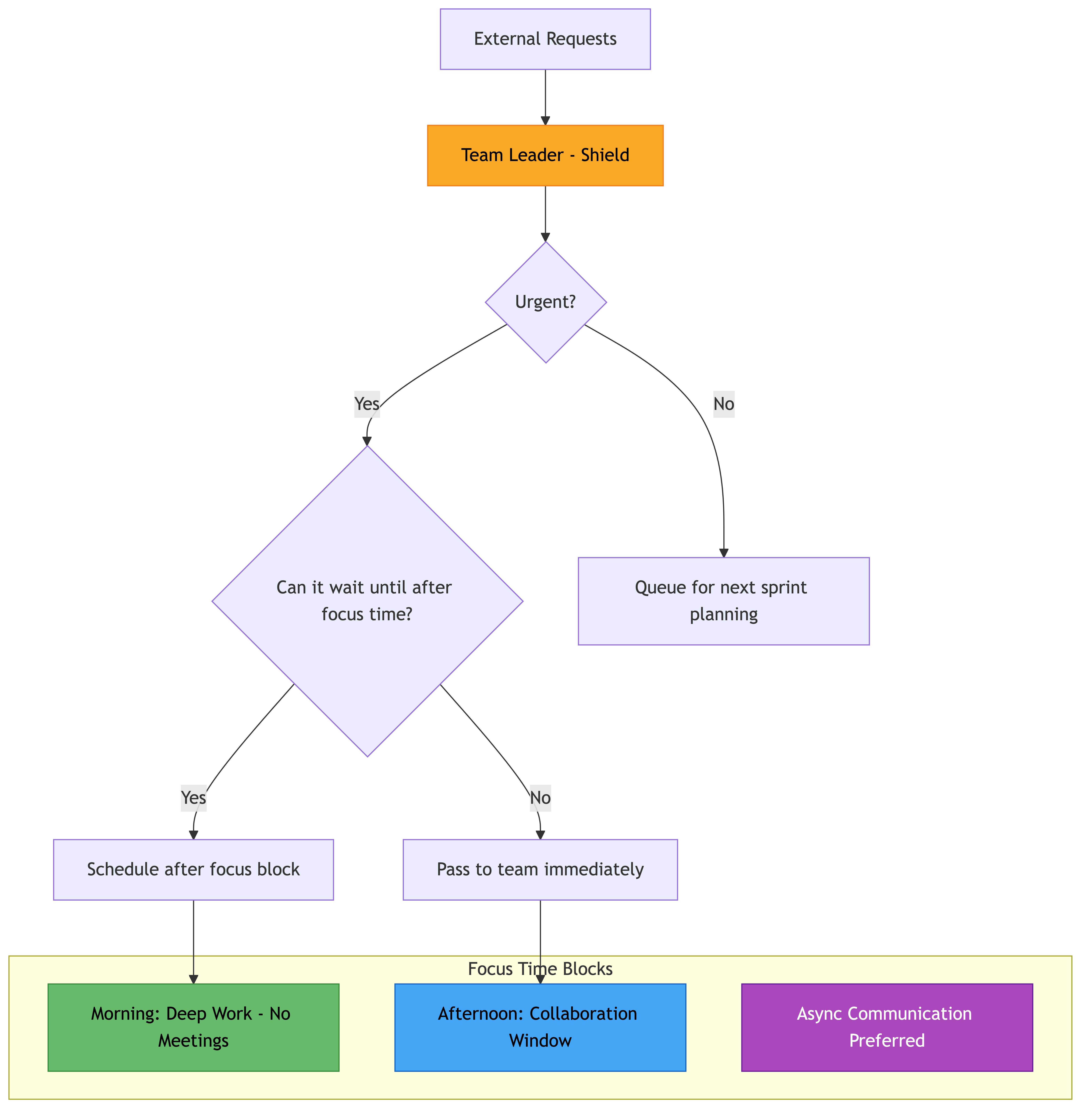
Your team's most valuable resource isn't their technical skill. It's their uninterrupted time. Every single thing you do as a team leader either protects that resource or destroys it. And most of the time, you're destroying it without even realizing it.
This guide is about becoming obsessively protective of your team's ability to do deep, focused work — because that's where all the real output comes from.
1. The Cost of Interruptions
Let's start with research that should scare you.
A study from the University of California, Irvine found that it takes an average of 23 minutes and 15 seconds to regain full focus after an interruption. Not 2 minutes. Not 5 minutes. Twenty-three minutes.
Now let's do the math for your team.
Say you lead 5 engineers. Each one gets interrupted 3 times a day. That's 15 interruptions across the team. Each one costs roughly 23 minutes of recovery time. That's 345 minutes — almost 5 hours and 45 minutes of lost deep work. Every single day.
Over a 5-day work week, that's nearly 29 hours of lost productivity. You're essentially losing one full engineer's entire week to interruptions. And that's with only 3 interruptions per person per day — many teams experience far more.
Here's what makes it worse: the interruptions themselves might only take 2-3 minutes each. A quick Slack question. A "hey, do you have a second?" tap on the shoulder. A notification from a meeting that got rescheduled. The interruption itself is trivial. The recovery cost is enormous.
Your team isn't lazy. They're not slow. They're being robbed of the conditions they need to do their job.
The real kicker: Not all focus time is equal. Engineers often report that their most productive hour is the third or fourth hour of an uninterrupted block — when they've loaded the entire problem into their head and they're operating at full capacity. An interruption at that point doesn't just cost 23 minutes of recovery. It costs the entire ramp-up time to get back to that peak state. Some engineers describe it as "losing the thread" — they had a complex chain of logic in their working memory, and after the interruption, they have to rebuild it from scratch.
This is why a day with six 45-minute blocks of free time is dramatically less productive than a day with one continuous 4-hour block — even though the total free time is actually higher in the first scenario.
2. Context Switching Kills Productivity
Interruptions are bad. But there's something even worse: putting your team on multiple projects at the same time.
Here's the math, and it's brutal.
When someone works on one project, they can dedicate roughly 100% of their productive time to it. Obvious.
When someone works on two projects, you might think each project gets 50% of their time. It doesn't. Each project gets about 40%. The remaining 20% is lost to context switching — the mental overhead of re-loading the other project's context, remembering where you left off, re-reading code you wrote two days ago, re-familiarizing yourself with the other project's architecture, catching up on that project's Slack channel.
When someone works on three projects, each project doesn't get 33%. Each project gets roughly 20%. A full 40% of their time is burned on context switching.
| Projects | Time per Project | Time Lost to Switching |
|---|---|---|
| 1 | 100% | 0% |
| 2 | 40% | 20% |
| 3 | 20% | 40% |
| 4 | 10% | 60% |
| 5 | 5% | 75% |
Look at that table. Really look at it. If you have an engineer working on 4 things at once, they are spending 60% of their time just switching between them. They're not slow. They're not struggling. You've created a situation where it's physically impossible to be efficient.
Multitasking is a myth for deep work. Your brain doesn't run multiple threads. It timeslices, and the overhead of that timeslicing is enormous for creative, complex work like software engineering. The research is overwhelming and unambiguous on this point.
The practical consequence: if someone on your team is assigned to three projects, they will deliver all three late and all three at lower quality. If you'd let them finish one at a time, they would have delivered all three faster and better.
Your job as a leader is to fight for single-project focus for your team members. Every time someone proposes splitting an engineer across two workstreams, you should feel a visceral resistance. Sometimes it's unavoidable — but it should always feel like a compromise, never a default.
3. Your Role as a Shield
Here's the mental model that will change how you operate: you are the buffer between your team and the rest of the organization.
Organizational noise is constant. Other teams need things. Leadership wants status updates. Stakeholders have questions. Product managers change priorities. There are company all-hands, cross-team syncs, planning sessions, architecture reviews, incident retros, and a hundred other things that all feel important to someone.
Most of that noise should never reach your team.
Your job is to absorb the interruptions so your engineers don't have to. When the VP of Product pings asking for a status update on project X, you answer it — not your engineer who's deep in a debugging session. When another team needs to know about an API change, you handle the communication. When there's a fire drill meeting about next quarter's roadmap, you attend so your team doesn't have to.
This is genuinely one of the most impactful things you can do as a team leader. It doesn't feel glamorous. Nobody gives you a performance award for "absorbed 47 interruptions that would have derailed your team's sprint." But the effect on your team's output is enormous.
What this looks like in practice:
- A stakeholder Slacks one of your engineers directly with a question. You respond: "Hey, I can answer that — let's keep Sarah focused on the migration. Here's the status..."
- Your team gets invited to a cross-team meeting about a dependency. You go alone, take notes, and share the two things that actually matter to your team in a 3-line Slack summary.
- Someone from another team walks over to ask a "quick question" about your team's service. You intercept it. You answer it yourself, or you write it down and bring it up at your next standup — not right now, when your engineer is in flow.
- Leadership asks your team to "just take a look" at something outside your team's scope. You push back: "We'd be happy to look at that. Let me understand the priority and timeline so I can plan it into our next sprint."
You're not being difficult. You're not being territorial. You're protecting the conditions your team needs to do the work the organization is paying them to do.
The paradox: Your calendar will look worse so your team's calendars can look better. Your day will be more fragmented so theirs can be less. That's the trade-off, and it's the right one. Your team's deep work is the bottleneck for delivery. Your administrative work is not.
4. Common Focus Killers
Know your enemy. These are the most common things that destroy your team's focus, roughly in order of damage:
Unnecessary Meetings
The number one killer. A single 30-minute meeting in the middle of a morning block doesn't cost 30 minutes. It costs the entire morning, because no one starts deep work knowing they'll be interrupted in 45 minutes. Engineers will do shallow work — respond to emails, review small PRs, read Slack — while they wait for the meeting. Then after the meeting, they need 20-30 minutes to reload their context. The meeting cost 30 minutes on the calendar but 2-3 hours of productive time in reality.
Slack/Chat Noise
The expectation of immediate response is toxic for deep work. If your engineers feel like they need to check Slack every 5 minutes, they will never reach a flow state. Ever. The constant low-grade anxiety of "am I missing something?" prevents the deep focus that real engineering work requires.
Ad-Hoc Requests from Other Teams
"Hey, can your team quickly build an endpoint for us?" "Can someone on your team help us debug this issue with your service?" These requests feel small and reasonable individually. Collectively, they can consume 20-30% of your team's capacity. And because they're unplanned, they disrupt whatever your team was actually supposed to be working on.
Unclear Priorities
When your team doesn't know what matters most, everything feels urgent. Engineers end up context-switching between tasks because they're not sure which one to focus on. This is a leadership failure, not an engineering failure. If your team is bouncing between priorities, you haven't done your job of establishing what's most important.
Too Many WIP Items
If your sprint board has 12 items in progress and 2 items done, you have a focus problem. Work in progress should be minimized. Ideally, each engineer is working on one thing at a time, finishing it, and then picking up the next thing. When you have too many items in flight, nothing gets finished, and the team feels like they're running hard but going nowhere.
Support/On-Call During Deep Work
Production issues and support tickets are real and important. But if every engineer is expected to drop everything and respond to support requests at any time, nobody can do sustained deep work. You need a rotation system that protects most of the team most of the time.
5. Focus Time Blocks
This is the single most effective tactical thing you can implement. It's simple, it's concrete, and it works.
The idea: Block 2-4 hours on your team's calendars, every day, where no meetings are allowed and no one is expected to respond to messages. This is sacred deep work time.
How to Implement It
Step 1: Choose the block. Morning blocks (9am-12pm or 10am-1pm) tend to work best because most people do their best cognitive work in the first half of the day. But ask your team — some people are afternoon focusers.
Step 2: Put it on the calendar. Create a recurring team-wide calendar block. Make it visible. Name it something clear: "Team Focus Time — No Meetings."
Step 3: Move existing meetings. This is the hard part. Go through your team's recurring meetings and move everything possible outside the focus block. Compress meetings into the afternoon. You'll be surprised how many meetings can move.
Step 4: Enforce it. The first time someone schedules over focus time, you need to push back immediately and politely. "Hey, that's during our team's focus block — can we find a time after 1pm?" If you let it slide once, it'll happen constantly.
Step 5: Protect it from yourself. Don't Slack your team during focus time. Don't walk over and ask questions. Don't schedule "quick syncs." You are the biggest threat to your own focus time policy, because you have the most access to your team.
Getting Buy-In from Stakeholders
People will push back. Here's how you handle it:
- "But I need to meet with your engineer during that time." "I want to make sure Sarah can give you her full attention. Let's find a slot in the afternoon when she's not in deep work mode."
- "This is urgent." "Understood — for genuine emergencies, we have a process. For everything else, the afternoon works. If Sarah's in the middle of implementing the payment flow, pulling her out will actually delay the thing you care about."
- "This seems rigid." "It is, intentionally. Our delivery speed improved 30% after we started protecting mornings. I'd love to keep that going."
The key insight: you're not saying no. You're saying "yes, but at the right time." Most requests are not actually urgent. They just feel urgent to the person making them.
6. Meeting Hygiene
Take a hard look at your team's calendars. If you've never done a meeting audit, you're going to find a lot of waste. Here's the process.
The Meeting Audit
Open every team member's calendar for the past two weeks. For every recurring meeting, ask:
- Does this meeting have an agenda? If not, cancel it. A meeting without an agenda is a group of people sitting in a room hoping something useful happens. It rarely does.
- Does this meeting need all the attendees? Most meetings have 2-3 people who actually need to be there and 4-5 who are "optional" but feel obligated to attend. Trim the invite list aggressively. Your engineers should only attend meetings where they're actively needed.
- Could this be async? Status updates, FYI announcements, simple decisions — all of these can be a document, a Slack thread, or a Loom video. Meetings are for discussion, debate, and decisions that require real-time back-and-forth. Everything else should be async.
- Is this meeting still serving its original purpose? Recurring meetings have a tendency to outlive their usefulness. That weekly sync you started during the big migration? The migration shipped three months ago. Cancel it.
Practical Tactics
Batch meetings together. If your team has to attend meetings, cluster them. A day with three meetings from 1pm-4pm is much better than a day with one meeting at 10am, one at 1pm, and one at 3:30pm. The first scenario gives you a clean morning. The second destroys the entire day.
Implement meeting-free days. Pick one or two days per week where no meetings are allowed for the entire team. Wednesday is popular because it breaks up the meeting-heavy Monday/Thursday pattern. Protect this fiercely.
Default to 25 or 50 minutes. Meetings expand to fill their time slot. A 25-minute meeting covers the same ground as a 30-minute meeting 90% of the time — and gives people a buffer before their next commitment. A 50-minute meeting replaces most hour-long meetings with room to spare.
Require agendas 24 hours in advance. If the organizer can't articulate what the meeting is about a day beforehand, the meeting doesn't need to happen. This sounds harsh. It will cut your useless meetings in half.
Kill the recurring meeting creep. Set a reminder every quarter to review all recurring meetings. Ask: is this still necessary? Can we reduce the frequency? Can we reduce the duration? Can we reduce the attendee list? The answer to at least one of those is almost always yes.
7. Managing Slack and Chat
Slack is both a communication tool and a focus-destruction weapon. The difference is entirely in how you set norms around it.
The Core Principle
Not everything needs an immediate response. In fact, almost nothing does. But without explicit norms, the default expectation becomes "respond within 5 minutes," and that default will prevent your team from ever doing deep work.
Set Explicit Expectations
Have this conversation with your team and your stakeholders:
"Here's how our team handles communication:
- If it's a production emergency: Call or text. We will respond immediately.
- If it's urgent but not an emergency: DM me directly and say it's urgent. I'll respond within 30 minutes and route it appropriately.
- If it's a normal request: Post in our team channel. We check channels between focus blocks and will respond within 2-4 hours.
- If it's informational: Post it. We'll read it when we read it."
This gives people a clear escalation path and eliminates the anxiety of "should I check Slack right now?" The answer is no — if something were truly urgent, someone would escalate it through the defined path.
Channel Organization
A messy Slack workspace makes everything feel urgent because important messages get buried in noise. Set up clear channels:
- #team-[name]-urgent: Only for things that need attention within the hour. This should be nearly empty most of the time.
- #team-[name]-general: Day-to-day team communication. Checked between focus blocks.
- #team-[name]-standup: Async standups and status updates.
- #team-[name]-social: Non-work chat. Checked whenever.
Encourage DND/Focus Mode
Explicitly tell your team: "During focus blocks, turn on Do Not Disturb. I expect you to not see my messages until the block is over. If I need you urgently, I will call you."
This sounds obvious, but many engineers feel guilty turning off notifications because they think their lead expects instant responses. You need to explicitly give them permission. Say it out loud. Say it more than once.
Model the Behavior
If you send a Slack message at 9:30am during focus time and then get annoyed when someone doesn't respond until 12:30pm, you've just destroyed your own policy. The team watches what you do, not what you say. If you want them to ignore Slack during focus time, you need to stop sending them messages during focus time. Write it down and send it at 1pm, or use Slack's scheduled send feature.
8. Saying No to Ad-Hoc Requests
This is where a lot of new team leaders fail. Someone from another team asks for something. It sounds reasonable. It's "just a small thing." You say yes because you want to be helpful. And then it happens three more times that week, and suddenly 30% of your team's sprint is unplanned work.
You need a default response, and it's this:
"Let me check our sprint capacity and get back to you."
That's it. That's the sentence. Memorize it. Tattoo it on your forearm if necessary. It buys you time, it sounds professional, and it prevents reflexive yes-saying.
Why Instant "Yes" Is Destructive
When you immediately agree to an ad-hoc request, several bad things happen:
- You've committed your team without consulting them. They now have unplanned work they didn't sign up for, which means something they did plan has to slip.
- You've trained the requester to come to you for quick bypasses of the normal prioritization process. They'll be back next week.
- You've undermined your own planning. If anyone can walk up and add work to your team's plate, what's the point of sprint planning? Your team will stop trusting the process.
- You've made yourself a bottleneck. If you're the person who always says yes, every ad-hoc request in the organization will eventually flow through you.
The Better Process
When someone makes an ad-hoc request:
- Acknowledge it. "That sounds like a reasonable ask. Let me understand the scope and urgency."
- Understand priority. "What's the deadline? What happens if we do this next sprint instead of this one? Is there a workaround in the meantime?"
- Check capacity. Actually look at your sprint board. Is there slack? If you take this on, what gets delayed?
- Be honest about trade-offs. "We can do this, but it means the search feature ships next Wednesday instead of this Friday. Are you okay with that trade-off?"
- Make the requester own the decision. Don't absorb the cost silently. If taking on their request means something else slips, make that visible. Often, when people see the real cost of their "quick ask," they'll say "actually, next sprint is fine."
When to Actually Say Yes Immediately
Not never. If production is down and your team has the expertise to help, you help. If a critical customer issue needs a hotfix and your team owns the code, you do it. The point isn't to be obstructionist. It's to make sure unplanned work is a conscious choice with visible trade-offs, not an invisible tax on your team's capacity.
9. Real-World Examples
Scenario 1: The Team That Protected Its Focus
A backend team at a growing SaaS company was consistently missing sprint commitments. They were talented engineers — the code quality was high, the technical decisions were sound. But they shipped about 60% of what they committed to each sprint.
Their new team leader did a time audit. She had each engineer track their interruptions for one week. The results: an average of 6.2 interruptions per engineer per day. Two engineers were in 4+ hours of meetings daily. The team had zero protected focus time.
She implemented three changes:
- Mornings (9am-12:30pm) became meeting-free for the entire team.
- She personally took over all cross-team communication and status meetings.
- She established a "no same-day requests" policy — any ad-hoc request from another team would be evaluated for the next sprint, not the current one.
Within two sprints, the team was shipping 40% more story points per sprint with the same team, the same codebase, and the same product requirements. Nothing changed except the amount of uninterrupted time each engineer had. The team's sprint completion rate went from 60% to over 90%.
The engineers reported being less stressed, not more. They weren't working longer hours. They were just actually able to focus during the hours they worked.
Scenario 2: The Team Drowning in Meetings
A platform team at a mid-size company was responsible for shared infrastructure used by six other teams. They were "important" — everyone needed them, everyone wanted their time, and everyone had meetings with them.
The result: the team's average engineer had 22 hours of meetings per week. In a 40-hour work week, that left 18 hours for actual work — broken into fragments scattered between meetings. Real deep work time? Maybe 6-8 hours per week per engineer.
The team hadn't shipped a meaningful feature in three months. They spent all their time in meetings talking about the work they were going to do, without ever having time to do it. Their backlog grew. Other teams got frustrated because nothing was getting built. Leadership started asking hard questions about the team's productivity.
The team leader's response was to add more status update meetings to "improve visibility." This made everything worse. The team eventually lost two senior engineers who were frustrated about not being able to do actual engineering work.
The turning point came when a new engineering director stepped in, saw the calendars, and mandated a reset: all recurring meetings canceled, rebuilt from scratch with a maximum of 8 hours of meetings per week per engineer. The team shipped more in the following month than they had in the previous quarter.
The lesson: meetings feel like work. They feel productive. But for an engineering team, meetings are overhead. Necessary overhead sometimes — but overhead. When overhead exceeds a threshold, real work stops.
Scenario 3: The Leader Who Learned to Be the Shield
A team leader at a fintech startup prided himself on being accessible. His door was always open. He responded to Slack within minutes. He CC'd his team on everything so they'd "have context." He forwarded stakeholder questions directly to engineers because they could answer better than he could.
His team's velocity was declining month over month, and he couldn't figure out why.
His manager eventually gave him blunt feedback: "You're not a shield. You're a funnel. You're taking every piece of organizational noise and directing it straight at your team."
He ran an experiment. For two weeks, he became the single point of contact for everything. Every stakeholder question went through him. Every cross-team request went through him. He stopped forwarding emails. He stopped CC'ing his team on status threads. When someone asked "can I talk to the engineer working on X?" he said "Tell me what you need and I'll get you the answer."
His team's output increased measurably within the first week. Engineers started finishing tasks that had been lingering for days. One engineer told him: "This is the first week in months I've been able to actually think about a problem for more than 45 minutes at a time."
He never went back to the old way.
10. Common Mistakes
Even well-intentioned team leaders undermine their team's focus. Watch out for these:
Being the Biggest Interrupter Yourself
This is the most common one, and the most ironic. You implement focus time, you protect the calendar, you push back on other teams — and then you walk over to your engineer's desk three times a morning with "quick questions." Or you send Slack messages during focus blocks expecting immediate answers. The team sees through this instantly. If you're the biggest source of interruptions, nothing else you do matters.
Fix: Batch your questions. Keep a running list. Bring them up at your 1:1 or standup, not the moment you think of them.
Not Actually Blocking the Calendar
You talk about focus time but never put it on the calendar. Or you put it on the calendar but don't enforce it. Someone schedules over it, and you let it slide. Then someone else does. Within two weeks, focus time exists in theory only.
Fix: The calendar block is real. Treat it like a meeting with the CEO. Decline conflicts immediately and consistently.
Saying Yes to Everything
You want to be seen as a team player. You want your team to be seen as helpful and collaborative. So you say yes to every request. The result is a team that's spread across a dozen priorities, finishing none of them.
Fix: Use the phrase from section 8. Every time. "Let me check our sprint capacity and get back to you."
Letting Meetings Creep Back
You do the meeting audit. You clear the calendar. It feels amazing for two weeks. Then someone adds a "quick weekly sync." Then another team wants a "biweekly touchpoint." Then there's a new initiative that needs "just a 30-minute check-in." Three months later, you're back where you started.
Fix: Schedule a quarterly meeting audit. Put it on your own calendar. Review every recurring meeting. Cancel anything that isn't actively earning its time slot.
Not Tracking the Impact
You implement focus time but never measure whether it's working. So when someone pushes back — "this focus time thing is causing delays in cross-team communication" — you have nothing to counter with.
Fix: Track sprint velocity, completion rates, and cycle time before and after implementing focus protections. Hard numbers win arguments.
Treating All Interruptions as Equal
A production incident is not the same as a question about API documentation. But if your team doesn't have a clear escalation framework, everything gets treated with the same urgency, and everything interrupts focus.
Fix: Define tiers. Production down = interrupt immediately. Everything else = it can wait for the next natural break.
Business Value
Protecting focus isn't a "nice to have" for developer happiness. It's a direct lever on business outcomes. Here's the case in terms your leadership will care about.
Productivity Gains
The math is straightforward. If protecting focus time gives each engineer back 1.5 hours of productive deep work per day — and that's conservative based on the interruption research — that's 7.5 hours per day for a team of 5. Over a month (20 working days), that's 150 hours of recaptured engineering time. At a fully-loaded engineering cost of 15,000-$22,500 per month** in recovered productivity. Per team. Without hiring anyone.
For organizations with 10 engineering teams, that's 225,000/month. That's the equivalent of hiring 8-12 additional engineers, just by protecting the ones you already have.
Delivery Speed
Teams with protected focus time consistently deliver 30-50% more per sprint than teams without it. This isn't a marginal improvement. This is the difference between shipping a feature every 3 weeks and shipping one every 2 weeks. Over a quarter, that's 4-5 additional features. Over a year, it compounds dramatically.
Faster delivery means faster time-to-market, faster feedback loops with customers, and the ability to course-correct sooner when something isn't working. These are competitive advantages.
Cycle Time Reduction
When engineers can focus, individual tasks move faster. A task that takes 3 days in a fragmented environment might take 1.5 days with protected focus. Multiply that across every task in every sprint, and your lead time from "idea" to "in production" drops significantly. Stakeholders notice this. Customers notice this.
Developer Satisfaction and Retention
Engineers who can't do deep work are unhappy engineers. The number one complaint in developer satisfaction surveys, year after year, is too many meetings and too many interruptions. Developers choose this career because they want to build things. When they spend their days in meetings and responding to Slack, they start looking for jobs where they can actually code.
Replacing an engineer costs 50-200% of their annual salary when you factor in recruiting, interviewing, onboarding, and the 3-6 month ramp-up period. If protecting focus prevents even one attrition per year, it pays for itself many times over.
In engagement surveys, teams with protected focus time consistently report higher satisfaction, higher sense of accomplishment, and stronger intent to stay. This isn't a coincidence. People want to do meaningful work, and you can't do meaningful work in 15-minute fragments between meetings.
The Executive Summary
If someone in leadership asks you to justify focus time protections, here it is in three bullet points:
- We ship 30-50% more with the same team size. That's equivalent to hiring additional engineers at zero cost.
- Our cycle time drops, so customers get value sooner. This is a measurable competitive advantage.
- Our engineers are more satisfied and more likely to stay. Each retained engineer saves 400k in replacement costs.
Focus isn't a perk. It's infrastructure. Protect it like you'd protect your production environment — because it's just as critical to your team's output.
Quick Reference: Your Focus Protection Checklist
Use this as a recurring self-assessment:
- Does your team have at least 3 hours of protected focus time per day?
- Is that focus time actually on the calendar and enforced?
- Are you absorbing interruptions before they reach your team?
- Does your team have meeting-free days?
- Are Slack response-time expectations explicit and reasonable?
- Have you audited your team's meetings in the last quarter?
- Do you have a clear escalation framework (emergency vs. normal)?
- Are you tracking velocity/cycle time to measure the impact?
- Is each engineer working on one project at a time (or as close as possible)?
- Are ad-hoc requests going through a process instead of being accepted on the spot?
If you can check all ten of those boxes, your team has a real focus culture. If you can't, you know exactly where to start.
Common Pitfalls
- Being the biggest source of interruptions yourself. You implement focus time and push back on other teams, then walk over to your engineer's desk three times a morning with "quick questions." The team sees through this instantly. Batch your questions and bring them up at standups or 1:1s.
- Establishing focus time on the calendar but not enforcing it. Someone schedules over it and you let it slide. Within two weeks, focus time exists in theory only. Treat it like a meeting with the CEO and decline conflicts immediately and consistently.
- Saying yes to every ad-hoc request from other teams. Each request seems small and reasonable individually, but collectively they can consume 20-30% of your team's sprint capacity as unplanned work. Always check sprint capacity before committing.
- Letting meetings creep back after an initial audit. You clear the calendar and it feels great. Then someone adds a quick weekly sync, then another team wants a biweekly touchpoint. Three months later you are back where you started. Schedule quarterly meeting audits.
- Assigning engineers to multiple projects simultaneously. An engineer on three projects does not get 33% per project. They get about 20% each, with 40% lost to context switching. Fight for single-project focus as the default, not the exception.
- Not tracking the impact of focus protections. Without before-and-after data on velocity, completion rates, and cycle time, you have nothing to counter pushback when someone claims focus time is causing communication delays.
Key Takeaways
- Your team's most valuable resource is uninterrupted time. It takes an average of 23 minutes to regain full focus after an interruption, making even brief disruptions enormously costly.
- Context switching between multiple projects destroys productivity in a nonlinear way. Two projects means 20% lost to switching; three projects means 40% lost. Fight for single-project focus for your engineers.
- You are the buffer between your team and the rest of the organization. Absorb interruptions, answer stakeholder questions, attend cross-team meetings, and handle ad-hoc requests so your engineers can stay in flow.
- Implement protected focus time blocks of 2-4 hours daily where no meetings are allowed and no one is expected to respond to messages. Enforce it from day one.
- Audit your team's meetings regularly. For every recurring meeting, ask whether it needs an agenda, whether all attendees are necessary, whether it could be async, and whether it still serves its original purpose.
- Set explicit Slack response-time expectations with tiers: emergencies get immediate response, urgent items within 30 minutes, normal requests within 2-4 hours, and informational items whenever convenient.
- Protecting focus delivers measurable business results: 30-50% more output per sprint, faster cycle times, higher developer satisfaction, and reduced attrition. It is infrastructure, not a perk.