
Budget & Headcount Planning
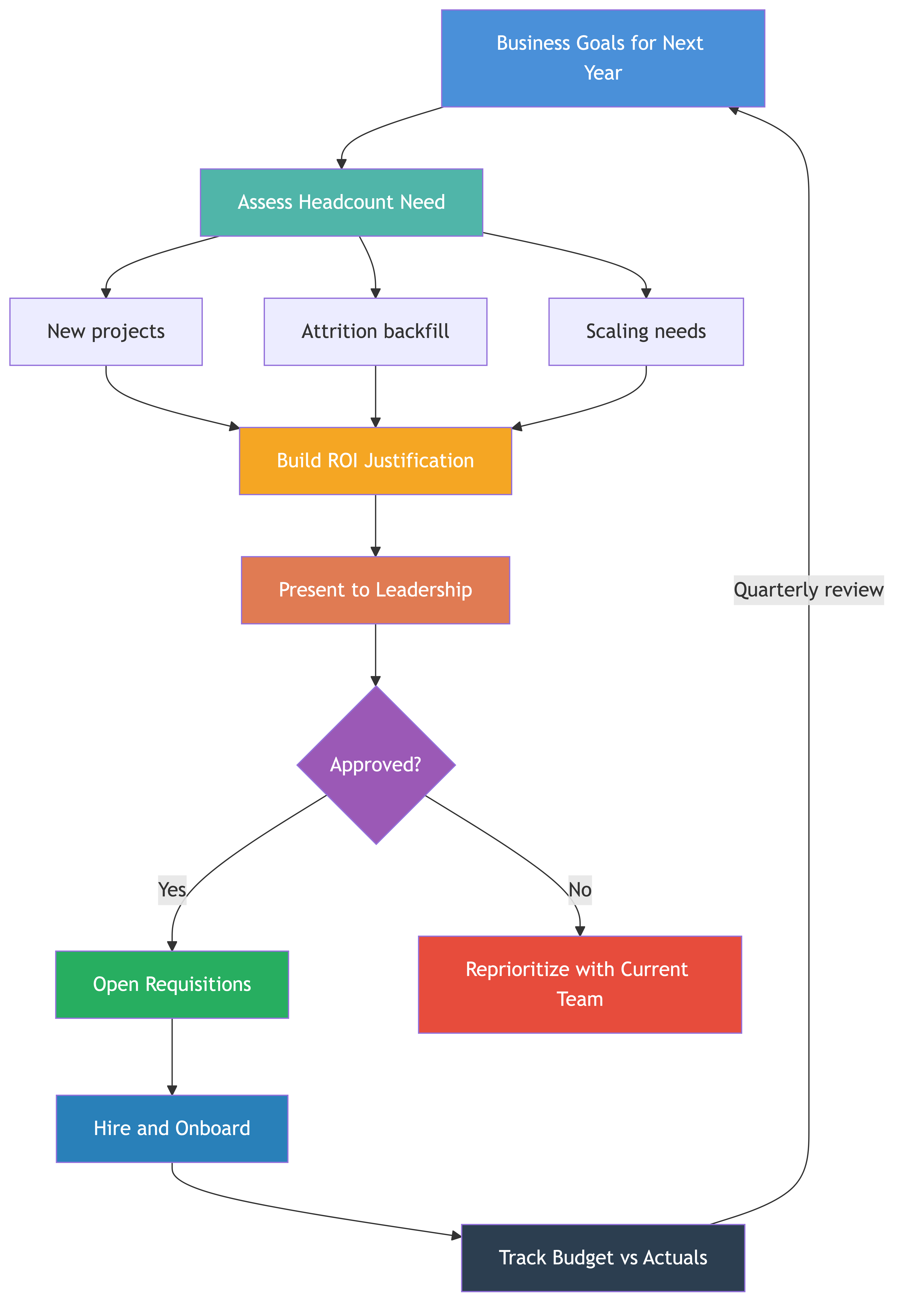
Why This Matters
Here is a truth that will either excite you or terrify you: as an engineering manager, you are running a small business inside a larger business. Your team has a cost. That cost is measured in real dollars. And somebody — your VP, your CFO, your board — is looking at that cost and asking: "What are we getting for this?"
If you cannot answer that question clearly, you are at risk. Not just your budget — your headcount, your team's scope, your credibility as a leader. The EMs who thrive are the ones who understand the financial side of their team and can speak the language of investment and return. The ones who struggle are the ones who think "I manage engineers, not money" and then get blindsided when the reorg hits and their team gets consolidated.
Budget and headcount planning is not a finance exercise you tolerate once a year. It is a leadership skill you practice continuously. Let's break down what that actually looks like.
1. Why You Need to Think About Money
Let's get the mindset shift out of the way first. You probably did not get into engineering management because you love spreadsheets. You got here because you cared about building great software and helping engineers grow. But the moment you accepted the EM title, you also accepted responsibility for a chunk of the company's spend.
Your team is likely one of the most expensive line items in the entire organization. A team of eight engineers in a major market can easily cost $2-3M per year when you account for everything. That is not pocket change. That is a serious investment that leadership expects a return on.
Here is the thing though — understanding the financials of your team is not about becoming an accountant. It is about building trust. When your VP sees that you understand what your team costs and can articulate what the company gets in return, they trust you with more. More headcount, more budget, more scope. When you cannot speak to these things, they start making decisions about your team without you. And you do not want that.
Think of it this way: you would never let someone else make your technical architecture decisions. Why would you let someone else make your team's financial decisions? Own the numbers the same way you own the roadmap.
What this looks like in practice:
- You know, roughly, what your team costs per quarter — not just salaries, but the full picture.
- You can explain to your VP why a proposed project is worth the investment in engineering time.
- When budget cuts come (and they always come eventually), you have a clear view of trade-offs and can advocate intelligently for your team.
- You proactively flag budget risks instead of being surprised by them.
2. Fully Loaded Cost of an Engineer
This is the number that catches most new EMs off guard. When you hear that an engineer on your team makes $180K, you might think that is roughly what they cost. It is not. Not even close.
Salary is typically only 60-70% of the total cost of an employee. The rest adds up fast, and if you do not understand these components, you are making decisions with incomplete information.
The real breakdown looks something like this:
| Component | Typical Range | Example ($180K base) |
|---|---|---|
| Base salary | 60-70% of total | $180,000 |
| Benefits (health, dental, vision, life insurance) | 15-25% of salary | 45,000 |
| Payroll taxes (employer side) | 8-12% of salary | 21,600 |
| Equity/stock (amortized annual cost) | Varies widely | 80,000 |
| Equipment (laptop, monitors, peripherals) | Amortized | 4,000/year |
| Office space or remote stipend | Per seat or stipend | 15,000/year |
| Software tools and licenses | Per user | 8,000/year |
| Training and development | Budget per person | 5,000/year |
| Recruiting cost (amortized) | If agency: 20-25% of salary | 15,000/year |
The real number: That 250K and $350K per year, depending on your location, benefits package, and equity structure. In high-cost markets with generous equity, it can be even higher.
Why does this matter? Because when you say "I need two more engineers," you are not asking for 500K-$700K in annual spend. That changes the conversation. That changes the ROI math. And that is the number leadership is using in their head when you make the ask — even if you are not.
Pro tip: Ask your HR or finance partner for the "fully loaded cost" or "total compensation cost" for each level on your team. Most companies track this. If yours does not, build a rough model yourself. You need this number to make credible business cases.
3. Making the Case for Headcount
Here is the single biggest mistake EMs make when asking for more people: they lead with the problem instead of the opportunity.
"My team is overwhelmed and we're burning out" — that is a problem. And it is a valid one. But it is not a business case. Your VP hears that and thinks "maybe we should reduce scope" not "let me give you more headcount."
"We're behind on our roadmap" — also a problem. Your VP hears "maybe this team isn't executing well."
"I need more people" — this is not even a problem statement. This is just a request with no context.
Here is what works:
"With 2 additional senior engineers, we can deliver the payments integration by Q3. Based on the business team's projections, this integration unlocks 700K annually, giving us a 5.7x return on the investment in year one alone."
That is a business case. That is a language your CFO understands. That is a request that gets funded.
The framework for a compelling headcount case:
- Start with the business outcome. What will the company get? Revenue, retention, cost savings, market expansion — pick the thing that matters most to leadership right now.
- Quantify the opportunity. Use real numbers wherever possible. Work with your PM, your sales team, your data team to get these. Even rough estimates are better than nothing.
- Show the gap. Explain clearly why your current team cannot deliver this in the required timeframe. Be specific — "We have 6 engineers, 4 of whom are committed to keeping the existing platform running. That leaves 2 engineers for new feature work, and this project requires an estimated 4 engineer-quarters of effort."
- Present the investment. State the fully loaded cost. Show that you understand the financial commitment you are asking for.
- Calculate the return. ROI = (Value - Cost) / Cost. If the math works, the headcount gets approved. If it does not, you either have the wrong project or the wrong timing.
- Address risks. What if you do not get the headcount? What gets delayed or cut? Make the cost of inaction clear.
One more thing: timing matters enormously. If you bring a headcount case during annual planning, you are part of the process. If you bring it mid-year, you are asking for an exception. Both can work, but mid-year requests need a stronger justification and usually require showing that something has changed since planning — a new market opportunity, an unexpected departure, a shift in company strategy.
4. Headcount Planning
Headcount planning is not a one-time event. It is a cycle that runs throughout the year, and the best EMs are always thinking at least two quarters ahead.
The annual planning cycle typically looks like this:
- Q4 (October-December): Most companies do annual planning here. You are building your headcount plan for the following year. This is when the big asks happen.
- Q1 (January-March): Budgets are locked. You are executing on the plan — opening reqs, kicking off hiring, onboarding new hires.
- Q2 (April-June): Mid-year check. Are you on track? Any departures to backfill? Any shifts in priority that change your needs?
- Q3 (July-September): Start thinking about next year. What did you learn? What will the roadmap need? Begin building your case for the next cycle.
Backfill vs. growth hires:
This distinction matters more than most EMs realize. A backfill replaces someone who left — it maintains your current capacity. A growth hire adds new capacity. From a budget perspective, backfills are usually easier to approve because the cost is already in the plan. Growth hires require a new business case.
But here is the nuance: a backfill is also an opportunity. If a mid-level engineer leaves, do you backfill at the same level, or do you make the case for a senior hire instead? If someone leaves from your platform team, is that still the highest-leverage place to add a person, or has the roadmap shifted? Treat every backfill as a strategic decision, not just a checkbox.
Forecasting needs based on roadmap:
Your headcount plan should flow directly from your roadmap. Here is a simple approach:
- List the major initiatives on your roadmap for the next 12 months.
- Estimate the engineering effort required for each (in engineer-quarters).
- Sum the total effort needed.
- Compare it to your current team's capacity (accounting for operational work, on-call, tech debt, etc. — typically 30-40% of capacity goes here).
- The gap between what you need and what you have is your headcount ask.
The critical factor everyone forgets: time.
Hiring takes 3-6 months from opening a req to a new engineer's first day. Onboarding and ramp-up takes another 2-4 months before they are fully productive. That means if you need someone productive for Q3 work, you need to open the req in Q4 of the previous year. Let that sink in. You are planning nearly a year ahead.
If you wait until you feel the pain to start hiring, you are already 6-9 months behind.
5. Compensation Benchmarking
Compensation is one of those topics that makes a lot of EMs uncomfortable. You did not sign up to be a comp analyst. But here is the reality: if you do not understand market rates, you will lose good people to companies that do, and you will overpay for new hires because you are negotiating blind.
Where to get market data:
- Levels.fyi — The gold standard for tech compensation data, especially for senior and staff-level roles. Real, verified data points with breakdowns by company, level, and location.
- Glassdoor — Useful for broader market data, though less precise at the top end.
- Radford/Mercer surveys — Your HR team likely has access to these. Enterprise-grade compensation surveys that many companies use for benchmarking.
- Recruiter conversations — Good external recruiters have real-time market intel. Build relationships with a few trusted ones even when you are not hiring.
- Pave, Carta Total Comp — Newer platforms with strong data sets, particularly for startups and growth-stage companies.
- Your own offer data — What are candidates asking for? What offers are they declining, and why? This is real-time market signal.
Internal equity is just as important as external benchmarking.
Nothing destroys team morale faster than engineers discovering they are paid significantly less than a peer doing the same work at the same level. This happens more often than you think, usually because of timing — someone hired during a hot market gets a higher offer than someone who joined two years earlier.
Review your team's compensation at least annually. Look for outliers — both people who are underpaid relative to their contributions and level, and people who may be overcompensated relative to peers. Flag issues early to your HR partner and manager.
Making the case for comp adjustments:
When you find someone who is underpaid, do not just say "they deserve more." Build the case:
- Show the market data for their role and level.
- Compare to internal peers at the same level.
- Quantify their impact and contributions.
- Present the retention risk — what would it cost to replace them? (Hint: typically 50-200% of annual salary when you factor in recruiting, onboarding, productivity loss, and team disruption.)
- Propose a specific number, not a vague "raise."
The best time to fix comp issues is before the person starts interviewing elsewhere. By the time they have an external offer, you are in a counter-offer situation, and those rarely end well for anyone.
6. Budget Tracking
You cannot manage what you do not measure. And yet, a shocking number of EMs have no idea how much their team actually costs on a monthly basis. They know the salaries — maybe. Everything else is a black box.
What you should be tracking:
| Category | What to Track | Why It Matters |
|---|---|---|
| People cost | Fully loaded team cost by month | This is 80-90% of your budget. Know it cold. |
| Contractor/vendor cost | Monthly spend on external help | Can creep up fast if not monitored. |
| Cloud/infrastructure | Your team's share of compute costs | Leadership increasingly cares about this. |
| Tools and SaaS | Per-seat licenses, dev tools, monitoring | Death by a thousand $20/user/month subscriptions. |
| Training and conferences | Spend vs. annual budget | Use it or lose it — but use it wisely. |
| Recruiting | Agency fees, job board costs | Can be a significant one-time hit. |
Monthly review cadence:
Set aside 30 minutes each month to review your budget actuals against your plan. Yes, every month. Here is what you are looking for:
- Variances. Are you over or under plan? By how much? Why? A new hire starting earlier or later than planned can shift your numbers significantly.
- Trends. Is cloud spend creeping up? Are contractor costs becoming structural rather than temporary?
- Forecasting. Based on current run rate, where will you end the quarter? The year? If you are tracking toward overspend, you want to know now, not in November.
Build a simple tracking spreadsheet if your company does not provide one. It does not need to be fancy. Columns for each cost category, rows for each month, actuals vs. plan. Update it monthly. Share it with your manager. This alone will put you ahead of 80% of EMs.
The goal is not to become a finance person. The goal is to never be surprised. When your VP asks "how's your budget looking?" you should be able to answer immediately and with confidence.
7. Hiring Forecasts
Hiring forecasts are where most EMs get burned, because they underestimate how long everything takes. Let me walk you through the real timeline, not the optimistic one.
The realistic hiring timeline:
| Phase | Duration | Notes |
|---|---|---|
| Req approval and job posting | 1-3 weeks | Faster if pre-approved in annual planning. |
| Sourcing and pipeline building | 2-4 weeks | Longer for senior/specialized roles. |
| Interview process | 3-6 weeks | Multiple rounds, scheduling conflicts, decision-making. |
| Offer and negotiation | 1-2 weeks | Can stall if comp is not competitive. |
| Notice period | 2-4 weeks | Sometimes longer for senior candidates or international hires. |
| Onboarding and ramp-up | 4-12 weeks | Depends on role complexity and team maturity. |
Total time from "we need someone" to "they are fully productive": 3-7 months.
Now do the math. If you need someone productive for Q3 (July-September), you need to open the req no later than January. For critical roles, December is better. For niche specialties like ML infrastructure or security engineering, start even earlier.
Factor in attrition.
Your team will lose people. The average attrition rate in tech is 13-20% annually. On a team of 8, that means you should expect to lose 1-2 people per year. Are you planning for that? If not, you will spend half your year doing reactive backfill hiring instead of proactive growth hiring.
Smart EMs build an "attrition buffer" into their headcount plan. If you need 8 people on the team, plan for 9 or 10 approved headcount so you can absorb a departure without derailing the roadmap.
The onboarding ramp is the hidden cost.
A new hire is not at full productivity on day one. Most engineers take 2-3 months to get up to speed on a new codebase, team processes, and domain knowledge. During that time, they also consume time from senior team members who are helping them onboard. Factor this into your capacity planning. If you hire two people in Q1, do not plan for their full output until Q2 at the earliest.
8. Cost Justification
Every dollar you spend should have a "because." Not because someone is breathing down your neck (though they might be), but because it is the right way to think about resource allocation. You have limited budget. Spending it wisely is part of your job.
The justification framework:
For every significant expense, answer three questions:
- What problem does this solve? Be specific. "Our deploys are slow" is vague. "Our deploy pipeline takes 45 minutes, causing engineers to context-switch and lose approximately 2 hours of productive time per deploy" is specific.
- What is the cost of not solving it? Quantify the status quo. If engineers are losing 2 hours per deploy and deploying twice a day, that is 4 hours per engineer per day. Across 6 engineers, that is 24 engineer-hours per day, or roughly $750/day in fully loaded cost.
- What is the ROI of the proposed solution? If a 10K investment recovers 190K per year. That is a 19x return.
Common expenses and how to justify them:
- Developer tools and SaaS. Frame in terms of time saved across the team. A 100K+ per year in engineering time.
- Conferences and training. Frame in terms of capability building and retention. "Sending 3 engineers to this conference costs $9K and directly supports our migration to the new architecture. It also signals investment in their growth, which matters for retention."
- Contractors and consultants. Frame in terms of speed and flexibility. "Hiring a contractor for 3 months at 500K in revenue."
- Cloud and infrastructure. Frame in terms of reliability and customer impact. "This 50K per incident in customer impact."
The key principle: Never present an expense as a cost. Present it as an investment with a return. If you cannot articulate the return, question whether you should be spending the money.
9. Real-World Examples
Scenario 1: The EM Who Made a Compelling Headcount Case
Maria managed a platform team of 5 engineers at a Series C fintech company. Her team was responsible for the payment processing infrastructure that all product teams depended on. She wanted to hire 2 additional engineers.
Instead of leading with "my team is stretched thin," she did the homework:
- She tracked every request her team received from product teams over the past quarter. There were 47 requests; her team completed 28. The remaining 19 were either delayed or worked around by product teams building their own (fragile) solutions.
- She talked to the PM and sales teams. Three enterprise deals worth a combined $2.8M in ARR were stalled because the payment platform lacked capabilities that only her team could build.
- She calculated the fully loaded cost of 2 senior engineers: approximately $750K/year.
- She presented this to her VP: "For a 2.8M in enterprise ARR this year and reduce the fragility that product teams are introducing by building workarounds. We can also increase our platform request completion rate from 60% to over 85%, directly improving product team velocity."
She got the headcount approved in one meeting. The VP later told her it was the best headcount case he had ever seen from an EM.
Scenario 2: The EM Who Lost Budget
James managed a frontend team of 7 engineers. During annual planning, he requested 3 additional engineers. His pitch: "The team is at capacity and we have more work than we can handle. We need more people to keep up with the product roadmap."
Finance pushed back. They asked what specific business outcomes the additional engineers would deliver. James could not answer with numbers. He talked about "moving faster" and "reducing tech debt" but could not connect those to revenue, retention, or cost savings.
The result: he got zero new headcount. Worse, when a mid-year budget cut came, his team was reduced by one because leadership viewed it as a team that could not clearly articulate its value. James was frustrated, but the reality was that he had not done the work to make his case in business terms.
The lesson is not that James was wrong about needing people. He probably was stretched thin. The lesson is that "we are busy" is not a business case. Every other EM was also busy. The ones who kept their headcount — and got more — were the ones who could connect their team's work to measurable business impact.
Scenario 3: Smart Use of Contractor Budget
Priya's team needed to build a data migration pipeline for a major customer onboarding. It was a 3-month project that required specialized knowledge in a legacy system the company was moving away from. Hiring a full-time engineer for this made no sense — the work would be done in a quarter, and the legacy system was being sunset.
Instead, Priya proposed using her contractor budget to bring in a specialist for 3 months at $75K. She justified it clearly:
- The migration was blocking a $1.2M enterprise deal that had a contractual deadline.
- Hiring full-time for a 3-month project would cost more in the long run (recruiting costs, benefits, and eventual severance or redeployment).
- The contractor could start in 2 weeks vs. 3-4 months for a full-time hire.
- She would pair the contractor with a full-time engineer who could absorb the knowledge, so they were not creating a permanent dependency.
The contractor finished the migration on time, the deal closed, and Priya returned the unused budget. Her VP started coming to her first when discussing budget strategy because she had demonstrated financial judgment, not just technical judgment.
10. Common Mistakes
These are the mistakes I see EMs make repeatedly. Learn from them so you do not have to make them yourself.
Not knowing your team's cost. If someone asks you right now "what does your team cost per quarter?" and you cannot answer within 15 seconds, that is a problem. You do not need to know it to the penny, but you should know the ballpark and the major components. This is basic operational awareness.
Asking for headcount without ROI. "I need more people" is not a strategy. Every headcount request should include what the company gets in return. If you cannot articulate the return, you are not ready to make the ask. Go back, do the analysis, talk to your PM and stakeholders, and come back with numbers.
Not tracking spend throughout the year. Too many EMs set a budget in January and do not look at it again until someone asks in October. By then, you have either underspent (which means you left value on the table and may get a smaller budget next year) or overspent (which means you have a difficult conversation ahead). Monthly check-ins take 30 minutes. Do them.
Not planning ahead for attrition. People leave. It is not a matter of if, but when. If your entire plan depends on zero attrition, your plan is fragile. Build buffer into your headcount and your timeline. Assume you will lose at least one person per year on a team of 6-8, and plan accordingly.
Treating the budget as someone else's problem. "Finance handles that" or "my VP deals with the budget" — these are abdications of responsibility. Yes, finance sets the overall envelope and your VP makes final decisions. But you should be the one providing the analysis, making recommendations, and flagging issues. Passive EMs get managed. Active EMs manage the outcome.
Confusing activity with value. "My team shipped 200 PRs this quarter" means nothing in a budget conversation. "My team delivered the self-serve onboarding flow that reduced our customer acquisition cost by 30%" means everything. When you are justifying your team's cost, speak in outcomes, not outputs.
Failing to build relationships with finance. Your finance business partner is one of the most valuable relationships you can build. They understand the budget process, they know what leadership cares about, and they can coach you on how to frame your requests. Buy them coffee. Ask them how the process works. Make them an ally, not an adversary.
Waiting until you are in pain to start hiring. By the time you feel the pain of being understaffed, you are already 6 months behind. Hiring takes time. Onboarding takes time. The moment you see a gap forming on the horizon — a big project coming, a likely departure, a new product initiative — start the conversation about headcount. Do not wait for the crisis.
Business Value
Everything in this guide connects to a single idea: your team is an investment, and your job is to maximize the return on that investment.
For your company:
- Budget-savvy EMs help leadership make better resource allocation decisions. When every team can articulate their cost and their return, the company invests in the right places.
- Accurate headcount planning reduces waste — both the waste of having too many people on low-impact work and the waste of missing opportunities because you did not hire soon enough.
- Cost justification discipline ensures the company spends money on tools, services, and people that actually move the needle.
For your team:
- When you can make a strong business case for headcount, your team gets the people it needs. That means less overwork, more capacity for innovation, and better career growth opportunities.
- When you understand compensation benchmarking, you can fight for fair pay for your engineers. Nothing builds trust faster than your team knowing you went to bat for their compensation.
- When you manage the budget well, you have credibility to invest in the things that improve your team's quality of life — better tools, conference attendance, training programs.
For your career:
- EMs who understand the financial side of the business get promoted. Full stop. The jump from EM to Director to VP requires increasing financial acumen at every level. Start building this muscle now.
- Budget and headcount planning is one of the clearest differentiators between an EM who is "managing a team" and an EM who is "running a business." The latter gets the bigger scope, the higher title, and the seat at the table where real decisions are made.
- Every headcount case you make, every budget review you run, every ROI analysis you present — these are reps. And like any skill, you get better with reps. The EM who has made 20 headcount cases makes a much better one than the EM making their first.
The bottom line: money is not a distraction from your "real" work as an engineering manager. Understanding and managing the financial dimension of your team IS your real work. The best EMs are the ones who are as comfortable talking about fully loaded costs and ROI as they are about system architecture and code quality. That is the bar. Now go clear it.
Common Pitfalls
- Not knowing your team's cost. If you cannot answer "what does your team cost per quarter?" within 15 seconds, you lack basic operational awareness. You do not need to know it to the penny, but you should know the ballpark and major components.
- Asking for headcount without a business case. Leading with "my team is overwhelmed" or "we need more people" without connecting the request to specific revenue, cost savings, or strategic outcomes gets headcount requests denied and signals weak strategic thinking.
- Not planning ahead for attrition. If your entire plan depends on zero departures, it is fragile. Expect to lose at least one person per year on a team of six to eight, and build buffer into both headcount and timelines accordingly.
- Treating the budget as someone else's problem. Saying "finance handles that" or "my VP deals with the budget" is an abdication of responsibility. Passive EMs get managed; active EMs who own their numbers manage the outcome.
- Waiting until you feel the pain to start hiring. By the time you feel understaffed, you are already six to nine months behind. Hiring takes three to six months, and onboarding adds another two to four months before full productivity. Start the conversation the moment you see a gap forming.
- Confusing activity with value in budget conversations. Reporting "my team shipped 200 PRs this quarter" means nothing in a financial context. Connecting your team's work to measurable business outcomes — "reduced customer acquisition cost by 30%" — is what justifies your team's investment.
Key Takeaways
- Your team is an investment, and your job is to maximize the return on that investment. Understanding the financial dimension of your team is a core leadership skill, not an accounting distraction.
- A single engineer costs far more than their salary. Fully loaded costs — including benefits, taxes, equity, equipment, tools, and recruiting — typically run 1.4x to 1.9x the base salary.
- The best headcount cases start with the business outcome, quantify the opportunity, show the capacity gap, present the fully loaded investment, calculate the ROI, and address the cost of inaction.
- Headcount planning is a continuous cycle, not an annual event. Think at least two quarters ahead, treat every backfill as a strategic decision, and factor in realistic hiring and onboarding timelines.
- Compensation benchmarking protects retention. Review your team's comp against market data at least annually, watch for internal equity issues, and advocate loudly with data when adjustments are needed.
- Track your budget monthly — people cost, contractors, cloud spend, tools, training, and recruiting. The goal is to never be surprised when leadership asks how things look.
- Every significant expense should be framed as an investment with a return. If you cannot articulate the ROI, question whether you should be spending the money.
- EMs who understand the financial side of the business get promoted. Budget and headcount planning is one of the clearest differentiators between an EM who manages a team and an EM who runs a business.