
Engineering Efficiency & Cost Awareness
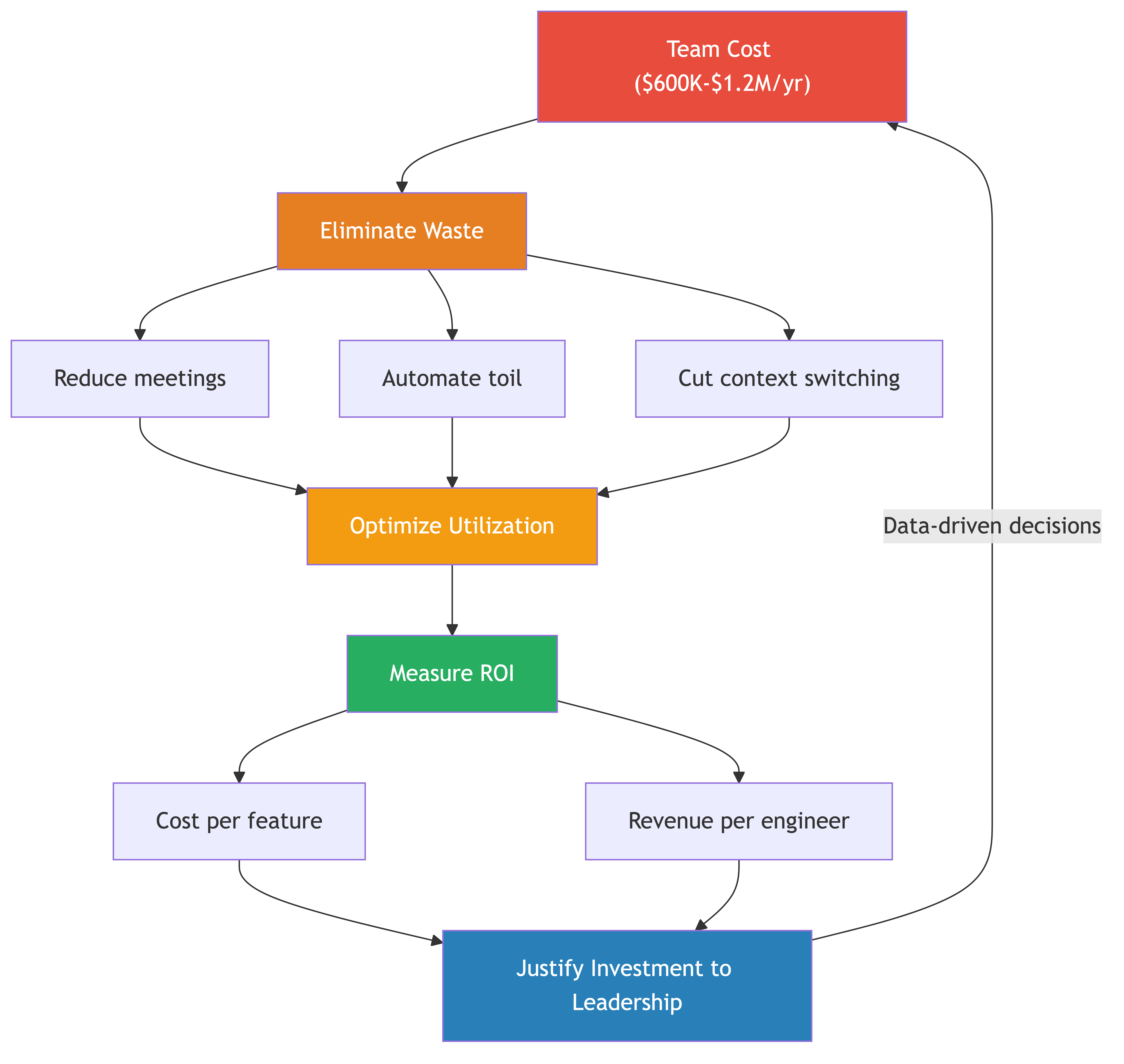
Nobody gets into engineering management because they love spreadsheets. But here's the thing — you're now responsible for one of the most expensive functions in the company. If you don't understand the economics of your team, someone else will make those decisions for you. And you probably won't like the outcome.
This isn't about becoming a bean counter. It's about being a thoughtful steward of resources so your team can do their best work on the things that actually matter.
1. Your Team is an Investment
Let's do some math that might make you uncomfortable.
A single mid-level engineer costs roughly 200K in salary. Add benefits, office space, equipment, software licenses, recruiting costs, and management overhead, and you're looking at 250K fully loaded. Some markets push that even higher.
A team of 6 engineers? That's 1.2M per year. Every year.
That's not a cost line item. That's an investment. And like any investment, leadership expects a return. They're not being unreasonable — they're running a business.
When you internalize this, it changes how you think about everything:
- That two-week spike that went nowhere? That cost 25K.
- The feature nobody uses? Months of salary, gone.
- The quarter spent on a rewrite that didn't ship? Six figures, easy.
This isn't meant to make you anxious every time someone opens their IDE. It's meant to make you intentional. Your job is to make sure that investment generates value — whether that's revenue, user growth, cost savings, or strategic positioning.
The EMs who get promoted are the ones who can articulate what their team's investment produced. "My team costs 3M in value we delivered" is a conversation leadership wants to have with you.
2. Cost Per Feature
Every feature has a price tag. Most teams never calculate it, and that's a mistake.
Here's a rough framework. Take the number of engineer-months a feature requires and multiply by your fully loaded monthly cost per engineer. A feature that takes 3 engineers 2 months is roughly 6 engineer-months, which might be 150K.
Now ask: is it worth it?
This isn't about penny-pinching or killing creativity. It's about making smart investment decisions. You wouldn't spend 150K on a feature without thinking about it either.
Some useful questions to ask before committing to work:
- What's the expected impact? Revenue, retention, efficiency — put a number on it, even a rough one.
- What's the opportunity cost? If your team builds this, what are they NOT building?
- Is there a cheaper way to validate the idea? Can you test the hypothesis with a prototype, a manual process, or even a fake door test before investing fully?
- What's the cost of delay? Sometimes speed matters more than cost. Sometimes it doesn't.
You don't need to do this analysis for every bug fix. But for any initiative that's going to consume weeks or months of team effort, you should have a back-of-napkin cost estimate and a clear rationale for why it's worth it.
The goal is to become the EM who says, "This feature will cost us roughly 4 engineer-months. Based on the expected conversion improvement, the payback period is about 3 months. I think it's worth it." That's a completely different conversation than "Product asked for it, so we're building it."
3. Eliminating Waste
Lean manufacturing identified seven types of waste. Software engineering has its own version, and most teams are swimming in it without realizing it.
Building the wrong thing. This is the most expensive waste by far. You can build something perfectly, on time, under budget — and it's still waste if nobody needed it. The cure is tight feedback loops with users and stakeholders. Validate before you build.
Rework. Building something, then rebuilding it because requirements were unclear, the design was wrong, or quality was poor. Some rework is inevitable. Chronic rework is a process problem. Look at your bug rate, your "we need to redo this" frequency, and your spec clarity.
Waiting. Engineers blocked on code reviews, waiting for decisions, waiting for access, waiting for another team's API. Blocked work is burning money. Track how long PRs sit unreviewed. Track how often engineers are waiting for answers. Then fix the bottlenecks.
Over-engineering. Building for scale you don't have, abstractions you don't need, flexibility you won't use. "But what if we need to..." is the most expensive phrase in engineering. Build for what you know, not what you imagine.
Unnecessary process. Meetings that don't produce decisions. Approval chains that slow things down without adding value. Documentation nobody reads. Ceremonies performed out of habit rather than purpose. Audit your processes regularly. If you can't articulate why a process exists and what value it provides, kill it.
Context switching. Engineers juggling 3-4 projects simultaneously finish none of them quickly. The cognitive cost of switching between tasks is enormous. Protect your team's focus.
Gold plating. Polishing something beyond what's needed. Spending a week perfecting a feature that 50 users will see. Good enough is often good enough.
Your job isn't to eliminate all waste — some is unavoidable. Your job is to see it, measure it, and systematically reduce it. Even a 20% reduction in waste across a team of 6 is like getting a free engineer.
4. Team Utilization
Let's get something out of the way: 100% utilization is a terrible goal. Here's why.
Think about a highway. At 100% capacity, traffic doesn't flow — it stops. The same thing happens with teams. When everyone is maxed out, there's no slack in the system. Urgent requests cause everything to grind to a halt. Nobody can help a teammate because they're all underwater. Quality drops. Burnout rises.
Healthy teams run at roughly 70-80% planned utilization. The remaining capacity absorbs unexpected work, allows for collaboration, and gives people room to think.
That said, there's a big difference between healthy slack and wasted time. Here's where teams commonly leak productivity:
Too many meetings. Audit your team's calendars. If engineers have less than 4 hours of uninterrupted focus time per day, you have a meeting problem. Be ruthless about which meetings your team actually needs to attend. Decline on their behalf when appropriate.
Unclear priorities. When people aren't sure what matters most, they either work on the wrong things or freeze. Your job is to make priorities crystal clear. If an engineer has to ask "what should I work on next?" more than occasionally, you've failed at this.
Context switching. Assigning engineers to multiple projects simultaneously feels efficient. It's not. The research is clear — context switching can cost 20-40% of productive time. Keep people focused on one thing at a time as much as possible.
Slow feedback loops. PRs sitting for days. Questions unanswered. Decisions delayed. Every hour an engineer is blocked is an hour of salary with zero output. Set team norms around review turnaround. Unblock people as a top priority.
Unnecessary overhead. Status reports that take an hour to write but nobody reads. Detailed estimates for work that's going to change anyway. Sprint ceremonies that run long without adding value. Challenge every piece of overhead.
Track these things. Not to micromanage — to identify systemic issues. "Our average PR review time is 4 hours" is a fact. "Our average PR review time is 2 days and it's costing us 15% of our throughput" is a problem you can fix.
5. Build vs. Buy
This decision trips up engineering teams constantly, usually because of ego.
Engineers love building things. It's literally what they do. So when someone suggests buying a tool instead of building one, the instinct is often "we can build that in a weekend." No, you can't. And even if you could, should you?
The real cost of building:
- Initial development (the "weekend" that becomes 3 months)
- Ongoing maintenance (the part everyone forgets — typically 2-4x the initial build cost over the tool's lifetime)
- Opportunity cost (your engineers aren't working on your core product)
- Operational burden (monitoring, on-call, upgrades, security patches)
- Knowledge concentration (when the person who built it leaves, then what?)
The real cost of buying:
- License fees (often per-seat, which adds up)
- Integration work (rarely plug-and-play)
- Vendor dependency (what if they raise prices, get acquired, or shut down?)
- Customization limits (it won't do exactly what you want)
- Data and security considerations
A framework for deciding:
Build when:
- It's your core competency or competitive advantage
- No existing solution fits your needs well
- You need deep integration with your systems
- The problem is unique to your business
Buy when:
- It's a solved problem (auth, payments, monitoring, CI/CD)
- It's not your core competency
- Time to market matters more than customization
- The vendor's solution is clearly better than what you'd build
Do a real TCO analysis. Total Cost of Ownership over 3 years. Include engineering time at fully loaded rates. Include maintenance. Include the opportunity cost of what your team won't build. The math often favors buying, even when the sticker price looks high.
The "we can build that in a weekend" trap is real. I've seen teams spend 6 months building an internal tool that a 300K+ in engineering time to avoid $18K in subscription costs. The math doesn't math.
6. Infrastructure Costs
Your team's code doesn't just cost money to write. It costs money to run. Every day. Forever.
Cloud spend is one of those things that sneaks up on teams. You spin up some instances for a project, add a database, set up some queues, maybe a few Lambda functions — and suddenly your monthly AWS bill has a comma in it that wasn't there before.
Basic FinOps awareness every EM should have:
Know your team's spend. You should know, roughly, what your team's services cost to run per month. If you don't know, find out today. Ask your platform team or check your cloud console.
Right-sizing. Most teams over-provision. That m5.4xlarge running at 15% CPU utilization? That's money on fire. Review instance sizes quarterly. Use monitoring data to right-size.
Reserved instances and savings plans. If you know you'll need compute for the next year, reserved instances can save 30-60% over on-demand pricing. This is free money that many teams leave on the table.
Kill unused resources. That staging environment nobody's used in 3 months? Those EBS volumes attached to terminated instances? That RDS instance for a project that was cancelled? They're all still billing you. Do a regular sweep.
Watch your data transfer. Cross-region and cross-AZ data transfer costs are a silent killer. Architecture decisions that seem minor can create massive data transfer bills.
Log and storage sprawl. Logs growing unbounded. S3 buckets accumulating data without lifecycle policies. Old snapshots and backups piling up. Set retention policies.
Development and test environments. Schedule them to shut down outside business hours. If your dev environments run 24/7 but are only used 8 hours a day, you're paying 3x what you need to.
You don't need to become a FinOps expert, but you should build basic cost awareness into your team's culture. Make cloud costs visible. Include them in architecture reviews. Celebrate when someone identifies and eliminates waste. A team that's cost-aware makes better technical decisions.
7. Justifying Engineering Investment
At some point, you're going to need to ask for something — headcount, a new tool, time for a technical initiative. The way you frame that request determines whether you get a yes or a no.
Leadership thinks in terms of investment and return. Speak their language.
Bad: "We need to hire two more engineers because we're overloaded."
Good: "We're turning away 400K fully loaded would let us deliver the payments integration (500K). Payback period: 4 months."
The ROI framework:
- Define the investment. What you're asking for, in dollars. Headcount, tool cost, engineering time diverted.
- Define the return. Revenue generated, costs saved, risks mitigated, time reclaimed. Be specific.
- Define the timeline. When will the return materialize? "Investing X will save/generate Y over Z months."
- Define the alternative. What happens if you don't make this investment? Lost revenue? Increased risk? Team attrition?
For technical debt and infrastructure work — the stuff that doesn't directly produce features — frame it in terms of speed and risk:
- "Our deployment process takes 4 hours. Investing 3 weeks of engineering time in CI/CD will reduce that to 15 minutes, saving 8 engineer-hours per week. That's $20K/year in recovered productivity, plus we ship faster."
- "Our test suite takes 45 minutes. Engineers context-switch while waiting. Investing 2 weeks to optimize it will save 30 minutes per developer per day across 6 engineers. That's roughly 15 hours per week of recovered focus time."
For tools and subscriptions:
- "This monitoring tool costs $2K/month. Last quarter we had 3 incidents that took 4+ hours to diagnose. Better observability would cut that to under an hour. At our incident cost rate, the tool pays for itself in avoided downtime within 2 months."
Always quantify. Even rough numbers are better than no numbers. Leadership doesn't expect precision — they expect that you've thought about the economics. The EM who can make a business case is the EM who gets resources.
8. Efficiency vs. Cutting Corners
Let's be absolutely clear: efficiency is not about doing less. It's about doing the right things with less waste.
Cutting corners means skipping tests, ignoring code quality, shipping without proper review, or taking on technical debt you know you'll regret. That's not efficiency — that's borrowing from the future, and the interest rate is brutal.
Real efficiency looks like this:
- Writing clear specs so engineers don't have to guess and rebuild
- Investing in CI/CD so deployments are fast and reliable
- Building reusable components instead of reinventing the wheel
- Having good monitoring so you catch issues before customers do
- Running effective meetings that end with decisions, not more meetings
Quality and efficiency reinforce each other. This is counterintuitive but important. Teams that write good tests ship faster because they spend less time debugging production issues. Teams that do thorough code reviews have fewer bugs and less rework. Teams that invest in developer tooling move faster over time.
The false economy of cutting corners is one of the most expensive mistakes in engineering. "We'll skip tests to ship faster" turns into "we're spending 40% of our time on bug fixes." "We'll worry about performance later" turns into a 3-month emergency rewrite.
Here's a useful mental model: efficiency is about reducing the cost of doing things right, not about lowering your standards. Automate your testing instead of skipping it. Streamline your review process instead of eliminating it. Simplify your architecture instead of hacking around complexity.
When someone on your team suggests skipping a quality practice "to move faster," ask: "Will this actually make us faster over the next 3 months, or just this week?" The answer usually makes the right choice obvious.
9. Real-World Examples
The EM Who Optimized Output Without Adding Headcount
Maria managed a team of 5 engineers that was constantly "behind." The default ask was to hire 2 more people. Instead, she did an analysis.
She found that her engineers spent an average of 12 hours per week in meetings — many of which they didn't need to attend. PR reviews took an average of 2 days because there was no team norm around turnaround time. And engineers were each juggling 2-3 projects simultaneously, destroying their focus.
She cut unnecessary meetings (saving each engineer ~6 hours/week), set a 4-hour PR review SLA, and restructured work so each engineer owned one project at a time. Within two months, the team's throughput increased by roughly 35%. They went from "we need more people" to "we're ahead of our roadmap" without adding a single headcount.
Cost of the fix: zero dollars. Value created: the equivalent of hiring 1.5 engineers (375K/year in equivalent output).
The Team Burning Money on Cloud Waste
A backend team had a monthly AWS bill of $45K. Nobody really questioned it — it had grown gradually and "that's just what our services cost."
A new engineer joined and, during onboarding, asked why they were running 8 staging environments when only 2 were actively used. That question led to a broader audit. They found $12K/month in waste: unused environments, over-provisioned instances running at 10% CPU, EBS volumes from terminated instances, and a logging pipeline that was storing everything at full resolution forever.
Over 3 weeks (partial effort from one engineer), they cleaned it up. Monthly spend dropped to 17K/month, or $204K/year. The engineer who drove it got a shout-out from the VP of Engineering.
The Build-vs-Buy Decision That Saved 6 Months
A platform team was tasked with building an internal feature flagging system. They estimated 6 weeks. The team lead pushed back and suggested evaluating LaunchDarkly instead.
The reaction was predictable: "It's too expensive," "We need custom logic," "We can build something better." The team lead ran the numbers anyway.
Building in-house: 6 weeks of initial build (which, based on the team's track record, would realistically be 10-12 weeks), plus ongoing maintenance estimated at 20% of one engineer's time. Three-year TCO: roughly $350K in engineering time.
Buying LaunchDarkly: 115K.
They bought. The 6 months they saved went toward building features that directly contributed to a product launch that generated $1.2M in new revenue in its first year. The "expensive" SaaS tool was one of the best investments the team made.
10. Common Mistakes
Ignoring costs entirely. "That's a finance problem, not an engineering problem." Wrong. If you manage a team, you manage a budget — whether there's a formal budget or not. Your team's salary is a budget. Your cloud spend is a budget. Own it.
Over-optimizing (premature optimization of people). Tracking every hour, measuring lines of code, obsessing over individual productivity metrics. This drives good engineers away. Focus on team-level outcomes, not individual micro-metrics. If the team is delivering value, don't micromanage how each person spends every hour.
Not tracking cloud spend. "I have no idea what our services cost to run." This is shockingly common and always embarrassing when leadership asks. Set up cost alerts. Review your bill monthly. Know your numbers.
Building everything in-house. "We're engineers, we should engineer things." No. You should engineer things that matter for your business. Use off-the-shelf solutions for everything else. Your competitive advantage is not your homegrown deployment pipeline.
Treating engineers as interchangeable. "We have 6 engineers, that's 6 units of capacity." Engineers have different strengths, different domain knowledge, different ramp-up times. Swapping someone onto a new codebase doesn't give you instant productivity — it gives you weeks of ramp-up time and a less productive engineer in the meantime.
Confusing busyness with productivity. A team that's always busy but never ships is more expensive than a team with slack time that consistently delivers. Measure output, not input.
Penny-wise, pound-foolish. Refusing to buy a 100/hour fully loaded is 500 to save $50. Stop it.
Not communicating value. You could be running the most efficient team in the company, but if leadership doesn't know, it doesn't help you when budget cuts come. Make your team's value visible. Regular updates on what was delivered and what it's worth.
Business Value
Everything in this guide ladders up to concrete business outcomes. Here's how to think about the value of engineering efficiency.
Direct Cost Savings
Efficiency improvements translate directly to the bottom line:
- Reducing cloud waste saves real dollars every month, compounding over time
- Eliminating unnecessary tools and licenses removes recurring costs
- Better build-vs-buy decisions prevent six-figure engineering investments in commodity problems
- Reducing rework means fewer engineer-hours spent on things that don't add value
Even modest improvements add up. A 10% efficiency gain across a team costing 100K in recovered value — every single year.
ROI of Efficiency Improvements
The return on investing in efficiency is often surprisingly high:
- CI/CD improvements that save 30 minutes per developer per day across 6 engineers = 15 hours/week = roughly $75K/year in recovered productivity
- Reducing meeting load by 5 hours per engineer per week = 30 hours/week = roughly $150K/year in recovered engineering time
- Cutting average PR review time from 2 days to 4 hours = faster shipping = earlier revenue realization
These aren't theoretical savings. They're engineer-hours that get redirected from waste to value-creating work. When your team ships the payments integration 6 weeks earlier because they weren't stuck in meetings and waiting for reviews, that's 6 weeks of additional revenue.
Competitive Advantage
Teams that operate efficiently move faster. Full stop.
If your team can ship a feature in 4 weeks that takes your competitor's team 12 weeks, you have a 3x speed advantage. That compounds over time into a significant product lead. Efficiency isn't just about saving money — it's about winning by moving faster with the same or fewer resources.
Companies that master engineering efficiency can do more with less, which means they can invest in more bets, respond faster to market changes, and outpace competitors who are burning resources on waste.
Leadership Trust
This might be the most underrated benefit. When you demonstrate cost awareness and efficiency thinking, leadership trusts you with more.
More headcount. Bigger projects. More autonomy. Strategic input.
The EM who says, "I need 3 more engineers" gets skepticism. The EM who says, "I've optimized our current team to deliver 30% more, and here's the data. Now, with 2 additional engineers, here's the specific revenue impact we can deliver" gets headcount.
Cost awareness isn't about being cheap. It's about being credible. When you show leadership that you understand the economics of your team and you're a responsible steward of resources, they give you more resources. It's that simple.
Pulling It All Together
Engineering efficiency isn't a one-time project. It's a mindset. It's checking your cloud bill the same way you check your team's sprint progress. It's asking "is this worth the investment?" before committing to major work. It's protecting your team's focus so they can do their best work on the things that matter most.
You don't need to become a finance person. You need to become an engineering leader who understands that every decision has an economic dimension, and who makes better decisions because of that understanding.
Start with three things:
- Know your numbers. What does your team cost? What does your infrastructure cost? What value did your team deliver last quarter?
- Make waste visible. Track meeting load, review times, blocked work, and unused resources. You can't fix what you can't see.
- Communicate value. Tell leadership what your team delivered and what it's worth. Regularly. In their language.
Do those three things consistently and you'll be ahead of 90% of engineering managers. Not because the bar is high — but because most EMs never think about this stuff at all. Be the one who does.
Common Pitfalls
- Ignoring costs entirely and treating them as someone else's problem. If you manage a team, you manage a budget — whether there is a formal one or not. Abdicating financial awareness means someone else will make decisions about your team without your input.
- Confusing busyness with productivity. A team that is always busy but never ships is more expensive than a team with slack time that consistently delivers. Measuring hours worked instead of value delivered creates the illusion of efficiency.
- Building everything in-house out of engineering pride. The instinct that "we can build that in a weekend" routinely leads to months of effort on commodity problems that a SaaS product solves better for a fraction of the cost.
- Not tracking cloud spend. Letting infrastructure costs grow unchecked because nobody is watching is shockingly common and always embarrassing when leadership asks. Over-provisioned instances, unused environments, and unbounded log storage silently burn budget.
- Penny-wise, pound-foolish decisions. Refusing to buy a $50/month tool that saves hours of engineering time, or skipping a conference that would accelerate a critical initiative, represents a failure of basic ROI thinking.
- Cutting corners and calling it efficiency. Skipping tests, ignoring code review, or shipping without monitoring is not efficiency — it is borrowing from the future at a brutal interest rate that shows up as incidents, rework, and technical debt.
Key Takeaways
- Your team is an investment, not a cost. A team of six engineers can easily cost 1.2M per year, and leadership expects a return on that investment. Your job is to articulate what that return looks like.
- Every significant feature has a price tag. Calculating cost per feature — even roughly — transforms the conversation from "product asked for it" to a deliberate investment decision with expected ROI.
- The seven types of engineering waste — building the wrong thing, rework, waiting, over-engineering, unnecessary process, context switching, and gold plating — are where most efficiency gains hide. Even a 20% reduction is like getting a free engineer.
- Healthy teams run at 70-80% planned utilization. 100% utilization destroys slack, prevents collaboration, and causes everything to grind to a halt when unexpected work arrives.
- Build vs. buy decisions should be based on total cost of ownership over three years, including maintenance, opportunity cost, and operational burden — not on sticker price or engineering pride.
- Infrastructure costs require active management: right-sizing instances, killing unused resources, using reserved capacity, and setting retention policies on logs and storage.
- Frame every significant expense as an investment with a return. "I need more people" is not a business case. "Two engineers at 4M in ARR with a 4-month payback" is.
- Quality and efficiency reinforce each other. Teams that write good tests ship faster, teams that do thorough reviews have less rework, and teams that invest in tooling accelerate over time.