
Cross-Team Coordination
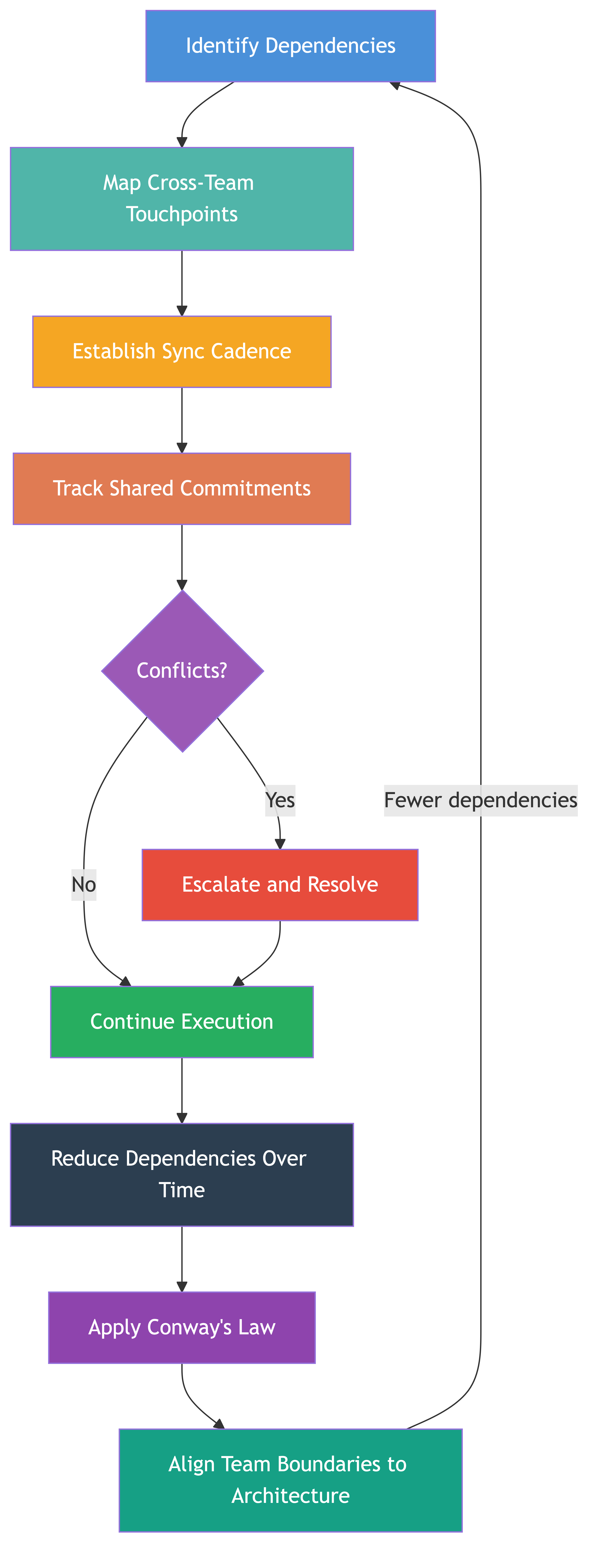
Why This Matters
Here is a truth that catches most engineering managers off guard: the hardest problems in your job are not within your team. They are between teams. The space between two teams is organizational no-man's land — no one owns it, no one maintains it, and that is exactly where projects go to die.
You can run the tightest ship in the entire engineering org. Your standups are crisp, your sprints are clean, your team ships like clockwork. And then a cross-team dependency slips, and your beautiful roadmap is suddenly three weeks behind because another team reprioritized and nobody told you.
Cross-team coordination is not a soft skill. It is a core engineering management competency. And if you do not get good at it, you will spend your career watching projects stall at team boundaries while everyone points fingers at everyone else.
Let's talk about how to actually make this work.
1. Why Cross-Team Work is Hard
Before you can fix cross-team coordination, you need to understand why it breaks so reliably. It is not because people are bad at their jobs. It is structural.
Different priorities. Your team's top priority is someone else's "nice to have." You need their API endpoint by March. They are heads-down on a migration that their leadership is tracking weekly. Your request is sitting in their backlog behind six other things. This is not malice — it is rational behavior given their incentive structure.
Different timelines. Your team plans in two-week sprints. The platform team plans in quarters. The data team is mid-reorg and not planning anything right now. These rhythms do not naturally sync, and nobody is responsible for making them sync.
Different managers. Your manager cares about feature delivery velocity. Their manager cares about system reliability. These are both valid goals, but they create fundamentally different decision-making frameworks. When your request lands on their desk, it gets evaluated through a lens that was not designed to value what you value.
No one owns the gaps. Inside your team, you own everything. The backlog, the architecture, the priorities, the delivery timeline — it is all yours. But the space between teams? That is a shared commons, and shared commons get neglected. No one's performance review says "kept cross-team interfaces healthy." So no one does.
Information asymmetry. You do not know what the other team is dealing with. They do not know what you are dealing with. You are both making decisions with incomplete information about the other's constraints, and those decisions interact in ways neither of you predicted.
This is not a people problem. It is a systems problem. And like all systems problems, it requires deliberate design to solve.
2. Types of Cross-Team Dependencies
Not all dependencies are the same, and treating them identically is a mistake. Each type requires different handling.
API dependencies. Your team consumes an API owned by another team. You need them to build an endpoint, modify a response format, or maintain uptime guarantees. This is the most common dependency and the most manageable — as long as you have clear contracts.
How to handle it: Define the API contract early. Write it down. Agree on the schema, the error handling, the SLAs. Then build against mocks while the other team builds the real thing. If you are blocked waiting for a live API before you can write any code, your architecture has a coupling problem.
Shared services. Authentication, notifications, payments, search — these services are used by multiple teams, which means every team is competing for the same roadmap. Your feature request goes into a queue with requests from five other teams.
How to handle it: Treat the shared service team like an internal vendor. Submit clear, well-scoped requests with business justification. Understand their prioritization framework so you can position your request effectively. And always have a fallback plan for if they cannot get to it in time.
Data dependencies. Your team needs data that another team produces. Maybe it is an event stream, a data pipeline, a shared table. Data dependencies are insidious because they look simple on the surface but are brittle underneath. Schema changes, data quality issues, pipeline delays — any of these can break you silently.
How to handle it: Define a data contract. What fields do you depend on? What are the acceptable value ranges? What is the freshness requirement? Set up monitoring that alerts you when the contract is violated, because the producing team will not always know when they broke something downstream.
Platform dependencies. Your team needs the platform or infrastructure team to provision something, enable a feature flag, update a configuration, or support a new deployment pattern. These dependencies often have long lead times and opaque processes.
How to handle it: Build relationships with the platform team before you need something urgent. Understand their request process and lead times. Submit requests early, with enough context that they can prioritize intelligently. And when possible, advocate for self-service tooling so the dependency disappears entirely.
Release coordination. Multiple teams need to ship changes at the same time for a feature to work end-to-end. This is the most nerve-wracking type because the blast radius of a slip is massive — if one team is not ready, nobody ships.
How to handle it: Identify coordinated releases as early as possible and treat them like projects, not like a collection of independent deployments. Assign a single owner for the coordination. Build in buffer time. Define rollback plans for each team independently. And practice the deploy sequence in staging before you do it in production.
3. Dependency Tracking
Hidden dependencies are the ones that hurt you. The dependency you know about, you can manage. The dependency you discover on launch day is a disaster.
Make dependencies visible. This sounds obvious, but most teams do not do it. They track their own work meticulously in Jira or Linear, but the links to other teams' work are informal — a Slack message, a verbal agreement, a "yeah they said they'd have it done by then."
Start simple. You do not need a fancy tool for this. A shared spreadsheet or a section in your project plan works fine:
| Dependency | Owner Team | Our Need-By Date | Their Committed Date | Status | Risk Level |
|---|---|---|---|---|---|
| User service API v2 | Platform | March 1 | Feb 15 | On track | Low |
| Event stream schema update | Data | March 1 | TBD | Not started | High |
| SSO integration | Auth | March 15 | March 10 | In progress | Medium |
Update it regularly. A dependency tracker that was accurate two months ago is worse than no tracker at all, because it gives you false confidence. Review it weekly. Reach out to the owning teams and confirm status. Do not rely on what they said last month — things change.
Flag risks early. The moment a dependency looks like it might slip, raise it. Do not wait until it actually slips. "I'm seeing some risk on the event stream schema update — the data team hasn't started and we need it by March 1" is a conversation you can have in January and do something about. That same conversation in late February is a fire drill.
Share it broadly. Your dependency tracker should not live in your head or in a doc that only your team can access. Share it with the teams you depend on. When people can see that someone is depending on them, it changes behavior. It is much harder to quietly deprioritize something when the downstream impact is visible.
4. Cross-Team Syncs
You need cross-team syncs. You also need them to not suck. Most cross-team meetings are terrible — eight people in a room giving status updates that could have been a Slack message. Here is how to make them worth everyone's time.
When to have them. Not always. You do not need a standing cross-team sync just because two teams share a codebase. You need them when there is active, ongoing coordination that requires real-time discussion. Specifically:
- When multiple teams are working toward a shared launch with interdependencies
- When there is an active conflict or misalignment that needs regular check-ins to resolve
- When a shared project is in its critical path and decisions need to happen quickly
Once the coordination need goes away, kill the meeting. Nothing is worse than a cross-team sync that outlived its purpose and now exists purely out of inertia.
Who attends. Keep it small. You need the people who can actually make decisions and commit their teams to actions. Typically that means the EM or tech lead from each involved team — not the whole team. If more than six people are in the meeting, you have too many people and the meeting will devolve into a spectator sport.
How to run them. Follow this structure and you will be fine:
- Blockers and risks (5 minutes). What is blocked right now? What might get blocked this week? This is the only part that is truly urgent. Start here.
- Decisions needed (10 minutes). What decisions require input from multiple teams? Make them in the meeting if possible. If not, assign an owner and a deadline.
- Action items from last time (5 minutes). Quick check — did the things we said would happen actually happen?
- Upcoming coordination needs (5 minutes). What is coming in the next two weeks that the other teams should know about?
That is a 25-minute meeting. You will be tempted to let it expand. Do not. If a topic needs deeper discussion, spin it out into a separate meeting with only the relevant people.
What to avoid. Status updates. If someone is reading their Jira board out loud, something has gone wrong. Status can be shared asynchronously. The meeting is for interaction — for the things you cannot do in a Slack thread.
5. Resolving Cross-Team Conflicts
Cross-team conflicts are inevitable. Two teams want the same engineer's time. Two teams disagree on an API design. Two teams have deadlines that cannot both be met. The question is not whether you will have conflicts — it is how you resolve them.
Start with shared goals. Most cross-team conflicts feel like zero-sum games because each team is optimizing for its own metric. The way out is to zoom up one level and find the shared goal. Both teams report to the same VP? That VP has a goal. Both teams serve the same customer segment? That segment has a need. Find the frame where both teams are on the same side, and the conflict transforms from "us vs. them" into "how do we solve this together."
Data over opinions. When two teams disagree about priority, the conversation usually sounds like "well, our thing is really important" vs. "well, our thing is really important too." This goes nowhere. The tiebreaker is data. What is the revenue impact? What is the customer impact? What is the risk if we delay? Bring numbers to the table and let them do the arguing for you.
Explore creative compromises. Before you lock into "either we get what we want or they get what they want," look for the third option. Can you get 80% of what you need with a simpler solution that does not require as much of their time? Can you stagger the work so both teams get what they need, just on a different timeline? Can you temporarily work around the dependency while they finish their higher-priority work?
The best cross-team coordinators are creative negotiators. They do not just advocate for their team's position — they actively look for solutions that work for everyone.
Escalation as a last resort. If you cannot resolve it at your level, escalate. But do it right:
- Escalate together, not behind each other's backs. "Hey, I think we need our managers to weigh in on this — can we set up a meeting together?" Not a side conversation where you lobby your VP to overrule their decision.
- Present the tradeoff clearly. "Here are the two options, here are the pros and cons of each, here is what we tried, and here is where we are stuck." Do not present it as "they are wrong and we are right."
- Accept the decision. Once leadership decides, commit to it fully. Do not relitigate. Do not undermine. Move forward.
Escalation is not failure. Sometimes two teams genuinely cannot resolve a priority conflict because the tradeoff requires information or authority they do not have. That is what management chains are for. But if you are escalating every conflict, you are either not trying hard enough at your level or you have a broken peer relationship that needs direct repair.
6. Alignment Documents
Verbal agreements between teams are not worth the air they are spoken into. Memories differ, contexts shift, people leave. You need things written down.
An alignment document is a contract between teams. Not a legal contract — a working agreement that makes expectations explicit so everyone can hold each other accountable.
What goes in an alignment document:
Ownership map. Who owns what? Be specific. "The auth team owns authentication" is not specific enough. "The auth team owns the login flow, session management, token issuance and validation, and SSO integration. The user team owns user profile data, preferences, and account settings. The auth team provides a /validate-token endpoint; the user team calls it but does not implement its own token validation." That is specific enough.
Interface definitions. What does the contract between the teams look like? If it is an API, write down the endpoints, the request/response schemas, the error codes. If it is a data pipeline, write down the schema, the freshness guarantees, the data quality expectations. If it is a shared library, write down the versioning policy and the deprecation process.
Timeline commitments. What are the key dates, and what does each team commit to delivering by those dates? Be honest about confidence levels. "We are 90% confident we can deliver the API by March 1, but if the scope expands to include batch operations, we would need until March 15" is far more useful than "we will have it done by March 1."
Slip protocol. What happens if someone misses a date? This is the part everyone forgets, and it is the most important part. If Team A slips by a week, what does Team B do? Do they have a workaround? Do they slip too? Is there a fallback plan? Define this before the slip happens, because in the moment, everyone will be too stressed to think clearly.
Escalation path. If there is a disagreement about interpretation or priority, who makes the call? Usually this is the managers of both teams, or a shared director.
Keep these documents short. One to two pages. If it is longer, no one will read it and it will become stale. Update it when things change — and things will change.
7. Working with Platform/Infrastructure Teams
Platform teams are a special case. They serve every team in the org, which means they are perpetually oversubscribed, and your request is always competing with requests from teams you have never even heard of.
Understanding this dynamic will make you a much more effective partner.
Be a good customer. When you submit a request to the platform team, make their job easy:
- Clearly describe what you need and why. Not "we need a new database," but "we need a PostgreSQL instance with read replicas in us-east-1 and eu-west-1 to support our multi-region launch, which is targeting Q2 and is a top-3 company priority."
- Provide business context. Platform teams constantly triage requests. Help them understand why yours matters. "This supports the enterprise launch that the CEO mentioned in the all-hands" gets prioritized differently than "we want to try a new database."
- Be specific about timelines. "We need this soon" is useless. "We need the instance provisioned by February 15 so we can begin load testing, with production readiness by March 1" gives them something to plan around.
- Ask what they need from you. Sometimes your request is blocked because they need information, access, or a decision from your side. Do not just throw a request over the wall and wait.
Understand their prioritization model. Most good platform teams have an explicit prioritization framework. Learn it. If they prioritize based on number of teams impacted, and your request only affects your team, you know it will rank lower. That is not unfair — it is rational resource allocation. If you need to escalate, do it through proper channels with business justification, not by complaining that they are not responsive.
Invest in self-service. The long-term answer to platform dependencies is not better coordination — it is self-service. Every time you work with the platform team, ask yourself: could this be a self-service capability? Could we provision our own databases through a portal? Could we set up our own monitoring dashboards without a ticket? Advocate for self-service investments. They reduce coordination cost for everyone.
Build the relationship before you need it. Do not let your first interaction with the platform team be an urgent request. Introduce yourself. Understand their roadmap. Attend their office hours if they have them. When you do need something urgent, it helps enormously to be someone they already know and trust.
8. Reducing Dependencies
The best cross-team coordination strategy is needing less of it. Every dependency is a potential point of failure, a communication overhead, and a scheduling constraint. Fewer dependencies means faster teams.
Decouple where possible. If your team constantly needs another team to make changes for you, something is wrong with your architecture. Look for ways to decouple:
- Can you consume their data through a published event stream instead of calling their API synchronously?
- Can you own a thin integration layer that translates their service's interface into what your team needs, so their changes do not ripple into your code?
- Can you use feature flags to ship your changes independently, even if the full feature requires coordinated changes?
API contracts over coordination. When two teams agree on an API contract — the endpoints, the schemas, the error handling, the SLAs — they can work independently as long as they honor the contract. This is the fundamental insight behind microservices (when done well) and the reason well-defined interfaces matter so much. A good contract turns a coordination problem into a testing problem, and testing is something each team can do on their own.
Autonomous teams. The ideal team can go from idea to production without needing anyone else's permission or participation. In practice, no team is fully autonomous, but you should be pushing in that direction. Every time you find yourself saying "we cannot do this until Team X does Y," ask: is there a way to restructure so we do not need that dependency?
Conway's Law. Melvin Conway observed in 1967 that organizations design systems that mirror their communication structures. This is not a suggestion — it is a law of nature in software. If two teams must communicate heavily to build a feature, the system boundary between their services is in the wrong place. When you see persistent, painful cross-team dependencies, it is often a signal that team boundaries and system boundaries are misaligned. Sometimes the fix is not better coordination — it is reorganizing which team owns what.
This does not mean you reorganize every time there is friction. But when the same two teams are constantly coordinating on the same interface, it is worth asking: should one team own both sides of this interface?
9. Real-World Examples
Theory is useful. Stories are better. Here are three scenarios that illustrate how cross-team coordination plays out in practice.
Scenario 1: The Well-Coordinated Launch
A payments team and a checkout team needed to launch a new payment method — buy-now-pay-later — that required changes on both sides. The payments team needed to integrate with a third-party provider and expose new endpoints. The checkout team needed to add UI for the new option and handle the new response types.
What they did right:
- They started coordination six weeks before the target launch, not two.
- They wrote an alignment document defining the API contract, the timeline, and the slip protocol.
- They set up a weekly 20-minute sync with just the two tech leads and the PM.
- The checkout team built against mock responses from day one, so they were never blocked waiting for the live integration.
- They defined three launch phases: internal dogfooding, 5% rollout, full rollout. Each phase had independent go/no-go criteria.
- When the payments team slipped by four days on the third-party integration, the checkout team was not affected because they were still working against mocks. The four-day slip ate into buffer time, not delivery time.
The launch went smoothly. Not because nothing went wrong, but because they had planned for things to go wrong.
Scenario 2: The Dependency That Blocked a Release
A feature team needed an update to the notification service — a new notification type with custom templates. The notification service was owned by the platform team. The feature team mentioned it to the platform team in a Slack message. The platform team said "sure, we can get to that." No timeline was discussed. No document was written.
Six weeks later, the feature team was code-complete and ready to ship. The notification service change had not been started. The platform team had taken on an urgent reliability project and pushed all feature requests to the next quarter. The feature team had no fallback plan.
The result: a three-week delay while the feature team scrambled. They ended up building a hacky workaround — sending emails through a completely separate service — which created technical debt that took months to clean up.
What went wrong:
- No written commitment. "Sure, we can get to that" is not a commitment.
- No timeline agreed upon. The feature team assumed "soon." The platform team assumed "whenever we get to it."
- No dependency tracking. If the feature team had been reviewing their dependency tracker weekly, they would have noticed the platform team had not started.
- No fallback plan. The feature team had a single path to launch and no backup.
- No early escalation. By the time the feature team raised the issue, it was too late to reprioritize without significant disruption.
Scenario 3: The Conflict Resolved Through Shared Goals
Two teams — growth and enterprise — both needed the data engineering team to build pipelines for them. Growth needed a real-time event pipeline for their experimentation platform. Enterprise needed a batch pipeline for their new reporting dashboard. The data team had capacity for one project that quarter, not both.
The initial conversation was adversarial. Growth said their project drove acquisition metrics. Enterprise said their project was needed to close a $5M deal. Both escalated to their respective directors.
The directors, instead of picking a winner, brought both teams together and asked: "What is the company's top priority this quarter?" The answer was clear from the CEO's quarterly letter — land enterprise deals. But the growth metrics also mattered for the Series C fundraise.
The resolution:
- The data team would build the batch pipeline for enterprise first, targeting a six-week delivery.
- They would then build the real-time pipeline for growth, targeting delivery by end of quarter.
- To make the growth timeline work, the growth team agreed to lend one engineer to the data team for the first three weeks to help with the batch pipeline, accelerating it.
- Both teams signed off on the plan in writing.
Nobody got everything they wanted on the timeline they wanted. But both teams got what they needed, and the cross-lending of an engineer actually built a stronger relationship between the teams long-term.
10. Common Mistakes
These are the mistakes I see engineering managers make with cross-team coordination over and over again. Learn from other people's pain.
Assuming the other team knows your timeline. You mentioned it once in a Slack thread three weeks ago. They have since had 500 other Slack conversations. They do not remember your timeline. Write it down. Remind them. Confirm it. And then confirm it again.
Not tracking dependencies. If your dependencies live in your head or in scattered Slack messages, you do not have dependency tracking. You have hope. Hope is not a strategy.
Escalating too quickly. Some managers escalate at the first sign of friction. This burns trust and reputation. The other team's EM does not want their VP getting pinged every time there is a minor disagreement. Try to resolve it at your level first. Most cross-team conflicts are solvable with a direct conversation between the two EMs.
Escalating too slowly. The flip side. Some managers are so conflict-averse that they let problems fester for weeks, hoping they will resolve themselves. They will not. If you have had two direct conversations and the conflict is not moving, escalate. Delayed escalation often means the problem grows to a size that is much harder to resolve.
Blaming other teams. "We missed the deadline because the platform team did not deliver their part." Maybe. But did you track the dependency? Did you follow up? Did you have a fallback plan? Did you escalate early when you saw risk? If you are surprised by another team's miss, that is at least partially your coordination failure.
Over-indexing on meetings. More meetings is not better coordination. In fact, too many cross-team meetings create meeting fatigue and crowd out actual work. Every meeting should have a clear purpose, and if that purpose can be served asynchronously, kill the meeting.
Not building relationships. Cross-team coordination is fundamentally about human relationships. If you do not know the other team's EM, if you have never had a coffee chat, if you only interact through Jira tickets — your coordination will be transactional at best and adversarial at worst. Invest 30 minutes in a relationship-building conversation and it will pay for itself a hundred times over.
Treating all dependencies the same. A hard deadline dependency where your launch is blocked is not the same as a soft dependency where a nice-to-have feature would be slightly better with another team's work. Prioritize your coordination effort on the dependencies that actually matter.
Business Value
Cross-team coordination is not just an operational nicety. It has direct, measurable business impact.
Blocked teams burn money. When a team of six engineers is blocked for a week waiting on another team, that is roughly 50,000 in fully-loaded salary cost producing zero output. Multiply that by every cross-team block across the org and you are looking at a staggering amount of wasted spend. Good coordination does not eliminate all blocks, but it reduces them significantly.
Coordination cost reduction. Every hour spent in an unnecessary cross-team meeting, every day spent on a miscommunication, every week spent rebuilding something because two teams made incompatible decisions — that is coordination cost. Organizations with good cross-team practices spend dramatically less time coordinating and more time building. The difference between a well-coordinated org and a poorly-coordinated one is often 20-30% of engineering capacity.
Faster cross-team delivery. Features that span multiple teams are almost always the highest-impact features — they are big enough to require multiple teams, which usually means they are big enough to move business metrics. When cross-team delivery is fast and reliable, the company can pursue more ambitious initiatives. When it is slow and unpredictable, the company defaults to small, single-team projects that are safe but incremental.
Customer impact. Customers do not care about your org chart. They experience your product as a single thing. When cross-team coordination fails, it shows up as inconsistent experiences, features that half-work, integrations that feel bolted on. Good coordination produces cohesive products.
Talent retention. Engineers hate being blocked. They hate waiting on other teams. They hate working on projects that stall at the finish line because of coordination failures. Organizations that are good at cross-team coordination are more enjoyable to work in, and that matters for retention.
The math is simple: invest time in coordination practices upfront, or pay for coordination failures on the back end. The upfront investment is always cheaper.
Common Pitfalls
- Assuming the other team knows your timeline. Mentioning a deadline once in a Slack thread three weeks ago does not constitute communication. If it is not written down, confirmed, and regularly revalidated, it is hope — not coordination.
- Not tracking dependencies in a visible, shared format. Dependencies that live in your head or in scattered Slack messages will surprise you at the worst possible time. Without active tracking, you are relying on luck to deliver cross-team work.
- Escalating too quickly or too slowly. Escalating at the first sign of friction burns trust and reputation. Letting problems fester for weeks hoping they will resolve themselves allows small issues to grow into major blockers. Find the balance — try to resolve at your level first, then escalate decisively when direct conversation fails.
- Blaming other teams for coordination failures. If you are surprised by another team's miss, that is at least partially your coordination failure. Did you track the dependency, follow up regularly, have a fallback plan, and escalate early when you saw risk?
- Relying on verbal agreements instead of written alignment documents. Memories differ, contexts shift, and people leave. Verbal agreements are not worth the air they are spoken into. Write down ownership, interface definitions, timeline commitments, and slip protocols.
- Over-indexing on meetings instead of reducing dependencies. More meetings is not better coordination. The best long-term strategy is to reduce the need for coordination through decoupling, API contracts, self-service tooling, and autonomous team design.
Key Takeaways
- The space between teams is where most project failures happen. Own that space deliberately.
- Different types of dependencies need different handling strategies. Do not treat them all the same.
- Make dependencies visible. Track them actively. A hidden dependency is a future crisis.
- Cross-team syncs should be short, focused, and action-oriented. Kill them when they are no longer needed.
- Resolve conflicts at your level using shared goals and data. Escalate only when you genuinely cannot resolve it.
- Write things down. Alignment documents are cheap insurance against miscommunication.
- Be a good partner to platform teams. Understand their constraints. Advocate for self-service.
- Reduce dependencies wherever possible. The best coordination is no coordination.
- Build relationships before you need them. You cannot build trust during a crisis.
- When teams are blocked, the company is burning money. Good coordination is a direct financial investment.