
Technical Roadmap & Vision
You've probably been in this situation: someone asks, "What's the team working on next quarter?" and the honest answer is, "Whatever's on fire." That's what happens without a technical roadmap. You're not leading — you're reacting. And reactive teams burn out, ship slowly, and lose the trust of the people around them.
A roadmap changes that. It turns your team from firefighters into builders.
Why You Need a Technical Roadmap
Here's the thing about engineering work — if you don't plan for it deliberately, it doesn't happen. Product will always have another feature. Support will always have another escalation. And that database migration you've been meaning to do for six months? It keeps sliding.
A roadmap does a few critical things:
- It creates space for technical investment. When tech debt reduction is on the roadmap, it's real work — not something you sneak in between features.
- It gives your team direction. People want to know their work is going somewhere. A roadmap says, "Here's where we're headed and why it matters."
- It justifies saying no. When someone asks for something unplanned, you can point to the roadmap and have a real conversation about trade-offs instead of just absorbing more work.
- It builds trust with leadership. Executives don't trust teams that can't articulate what they're doing and why. A roadmap is your credibility on paper.
Without a roadmap, you're managing a to-do list. With one, you're leading an engineering organization.
Roadmap vs. Vision
These two things are related but different, and confusing them causes problems.
Vision is where you're going. It's a 1-2 year picture of what your technical landscape looks like when things are going well. It answers questions like:
- What does our architecture look like?
- What capabilities do we have that we don't have today?
- What problems have we solved?
- What does the developer experience feel like?
A vision might sound like: "In 18 months, we've migrated off the monolith, our deploy pipeline is under 15 minutes, and any engineer can spin up a new service in a day."
Roadmap is how you get there. It's the quarter-by-quarter plan that breaks the vision into concrete, sequenced work. It answers:
- What are we doing this quarter?
- What comes next quarter and why?
- What are the dependencies and milestones?
Think of it this way — the vision is the destination on the map. The roadmap is the route you're driving. You need both. A vision without a roadmap is a daydream. A roadmap without a vision is a random collection of projects.
One important note: the vision should be stable. You don't change your destination every month. The roadmap, on the other hand, gets updated regularly as you learn more. That's healthy — it means you're adapting.
Aligning Technical Work with Business Goals
This is where a lot of engineering managers struggle, and it's arguably the most important skill in roadmap building.
Every single item on your technical roadmap should trace back to a business outcome. Every one. If you can't explain why a piece of technical work matters to the business, either you haven't thought about it hard enough or it shouldn't be on the roadmap.
Here's what good alignment looks like:
| Technical Initiative | Business Outcome |
|---|---|
| Migrate to managed Kubernetes | Reduce infrastructure costs by 30%, enable auto-scaling for traffic spikes |
| Rewrite payment processing | Reduce failed transactions by 50%, unblock international expansion |
| Implement feature flags | Ship features 3x faster, enable A/B testing for product team |
| Upgrade monitoring stack | Reduce MTTR from 2 hours to 15 minutes, improve uptime SLA |
Notice the pattern: "We're doing X because it enables Y." That "because" is everything.
When you present technical work this way, a few things happen:
- Product and leadership understand it. They may not know what Kubernetes is, but they understand reducing costs by 30%.
- Prioritization becomes easier. When everything ties to business value, you can compare apples to apples.
- You get buy-in faster. "I want to refactor the codebase" gets pushback. "I want to reduce our time-to-ship from 3 weeks to 1 week by simplifying our deployment architecture" gets funding.
If you're having trouble making the connection, ask yourself: "If we don't do this, what happens to the business in 6 months?" The answer to that question is your business case.
Building the Roadmap
Building a good roadmap is a process, not a one-time event. Here's how to approach it.
Gather Inputs
You need information from multiple sources. Don't build a roadmap in isolation.
- Business goals. What is the company trying to achieve this year? Revenue targets, new markets, new products? Your roadmap should support these.
- Tech debt inventory. What's broken, slow, fragile, or painful? You need an honest assessment. Talk to your engineers — they know where the bodies are buried.
- Team feedback. What's slowing people down? What tools are missing? What processes are painful? Your team lives in the codebase every day. Listen to them.
- Reliability needs. What's your uptime? Where are the single points of failure? What keeps you up at night on-call?
- Scalability requirements. Where will things break as you grow? If traffic doubles, what falls over first?
- Security and compliance. Are there regulatory deadlines? Audit findings? Known vulnerabilities?
Prioritize
Not everything can happen at once. You need a framework for deciding what comes first. I like to evaluate each initiative on three dimensions:
- Impact — How much does this move the needle on business outcomes or engineering effectiveness?
- Urgency — Is there a deadline, a growing risk, or a window of opportunity?
- Effort — How much time and how many people does this take?
High impact, high urgency, low effort? Do it now. High impact, low urgency, high effort? Plan it for a future quarter. Low impact, any urgency, high effort? Probably never.
Sequence
Order matters. Some things have to happen before other things. Map out dependencies:
- "We can't build the new API until we've migrated the data layer."
- "Feature flags need to be in place before we can do incremental rollouts."
- "We need to hire two more backend engineers before we can take on the platform rewrite."
Sequencing also means being realistic about capacity. You can't do everything in Q1 just because it's all important. Spread the work across quarters in a way that's achievable.
Communicate
A roadmap that lives in your head is useless. Write it down. Share it. We'll talk more about communication below, but the key point here is: the roadmap is a communication tool first and a planning tool second.
Tech Debt Prioritization
Let's go deeper on tech debt because it's one of the hardest things to manage.
Not all tech debt is created equal. Some debt is a minor annoyance. Some debt is a ticking time bomb. You need to tell the difference.
The Tech Debt Quadrant
Think about tech debt on two axes: impact (how much it hurts) and frequency (how often it hurts).
                    High Impact
                        |
     CRITICAL           |          STRATEGIC
     (Fix now)          |          (Plan to fix)
                        |
  ----------------------+----------------------
                        |
     TOLERABLE          |          ANNOYING
     (Monitor)          |          (Fix opportunistically)
                        |
                    Low Impact

        High Frequency  <----->  Low Frequency
- Critical (high impact, high frequency): This debt causes outages, blocks features regularly, and slows everyone down. Fix it as soon as possible. Example: a brittle deployment pipeline that fails 30% of the time.
- Strategic (high impact, low frequency): This debt is a big risk but doesn't bite you often — yet. Plan a dedicated effort. Example: a single-region architecture that would cause total downtime if that region goes down.
- Annoying (low impact, high frequency): Small papercuts that happen constantly. Fix these opportunistically — when someone's already working in that area. Example: a confusing config file format that trips people up every sprint.
- Tolerable (low impact, low frequency): It's not great, but it rarely matters. Monitor it but don't prioritize it. Example: a legacy admin tool with an ugly UI that two people use once a month.
Practical Prioritization Questions
When evaluating a piece of tech debt, ask:
- How often does this cause pain? (Daily? Weekly? Rarely?)
- What's the blast radius if it fails? (One user? One team? The whole platform?)
- Is it blocking new features we need to build?
- How much does it slow down developer velocity?
- Is the problem getting worse over time?
If you answer "yes" or "a lot" to multiple questions, that debt goes to the top of the list.
Quarterly Planning
Quarters are the natural rhythm for roadmap execution. Here's how to plan one well.
The Allocation Model
A healthy quarter typically looks something like this:
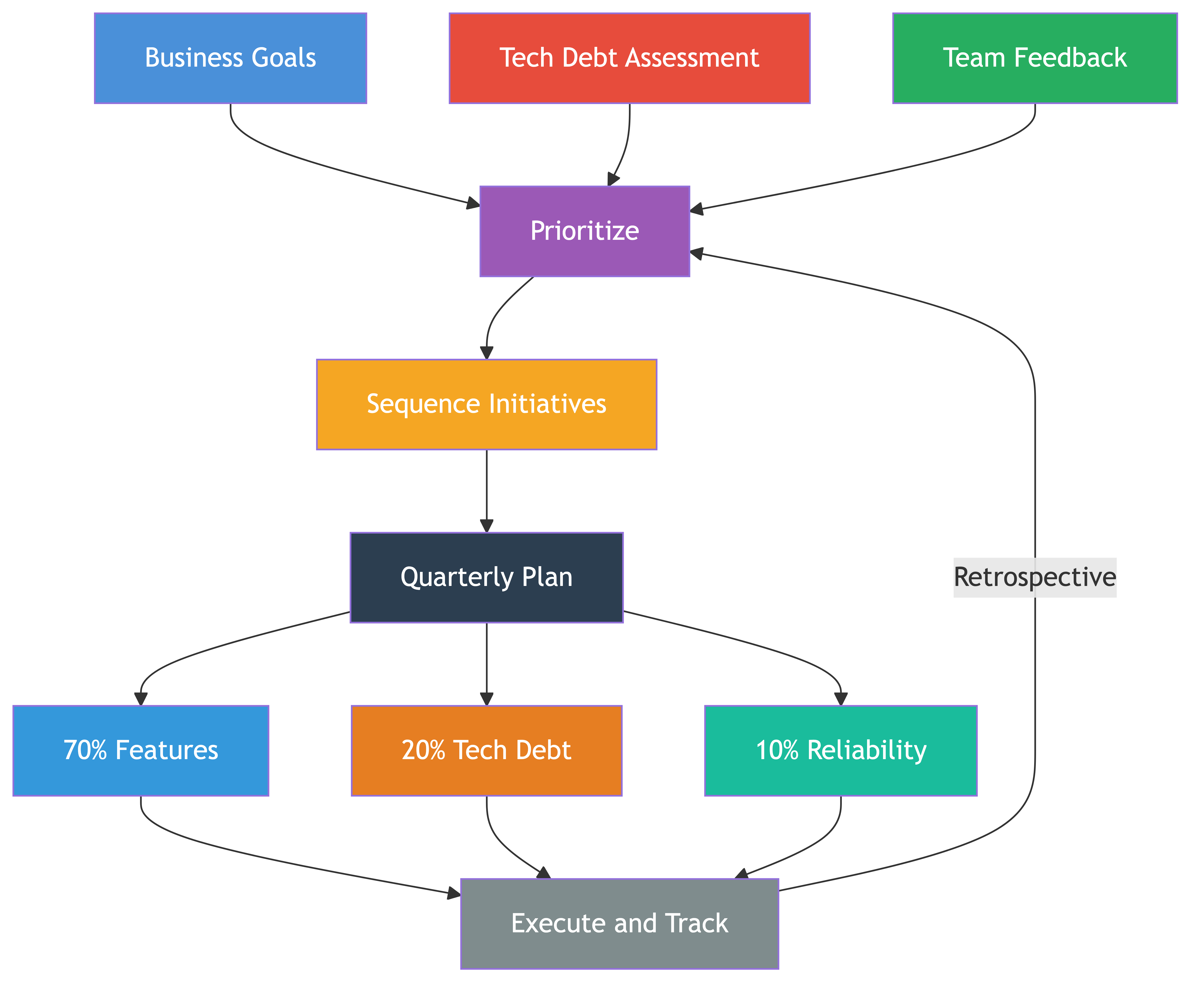
- 60-70% feature work — New capabilities driven by product and business needs.
- 20-30% tech debt and infrastructure — Paying down debt, improving tooling, upgrading systems.
- 10% reliability and security — Monitoring improvements, incident follow-ups, security patches, compliance work.
These aren't rigid numbers. Some quarters you'll skew heavier on features because there's a big launch. Some quarters you'll invest more in infrastructure because you've accumulated too much debt. The point is that every quarter should have some allocation for non-feature work. If your quarter is 100% features, you're borrowing from the future.
Getting Buy-In
Here's how to get product and leadership to agree to that 20-30% tech debt allocation:
- Show the cost of not investing. "Last quarter, we spent 15% of our time on incidents caused by technical debt. If we invest 20% this quarter in fixing root causes, we'll get that time back for features next quarter."
- Connect it to speed. "This infrastructure work will reduce our deploy time from 45 minutes to 5 minutes. That means we ship features faster."
- Make it visible. Put tech debt work on the same board as feature work. Track it the same way. Don't hide it.
- Negotiate, don't dictate. "I recommend 25% for tech debt this quarter. Here are the three most important items. Can we align on this?"
Product managers who've worked with good engineering managers understand this trade-off. If yours don't yet, educate them. Show them the data. Be patient but persistent.
The Planning Process
A quarterly planning cycle typically looks like this:
- Week 1: Review last quarter's outcomes. What shipped? What didn't? What did we learn?
- Week 2: Gather inputs — business priorities, tech debt assessment, team feedback.
- Week 3: Draft the plan. Sequence work, assign rough capacity, identify risks.
- Week 4: Review with stakeholders, adjust, finalize, communicate.
Start this process 4-6 weeks before the quarter begins. Don't wait until the last week — you'll end up with a rushed plan that nobody believes in.
Communicating the Roadmap
A roadmap is only useful if people understand it. And different people need different views.
For Leadership and Executives
They want to know:
- What are we investing in and why?
- How does this support company goals?
- What are the expected outcomes and timelines?
- What are the risks?
Keep it high-level. Use business language. One page, maybe two. No technical jargon. Focus on outcomes, not implementation details.
Example: "Q2: Platform reliability — reduce customer-facing incidents by 60%, enabling us to pursue enterprise customers who require 99.9% uptime SLAs."
For Your Team
They want to know:
- What are we building?
- Why are we building it? (They really care about this.)
- How does it fit together?
- What's the priority order?
- What are we explicitly not doing?
Be detailed. Share the rationale behind decisions. Engineers are smart — they'll poke holes in a plan that doesn't make sense, and that's a good thing. If your team can't understand why something is on the roadmap, either your reasoning is weak or your communication is.
For Product Partners
They want to know:
- What technical work has dependencies on product work (and vice versa)?
- What's the timeline for technical work that unblocks features?
- What trade-offs are we making?
- Where do they have input?
Be collaborative. Product and engineering roadmaps should be interleaved, not separate. If they're planning a feature that depends on your infrastructure work, they need to know your timeline — and you need to know theirs.
General Communication Tips
- Update regularly. Share progress monthly at minimum. A roadmap that goes silent loses credibility.
- Be honest about changes. If something slipped or got reprioritized, say so and explain why.
- Use visuals. A timeline or Gantt-style view communicates sequence and dependencies much better than a bullet list.
- Write it down. The roadmap should live in a shared document that anyone can reference. Not in slides from a meeting three months ago.
When the Roadmap Changes
Your roadmap will change. Count on it. Markets shift, priorities evolve, that "simple" migration turns out to be a six-month effort, or a major incident reveals a risk you didn't know about.
This is normal and healthy. A roadmap that never changes is either fiction or irrelevant.
How to Handle Changes Well
Acknowledge the change clearly. Don't quietly shuffle things around and hope nobody notices. They will. Say: "We're reprioritizing Q3. Here's what changed and why."
Explain the trade-off. Every change means something else doesn't happen. Be explicit: "We're pulling in the security audit, which means the API redesign moves to Q4."
Distinguish between adjustment and abandonment. Shifting timelines by a few weeks is normal. Dropping a major initiative entirely deserves a real conversation about what changed in the business context.
Don't lose credibility by over-rotating. If you change direction every two weeks, people stop believing the roadmap matters. Save changes for meaningful shifts, not every small piece of new information.
Keep a changelog. Seriously. When someone asks "Why did we stop working on X?", you want to be able to point to the decision and the reasoning behind it, not reconstruct it from memory.
When to Trigger a Re-Plan
- A major business priority shifts (new competitor, acquisition, market change)
- A critical incident exposes a risk you didn't account for
- A key person leaves, significantly impacting capacity
- You learn something that fundamentally changes the effort estimate for a major initiative
- An external dependency changes (vendor sunset, API deprecation, regulatory deadline)
Real-World Examples
Scenario 1: The Roadmap That Enabled a Platform Shift
A mid-size SaaS company had a monolithic Rails application that was becoming increasingly difficult to scale and deploy. The engineering manager created an 18-month vision: "Decompose the monolith into services, with each team owning their domain end-to-end."
The roadmap broke this into phases:
- Q1: Extract the authentication service (lowest risk, highest learning opportunity). Build the service template and CI/CD pipeline that all future services would use.
- Q2: Extract the billing service (high business value — the billing team was completely blocked by monolith deploy conflicts).
- Q3-Q4: Extract two more services in parallel, now that the team had the patterns and tooling down.
- Q5-Q6: Migrate remaining components, decommission the monolith.
What made this work: each quarter delivered standalone value. They didn't ask for 18 months of investment before seeing results. Q1 gave them the auth service and the tooling. Q2 unblocked the billing team. By Q3, leadership was bought in because they could see the pattern working.
Scenario 2: The Team With No Roadmap
A platform team at a growing startup had no roadmap. Their work was entirely driven by incoming requests from product teams and incident follow-ups. Every Monday, the manager looked at the queue of requests and assigned work.
The consequences were predictable:
- No strategic investment. They never improved their deployment pipeline, even though it took 90 minutes and failed regularly. There was always something more "urgent."
- Constant firefighting. Because they never addressed root causes, the same types of incidents kept recurring. The team spent 30-40% of their time on incident response.
- Low morale. Engineers felt like they were on a hamster wheel. No one could see progress toward anything meaningful. Two senior engineers left within six months.
- No credibility with leadership. When the manager asked for more headcount, the response was, "What would they work on? Show me a plan."
The turnaround started when a new manager came in and spent the first month building a roadmap. She cataloged the tech debt, quantified the cost of incidents, and presented a plan that showed how a quarter of infrastructure investment would reduce incident load by 50%. Leadership approved it because for the first time, they could see a plan.
Scenario 3: Balancing Debt and Features
An e-commerce team needed to ship a major new checkout flow (business-critical for the holiday season) while also addressing a growing database performance problem that was causing intermittent slowdowns.
The manager built a quarter that allocated 65% to the checkout feature and 35% to database work. The sequencing was key:
- Weeks 1-3: Database team did a focused performance audit and implemented the highest-impact optimizations (query tuning, index additions). This immediately reduced p99 latency by 40%.
- Weeks 4-10: Database improvements continued at lower intensity (one engineer, background work) while the rest of the team focused on checkout.
- Weeks 11-12: Final checkout testing and database monitoring to validate improvements under load.
The result: the checkout feature shipped on time for the holiday season, and the database problems were resolved enough to handle the traffic spike. Neither goal was sacrificed for the other. The trick was honest sequencing — doing the most impactful database work first, then shifting focus.
Common Mistakes
Feature-only roadmaps. If your roadmap is 100% product features, you're not managing your technical investment — product is. You'll accumulate debt until the system becomes unmaintainable, and then you'll need a "stop the world" rewrite that's 10x more expensive than incremental investment would have been.
No tech debt allocation. Related to the above. If you don't explicitly allocate time for tech debt, it won't happen. "We'll fit it in between features" is a lie you tell yourself. It never fits.
The roadmap in your head. You might know exactly where the team is headed, but if it's not written down and shared, nobody else does. Your team is guessing, your stakeholders are confused, and when you go on vacation, everything stalls.
Not updating the roadmap. A roadmap from January that hasn't been updated by April is worse than no roadmap at all. It's actively misleading. Set a cadence — update it monthly at minimum.
Over-planning. Don't plan 12 months in detail. The further out you go, the less you know. Plan the current quarter in detail, the next quarter in broad strokes, and beyond that in themes. If you've got a week-by-week plan for Q4 in January, you're wasting your time — it will change.
Planning in isolation. If you build the roadmap without input from your team, product, or leadership, you'll miss important context and lose buy-in. Roadmap building should be collaborative.
Confusing roadmap with backlog. A roadmap is not a prioritized list of tickets. It's a strategic plan that shows direction and sequencing of major initiatives. Individual tasks and stories are a level below.
No milestones or checkpoints. If your roadmap is just "Q2: Migrate to new database," how do you know if you're on track in week 4? Break major initiatives into milestones so you can course-correct early.
Business Value of a Technical Roadmap
Let's be explicit about why this matters to the business. This is what you're delivering when you maintain a strong technical roadmap:
Predictable Delivery
A roadmap forces you to think about sequencing, capacity, and dependencies — which means your estimates get better and your delivery becomes more predictable. Leadership and product can plan around your timelines because they're based on real analysis, not gut feeling.
Strategic Technical Investment
Without a roadmap, technical investment happens reactively — you fix things when they break. With a roadmap, you invest proactively — you fix things before they break. Proactive investment is cheaper, less disruptive, and builds a healthier system over time.
Velocity Preservation
Tech debt slows teams down. It's a tax on every feature you build. A roadmap that includes debt reduction is a roadmap that preserves (and often improves) your team's velocity over time. The team that invests 20% per quarter in debt reduction ships more features over a year than the team that spends 100% on features but gets progressively slower.
Stakeholder Confidence
When you can articulate what your team is working on, why it matters, and when it'll be done — people trust you. They trust your team. They fund your headcount requests. They give you the autonomy to make technical decisions. That trust is earned through consistent, transparent communication — and the roadmap is the backbone of that communication.
Wrapping Up
A technical roadmap isn't a bureaucratic artifact. It's how you lead. It's how you turn a collection of engineers into a team with direction. It's how you balance the endless tension between "ship features now" and "invest for the future."
Start simple. Write down your vision — where do you want your technical landscape to be in a year? Then map out next quarter — what's the most important work to do right now to move toward that vision? Share it with your team and your stakeholders. Get feedback. Adjust.
You don't need a perfect roadmap. You need a written-down, shared, regularly-updated one. The act of building it forces the right conversations, and those conversations are where the real value lives.
Common Pitfalls
- Feature-only roadmaps with no tech debt allocation. If your roadmap is 100% product features, you are accumulating debt until the system becomes unmaintainable, and the eventual "stop the world" rewrite will cost 10x more than incremental investment would have.
- Keeping the roadmap in your head. You might know exactly where the team is headed, but if it is not written down and shared, nobody else does. Your team is guessing, stakeholders are confused, and everything stalls when you are unavailable.
- Over-planning the distant future. Planning 12 months out in week-by-week detail is wasted effort because it will all change. Plan the current quarter in detail, the next quarter in broad strokes, and beyond that in themes.
- Building the roadmap in isolation. Creating the plan without input from your team, product partners, or leadership means you miss important context, lose buy-in, and end up with a plan that does not survive first contact with reality.
- Not updating the roadmap. A roadmap from three months ago that has not been revised is actively misleading. It gives stakeholders false confidence and makes the planning process feel like theater rather than a real leadership tool.
- Confusing the roadmap with a backlog. A roadmap is a strategic plan showing direction and sequencing of major initiatives. It is not a prioritized list of Jira tickets. Conflating the two robs the roadmap of its strategic value.
Key Takeaways
- A technical roadmap transforms your team from firefighters into builders by creating space for deliberate investment and giving everyone a shared sense of direction.
- Vision and roadmap serve different purposes: the vision is where you are going (stable, 1-2 year horizon), and the roadmap is how you get there (quarterly, updated regularly as you learn).
- Every item on the roadmap should trace to a business outcome. If you cannot explain why a piece of technical work matters to the business, it probably should not be prioritized.
- A healthy quarter allocates 60-70% to features, 20-30% to tech debt and infrastructure, and roughly 10% to reliability and security. Quarters that are 100% features are borrowing from the future.
- Different audiences need different views of the roadmap: leadership wants outcomes and risks, your team wants rationale and sequencing, and product partners want dependencies and timelines.
- Tech debt should be prioritized using impact and frequency, not treated as a monolithic problem. Critical debt that causes frequent pain gets fixed first.
- Roadmap changes are healthy and expected. Handle them by acknowledging the change clearly, explaining the trade-off, and maintaining a changelog so decisions are traceable.
- The act of building a roadmap forces the right conversations about priorities, trade-offs, and dependencies — and those conversations are where much of the real value lives.