
Executive Communication
There is a moment in every engineering manager's career where you realize the skills that made you effective with your team are actively hurting you with executives. You write a detailed Slack message explaining the nuances of a technical decision. Your VP reads the first sentence, skips the rest, and asks a question you answered in paragraph three. You think they did not read it. They think you cannot communicate.
Neither of you is wrong. You are just speaking different languages.
Executive communication is a skill. It is learnable. And it is one of the highest-leverage things you can develop as an EM, because the resources your team gets, the air cover you receive, and the trust leadership places in you all depend on how well you communicate upward.
Why Executive Communication is Different
Here is the fundamental truth: executives have five minutes, not thirty. Sometimes they have two minutes. They are context-switching between your update, a board prep, a hiring decision, and a customer escalation. They are not going to follow your carefully constructed narrative arc.
This means you need to lead with the answer. Not the background. Not the journey. The answer.
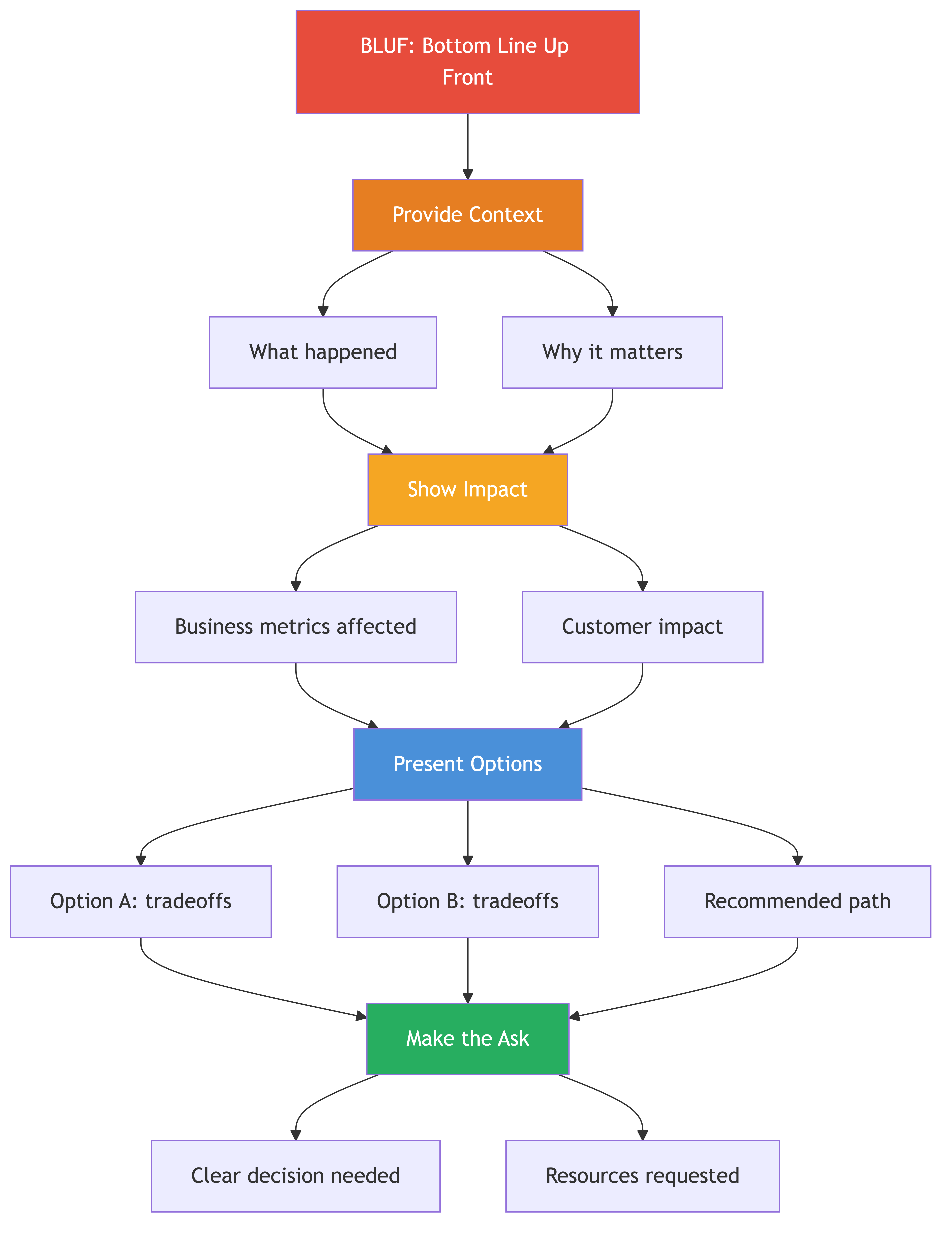
The military calls this BLUF — Bottom Line Up Front. It is the single most important communication habit you can build.
Instead of this:
"So we started looking into the performance issues three sprints ago, and after investigating several possible root causes including database query optimization, CDN configuration, and frontend rendering, we discovered that the main bottleneck was actually in our API gateway middleware, which was doing synchronous calls to three downstream services..."
Do this:
"Page load times are down 40% as of last Tuesday. We identified and fixed the API bottleneck. No further action needed from you."
The first version is accurate and thorough. The second version is what executives actually need. If they want the details, they will ask. And when they ask, you should absolutely be ready with the details. But do not lead with them.
A good mental model: imagine your executive is reading your message while walking between meetings, glancing at their phone. What do they need to take away in ten seconds? Start there.
Writing Executive Summaries
An executive summary is not a summary of everything that happened. It is a summary of everything that matters. There is a big difference.
A good executive summary is 3-5 sentences and answers three questions:
- What happened? — The fact. One sentence.
- What is the impact? — Why should they care? Business terms.
- What do you need? — A decision, resources, awareness, nothing.
Here is an example:
"We shipped the new onboarding flow on Wednesday. Early data shows a 15% improvement in activation rate, which would translate to roughly $2M in annual revenue if it holds. No action needed — we will share a full analysis after two weeks of data."
That is it. Three sentences. The exec knows what happened, why it matters, and what they need to do (nothing, in this case).
Rules for executive summaries:
- No jargon. Not "we refactored the service mesh." Executives do not know what a service mesh is, and they should not have to.
- No technical details unless asked. The implementation is your concern. The outcome is theirs.
- Quantify everything you can. "Improved performance" means nothing. "Reduced latency from 800ms to 200ms" means something. "Which improves conversion by an estimated 2%" means even more.
- Be specific about what you need. "I wanted to flag this" is weak. "I need a decision on X by Friday" is strong. Executives appreciate clarity about what you want from them.
Presenting to Skip-Levels
At some point you will present to your boss's boss. Maybe it is a quarterly business review. Maybe it is a project update. Maybe they just stopped by your desk and asked how things are going. Whatever the context, you need to know what they care about.
Your boss's boss cares about:
- Business outcomes. Revenue, customers, growth, retention. Not features shipped.
- Risks. What could go wrong? What is the probability? What is the mitigation?
- People. Is the team healthy? Are we going to lose anyone? Do we have the right skills?
- Budget. Are we on track with spend? Do we need more? Can we do it with less?
Your boss's boss does not care about:
- Sprint velocity
- Code architecture decisions
- Which testing framework you chose
- The details of your CI/CD pipeline
- Inter-team disagreements about API design
This does not mean those things are unimportant. They are very important — to you. But they are at the wrong altitude for a skip-level conversation.
When you present to skip-levels, go in with a clear structure. Something like:
- Here is where we are (one sentence on current state)
- Here is what is going well (one to two highlights, business terms)
- Here is what I am worried about (one to two risks, with mitigation plans)
- Here is what I need (if anything)
Prepare for questions, but do not preemptively answer every possible question in your presentation. Keep it tight. Let them pull information from you rather than pushing everything at them.
Framing Engineering in Business Terms
This is where most engineering managers fail. We are trained to think in technical terms. We are proud of technical accomplishments. So we communicate them technically.
The problem is that technical accomplishments are invisible to the business unless you translate them. And if the business cannot see the value of what engineering does, engineering gets treated as a cost center instead of a value driver.
Here is the translation exercise:
| What You Did (Technical) | What You Say (Business) |
|---|---|
| Refactored the API gateway | Reduced page load time by 40%, which improves conversion |
| Migrated to Kubernetes | Reduced infrastructure costs by 30% and improved deployment speed by 5x |
| Built a feature flag system | We can now A/B test with customers in hours instead of weeks |
| Paid down tech debt in the payments service | Reduced payment processing errors from 0.3% to 0.01%, saving an estimated $500K/year in failed transactions |
| Implemented automated testing | Reduced production incidents by 60%, which means fewer customer-facing outages |
Notice the pattern. Every technical accomplishment has a business outcome attached. You are not lying or exaggerating. You are translating. You are making the invisible visible.
The discipline here is to always ask yourself: "So what?" You refactored the API gateway. So what? It is faster. So what? Pages load quicker. So what? Users convert more. So what? More revenue. That is what you say.
Keep asking "so what" until you hit something an executive cares about: revenue, cost, risk, speed, customers, or retention. That is your headline.
Handling Tough Questions
Executives will ask you hard questions. That is their job. Your job is to handle them well.
The most common tough questions:
"Why is this taking so long?"
Bad answer: "Well, the technical complexity is higher than we estimated because the legacy system has a lot of coupling and we had to refactor the data layer before we could even start on the feature and also we lost a senior engineer last month..."
Good answer: "We underestimated the scope by about 3 weeks. The main gap was in the data migration, which turned out to be more complex than we thought. We have re-estimated and the new target is March 15. I am confident in that date."
"Why did this break?"
Bad answer: "It was a race condition in the caching layer that only manifests under high concurrency when the TTL expires at the same time as a write operation..."
Good answer: "A bug in our caching system caused errors for about 2% of users for 45 minutes on Tuesday. We fixed it within the hour. We have added monitoring to catch this class of issue earlier. No customer data was affected."
The principles:
- Be honest. Executives can smell spin. If you messed up, say so. Briefly.
- Be brief. Answer the question. Do not over-explain.
- Have a plan. Every problem you surface should come with what you are doing about it. "Here is what broke, here is why, here is what we are doing so it does not happen again."
- Never be defensive. Defensiveness signals insecurity. Confidence signals competence. You can be confident and honest at the same time. "Yes, we got this wrong. Here is how we are fixing it."
- Say "I don't know" when you don't know. Follow it with "I will find out and get back to you by [time]." Then actually do it.
The Status Update Executives Want
Most status updates are too long, too detailed, and missing the information executives actually need. Here is what they want, and it fits on one page.
Project/Team: [Name] Period: [Date range] Overall Status: Green / Amber / Red
Key Highlights (2-3 bullets)
- What went well this period. Business outcomes, milestones hit.
Key Risks (1-3 bullets)
- What could go wrong. Probability and impact. Mitigation plan.
Decisions Needed (0-2 items)
- What do you need from leadership? Be specific. Include a deadline.
Timeline Confidence: High / Medium / Low
- One sentence on why. "High — we are on track and no blockers." or "Medium — dependent on Platform team delivering auth service by April 1."
That is it. One page. Maybe half a page. RAG status (Red, Amber, Green) gives them an instant read. Key risks tell them where to pay attention. Decisions needed tell them what to do. Timeline confidence tells them whether to worry.
Do not bury bad news at the bottom. If the status is Red, say it is Red at the top. If you need help, ask for help explicitly. Executives would rather know about problems early than be surprised later.
Real-World Examples
The EM Who Communicated Well
Priya managed a platform team that was struggling with reliability. Her services were causing downstream issues for three product teams, and her team was underwater fighting fires.
Instead of hiding the problem or drowning leadership in technical details, Priya wrote a one-page brief to her VP:
"Our platform reliability is at 99.2%, below our 99.9% target. This is causing approximately 4 hours of developer downtime per week across 3 product teams, which I estimate costs us $200K/quarter in lost productivity. I need two additional senior engineers and a 6-week reliability sprint. I project we can hit 99.95% within 8 weeks with these resources. Without them, we will stay at current levels and the downstream impact will grow as we add more product teams."
The VP approved the headcount within a week. Not because the technical problem was interesting, but because Priya framed it in business terms, quantified the cost of inaction, and made a specific ask with a clear expected outcome.
After the reliability sprint, Priya sent a follow-up: "We are now at 99.97% reliability. Developer downtime across product teams has dropped from 4 hours to 20 minutes per week. The two engineers have already paid for themselves."
Priya built enormous trust with leadership through this cycle. She identified a problem, quantified it, asked for help, and delivered. That is the pattern.
The EM Who Lost Trust
David managed a team building a critical integration with a major partner. The project was behind schedule by three weeks, and the root cause was a misunderstanding about the partner's API capabilities. David knew about the delay two weeks before the deadline.
David did not escalate. He thought his team could make up the time. He kept reporting Amber status and saying things like "some risks but we are managing them." When the deadline arrived and the integration was not ready, the VP learned about the three-week delay for the first time in a meeting with the partner.
The fallout was significant. Not because the project was late — projects are late all the time. But because the VP was blindsided. She had made commitments to the partner based on David's status reports. She looked unprepared and uninformed. Her trust in David dropped immediately.
David's mistake was not the delay. It was hiding the delay. If he had escalated two weeks earlier with "We are going to miss the deadline by approximately three weeks. Here is why. Here is what I need to get back on track, or here is the revised timeline I recommend we share with the partner" — the outcome would have been completely different. The VP could have managed the partner relationship. She could have offered help. Instead, she was surprised, and nobody likes surprises.
The lesson: bad news early is manageable. Bad news late is a trust destroyer. Always, always escalate early.
Common Mistakes
Too much detail. You spent a week on a complex technical problem and you want to explain it all. Do not. The exec does not need to understand the problem. They need to understand the impact and the resolution.
Burying the lead. Starting with context, background, and caveats before getting to the point. By the time you reach your actual message, the executive has mentally moved on. Put the most important thing first. Always.
Defensive responses. When an exec challenges you, your instinct might be to justify, explain, and defend. Resist it. Acknowledge, explain briefly, and pivot to the plan. "You are right, we missed that. Here is what we are doing about it."
Jargon. Every piece of jargon you use is a small barrier between you and your audience. "We implemented a circuit breaker pattern in our service mesh" means nothing to a non-technical executive. "We added automatic protection against cascading failures" is better. "Our systems now self-heal instead of cascading when something breaks, reducing outage duration by 80%" is best.
No ask. You present a problem with no ask. The executive is left wondering, "What do you want me to do with this information?" Always be clear: "This is for awareness only," or "I need a decision on X," or "I need you to unblock Y." Do not make them guess.
Waiting too long to escalate. The number one way to lose executive trust is to surprise them with bad news. If something is going sideways, say so early. Executives can handle problems. They cannot handle surprises.
Treating every interaction the same. A hallway conversation is not a board presentation. A Slack message is not an email to the CEO. Calibrate your formality, length, and detail to the context and the audience.
Business Value
Executive communication is not a soft skill you develop because it is nice to have. It is a hard skill that directly determines your effectiveness and your team's success.
EMs who communicate well with leadership get more resources. They get more trust. They get more autonomy. They get the benefit of the doubt when things go wrong. They get their projects funded and their headcount approved.
EMs who communicate poorly get micromanaged. They get their projects questioned. They get less investment. They spend their time justifying their team's existence instead of building things.
The math is simple. If you manage a team of eight engineers with an average fully-loaded cost of 2M in annual investment. The ability to clearly communicate what that $2M is producing, what risks exist, and what you need to be successful is not optional. It is the job.
Learning to communicate with executives does not mean becoming a politician or a salesperson. It means learning to translate the work you and your team do into terms that the business can understand, evaluate, and support. It means being honest, being clear, and being brief. It means leading with the answer, framing in business terms, and never letting your leadership be surprised.
These are skills that compound. The better you get at them, the more effective you become, and the more your team benefits from the trust and resources that follow.
Common Pitfalls
- Leading with context instead of the answer. Starting with background, narrative arc, and technical journey before getting to the point causes executives to mentally check out before you reach your actual message. Put the bottom line first, always.
- Using technical jargon with non-technical audiences. Every piece of jargon is a barrier between you and your audience. "We implemented a circuit breaker pattern in our service mesh" means nothing to a VP. "Our systems now self-heal instead of cascading when something breaks" communicates the same thing in language they understand.
- Waiting too long to escalate bad news. The number one way to lose executive trust is to surprise them with problems. Executives can handle bad news — they handle it daily. What they cannot handle is being blindsided in front of a partner, a board member, or a customer.
- Being defensive when challenged. Responding to tough questions with justifications and lengthy explanations signals insecurity. Acknowledging the issue briefly, sharing what you are doing about it, and pivoting to the plan signals competence and builds trust.
- Presenting problems without an ask. Surfacing an issue without making it clear what you want the executive to do with the information — decide, unblock, be aware, or do nothing — leaves them guessing and makes you appear unfocused.
- Providing too much detail in status updates. Multi-page reports covering every aspect of the team's work overwhelm rather than inform. Executives want 3-5 key points: what is on track, what is at risk, and what they need to do. One page is almost always enough.
Key Takeaways
- Executive communication requires leading with the answer, not the journey. Use BLUF (Bottom Line Up Front) as your default: what happened, what is the impact, what do you need.
- Executive summaries should be 3-5 sentences covering the fact, the business impact, and the action required. No jargon, no technical details unless asked, and everything quantified where possible.
- When presenting to skip-levels, focus on business outcomes, risks, people, and budget. Leave sprint velocity, architecture decisions, and testing frameworks at your altitude — they are at the wrong level for that conversation.
- Frame every engineering accomplishment in business terms by repeatedly asking "so what?" until you reach something an executive cares about: revenue, cost, risk, speed, customers, or retention.
- Handle tough questions by being honest, brief, and forward-looking. Have a plan for every problem you surface. Say "I don't know" when you don't, followed by when you will have the answer.
- The status update executives want fits on one page: RAG status, key highlights, key risks with mitigation, decisions needed, and timeline confidence.
- Bad news early is manageable and builds trust. Bad news late is a trust destroyer. Always escalate at the first sign of a problem, not after you have tried to fix it quietly.
- Executive communication is a hard skill that directly determines your effectiveness. EMs who communicate well get more resources, more trust, and more autonomy. EMs who communicate poorly get micromanaged and under-resourced.