
Product & Business Alignment
Why This Matters
Here is the uncomfortable truth that nobody tells you when you move into engineering management: your job is no longer about technology. Technology is your tool. Your job is about outcomes. The moment you got the EM title, you signed up to be responsible for what your team delivers to the business — not what your team builds in the codebase.
This is the single biggest mindset shift that separates great engineering managers from mediocre ones. And it is the one most new EMs resist the hardest, because we all came up through the ranks loving the craft. But the craft is now in service of something bigger.
Let's dig into what that actually looks like day to day.
1. Your Job is Business Outcomes, Not Code Output
Stop counting pull requests. Stop measuring velocity as a success metric. Stop reporting "we shipped 47 tickets this sprint" as if that means anything to anyone outside the engineering org.
Here is the reframe: nobody in the C-suite cares that you shipped 47 tickets. They care that checkout conversion went up 3%, or that enterprise onboarding time dropped from 14 days to 3, or that the integration your team built unlocked a $2M partnership deal.
Your team's output is only valuable insofar as it produces outcomes. This does not mean you ignore engineering quality or developer experience — those things matter enormously because they are the engine that produces outcomes sustainably. But the engine is not the destination.
What this looks like in practice:
- When you present to leadership, lead with impact, not activity. "We reduced API latency by 40%, which improved our conversion funnel completion rate by 8%" hits different than "We refactored the API layer."
- When you plan a sprint, ask "what business outcome does this serve?" for every major item. If you cannot answer that question, you need to either find the answer or question whether the work belongs on the roadmap right now.
- When you evaluate your team's quarter, measure it by what changed in the product and for customers, not by how busy everyone was.
This is not about devaluing engineering work. It is about connecting it to something that matters beyond the team. Your engineers will actually find this more motivating once they see the impact of what they build, rather than just watching tickets move across a board.
2. Understanding the Business Model
You cannot align with the business if you do not understand how the business works. And I do not mean a vague sense of "we sell software to enterprises." I mean a deep, specific understanding of the mechanics.
Revenue streams. How does the company make money? Is it subscription-based? Usage-based? Transaction fees? Ad-supported? A combination? Which revenue streams are growing and which are flat? Where does the company want to invest next?
Cost structure. What are the major cost centers? Infrastructure? Headcount? Customer acquisition? How does your team's work affect costs — does reducing latency save on compute? Does automating a manual process reduce support headcount?
Unit economics. What does it cost to acquire a customer (CAC)? What is a customer worth over their lifetime (LTV)? What is the ratio between those two numbers? A healthy SaaS business typically wants LTV to be at least 3x CAC. If your team is working on features that improve retention, you are directly improving LTV. Know that.
Growth metrics. What is the company's growth rate? What are the leading indicators the board watches? Is it new logo acquisition? Net revenue retention? Market expansion? Your team's work plugs into these somewhere — find out where.
How to build this understanding:
- Read the company's investor materials, board decks, or annual reports if available. If your company is private, ask your skip-level or the finance team to walk you through the business model.
- Sit in on quarterly business reviews. Even if you are not presenting, absorb the language, the metrics, and the priorities.
- Have coffee with someone in finance, sales, or customer success. Ask them what keeps them up at night. You will learn more about the business in one lunch than in a month of engineering standups.
- Ask your PM to walk you through the product strategy and how it connects to business goals. If they cannot do this clearly, that is a signal worth paying attention to.
When you understand the business model, you stop making decisions in a vacuum. You start seeing trade-offs the way the CEO sees them. And that is when you become truly dangerous — in the best way.
3. Speaking the Language of Business
You need to be fluent in business language the same way you are fluent in technical language. Not because you are trying to impress anyone, but because language shapes thinking, and if you can only think in technical terms, you will only make technical decisions.
Key terms you need to own:
- ARR (Annual Recurring Revenue): The annualized value of all active subscriptions. This is the headline number for most SaaS companies.
- MRR (Monthly Recurring Revenue): ARR divided by 12. Useful for tracking month-over-month growth.
- Churn: The rate at which customers leave. Measured as a percentage of revenue or customers lost per period. Churn is the silent killer of SaaS businesses.
- LTV (Lifetime Value): The total revenue you expect from a customer over the entire relationship. Higher LTV means you can afford to spend more to acquire customers.
- CAC (Customer Acquisition Cost): What it costs to acquire a new customer, including marketing, sales, and onboarding costs.
- NPS (Net Promoter Score): How likely customers are to recommend your product. Ranges from -100 to 100. Anything above 50 is excellent.
- Conversion rate: The percentage of users who take a desired action — signing up, upgrading, completing onboarding, whatever the funnel step is.
- Net Revenue Retention (NRR): Revenue from existing customers compared to the same period last year, including expansion and churn. Above 100% means you are growing even without new customers.
- Gross margin: Revenue minus cost of goods sold. For software, this is mostly infrastructure and support costs. Investors love high gross margins.
How to use this language:
Do not just know the definitions. Use these terms in your communications. When you write a project proposal, include a section on expected business impact using these terms. When you present to leadership, frame your results in their language.
Instead of: "We migrated to a new caching layer and reduced p99 latency from 800ms to 200ms."
Try: "We reduced checkout latency by 75%, which we expect to improve conversion by 2-4% based on industry benchmarks. For our current traffic, that translates to roughly $500K in additional ARR."
Same work. Same engineering achievement. But one version gets a nod and the other gets budget for your next project.
4. The Product-Engineering Partnership
The relationship between you and your PM is one of the most important dynamics on the team. When it works well, the team moves fast, builds the right things, and has high morale. When it breaks down, everything suffers.
Here is the mental model: you and the PM are co-owners of outcomes. The PM does not "hand requirements to engineering." You do not "just build what product asks for." You are partners, each bringing different expertise to the same goal.
What the PM brings: Customer insight, market understanding, business context, prioritization frameworks, stakeholder management.
What you bring: Technical feasibility, system understanding, scalability implications, effort estimates, risk assessment, knowledge of what is possible that product has not imagined yet.
Building a great partnership:
-
Shared goals. At the start of every quarter, you and your PM should be fully aligned on what success looks like. Not "ship features X, Y, Z" but "improve metric A by B%, launch in market C, reduce customer pain point D." If you are not aligned on goals, you will fight about priorities constantly.
-
Regular syncs. Meet with your PM at least weekly, separate from team ceremonies. Use this time to discuss upcoming priorities, share context you are each hearing from different parts of the org, and work through disagreements privately instead of in front of the team.
-
Mutual respect. Your PM is not your boss. You are not their boss. You are peers with different domains of expertise. Respect their judgment on customer and market questions the same way you expect them to respect your judgment on technical questions.
-
Healthy tension. Disagreement is not dysfunction. If you and your PM agree on everything, one of you is not doing your job. The best partnerships have productive tension — you push back when something does not make technical sense, they push back when you are over-engineering or missing the customer need. The key is that the tension is about the work, not about egos.
When the partnership is broken:
If your PM is treating engineering as an order-taking function, have the conversation directly. "I want us to be partners on outcomes, not just a delivery team. How can we restructure our working relationship?" If that does not work, escalate to your shared leadership. This is too important to let fester.
If you are the one treating product as an annoyance — and be honest with yourself here — you need to adjust. Product managers deal with enormous pressure from sales, customers, executives, and the market. They need you as an ally, not a gatekeeper.
5. Connecting Roadmap to Revenue
Every quarter, you should be able to draw a clear line from your team's roadmap to business results. Not every item will have a direct revenue connection — some things are about reliability, developer experience, or technical foundations. But the overall portfolio of work should clearly trace to business value.
The connection chain:
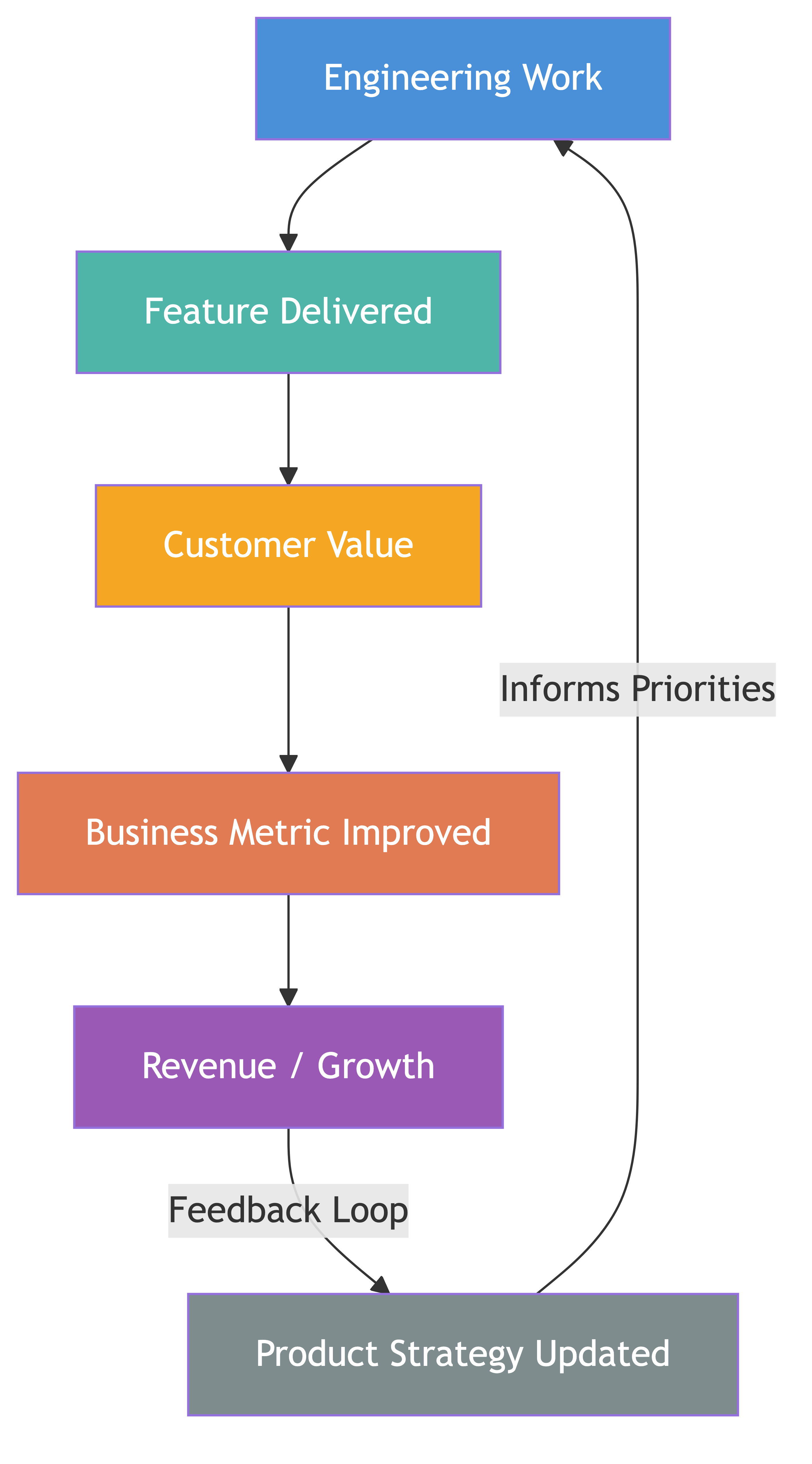
"We built X → it improved Y → which drives Z revenue (or reduces Z cost)."
For example:
- "We built the self-serve upgrade flow → it improved the trial-to-paid conversion rate from 8% to 12% → which drives an additional $1.2M in ARR based on current trial volume."
- "We automated the compliance reporting pipeline → it reduced the enterprise sales cycle from 90 days to 60 days → which means the sales team can close 50% more deals per quarter."
- "We rebuilt the search infrastructure → it improved search relevance scores by 30% → which drove a 15% increase in user engagement, reducing churn by 2 points."
How to build this muscle:
- Start every roadmap planning cycle by looking at the company's top 3-5 business priorities for the quarter. Then ask: what can our team do that most directly moves those priorities?
- For each major initiative, write a one-paragraph business case before you write a technical design. If you cannot articulate the business case, either find it or reconsider the initiative.
- At the end of each quarter, do a retrospective that includes business impact. Did the things you shipped actually move the metrics you expected? If not, why? This feedback loop is how you get better at predicting impact over time.
What about infrastructure and tech debt work?
This is where a lot of EMs struggle. How do you connect "we need to upgrade our database" to revenue? You do it through the lens of risk and enablement.
- "If we don't upgrade the database, we'll hit scaling limits in Q3, which means we literally cannot onboard the enterprise customers in the sales pipeline. That pipeline is worth $5M in ARR."
- "Our current deployment process takes 4 hours and requires a dedicated engineer. Investing 3 weeks in CI/CD will free up 20 hours per week of engineering capacity, which we can redirect to the product roadmap."
The business case is always there. Sometimes you just have to work harder to find it.
6. Making Trade-off Decisions
Every week, you face trade-off decisions. Feature work vs. tech debt. Speed vs. quality. This customer request vs. that market opportunity. Security hardening vs. new functionality.
Most EMs make these decisions based on technical instinct. Good EMs make them with business context.
The trade-off framework:
When you face a trade-off, ask these questions:
- What is the business impact of each option? Not just "this is technically better" but "this will allow us to do X, which is worth Y."
- What is the cost of delay? If you do not build this feature now, what happens? Does a competitor win the deal? Does a customer churn? Or does nothing happen for another quarter?
- What is the cost of inaction on the technical side? If you do not address this tech debt now, what happens? Does the system degrade? Do incidents increase? Does velocity slow down?
- What is reversible and what is not? Reversible decisions should be made quickly. Irreversible decisions deserve more deliberation.
- Who bears the risk? If you cut corners to ship faster, who pays the price when things break? Customers? The on-call engineer? The support team?
Feature vs. tech debt:
The "feature vs. tech debt" framing is actually a false dichotomy. Tech debt is not the opposite of features — it is a tax on future feature development. The question is not "should we build features or pay down tech debt?" The question is "given our current velocity drag from tech debt, what is the optimal investment in debt reduction that maximizes our feature throughput over the next 2-4 quarters?"
Frame it this way with leadership and you will get a lot more support for tech debt work.
Reliability vs. features:
After a major incident, there is always pressure to invest in reliability. After a quiet quarter, there is always pressure to ship more features. Good EMs maintain a steady investment in reliability regardless of recent incident history, because reliability is not something you fix after it breaks — it is something you maintain continuously.
A good rule of thumb: allocate 15-20% of your team's capacity to reliability, performance, and operational excellence. This is not negotiable, the same way a manufacturing company does not skip maintenance on the factory floor because there is a rush order.
7. Influencing Product Direction
You have something that nobody else in the product trio has: deep technical understanding of the system. This gives you a unique vantage point, and you should use it.
Where technical insight creates product opportunity:
- You see what is possible. Maybe the data pipeline your team built for analytics could also power a real-time recommendation engine that product has not thought of yet.
- You see what is fragile. You know that the integration layer is held together with duct tape and that building more features on top of it is risky. Product needs to hear this.
- You see patterns in incidents. Customer-facing incidents often reveal unmet needs or broken workflows. Share these insights with product.
- You see efficiency opportunities. Maybe automating a workflow that customers currently do manually would be a huge differentiator, and you know it is technically straightforward.
How to influence effectively:
- Come with data, not opinions. "I think we should rewrite the billing system" is an opinion. "We've had 12 billing-related incidents in the last quarter, costing us 47 hours of engineering time and affecting 2,300 customers. Here's a proposal to address the root causes" is a data-driven recommendation.
- Speak in customer and business terms. Do not say "the architecture is bad." Say "our current architecture limits us to processing 10K transactions per minute, and our largest prospect needs 50K. We need to address this to close the deal."
- Propose solutions, not just problems. Anyone can point out what is broken. Your value is in proposing a path forward that balances technical needs with business constraints.
- Pick your battles. You cannot push back on everything. Save your political capital for the decisions that truly matter — the ones where technical reality conflicts with business assumptions in ways that will cause real damage.
Pushing back on bad ideas:
Sometimes product will propose something that is technically infeasible, unreasonably expensive, or architecturally dangerous. You need to push back, but how you push back matters.
Do not say: "That's impossible" or "That will take forever."
Do say: "Here's what it would take to build that, and here's the trade-off. We could do a simpler version that gets 80% of the value in a quarter of the time. Want me to sketch that out?"
You are not a gatekeeper. You are a problem solver who happens to understand the constraints of the system better than anyone else in the room.
8. Metrics That Matter
Stop reporting velocity to leadership. Velocity is a team-internal planning tool, not a measure of success. When you show velocity charts to your VP, you are telling them how busy your team is, not how effective your team is. Those are very different things.
Metrics to track and present:
- Feature adoption. Of the features you shipped, how many users are actually using them? A feature that nobody uses is worse than a feature you never built, because it cost you time and adds maintenance burden.
- Customer impact. What changed for customers as a result of your team's work? Did support tickets decrease? Did NPS improve? Did customers achieve their goals faster?
- Time-to-value. How long does it take from when you start working on something to when it delivers value to customers? This is different from cycle time — it includes rollout, adoption, and impact realization.
- Revenue impact. Can you trace your team's work to revenue changes? Not always directly, but you should be able to tell the story.
- Reliability metrics. Uptime, incident frequency, mean time to recovery. These are table stakes, not bragging rights — but they matter because they directly affect customer trust and retention.
- Engineering efficiency. Deploy frequency, lead time for changes, change failure rate, time to restore service. These are the DORA metrics, and they are useful because they measure your team's ability to deliver sustainably.
How to present metrics:
Build a simple dashboard or quarterly slide that shows:
- What you committed to delivering this quarter
- What you actually delivered
- The business impact of what you delivered
- What you learned and how it informs next quarter
Keep it simple. Leadership does not want a 30-slide deck. They want a clear picture of whether your team is moving the right needles.
A warning about metrics:
Do not let metrics become the goal. Goodhart's Law applies here: when a measure becomes a target, it ceases to be a good measure. Use metrics as indicators and conversation starters, not as scorecards. If feature adoption is low, the interesting question is "why?" — not "how do we make the number go up?"
9. Real-World Examples
Scenario 1: The Feature Factory vs. The Impact Driver
EM in a silo — Jordan: Jordan's team ships features at an impressive rate. Every sprint, tickets are completed, PRs are merged, and features go live. When leadership asks what the team accomplished last quarter, Jordan pulls up the Jira board and walks through 43 completed stories. Leadership nods politely but struggles to understand the impact. When budget conversations happen, Jordan's team is seen as a cost center that "does what product asks." Jordan's team gets a modest headcount allocation, and Jordan is frustrated because the team is working so hard but does not seem to get recognition.
EM aligned with business — Priya: Priya's team ships fewer features than Jordan's, but every major initiative has a clear business case. At the quarterly review, Priya presents three slides. Slide one: "We redesigned the onboarding flow, reducing time-to-first-value from 7 days to 2 days." Slide two: "This improved 30-day retention by 18%, which our model projects will add $800K to ARR this year." Slide three: "Next quarter, we're targeting the upgrade funnel, which we believe has similar potential." Leadership sees Priya's team as a revenue driver. When headcount planning comes around, Priya gets two additional engineers without having to fight for them.
The difference: Same level of effort. Same caliber of engineers. But Priya's team is connected to the business, and Jordan's is operating in a bubble.
Scenario 2: The Tech Debt Standoff
EM in a silo — Marcus: Marcus's team has been fighting a growing pile of tech debt in the payment processing system. Marcus brings it up in every planning meeting: "We need to rewrite the payment service. It's a mess." Product pushes back because they have a full roadmap. Marcus grows resentful, the tech debt grows worse, and eventually there is a major incident that takes down payments for 4 hours. Now the rewrite happens, but it happens in crisis mode, under pressure, with leadership asking why it was not addressed sooner. Marcus says "I told you so," which does not help his credibility.
EM aligned with business — Aisha: Aisha's team faces the same tech debt. But Aisha approaches it differently. She pulls incident data from the last 6 months: 8 payment-related incidents, 23 hours of cumulative downtime, an estimated 2M in annual transaction volume." The proposal is approved in the next planning cycle.
The difference: Marcus framed tech debt as a technical problem. Aisha framed it as a business risk with a quantified cost and a clear ROI on the fix.
Scenario 3: The Product Partnership Gap
EM in a silo — Chen: Chen and the PM, Lisa, have a strained relationship. Lisa writes detailed PRDs and hands them to Chen's team. Chen's engineers build exactly what is specified. When features underperform, Lisa blames engineering for poor execution. Chen blames Lisa for bad requirements. The team is demoralized because they feel like a factory line. Lisa starts going directly to senior engineers to get answers faster, undermining Chen's authority. The whole dynamic spirals.
EM aligned with business — Derek: Derek and his PM, Sam, start every quarter with a joint planning session. They review business metrics together, identify the biggest opportunities, and co-author a set of quarterly objectives. When Sam proposes a feature, Derek asks questions: "What problem does this solve? How will we measure success? What's the simplest version that tests the hypothesis?" Sometimes Derek pushes back: "I think we can get 80% of this value with a much simpler approach. Let's ship that first and learn." Sometimes Sam pushes back: "The customer data is clear — we need the full solution here." They argue productively, make a decision together, and present a united front to the team. When features succeed, they celebrate together. When features fail, they do a joint retro and learn together.
The difference: Chen treated the PM relationship as a handoff. Derek treated it as a partnership. The team's output, morale, and business impact all reflect this difference.
10. Common Mistakes
Building What Is Asked Without Questioning
This is the most common trap for new EMs, especially those who were high-performing ICs. You were rewarded for years for executing well on what was asked. Now you are rewarded for asking "should we build this at all?"
Every significant piece of work should pass the "why" test. Why are we building this? What problem does it solve? How do we know this is the right solution? What happens if we do not build it? If nobody can answer these questions clearly, the work should not start.
This does not mean you question every bug fix or small improvement. It means that for any initiative that takes more than a week of team effort, you should understand and agree with the business rationale.
Not Understanding the Customer
If you have never talked to a customer, you are flying blind. You are building software for people you have never met, based on requirements written by someone who may or may not have talked to them recently.
Make it a habit to join customer calls, read support tickets, watch user session recordings, or sit in on sales demos. You do not need to do this every week, but you should do it regularly enough that you have genuine empathy for the people using your product.
When you understand the customer, you make better technical decisions. You know which performance improvements actually matter (the ones customers notice), which features are truly needed (vs. which ones sound cool in a brainstorm), and where the real pain points are.
Treating Product as the Adversary
Some engineering cultures develop an "us vs. them" mentality with product. Engineers complain that PMs do not understand technical constraints. PMs complain that engineers do not care about the customer. This is toxic and it is often the EM's fault for not bridging the gap.
You are the bridge. You translate technical reality into business language and business priorities into technical plans. If your team sees product as the enemy, look in the mirror first. Are you modeling partnership or are you modeling resentment?
Ignoring Business Metrics
"I'm an engineering manager, not a business analyst." If you have ever thought this, you are limiting your own career and your team's impact.
You do not need to become a finance expert. But you need to know the 5-10 business metrics that matter most to your company, understand how they are trending, and be able to articulate how your team's work connects to them.
If you cannot explain to your skip-level how your team's last quarter of work moved business metrics, you have a gap. Fill it.
Over-Indexing on Technical Perfection
There is a time for elegant architecture and there is a time for shipping something that works. Business context tells you which one you are in. If the company is in a land grab and speed matters more than polish, building the perfect system is the wrong call. If the company is in a regulated enterprise market where reliability is the product, cutting corners is the wrong call.
Read the room. Match your engineering standards to what the business actually needs right now, while keeping an eye on what it will need in 18 months.
Not Having an Opinion on Product Strategy
Your PM is not the only person allowed to have ideas about what the product should do. You see things they do not see — technical possibilities, system limitations, data patterns, customer pain revealed through incidents. If you keep all of this to yourself and wait for product to tell you what to build, you are leaving value on the table.
Have an opinion. Share it. Be willing to be wrong. But do not be silent.
Business Value
Here is why all of this matters, beyond your team, beyond your product area, in terms of raw business value.
Revenue acceleration. When engineering is aligned with the business, features ship that customers actually want and are willing to pay for. Fewer cycles are wasted on work that does not move the needle. This directly accelerates revenue growth.
Cost efficiency. Business-aligned EMs invest in tech debt reduction and infrastructure improvements that have clear ROI. They do not gold-plate systems that do not need it, and they do not neglect systems that are costing the company money through incidents and inefficiency. The result is a more efficient use of the most expensive resource the company has — engineering talent.
Strategic advantage. Companies where engineering deeply understands the business can move faster than competitors where engineering operates in a silo. Technical decisions are made with market context. Opportunities are spotted earlier. Risks are identified before they become crises. This compounds over time into a significant competitive advantage.
Talent retention. Engineers want to work on things that matter. When you can show your team exactly how their work impacts customers and the business, they are more engaged, more motivated, and less likely to leave for the next company offering a 10% raise. Purpose is a powerful retention tool.
Organizational trust. When leadership trusts that engineering understands and cares about business outcomes, engineering gets more autonomy, more budget, and more influence on company direction. This creates a virtuous cycle: more trust leads to more autonomy, which leads to better outcomes, which leads to more trust.
Personal career growth. EMs who understand the business get promoted. It is that simple. The path from EM to Director to VP requires increasing business acumen. If you start building that muscle now, you are investing in your own future. The EMs who stay in technical silos plateau. The ones who bridge engineering and business rise.
The bottom line: product and business alignment is not a nice-to-have skill for engineering managers. It is the skill. Everything else you do — hiring, coaching, architecture decisions, process improvements — is in service of delivering business outcomes. Once you internalize this, everything about how you lead your team changes for the better.
Summary
- Your job is outcomes, not output. Measure and communicate impact, not activity.
- Learn the business model deeply. Understand revenue, costs, and growth mechanics.
- Speak business language fluently. ARR, churn, LTV, CAC — these are your words now.
- Build a true partnership with your PM. Co-own outcomes, not just deliverables.
- Connect your roadmap to revenue. Every initiative should trace to a business metric.
- Make trade-offs with business context, not just technical instinct.
- Use your technical insight to influence product direction. You see things others cannot.
- Report metrics that matter. Feature adoption and customer impact, not velocity.
- Study the difference between business-aligned EMs and siloed EMs. The gap in outcomes is enormous.
- Avoid the common traps: building without questioning, ignoring customers, treating product as the enemy, and staying in your technical comfort zone.
The best engineering managers are the ones that leadership sees as business partners who happen to manage engineers — not as technical managers who happen to work at a business. Be that person.
Common Pitfalls
- Counting output instead of outcomes. Reporting the number of tickets closed or PRs merged instead of business impact trains leadership to see your team as a cost center rather than a value driver.
- Building without questioning the business rationale. Executing on every request without asking "why" and "for whom" leads to wasted engineering effort on features that do not move the needle.
- Treating product as an order-taking relationship. Positioning yourself as someone who simply builds what product asks for, rather than as a co-owner of outcomes, limits your team's impact and your own influence.
- Ignoring business metrics entirely. Assuming that business metrics are someone else's problem means you cannot articulate your team's value, which makes you vulnerable during budget conversations and reorgs.
- Framing tech debt as a purely technical problem. Asking for investment in tech debt without connecting it to business outcomes — such as reduced incident cost, recovered engineering capacity, or unblocked revenue — will consistently get deprioritized.
- Over-indexing on technical perfection at the wrong time. Building the architecturally ideal solution when the business needs speed, or cutting corners when the business needs reliability, reflects a failure to read the business context.
Key Takeaways
- Your job as an EM is outcomes, not output. Measure and communicate the business impact of your team's work, not the volume of activity.
- Understanding the business model deeply — revenue streams, unit economics, growth metrics — is essential for making informed engineering decisions.
- Fluency in business language (ARR, churn, LTV, CAC) allows you to frame technical work in terms that earn budget, headcount, and trust from leadership.
- The EM-PM relationship is a partnership of equals. Co-own outcomes, disagree productively, and present a united front to the team.
- Every major initiative on your roadmap should trace back to a business metric. If you cannot articulate the business case, the work probably should not be prioritized.
- Trade-off decisions should be made with business context, not just technical instinct. Understand the cost of delay, the cost of inaction, and who bears the risk.
- Use your unique technical insight to influence product direction — you see possibilities, risks, and patterns that no one else in the room can see.
- Report metrics that matter to the business: feature adoption, customer impact, and revenue contribution — not velocity or story points.